
By Jay Sorgi
for the Register
They found holy sites and spiritual rest amidst unrest, a pilgrimage to the divine amongst political discord.
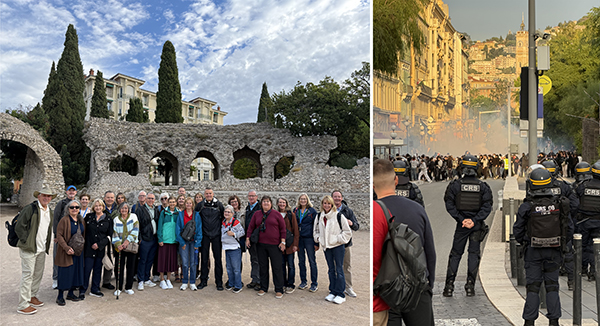
Twenty-six Nebraskans from the Diocese of Lincoln joined a pair of guides and Father Eric Clark, pastor at All Saints Parish in Holdrege and St. John in Smithfield, for 11 days in Southern France and Northern Italy, experiencing reasons for praise and gratitude juxtaposed with unrest occurring throughout France due to the nation’s economic conditions.
“It’s kind of contrary to the goodness that God has called each and every one of us to, to use our gifts and our talents to build the kingdom of God, not tear down,” Father Clark said about the unrest which pilgrims witnessed during the trip which left Nebraska Oct. 19 and returned Oct. 29. Half the group was from St. Peter Church in Lincoln, where Father Clark previously was pastor.
Yet so much of the trip brought incredible spiritual fruit, surrounded by the Mediterranean Sea and the majestic Alps. It all began with a flight into Turin and a visit to the Basilica of Corpus Domini.
“A Eucharistic miracle happened there in the 17th century,” Father Clark said. “French troops stole a monstrance.
The host was still in there. They traveled to the next town. A donkey stumbled, then the Eucharist started elevating. People bowed down and started worshiping.”
Day two led them to the Cattedrale di San Giovanni Battista, the home of the Shroud of Turin – believed to be the burial cloth of Christ – and the resting place of recently-canonized St. Pier Giorgio Frassati.
“He used his youth in order to really bring about a Catholic presence for the youth in northern Italy,” Father Clark said of the young saint, contrasting to the unrest that they were about to see a few days later.
But before then, they toured the Salesians of Don Bosco’s home church, the Basilica di Maria Ausiliatrice, where the bodies of both Sts. John Bosco and Dominic Savio reside.
“What St. John Bosco did with the youth and the poor in the streets of Turin just really show that they have a dignity,” Father Clark said. St. John Bosco was known for teaching young boys the faith while using feats like juggling and storytelling to get their attention.
A visit to Monaco and the burial place of Grace Kelly, a Catholic actress who married the prince of that country before dying in a vehicular accident, predicated a three-day stop in Nice in the French Riviera, the first stop in a nation often called the first daughter of the Church due to the presence of so many saints.
Their time included visiting the retreat house of St. Francis of Assisi and the ruins of a coliseum where numerous Christian martyrs were buried. It also included tours of Catholic architecture in the southern French city.
Then, they witnessed civic unrest, blocks away from their hotel, with police and military members protecting them.
Father Clark ventured from the hotel and spent time near the demonstrators.
“We walked down there and saw the water cannons, the riot gear and everything that was going on,” he said. “I’m obviously a priest wearing all black, and all the rioters were wearing black, too. At first (the law enforcement were) like, ‘What’s going on?’ I pulled out my rosary and held up my hands, and so they kind of understood what I was doing and they were pretty grateful.”
The pilgrims’ next destination took them to the sea and the Lérins Islands with an 11th-century monastery, holding a day-long retreat with Carthusian monks, but a slight mishap led to blessed serendipity.
Photos courtesy Jeff Runyan, founder and owner of Encounter Travel
“Our bus driver got lost. We missed the ferry time. We had to go an hour later, and the abbey was locked,” Father Clark said. “I said, ‘I’ve got my Mass kit. Let’s have Mass right here by the ocean on a picnic table.’ It was just so serene, this beautiful island. People said that was so moving.”
Cotignac, a small village in the French Alps, led them to the Sanctuary of Our Lady of Graces, a Marian apparition site, and a site which hosted an apparition by St. Joseph in the 1860s.
“Probably the most impactful for the people was the St. Joseph apparition site,” Father Clark said. “It was a couple-hour hike, and some of these people were in their late 70s. The fact that they made it up there [gave] the true understanding of a pilgrimage, actually suffering a little bit in order to get there.”
He said they also conducted a healing Mass that day, offering the Anointing of the Sick.
Provence, France, led them to the home and relics of St. Mary Magdalene, what Father Clark called “a little cave up in the mountains.”
“It was just a beautiful chance to pray with the first of the disciples to announce the Resurrection,” he said. “We emphasized with the pilgrims that you know we’ve encountered Christ, and it’s our job now to go out and tell other people that He’s alive, He’s resurrected, as Mary Magdalene had done.”
The last stop was Marseilles, France’s second largest city, home to the Basilica of Our Lady the Guardian, and the Abbey of St. Victor which houses the relics of St. Lazarus.
All this happened as hundreds of thousands of young people across France were involved in civic unrest, and
Father Clark said some of the demonstrators told him they didn’t really understand why they were doing it.
“St. Pier Giorgio Frassati demonstrated, too. He used his Christian demonstration to fight against fascism,” Father Clark said.
“St. Francis, St. John Bosco with the Salesians, [St.] Pier Giorgio Frassati or even the early Christian martyrs, their vigor was really guided by the Holy Spirit,” he added. “[Demonstrators are] searching for meaning and a purpose, but it just hasn’t been guided by the openness to what the Holy Spirit wants to do with them.”
He said the pilgrimage allowed for new relationships and friendships to form between the travelers, but the greatest encounter that lasts is that with the Lord.
“Who do you encounter along the way on your pilgrimage?” he asked. “Ultimately that encounter is supposed to be to encounter Christ.”
