

By Andrew Winter
1. Sacramentals are holy objects established and governed by the Church for the sanctification of the faithful. The Church can establish new sacramentals and nullify old ones at will, so there are theoretically an infinite number of sacramentals. There are three main types of sacramental: blessings, exorcisms, and forms of piety and devotion.
2. Sacramentals point the faithful to the seven sacraments, and dispose them to receive the graces of the sacraments. The sacraments dispense grace by virtue of their very substance (ex opere operato), but sacramentals do not share this power. They are indirect means of grace: Catholics do not pray to crucifixes, but to the crucified Jesus, the Author of grace.
3. Magic and superstition have no place in Catholic theology, and sacramentals are not talismans. They are not guaranteed to achieve any benefit for the user, either spiritual or physical. Sacramentals are merely channels through which God can choose to bestow His grace.
4. Blessings, the first category of sacramentals, are said over people, food, buildings, rosaries, and everything in between. They always sanctify the blessed object, and often are given to impart a specific holy quality to the object. Blessings ask God to pour out His grace onto and through the blessed person, place, or thing.
5. Exorcisms in their highest form are a rare type of spiritual combat wherein a specially-trained priest commands a devil, in the name of Jesus, to leave a possessed person or place. There are also less intense exorcism-like actions, such the praying of deliverance prayers suitable for the laity.
6. Forms of piety and devotion, the last category of sacramental, can be physical objects, actions, or prayers. When most Catholics think of sacramentals, they think of physical objects that recall God or the saints and often have prayers attached to them. A short list of this third type of sacramental includes: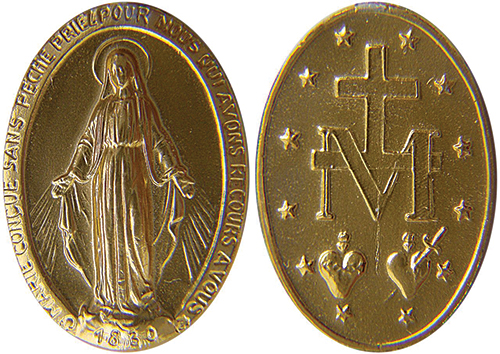 Crucifixes
Holy water
The Rosary
Incense
Scapulars
The Miraculous Medal
Vestments
The Confiteor
Alms
Third-class relics
Baptismal fonts
Breviaries
7. Perhaps the most enduring of all sacramentals is the Sign of the Cross. St. Cyril of Jerusalem in the fourth century wrote: “Be the Cross our seal made with boldness by our fingers on our brow, and on everything; over the bread we eat, and the cups we drink.” And even in the early third century, Tertullian said, “Whatever employment occupieth us, we mark our foreheads with the sign of the cross.”
8. Protestants may denounce sacramentals as idolatrous or anti-Biblical, but in reality, they serve as a religious connection between the human body and the human soul. Humans need to feel the faith with their fingers and see it with their eyes. And sacramentals appeared in the Bible countless times: incense at the Temple of Solomon, vestments for the Mosaic priests, the blood of the lamb sprinkled on the doorposts, the tassel of Christ’s cloak touched by the hemorrhaging woman who was healed, and the shadow of St. Paul, which passed over the sick who were cured.
9. It would be appropriate to give a blessed object due reverence in its disposal. There is a traditional, pious custom of burning or burying objects that have been blessed so that these objects won’t be subjected to profane use.
