

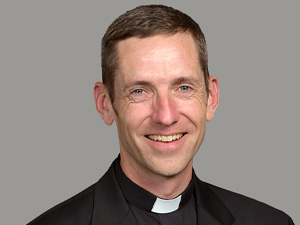
Guest column by Fr. Matthew Rolling
Academic Dean, St. Gregory the Great Seminary
As an alumnus and now an administrator and faculty member of St. Gregory the Great Seminary in Seward, I think we have a very fine institution. I may be accused of bias, but Bishop James Conley also does like to brag regularly about his diocesan seminary. This past March, those claims were put to the test, so to speak.
 The seminary underwent a comprehensive evaluation to renew our accreditation as an institution of higher learning. As an accredited institution, St. Gregory’s is formally recognized as adhering to certain industry-wide standards. Additionally, being accredited means, among other things, our college courses must necessarily be recognized by other colleges and universities and accepted as transfer credits. It also gives further weight and formal recognition to the degrees that we award our graduates. This accreditation, which is backed by the federal Department of Education, is granted by various agencies. The agency which accredits St. Gregory the Great Seminary, the Higher Learning Commission, also accredits a number of other institutions including the University of Nebraska and Nebraska Wesleyan University.
This process of accreditation began back in 2007 when the rector, now Bishop John T. Folda of the Diocese of Fargo, N.D., first applied to obtain accreditation. While the seminary had been in existence for nine years at this point, neither our coursework nor our degrees were recognized outside the seminary itself. After three years of intense work in developing policies and procedures, as well as gathering evidence to demonstrate the quality of the institution, the seminary first received federal accreditation as an institution of higher learning in 2010. Since then, the seminary has regularly undergone evaluations to ensure that it continues to run according to those high standards and policies which earned it accreditation in the first place. These regular evaluations, which take place roughly every five years, alternate between a “mid-cycle evaluation” and a comprehensive evaluation for reaffirmation of accreditation. As already noted, this most recent visit was a comprehensive evaluation.
The process by which the seminary administration and staff comprehensively demonstrate the quality of the various aspects of its program requires, as the name suggests, a significant amount of time and energies. Further, this process involves an in-depth review in two stages. The first, known as the assurance review, involves a great deal of writing and gathering of evidence, in the form of documents and reports, in order to demonstrate the quality of our institution. This assurance review included roughly 20 different written reports, each being about two or three pages in length, and the organizing of hundreds of documents worth of evidence for the claims of the written reports.
The second portion of the evaluation involves a two-day, on-site visit by a team of peer reviewers. This team was assembled by the Higher Learning Commission to undertake the evaluation. These individuals, who are employed at similar institutions, have extensive college-level experience in education and administration. Our most recent visit took place this past spring, on March 16 and 17.
Together, this team looked at four distinct areas of the seminary’s operations. These areas or criteria are: mission, integrity, student success, and planning and sustainability. In the criteria of mission, the seminary was asked to demonstrate that its various efforts and undertakings align with its mission, which is to form “…Catholic men as disciples of Jesus Christ and assists their discernment of a priestly vocation to serve God and His Church…” and offer “its resources to the larger community as such need is discerned in collaboration with the Catholic Bishop of Lincoln.” Under the heading of integrity, the team considered integrity both internally and externally. These include integrity in areas such as institutional operations, academic programs and administrative oversight. In assessing the area of student success, the team evaluated aspects such as degree programs, individual courses, faculty and staff qualifications and support resources for students. Finally, evaluating the area of planning and resource sustainability, the accreditation team considered administrative structures, long-term financial resources, and plans for improvement.
While visiting, the team spoke with all members of the seminary community: administration, faculty, staff, students, and members of the seminary board. The reviewers held various forums to further investigate the nature and workings of the seminary. To no one’s surprise, the review team members generally agreed their favorite people in the seminary are our beloved Franciscan Apostolic Sisters.
The team, comprised of members from various Christian colleges and universities of various denominations, was very positive and encouraging regarding the program as we offer it, as well as our ability to articulate what we are about. The team also expressed how impressed they were by the seminarians’ response to a number of questions posed to them. One of the team members later commented to the seminary administration: “It’s clear that you do what you say you do and what you do is working. We would love to have students like this at our institution!” In a follow-up meeting regarding the decision to reaffirm the seminary’s accreditation, the seminary’s liaison to the Higher Learning Commission noted that, even with the few improvements required, the team was generally impressed by what we do at St. Gregory’s.
At this point, you’re probably dying to know: was our accreditation renewed? The answer is: Yes! The Higher Learning Commission approved our accreditation for another 10 years! Thanks be to God.
If you’ve gotten this far in hearing the explanation of the process, you may also be wondering: why would anyone voluntarily go through all this? While I rhetorically asked myself this question a number of times during the course of this past year, there really are a number of good reasons for undertaking such a venture. The first reason for doing so is quite in line with our understanding of Christian discipleship. As we know, the path of Christian discipleship is also the path of conversion. As St. John Henry Newman famously wrote, “To live is to change, and to be perfect is to have changed often.” To grow unto the fullness of God’s calling, both as individuals and as a community, we need to change.
These reviews and evaluations are a structured way by which the seminary community accepts and undertakes to change so as to become better at who we are and what we do. Thus, it is good for the seminary community and all her members. Second, as mentioned above, it is good for our students. The majority of young men who begin seminary formation at St. Gregory’s never earn a bachelor’s degree from the seminary. This is a normal part of the process of discernment. Nonetheless, a young man who comes to St. Gregory’s for a year or two or three, and then transfers to another college or university, can transfer their credits from St. Gregory’s to another college or university.
Finally, it is a good for the wider Catholic community. Because of its status as an accredited college, St. Gregory’s can also accredit courses elsewhere. Thus, college students at the University of Nebraska-Lincoln are able to take college courses for credit in theology, philosophy, and the humanities through the Newman Institute at the St. Thomas Aquinas Newman Center. St. Gregory’s has a similar arrangement at the St. Paul Newman Center at North Dakota State University in Fargo, where a number of St. Gregory seminarians have studied prior to entering seminary formation. And St. Gregory’s also accredits dual-credit humanities courses for juniors and seniors at Pius X High School in Lincoln.
Thus, while it can be challenging and demanding to undertake such a venture, the fruits are manifold. Most importantly, it just might give concrete proof that St. Gregory the Great Seminary is, in fact, a very fine institution.
Finally, we are glad to continue that excellence during this new academic year, which begins Aug. 24, with 49 seminarians from eight different dioceses. Please pray that we all continue to respond to the Lord’s invitation to “grow in every way into Him who is the Head, Christ.” (Eph4:15)
