

By Katie Patrick
Executive Director, Catholic Social Services of Southern Nebraska
They escaped at night, climbing onto wooden fishing boats to avoid being seen. As their homeland fell to communism, hundreds of thousands of Vietnamese braved the open seas. Of those who fled, many died from dehydration, starvation, rough weather, and pirate attacks on the South China Sea.
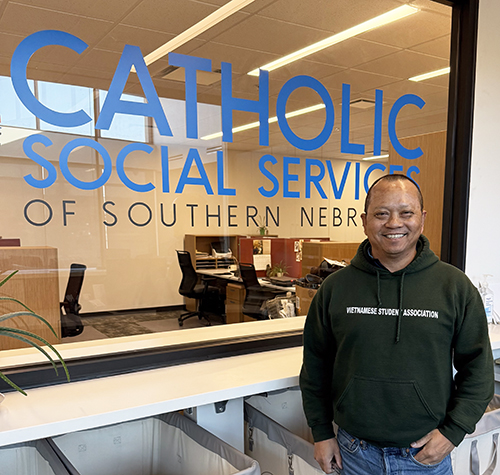
The Tran family was among the few who survived. Three days into their journey, they spotted an American ship. Clinging to the chance of rescue, refugee boats clustered around the vessel.
“All we knew was that the Americans would save us,” said Alex Tran. “They’ll take care of us.”
Tran was 10 years old when American soldiers pulled him aboard the ship in 1975.
The magnitude of the refugee crisis in the aftermath of the Vietnam War prompted Congress to enact the Refugee Act of 1980. This action established the legal definition of a refugee into U.S. law, which has its origins in the United Nations 1951 Convention and 1967 Protocols, of which the U.S. became a party in 1968.
Under U.S. law, a “refugee” is a person who is unable or unwilling to return to his or her home country because of persecution or a well-founded fear of persecution due to race, membership in a particular social group, political opinion, religion, or national origin. The Refugee Act of 1980 also contributed to forming the U.S. Refugee Admissions Program (USRAP), which to this day provides a safe and secure pathway for refugees fleeing their home countries to rebuild their lives in the U.S.
The Catholic Church responded magnanimously to the plight of Vietnamese refugees and the request by the federal government to participate in the refugee resettlement program (USRAP). In partnership with local affiliates, the U.S. Conference of Catholic Bishops (USCCB) administered one of the most robust systems of compassionate, quality care to hundreds of thousands of refugees fleeing famine, violence, and persecution from 1980 to 2025.
Catholic Social Services of Southern Nebraska (CSS), an affiliate of the USCCB, was honored to have been a place of refuge and hope for those who came to our country. From Sudan to Cuba, Bosnia to Iraq, families eager to rebuild a safer, more prosperous home for their children were warmly welcomed into communities across the Catholic Diocese of Lincoln.
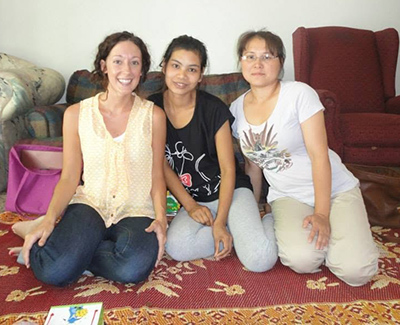
In addition to welcoming thousands of families over the years, the refugee resettlement program at CSS impacted hundreds of everyday Nebraskans by inviting them to serve as refugee case managers, host families, volunteer English teachers, mentors, employment counselors, and more. My life was profoundly changed the day I met an Afghan refugee and her children through a volunteer experience as a student at Pius X High School in Lincoln in the fall of 1999.
Changes to the U.S. Refugee Admissions Program were anticipated when the Trump administration took office in January 2025, but few could have predicted the dismantling of a 45-year partnership between the U.S. government and the USCCB. As executive orders cancelling long-standing contracts poured out of the White House, the USCCB—our national affiliate—with its dedicated team maintained constant communication with us.
Their support strengthened our resolve to continue serving refugee families entrusted into our care, which included 15 active cases with 42 individuals from Burma (Myanmar), Syria, Afghanistan, Iraq, Iran, Sudan, South Sudan, and Venezuela.
Guided by our mission—to perform the Works of Mercy in response to the call of God—we forged ahead with no certainty of funding, but an unbreakable commitment to our Catholic faith and to welcoming the stranger.
Thankfully, the Lord provided.
—
In 1945, the world fell to its knees in the aftermath of the Second World War. Millions of families lost their loved ones, their homes, their neighbors, their businesses, and their communities. Entire livelihoods, traditions, and cultures were displaced. Cities were reduced to rubble and fields laid to waste. But humanity is resilient, and people began to rebuild.
One of those families was Josephine and Petro Witkowicz. Josephine was taken from her home in Poland as a teenager and forced to work as slave labor on a farm in Germany. Similarly, Petro was forcibly taken from his home in Ukraine and labored in a coal mine. Following the war, Josephine and Petro met at a displaced persons camp, and they were married in 1947. They immigrated to the U.S. with their two young children, arriving in Lincoln, Nebraska in March 1951.
Petro and Josephine raised three children in Lincoln: Victor, Gene, and Maria. The family belonged to St. Mary Parish, and later moved to Sacred Heart Parish, where their children attended elementary school before going on to Pius X High School. Their daughter Maria graduated from Pius X in 1971 and went on to receive her degrees in accounting and business administration from the University of Nebraska-Lincoln. She also became a Certified Public Accountant.
In January 2024, I had the opportunity to meet Maria at our office. She and her brother, Victor, came to CSS to learn more about our programs. I told Maria about the history of refugee resettlement and that, for decades preceding our partnership with the USCCB, Catholic Social Services welcomed WWII refugees and others fleeing violence and persecution around the world. That was when she and Victor shared with me the heroic journey of their parents. With Maria’s initial gift that year, we directed it all toward our refugee resettlement program at CSS.
Maria passed away on Christmas Day 2025, but her legacy will continue for generations.
In addition to leaving Catholic Social Services a significant financial gift, Maria gave us and those we serve hope: hope in a new day for those fleeing war, and hope that a family struggling to feed their children will be fed; hope that those facing persecution will find safety, and hope that God’s love for us will be triumphant.
At Catholic Social Services, we understand that government priorities and programs evolve, and that as individuals, we too may hold unique sets of values and beliefs that might not always align. Yet, our call as Catholics to live the Gospel each and every day is paramount not only to our earthly life but to our eternal life.
This article isn’t about what side of the political aisle you are on, but rather a reminder that living the Gospel is a personal task—an invitation from Christ to love our neighbor as ourself.
We all have the capacity to respond to God’s call. For some, it is through a financial contribution, while for others, it is through the gift of time, and still others it is in silence and through prayer. Regardless of the medium in which you find yourself responding to God’s call, individual actions are what make a difference in the lives of those in need.
Contributions make it possible for our case managers to accompany families as they adjust to American life.
Volunteer English teachers and mentors share their knowledge but also a spirit of encouragement for newcomers.
Prayers sustain us.
And so I invite you, as you finish reading this article, to spend a few moments considering the different ways you can respond. How is God calling you to welcome the stranger? Learn more at csshope.org.
_
On Jan. 26, 2025, the U.S. Conference of Catholic Bishops (USCCB) issued the following statement on its long-time partnership with the federal government to serve refugees:
“Faithful to the teaching of Jesus Christ, the Catholic Church has a long history of serving refugees. In 1980, the bishops of the United States began partnering with the federal government to carry out this service when Congress created the U.S. Refugee Admissions Program (USRAP). Every person resettled through USRAP is vetted and approved for the program by the federal government while outside of the United States. In our agreements with the government, the USCCB receives funds to do this work; however, these funds are not sufficient to cover the entire cost of these programs. Nonetheless, this remains a work of mercy and ministry of the Church.”
_
‘Everything will be okay. It may look different here, but it’s safe’
People assisted by Catholic Social Services of Southern Nebraska share their stories:
Albert Maribaga
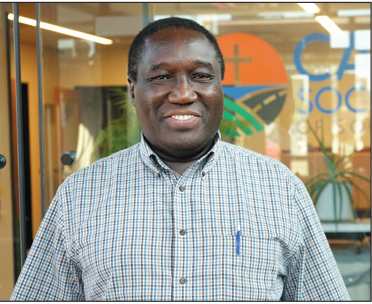 In 1983, civil war broke out in Sudan, marking the start of a 22-year conflict that killed an estimated two million people and displaced twice as many. Albert Maribaga was one of the millions forced to flee their homes for safety.
He first escaped to Syria, and then to Egypt, where he was granted refugee status after two and a half years. In 2000, Maribaga and his family were resettled in Lincoln, where CSS helped them secure housing, employment, and other essential services.
Maribaga became a U.S. citizen in 2005, and, feeling a duty to give back to his new country, served as an interpreter alongside U.S. forces during the Iraq War from 2007 to 2011. Following service, he was recruited by CSS to be a case manager for the Lost Boys of Sudan and later became an employment specialist. He has held this role for more than a decade and has helped hundreds of clients find jobs in Lincoln.
Kyae Nay Moo Hsa Gay Paw
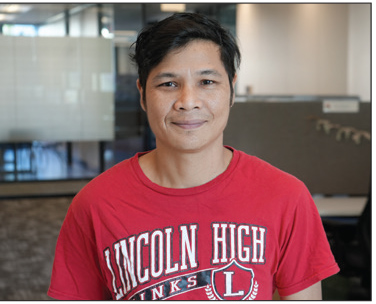 Kyae Nay Moo Hsa Gay Paw grew up in a war-torn area of Myanmar (Burma), where he experienced frequent displacement. He did not have access to formal education and supported himself as best he could through farming. He was eventually forced to flee to Thailand for safety, and arrived at a refugee camp in 2006 as a stateless refugee. Faced with ongoing job insecurity, he felt a sense of hopelessness living in the camp.
It wasn’t until 2024, nearly two decades later, that Hsa Gay Paw was given the opportunity to resettle in the U.S. with his family. Almost two years after this, he is stably employed at a local manufacturing company. His children are enrolled in school, just as he always dreamed. He and his wife also take English classes. As they continue to build a new life here in Lincoln, Hsa Gay Paw is willing to do whatever it takes to provide his children with the best possible future and a place to finally call home.
Evelina Lytvak
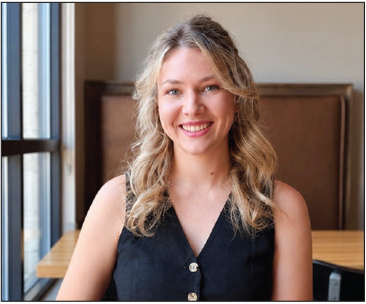 Unlike more recent arrivals from Ukraine, Evelina Lytvak came to the U.S. in 2020 not to flee Russia’s war of aggression, but to escape religious persecution from her own government.
Here in Nebraska, Lytvak and her husband have been able to build a better, more free life for themselves. They even started their own trucking business. Lytvak attributes this success to the initial assistance her family received upon arrival: “It’s because of the United States, because of refugee resettlement and the people who helped us, who lifted us, who guided us.”
She is especially grateful to her former CSS case manager, whom she credits with starting her American life. Lytvak later drew from this positive experience during her own time working as a resettlement case manager, before federal funding was cut. Like Maribaga, she felt called to give back to the country that took her in and to support fellow newcomers, just as she was supported.
Hussein Alhussein
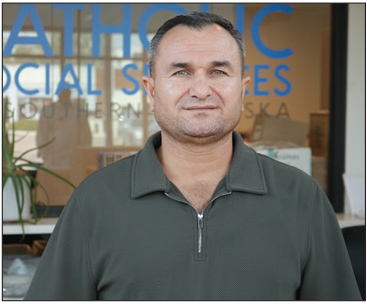 When Hussein Alhussein and his family learned that they had been approved to resettle in the U.S., there was a big celebration in the refugee camp. The husband and father of seven had been living in Jordan for 10 years by that point, having fled the deadly civil war in his home country of Syria in 2013. The children, several of whom were born in Jordan and had never experienced life outside of the refugee camp, were perhaps most excited by the news.
Today, Alhussein enjoys the peace and quiet of living in a “small town” like Lincoln, where he works in manufacturing to support his family. His children have adapted quickly to their new home and are very happy to attend school. When asked what advice he would give to new arrivals, Alhussein wanted to assure other refugees that “Everything will be okay. It may look different here, but it’s safe.”
