One of the recent efforts of the secularists in their campaign to expunge all religion from American cultural life was represented by a citizen from California who brought a lawsuit in federal court trying to impose his desire to disallow the use of the phrase "under God" in the American Pledge of Allegiance to the national flag. The lawsuit was dismissed on a legal technicality, but there are promises from secularists to continue their efforts to get the mention of God out of the Pledge. Those words, "under God", were inserted officially into the Pledge by a bill passed by the U.S. Congress on June 14, 1954, and signed into law on that same day by President Dwight D. Eisenhower, who said, "In this way we are reaffirming the transcendence of religious faith in America’s heritage and future. In this way we shall constantly strengthen those spiritual weapons which forever will be our country’s most powerful resource in peace and war." The President then stood on the steps of the U.S. Capitol and recited the Pledge of Allegiance officially for the first time using the phrase "one nation under God" .
The phrase "under God" was taken from the Gettysburg Address of Abraham Lincoln, who said "that this nation under God shall enjoy a new birth of freedom...". The effort to bring about that insertion into the Pledge of Allegiance was largely led by the Knights of Columbus in the United States. The original Pledge itself seems to have been composed in 1892 by Francis Bellamy and was first published on September 8, 1892, in a Protestant magazine of the time called "The Youth’s Companion". It was first used publicly when a large group of public school children recited it together at the beginning of the International Columbian Exposition in Chicago (World’s Fair) on October 12, 1892, commemorating "landing day", the 400th anniversary of the discovery of America by Christopher Columbus.
Another Absurdity
Sometimes the anti-religion work of the secularists takes on preposterous dimensions. Recently a public school district somewhere in America sent a stern warning to its school bus drivers that they were forbidden to post in their buses any pictures of Santa Claus, the reason asserted being that he is a "Catholic saint", and, therefore, those bus drivers who would post such pictures were "establishing a religion" in violation of the first amendment to the Federal Constitution. Now we all know that the Santa myths came about through ancient Christian devotion to Saint Nicholas, who was the Catholic Bishop of Myra in the fourth century and whose body was brought by the Crusaders to Bari, Italy, where it rests to this day. However, the real and genuine Saint Nicholas did not live at the North Pole, did not have a wife, did not cavort with elves, was not overweight, did not wear a red suit and ride about with reindeer, etc. It certainly takes a very fanatic public-school secularist to identify a figure that has morphed into Santa Claus with an actual Catholic saint.
Most recently, a current federal bureaucrat in the United States Veterans’ Administration forbade the use of the words "God" or "Jesus" in any burial rites in a national cemetery for military veterans and their families. The matter was threatened with litigation causing the bureaucrat to retreat somewhat, saying she only means to forbid chaplains from the American Legion or VFW from using those words, but other chaplains may do so! This is a secularist idea of religious freedom!
Congressional Report
On January 19, 1853, in the midst of some general public outrage in America over the organization called "The American Protective Association" (which was popularly called the "No Nothing Party" from the practice of its members responding to all inquiries with the phrase "I know nothing"), the U.S. Congress received an interesting report from the Senate Judiciary Committee about the first amendment, which already then was beginning to be given a distorted construction. "The first amendment clause speaks of an establishment of religion. What is meant by that expression? It referred without a doubt to that establishment which existed in the mother country, endowment at the public expense, peculiar privileges to its members, disadvantages and penalties upon those who should reject its doctrines or belong to other communions. Such a law would be a "law respecting an establishment of religion". They intended by this amendment to prohibit an establishment of religion such as the English Church presented or anything like it. But, they had no fear or jealousy of religion in itself, nor did they wish to see us become an irreligious people."
"They did not intend to spread over all the public authorities and the whole public action of the nation the dead and revolting spectacle of atheistic apathy. Not so had the battles of the Revolution been fought and the deliberations of the Revolutionary Congress been conducted." The term "atheistic apathy" is an interesting but accurate description of current day secularism and its goals. The Judiciary Committee noted the religious aspects of the 1783 treaty between the United States and Great Britain, which ended our Revolutionary War and, in effect, brought about our national independence, and which begins with these words: "In the Name of the Most Holy and Undivided Trinity: It having pleased the Divine Providence to dispose the hearts of the most serene and most potent Prince George the Third, by the Grace of God, King of Great Britain, France, and Ireland, Defender of the Faith, and of the United States of America to forget all past misunderstandings and differences, etc."
Court Confusion
The U.S. Supreme Court has found itself seriously conflicted in recent times in matters pertaining to the issues of church and state. This is easily seen in the confusing and often contradictory rulings it sets out. There even are occasionally some that actually do not favor secularism. For instance, in 1985 (in "Wallace versus Jafree"), Justice William Rehnquist, rendering the Court’s decision, said, "It is impossible to build sound constitutional doctrine upon a mistaken understanding of constitutional history. The establishment clause had been expressly freighted with Jefferson’s misleading metaphor for nearly forty years. There is simply no historical foundation for the proposition that the framers intended to build a wall of separation between church and state. The recent court decisions are in no way based on either the language or intent of the framers."
In a 1963 case ("School District of Abington Township versus Schempp"), Justice Tom Clark, writing the Court’s opinion, said, "The history of man is inseparable from the history of religion. Secularism is unconstitutional, preferring those who do not believe over those who do believe. It is the duty of government "to deter no-belief religions". The facilities of government cannot offend religious principles. The state may not establish "a religion of secularism" in the sense of affirmatively opposing or showing hostility to religion...." On March 3, 1865, the U. S. Congress approved the proposal of Treasury Secretary Salmon Chase to have the U.S. mint inscribe on all American coinage the motto "In God We Trust", to the fury of the rabid secularists even to this day who are trying to get it removed.
Last October 26th, Bishop William Lori, the Catholic Bishop of Bridgeport and the Chairman of the Ad Hoc Committee of the United States Conference of Catholic Bishops on Religious Liberty, testified before a subcommittee of the Judiciary Committee of the House of Representative in the U. S. Congress. He noted that the Bishops of the United States, representing more than 69 million Americans who are Catholics, are very concerned about recent grave threats to religious freedom in our country. He remarked that both the Bill of Rights and our Declaration of Independence require the government "to acknowledge and protect religious liberty as something fundamental, no matter the moral or political trends of the moment." Bishop Lori said, " However, in recent days the Bishops of the United States have watched with increasing alarm as this great national legacy of religious liberty, so profoundly in harmony with our own teachings, has been subject to ever more frequent assault and ever more rapid erosion."
In the name of all the American Catholic Bishops, Bishop Lori urged some "corrective action by the Congress". He said "The ultimate root causes of these threats to religious liberty are profound and lie beyond" (the scope of the Congress to fix) "But, we can and must also treat the symptoms immediately, lest the disease spread so quickly that the patient is overcome before the ultimate cure can be formulated and delivered."
Six Areas
The Bishop stated that there are six areas of immediate and urgent concern for the Bishops and for American Catholics: First, there are the regulations issued last August by the Federal Department of Health and Human Services, mandating coverage of contraception, sterilization, and other evil practices in almost all private health insurance plans in the U.S., (as though those things have anything to do with "health"), with a conscience exception clause so preposterously drawn that, as one observer said, Jesus and the Apostles would be required by Mrs. Secretary Sebelius to get involved in artificial birth prevention and other wickedness. Second, there is a new requirement by the Federal HHS that would force the Bishops’ Migration and Refugee Services to agree to provide the "full range of reproductive services, including abortion and contraception, to all human trafficking victims and all unaccompanied refugee minors."
The third attack by the current federal government upon religious freedom and upon the Catholic Church in particular involves a new requirement by the U.S. Agency for International Development that Catholic Relief Services and all other contractors include condom distribution in all HIV prevention activities and provide contraception in a wide range of international relief and development programs. Fourth, there are the Department of Justice actions to mischaracterize the Federal Defense of Marriage Act, which states that marriage is the union of one man and one woman, as an "act of bigotry", and the Justice Department also is actively attacking the DOMA’s constitutionality. Fifth, that same Justice Department is working hard to undermine all "ministerial exceptions" which generally exempt religious institutions from civil laws when it comes to hiring and firing (their own priests or ministers, etc.). Sixth, State actions promoting same-sex marriage resulted in Catholic Charity agencies in Illinois "being driven out of the work of adoption and foster care" and "some county clerks in New York State having to face legal action for refusing to participate in same-sex unions." Bishop Lori said that "these areas are only the most recent instances in a broader trend of erosion of religious liberty in the United States." The ardent and fanatical secularists are unrelenting in their determination to force their anti-religion on the United States, trying to make us accept godlessness as our "national church".
Final Verses
It was on September 14, 1814, that Francis Scott Key, a Washington D.C. lawyer and poet, was being held captive on a British warship off the harbor of Baltimore and witnessed the bombardment by the British fleet of the American-held Fort McHenry. The next morning when the mist and smoke had cleared, he saw the American flag still flying over the fort and was inspired to write "The Star Spangled Banner". As he wrote the poem he kept in mind the cadence of an old English drinking song "To Anacreon in Heaven", and the poem almost immediately was set to the music of that tune and then quickly became very popular throughout our country. On March 3, 1931, by an Act of Congress, all four of its verses became the official national anthem of the United States.
The fourth verse is little known and seldom sung, except in wartime, but it stands as another refutation of the efforts to force national secularism on our country: "O thus be it ever, when free men shall stand between their loved homes and the war’s desolation. Blest with victory and peace, may the heaven rescued land praise the Power that hath made and preserved us a nation. Then conquer we must, when our cause it is just, and this be our motto: In God is our trust! And the star spangled banner in triumph shall wave o’er the land of the free and the home of the brave."
In 1831, Samuel Francis Smith, using the melody of the national anthem of Great Britain ("God Save the King"), wrote one day within a half hour the words of the patriotic hymn "My Country ‘Tis of Thee". Its last verse is the famous prayer: " Our fathers’ God, to Thee, Author of Liberty, to Thee we sing. Long may our land be bright with freedom’s holy light. Protect us by Thy might, Great God. our King."
Some Quotes
It is useful occasionally to recall some interesting words of George Washington, especially in relation to the current controversies about church-state issues and religious freedom. The father of our country wrote and said much that is useful for America even today. He said, "While just government protects all in their religious rights, true religion affords to government its surest support." Under date of March 11, 1792, he wrote in a private letter, "I am sure that there never was a people who had more reason to acknowledge a divine interposition in their affairs than those of the United States, and I should be pained to believe that they have forgotten that Agency, Which was so often manifested during our revolution, or that they failed to consider the omnipotence of that God Who is alone able to protect them."
On November 19, 1794, Washington said in a speech: "Let us unite, therefore, in imploring the Supreme Ruler of nations to spread His holy protection over these United States; to turn the machinations of the wicked to the confirming of our constitutions: to enable us at all times to root out internal sedition, and to put invasion to flight; to perpetuate to our country that prosperity which His goodness has already conferred, and to verify the anticipation of this government being a safeguard to human rights."
A wise man stated that trying to be neutral between belief in God and atheism is like trying to be neutral between the fire and the fire department. That kind of neutrality always favors the fire.
In his most recent Apostolic Letter, written to the Universal Church, entitled "The Door of Faith", ( words from the Acts of the Apostles 14:27), and dated October 11, 2011, Pope Benedict XVI said, "I have decided to announce a Year of Faith. It will begin on October 11, 2012, the fiftieth anniversary of the opening of the Second Vatican Council, and it will end on the Solemnity of Our Lord Jesus Christ, Universal King, November 24, 2013. The starting date of October 11, 2012, also marks the twentieth anniversary of the publication of the "Catechism of the Catholic Church", a text promulgated by my Predecessor, Blessed John Paul II, with a view to illustrating for all the faithful the power and beauty of the faith."
The Holy Father has made it an important point of his pontifical teaching to emphasize, more than a few times in the past seven years, that the Second Vatican Council, which is a precious gift from God, the Holy Spirit, to Christ’s Catholic Church, had been subject sadly to serious misunderstanding and misinterpretation by people inside and outside the Church over the past half century. To correctly understand and interpret the Council one must use what the Pope calls "a hermeneutic of continuity" whenever reading what the Council did and intended to do. This is why he wrote in his Apostolic Letter: "It seemed to me that timing the launch of the Year of Faith to coincide with the fiftieth anniversary of the opening of the Second Vatican Council would provide a good opportunity to help people understand that the texts bequeathed by the Council Fathers, in the words of Blessed Pope John Paul II, have lost nothing of their value or brilliance. They need to be read correctly, to be widely known and taken to heart as important and normative texts of the Magisterium within the Church’s Tradition. I feel more than ever duty bound to point to the Council as the great grace bestowed on the Church in the twentieth century. There we can find a true compass by which to take our bearings in the century now beginning. I would also like to emphasize strongly what I had occasion to say concerning the Council a few months after my election as the Successor of Peter, namely, if we interpret and implement it guided by a right hermeneutic, it can be and can become increasingly powerful for the ever necessary renewal of the Church."
Neither the Council Fathers nor anyone else in authority in the Catholic Church intended the Council to constitute any kind of break with the Church’s past or to discard her traditions, customs, and perennial teachings, but rather intended that sacred gathering to endow the Catholic Church, in the words of Blessed Pope John XXIII, with "greater spiritual riches and new energy" for the tasks that her Divine Founder, Jesus Christ, has commissioned her to carry out until He returns to earth at the end of time.
Precedent
Pope Benedict XVI notes, "It is not the first time the Church has been called to celebrate a Year of Faith. My venerable Predecessor, the Servant of God, Pope Paul VI, announced one in 1967, to commemorate the martyrdom of Saints Peter and Paul on the 19th centenary of their supreme act of witness. He thought of it as a solemn moment for the whole Church to make an authentic and sincere profession of the same faith. Moreover, he wanted this to be confirmed in a way that was individual and collective, free and conscious, inward and outward, humble and frank. He thought that in this way the whole Church could reappropriate an exact knowledge of the faith, so as to reinvigorate it, purify it, confirm it, and confess it. The great upheavals of that year made even more evident the need for a celebration of this kind. It concluded with the "Credo of the People of God" (composed by Pope Paul VI himself) , intended to show how much the essential content that for centuries has formed the heritage of all believers needs to be confirmed, understood, and explored anew, so as to bear consistent witness in historical circumstances very different from those of the past."
In his opening address at the beginning of the Second Vatican Council, Blessed Pope John XXIII said, "The greatest concern of this Ecumenical Council must be this, that the sacred deposit of Christian doctrine should be guarded and taught more efficaciously." That Blessed Pope noted that "modern society is earmarked by a great material progress to which there is not a corresponding advance in the moral field. Hence, there is a weakening in the aspiration toward the values of the spirit. Hence, there exists an urge for an almost exclusive search for earthly pleasures, which progressive technology places with such ease within the reach of all. And, thus there is a completely new and disconcerting fact, the existence of a militant atheism which is active on the world level."
Pope’s Desire
Pope Benedict XVI said, "We want this (coming) Year (of Faith) to arouse in every believer the aspiration to profess the faith in its fullness and with renewed conviction, with confidence and hope. It will also be a good opportunity to intensify the celebration of faith in the liturgy, especially in the Eucharist, which is the summit towards which the activity of the Church is directed and also the source from which all its power flows. At the same time we make it our prayer that believers’ witness of life may grow in credibility. To rediscover the content of the faith that is professed, celebrated, lived, and prayed and to reflect on the act of faith is a task that every believer must make his own, especially in the course of this Year." Saint Thomas Aquinas remarked, "The infused light of the habit of faith discovers the meaning of the articles of the Creed, just as the mind’s natural power of abstraction discovers the first evidences of reason."
The Holy Father says, "In fact, there exists a profound unity between the act by which we believe and the content to which we give our assent. Saint Paul helps us to enter into this reality when he writes: ’Man believes with his heart and so is justified, and he confesses with his lips and so is saved’ (Romans 10:10). The heart indicates that the first act by which one comes to faith is God’s gift and the action of grace which acts and transforms the person deep within."
The First Vatican Council teaches, "Faith is that supernatural virtue by which, through the help of God and through the assistance of His grace, we believe what He has revealed to be true, not on account of the intrinsic truth perceived by the natural light of reason, but because of the authority of God Himself, the Revealer, Who can neither deceive nor be deceived." Saint Augustine of Hippo said, "There is no love without hope and no hope without love, and no hope nor love without faith." Blase Pascal wrote, "If we surrender everything to reason, our religion will lose all mystery and will lose the supernatural, but if we offend against the principles of reason, our religion will be absurd and ridiculous."
Thanksgiving, a civil holiday celebrated in the United States on the last Thursday of each November, became an official and annual national holiday in 1863, during the administration of President Abraham Lincoln. However, it appears to have been first observed by President George Washington, who issued the first presidential proclamation of national Thanksgiving to God in 1789. He wrote, "Now, therefore, I do recommend and assign Thursday, the 26th day of November next to be devoted by the people of these States to the service of that great and glorious Being, Who is the beneficent Author of all the good that was, that is, or that will be, that we may all unite in rendering unto Him our sincere and humble thanks for His care and protection of the people of this country previous to their becoming a nation, for His signal and manifold mercies, for the favorable interposition of His providence, which we experienced in the course and conclusion of the late war, for the great degree of tranquility, union, and plenty, which we have since enjoyed, for the peaceable and rational manner in which we have been enabled to establish constitutions of government for our safety and happiness, and particularly the national one now lately instituted. for the civil and religious liberty with which we are blessed, and the means we have of acquiring and diffusing useful knowledge, and in general for all the great and various favors which He hath been pleased to confer upon us."
In His proclamation, Washington goes on to say that he is proclaiming a national day of Thanksgiving to God "that we may then unite in most humbly offering our prayers and supplications to the great Lord and Ruler of nations and beseech Him to pardon our national and other transgressions, to enable us all, whether in public or private stations, to perform our several and relative duties properly and punctually, to render our national government a blessing to all the people, by constantly being a government of wise, just, and constitutional laws, discreetly and faithfully executed and obeyed, to protect and guide all sovereigns and nations, especially such as have shown kindness unto us, and bless them with good governments, peace, and concord, to promote the knowledge of true religion and virtue and the increase of science among them and us, and generally to grant unto all mankind such a degree of temporal prosperity as He alone knows to be best."
The States
Washington cited a series of precedents for his action, particularly certain days of Thanksgiving to God which had been established by the Continental Congress following the American victories at Saratoga and Yorktown, during the Revolution.
Presidents John Adams and James Madison subsequently issued Thanksgiving proclamations, but the other presidents up until the time of Lincoln preferred to leave such undertakings to the governors of the States. The custom grew rather rapidly. By the 1840’s a Thanksgiving holiday was celebrated in Connecticut, Massachusetts, Vermont, Maine, New York, Michigan, Illinois, Iowa, Wisconsin, Indiana, Missouri, and Pennsylvania. Lincoln himself issued a first Thanksgiving proclamation in 1863, telling the people to thank God for the victories of the Union Armies at Gettysburg and Vicksburg.
However, Lincoln was persuaded to establish another national Thanksgiving holiday in that same year of 1863, and to make it perennial, largely through the untiring efforts of an enthusiastic woman named Sarah Josepha Hale.
Mrs. Hale
Mrs. Hale was the editor of a 19th century influential woman’s magazine called "Godey’s Lady Book", and from the 1840’s she was unrelenting in her determination to have an annual Thanksgiving Day in the United States celebrated on the last Thursday of every November. She wrote editorial after editorial on the matter and her magazine illustrated many features telling housewives on how to celebrate such a holiday. With regularity she published articles about historical Thanksgiving celebrations recorded among the early English settlers in America, especially in Plymouth, Massachusetts, and Jamestown, Virginia. She continually wrote to all the governors of the States and territories, urging them to persuade the Congress and the President to establish such a national holiday. Finally, she managed to touch the right note for persuading Lincoln when she kept insisting that such a national holiday would promote reconciliation in the country when it was being torn and divided by the Civil War, and, thus, he instituted this national holiday that perdures to this day.
Initially the day was basically a home and church event, but the "add-ons" came soon. By the 1880’s football, especially the Yale-Harvard Game at the Polo grounds, began to be part of the occasion. In 1934 the Detroit Lions established their custom of playing a Thanksgiving Day game, first broadcast on radio and then on television. In 1924 Macy’s Department Store began having their annual Christmas parade in New York on Thanksgiving, and now that seems to have become an American Thanksgiving Day custom.
Lincoln
Lincoln wrote in his proclamation, "The year that is drawing toward its close has been filled with the blessings of fruitful fields and healthful skies. To these bounties, which are so constantly enjoyed that we are prone to forget the Source from Which they come, others have been added, which are of so extraordinary a nature that they cannot fail to penetrate and soften even the heart which is habitually insensible to the ever watchful providence of Almighty God. No human counsel hath devised nor hath any mortal hand worked out these great things. They are the gracious gifts of the Most High God, Who, while dealing with us in anger for our sins, hath nevertheless remembered mercy."
Lincoln went on to write, "It has seemed to me fit and proper that they should be solemnly, reverently, and gratefully acknowledged as with one heart and voice by the whole American people. I do, therefore, invite my fellow citizens in every part of the United States, and also those who are at sea and those who are sojourning in foreign lands, to set apart and observe the last Thursday of November as a Day of Thanksgiving and praise to our beneficent Father Who dwelleth in the heavens. And I do recommend to them that, while offering up the ascriptions justly due to Him for such singular deliverances and blessings, they do also, with humble penitence for our national perverseness and disobedience, commend to His tender care all who have become widows, orphans, mourners, or sufferers in the lamentable civil strife in which we are unavoidably engaged, and fervently implore the interposition of the Almighty Hand to heal the wounds of the nation and to restore it as soon as may be consistent with the divine purposes to the full enjoyment of peace, harmony, tranquility and union."
There are many liturgical texts which can help us focus our thoughts each year during the season of Advent on the reality of the coming of Christ. As we prepare to commemorate on Christmas, the Solemnity of His Nativity, His coming out of His eternal timelessness into our human space and time, during Advent we also ought carefully to remember and ponder His promise to return to us one day in glory on the clouds of heaven at the end of the world (Matthew 24:30). And then, of course, there are His "intermediate comings to us" to remember, especially in the Holy Eucharist (Luke 22:14-20) and in the persons of the poor and needy whose lives touch ours and for whose help He will hold us responsible when He returns to judge the earth (Matthew 25:34-46).
Among those traditional Advent liturgical texts, several can be found in the words of the Nicene-Constantinople Creed with which we profess our Catholic Faith at every Mass on Sundays and Holy Days. We say, for instance, "He will come again in glory to judge the living and the dead and His kingdom will have no end." We conclude the recitation of the Creed by saying (in the new translation), "I look forward to the resurrection of the dead and the life of the world to come." The old translation simply says "look", but the Latin word "expecto" really has a deeper and richer meaning, which is better translated "look forward", and this new translation which makes it much more an Advent expression, echoes the phrase in the prayer after the "Our Father" when the priest, in the ordinary form of the Roman Rite, says, "as we wait in joyful hope for the coming of our Savior, Jesus Christ."
Last Judgment
The Catechism of the Catholic Church teaches, "The last judgment will come when Christ returns in glory. Only the Father knows the day and the hour. Only He determines the moment of its coming. Then through His Son, Jesus Christ, He will pronounce the final word on all history. We shall know the ultimate meaning of the whole work of creation and of the entire economy of salvation and understand the marvelous ways by which His providence led everything towards its final end. The last judgment will reveal that God’s justice triumphs over all the injustices committed by His creatures and that God’s love is stronger than death."
"The message of the last judgment calls men to conversion while God is still giving them the acceptable time, the day of salvation (2 Corinthians 6:2). It inspires holy fear of God and commits them to the justice of the kingdom of God. It proclaims the blessed hope of the Lord’s return, when He will come to be glorified in His saints and to be marveled at in all who have believed (Titus 2:13 & 2 Thessalonians 1:10). Since the Ascension, Christ’s coming in glory has been imminent, even though it is not for you to know the times of seasons which the Father has fixed by His own authority (Acts of the Apostles1:7 & Mark 13:32). This eschatological coming could be accomplished at any moment, even if it and the final trial that will precede it are delayed (Matthew 24:44; 1 Thessalonians 5:2; 2 Thessalonians 2:3-12)."
Saint Augustine
In speaking about the correct Christian attitude that should condition and characterize our celebration of Advent each year, Saint Augustine, the great Doctor of the Church and the Bishop of the North African city of Hippo, said, "Let us not resist His (Christ’s) first coming (by wickedly resisting those He has commissioned to preach His Gospel), so that we may not dread the second. What then should the Christian do? He ought to use the world, but not become its slave. He who is without anxiety waits without fear until His Lord comes. For what sort of love of Christ is it to fear His coming? Brothers, do we not have to blush with shame? We love Him, yet we fear His coming. Are we really certain that we love Him, or do we love our sins more? Therefore, let us hate our sins and love Him Who will exact punishment for them. He will come whether we wish it or not. Do not think that, because He is not coming just now, He will not come at all. He will come. You know not when. Provided He finds you prepared, your ignorance of the time of His coming will not be held against you."
In talking about the last judgment, Saint Augustine says, "Do you, because you are unjust, expect the Judge not to be just? Or, because you are a liar, will the truthful One not be true? Rather, if you wish to receive mercy, be merciful before He comes. Forgive whatever has been done against you. Give of your abundance. Of whose possessions do you give if not from His? If you were to give from your own, it would be largess, but since you give of His, it is restitution. For what do you have that you have not received? (Matthew 10:8). These are the sacrifices most pleasing to God, mercy, humility, praise, peace, charity. Such as these, then, let us bring and, free from fear, we then shall await the coming of the Judge Who will judge the world in equity and the peoples in His truth."
Encyclopedia
In writing about the liturgical season of Advent, the Catholic Encyclopedia says, "Because Christ has come once, He will come again. Indeed, He has never left, but is continuously present in His Catholic Church. For this reason, Advent is at once a celebration of His first coming and His presence in the midst of His Church as well as a looking forward to the full and final coming, when He will complete the work of redemption. The word Advent must, therefore, be taken in the fullest sense, past, present, and future. This is the basis for speaking of three comings of Christ. Since the time of Saint Bernard, Christian spirituality has maintained this way of approaching Advent, an approach that finds its best justification in the liturgy itself. For, between the first and second coming of Christ, the present coming in grace is constantly taking place, His coming by grace in men’s hearts, (to be born anew in that grace and in those hearts at Christmas). The Catholic Church not only prepares during Advent to welcome Him at Christmas time and to greet Him in the hour of His final triumph, but she rejoices even now in the possession and the presence of the Lord within her. (Intensely during Advent) but all through the year (the children of the Church) are summoned to prepare the way of the Lord, to hear the voice of Him Who even already now is in their midst, and to prepare for His second coming by living the mystery of Christ in the present moment."
Saint Bernard said that during every Advent, we who are Christ’s disciples must ask ourselves anew "Who it is that is coming? Where is He coming from and how is He coming? To what purpose and when and where does He come?" This kind of curiosity is "praiseworthy and salutary." We must "consider before everything else with the awed and wondering Apostle (Hebrews 7:4) Who it is that is coming. He is the Son of the Most High (Luke1:32) and co-equal with the Father, equal in majesty and equal in dignity. He comes from the Heart of God the Father, and into the womb of the Virgin Mary. He comes from the sublimity of heaven to the lowliness of our earth. He comes to love us, to call us, and to save us."
Our season of Advent, which always occurs almost entirely in the month of December, is made more beautiful each year by several liturgical celebrations in which the Blessed Virgin Mary is particularly honored, venerated, and invoked by us, and in which we are invited to request her special intercessory prayers to God to help us better prepare annually for Christmas, when we are to welcome a new rebirth of Jesus Christ by grace in our souls. The feasts which immediately come to mind are the Solemnity of Mary’s Immaculate Conception on December 8th, and the Feast of Our Lady of Guadalupe on December 12th. In the Litany of Loreto Mary is called the "Mystical Rose", reminding us each year in wintry December of God’s special and miraculous goodness to her and through her to all of us.
Nine months before Mary’s birthday (September 8th) we recall that from "the first moment of her conception", which came about in the normal way in the womb of Saint Ann, her mother, "by a singular grace and privilege of Almighty God and by virtue of the merits of Jesus Christ, the Savior of the human race, she was preserved immune from all stain of original sin." The Catechism of the Catholic Church says, "The splendor of an entirely unique holiness by which Mary is enriched from the first instant of her conception comes wholly from Christ. She is redeemed in a more exalted fashion, by reason of the merits of her Son. The Father blessed Mary more than any other created person in Christ with every spiritual blessing and chose her in Christ before the foundation of the world to be holy and blameless before Him in love."
The Catechism tells us, "Through the centuries the Church has become ever more aware that Mary, full of grace through God, was redeemed from the moment of her conception. That is what the dogma of the Immaculate Conception confesses." Implicitly but clearly this truth is found in the fonts of divine revelation, that is, in Sacred Tradition and Sacred Scripture, and that is what Blessed Pope Pius IX said when he defined that dogma in 1854. The dogma of the Immaculate Conception is often and mistakenly confused with another dogma of our Catholic Faith, that is, with the miraculous Virginal Conception and Birth of our (and Mary’s) Redeemer, Jesus Christ. Both dogmas are very important truths revealed by God.
Pope Benedict XVI
Our Holy Father, the Bishop of Rome, has said, "In today’s consumer society the period of Advent has unfortunately suffered a sort of commercial pollution that risks changing its authentic spirit, marked by recollection, moderation, and joy, which is not external but intimate. It is thus providential that almost as a portal to Christmas there should be the feast of one who is the Mother of Jesus and who, better than anyone else, can lead us to know, love, and adore the Son of God made Man. Let us therefore allow her to accompany us. May her sentiments prompt us to prepare ourselves with heartfelt sincerity and openness of spirit to recognize in the Child of Bethlehem the Son of God Who came into the world for our redemption. Let us walk together with her in prayer and accept the repeated invitation that the Advent liturgy addresses to us to remain in expectation, in watchful and joyful expectation. For the Lord will not delay. Thus it is Mary who tells us what Advent is: a going forth to meet the Lord Who comes to meet us. It is waiting for Him, listening to Him, longing for Him, and looking at Him."
Tepayac
Thirty-nine years after Christopher Columbus discovered our New World, while sailing on a ship called "Holy Mary" ("Santa Maria"), Mary herself chose to visit a part of that world on a hill in present day Mexico, which the Spaniards called "Guadalupe" and which the natives called "Tepayac". It was in December of 1531 that she appeared to an extremely poor, insignificant, and humble indigenous peasant, Juan Diego, recently canonized a saint by Pope John Paul II. Juan Diego then was a widower who lived with an aged and sick uncle and was on his way to Mass when the first apparition happened.
We know well the charming story of how Mary told him to go to the Bishop and tell him to build a beautiful church on that hilltop. The Bishop put him off and Juan Diego, discouraged, asked Mary in the second vision to go to the Bishop herself or to send a noble hidalgo because the Bishop would not believe an ignorant and impoverished Indian. She told him to return. The Bishop’s servant initially would not let him see the Bishop a second time, but the Bishop, hearing the commotion at his doorway did encounter Juan Diego, but told him, "Words are cheap. Tell this lady you are seeing that I, your Bishop, ask her for a sign." On December 12th, the uncle of Juan Diego looked like he was dying and so Juan Diego ran for a priest, but tried to avoid Tepayac so he would not be delayed talking to Mary, but she encountered him on the side of the hill, told him his uncle was cured, and instructed him to ascend the hill to find the sign for the Bishop. There Juan Diego found, despite the frost, cold, and barren rocks, a field of beautiful roses. Mary said, "Fill your cloak with those roses and bring them to the Bishop. He will understand." Juan Diego did so and ran to the Bishop’s house and dumped the roses in front of the Bishop, who rose from his desk and then fell on his knees in wonder because on Juan’s tilma, that had held the roses, there was a splendid image of Mary and her face, in a golden halo, was that of an Aztec princess.
The image persists to this day. Scientists have examined it. The paint is a strange combination of oil, water-color, tempera, and fresco. The tilma is woven of cactus fiber (as was the Indian custom), but there is no explanation of why it has not crumbled to pieces over these centuries, as have all other garments of that nature. During the 20th century Mexican persecution by the Marxists and Free Masons, led by Calles and supported by many American liberals, the government planted a bomb to destroy the tilma, but it was not damaged although the basilica that housed it was severely harmed. The image depicts Mary as pregnant with the stars on her mantle arranged in the constellations that were over Mexico in December of 1531.
Father Joseph Manton observes, "At Guadalupe our Lady said to the Spaniards: These Indians have souls as precious as yours. To the Indians she said, These Spaniards, for all their faults, are bringing you the true faith, the religion of Jesus Christ. Accept it and fling away forever your pagan superstitutions." He goes on to remark: "Guadalupe reminds us that nobody can be so lowly or stupid or blundering that heaven is not interested in him. What could be less important than Juan Diego and his old cloak." Another author writes, "In our Lady of Guadalupe God overturns the world by identifying with the poor and powerless. She is a magnificent symbol of our Advent hopes and longings that the Word of God at Christmas will be born anew by grace in our souls and will continue to dwell among us (John 1:14)." Archbishop Fulton Sheen said, "On that first Christmas God took Flesh and climbed upon Mary’s body as an ivory tower to kiss on her lips a mystic rose." Roses in December, indeed!
In the beautiful cycle of the liturgical year, the Church’s official prayer arrangement gives us in each Advent Season a spiritual opportunity to encounter anew the person and message of Saint John the Baptist, about whom Jesus spoke saying, "...among those born of women there is not a greater prophet than John the Baptist, yet the least in the kingdom of God is greater than he" (Luke 7:28). The words and example of the great Jewish priest who was the precursor and cousin (Luke 1:36 & 76-79) of our divine Savior resonate down the centuries to help us annually to prepare for Christmas and for the coming of Christ at the end of the world as well for His intermediate comings to us, especially in our Eucharistic encounters with Him. John’s fearless words and his heroic martyrdom for the cause of God-given morality can have the effect, if we allow them, to inspire us before our celebration of the Solemnity of Christ’s Nativity to straighten out the pathways and roads of our lives if they might have become distorted and twisted by our cultural hedonism and materialism, to lower the mountains and hills of our overbearing pride in ourselves and our accomplishments, and to fill in the valleys of our culpable omissions and neglect. God’s providential economy of salvation arranged that John should be the last and the greatest prophet of the Old Testament with the mission to straddle the unification of the Old and New Covenants. Our Lord said, "All the prophets and the law have prophesized until John" (John 11:13).
It is clear that the story of Saint John the Baptist always occupied an important place at the beginning of the proclamation of the Gospel from the earliest days of the Church (Acts of the Apostles 1:22 & 10:37). This place of John the Baptist in the drama of human salvation appears to receive special emphasis in the magnificent words of the Prologue to the Gospel according to Saint John, which is the Gospel passage that is liturgically used for the Third Mass on Christmas Day, and which, in the Extraordinary Form of the Roman Rite, constitutes what used to be called "The Last Gospel". Saint John the Evangelist said of John the Baptist, "There was a man sent from God whose name was John. This man came as a witness to bear witness concerning the Light that all might believe through him" (John 1:6-70). Pope Benedict XVI notes that all four Gospels describe the (Baptist’s) mission using a passage from Isaiah (40:3): "A voice crying in the wilderness: Prepare the way of the Lord, etc. ....These Old Testament texts envisage a saving intervention of God, Who emerges from His hiddenness to judge and to save. It is for this God that the door is to be opened and the way made ready. These ancient words of hope were brought into the present with the Baptist’s preaching. (They indicate that) great things are about to unfold."
A Sect
There can be little doubt that John the Baptist had a powerful personality which made an enormous impact on many people. Although he might have been using hyperbole, Saint Mark noted that "All the country of Judea and all the inhabitants of Jerusalem went out to him..." (Mark 1:5). John’s words and manner of expression were attractive, it seems, even to those, like Herod, his eventual murderer, who were troubled by them (Mark 6:20), and his influence extended beyond the borders of the Holy Land, because Saint Paul, well after Pentecost, encountered twelve of John’s disciples at Ephesus (Acts of the Apostles 19:1-7). Like Apollos initially (Acts of the Apostles 18:25) , they did not yet know about the Holy Trinity and Christian Baptism.
It was most likely the continued existence of groups of disciples of John the Baptist still existing well into the Christian era which accounts for the repeated polemical elements in the Prologue regarding John the Baptist and his relationship to Jesus. The Evangelist says, "He himself was not the Light but was to bear witness to the Light" and "John bore witness concerning Him and cried: This was He of Whom I said: He Who is come after me has been set above me because He was before me" ( John 1:8 & 1:15).
Probably to call attention to the disciples of the Baptist who had not yet journeyed to Christianity, the Synoptic accounts of the ministry of the Baptist also emphasized, in addition to his heroic denunciations of evil, his profound and exceptional humility in relationship with the coming Messiah. "One mightier than I is coming, the strap of Whose sandals I am not worthy to loose" (Luke 3:16); "One mightier than I is coming after me..." (Mark 1:7); "But He Who is coming after me is mightier than I....His winnowing fan is in His hand and He will thoroughly clean out His threshing floor, and He will gather His wheat into the barn, but the chaff He will burn up with unquenchable fire" (Matthew 3:11-12).
Rival Baptisms?
Along the same line, Saint John the Evangelist recounts the incident of some Jews having a discussion about "purification" with some disciples of the Baptist in the course of which the Jews noted that Jesus’ disciples had begun baptizing down the way from where John was doing his work, and actually had been baptizing and making more disciples than John (John 3:22-30 & 4:1-2). It was on that occasion that Saint John the Baptist compared himself to the best man at a wedding in reference to the groom.
He said, "You yourselves bear me witness that I said I am not the Christ, but have been sent before Him. He who has the bride is the bridegroom, but the friend of the bridegroom, who stands and hears him, rejoices exceedingly at the voice of the bridegroom. This my joy, therefore, is made full. He must increase, but I must decrease."
Although Jesus was the cousin of the Baptist and John must have had some suspicion that He was the Messiah, he seemed to be somewhat uncertain. Saint John notes that the Baptist initially "did not know" Christ’s messianic identity (John 1:30-33).. This appears corroborated by the deputation the Baptist sent to Jesus after his imprisonment (Matthew 11:1-19) to ask for a clear answer about the mission of Jesus, to which our Lord replied with a famous messianic passage from the Book of Isaiah (Isaiah 35). Then our Savior went on to praise John the Baptist and to identify him with Elijah, who, according to Hebrew tradition, was to return to earth to precede the arrival of the "Anointed One", that is, the Messiah. Jesus called John the Baptist "a prophet and more than a prophet."
Advent Preacher
Father Pius Parsch has often said that John the Baptist "par excellence" is "our Advent Preacher". His words "Prepare the way of the Lord" are intended by God "not just for the Jewish People of a bygone era, but for the Church, as long as she remains a pilgrim." Also the words of the Baptist, "In your midst stands someone you do not know" should be understood as directed to the whole world and also to all of us. The paradoxical reality of Advent is that we await the Lord, while at the same time realizing that in many marvelous ways we already possess Him.
Pope Benedict XVI has given us some interesting Christmas reflections on the meaning of "light". They are particularly meaningful when we see and admire so many Christmas illuminations and decorations which feature beautiful lights. He remarks, "In our hemisphere, the Feast of Christmas coincides with the days of the winter solstice, after which the daylight time gradually lengthens, in accordance with the sequence of the seasons. This helps us understand better the theme of light that overcomes the darkness (John 1:4-5). It is an evocative symbol of a reality that touches the innermost depths of a human being. I am referring to the light of good that triumphs over evil, the light of love that overcomes hatred, the light of life that defeats death. Christmas makes us think of this inner light, the divine Light that returns to propose anew to us the proclamation of the definitive victory of God’s love over sin and death. Let us remember in particular as we look at the streets and squares of the cities decorated with dazzling lights, that these lights refer to another Light, invisible to the eyes but not to the heart. While we admire them, while we light the candles in churches or illuminations of the crib and the Christmas tree in our homes, may our souls be open to the true spiritual Light brought to all people of good will."
The Holy Father says, "The grace of God has appeared. That is why Christmas is a feast of light. Not like the full daylight which illumines everything, but a glimmer beginning in the night and spreading out from a precise point in the universe, from the stable at Bethlehem where the divine Child was born. This is Christmas, the historical event and the mystery of love, which for more than two thousand years has spoken to men and women of every era and every place. It is the Holy Day on which the great Light of Christ shines forth bearing peace. Certainly, if we are to recognize it, faith and humility are needed, the humility of Mary, who believed in the word of the Lord, and, bending low over the manger, was the first to adore the Fruit of her womb. The glory of the true God becomes visible when the eyes of our hearts are opened before the stable of Bethlehem. Only if people change will our world change, and, in order to change, people need the Light that comes from God, the Light, which so unexpectedly on the night of Christmas entered into our earthly night."
Smallness
In his Christmas reflections, our Supreme Pontiff often has talked about the divine condescension. "God has made Himself small for us. God comes not with external force, but He comes in the powerlessness of His love, which is where His true strength lies. He places Himself in our hands. He asks for our love. He invites us to become small ourselves, to come down from our high thrones and to learn to be childlike before Him. He speaks to us informally. He asks us to trust Him and thus to learn how to live in truth and love. In the Child of Bethlehem the smallness of God-made-Man shows us the greatness of man and the beauty of our dignity as children of God and brothers and sisters of Jesus."
The Pope goes on to say, "God’s sign is His humility. God’s sign is that He makes Himself small. He becomes a little Child. He lets us touch Him, and He asks for our love. How we would prefer a different sign, an imposing, irresistible sign of God’s power and greatness! But, His sign summons us to faith and love, and thus it gives us hope. This is what God is like. He has power. He is Goodness Itself. He invites us to become like Him. Yes indeed, we become like God if we allow ourselves to be shaped by this sign, if we learn humility, and hence true greatness, if we renounce violence and use only the weapons of truth and love. Having become a Man, Christ gave us the possibility of becoming, in turn, like Him. The Heart of God on the holy night of Christmas stooped down to the stable. If we approach this humility of God, then we can touch heaven even now, and we help the earth too to be made new."
Our Involvement
The Successor of Saint Peter notes that the mystery of Christmas profoundly involves all of us who are Christ’s disciples.. "Wake up, O men and women of the Third Millennium! At Christmas the Almighty becomes a Child and asks for our help and protection. His way of showing that He is God challenges us and our freedom. He calls us to examine how we understand and live our lives. In being born again among us (by grace in our hearts), may the Child Jesus not find us distracted or merely busy beautifying our houses with decorative lights, but rather let us deck our soul and make our families a worthy dwelling place where He feels welcomed with faith and love. Christmas is the day when God gave a great Gift to us, not something material, but His Gift was the Gift of Himself. He gave us His Son, so Christmas became the feast of gifts."
"The tree and the crib are elements of that typical Christmas atmosphere which is part of the spiritual heritage of our communities. It is a climate steeped in religiosity and family warmth, which we must also preserve in contemporary society, where the consumeristic rush and the search for material goods alone sometimes seem to prevail. Every Christmas crib is a simple yet eloquent invitation to open our hearts and minds to the mystery of life. It is an encounter with the immortal Life Which became mortal in the mystic scene of the nativity. Joy is the true gift of Christmas, not expensive presents that demand time and money. We can transmit this joy simply, with a smile, with a kind gesture, with some small help, with forgiveness. Let us give this joy and then the joy we give will be returned to us."
"Christmas brings joy and peace to those who, like the shepherds, accept the Angel’s words. This is still the sign for us, too, men and women of the Third Millennium. There is no other Christmas. In the divine Newborn, Whose image we place in the manger, our salvation is made manifest. In the God Who makes Himself Man for us, we all feel loved and welcomed. We discover that we are precious and unique in the eyes of the Creator."
Genuflection
At Midnight Mass and at all the Christmas Masses we genuflect at the words in the Creed: "For us men and for our salvation He came down from heaven and by the Holy Spirit was incarnate of the Virgin Mary and became Man." Pope Benedict says, "We genuflect at this clause because at this point the heavens, the veil behind which God is secluded, are swept aside and the mystery touches us directly. The distant God, our God, becomes "Emmanuel", God-with-us (Matthew 1:23). The Word became Flesh, that Word Who is with God and Who is God (John 1:1).
Preaching on Christmas in Rome in the early 7th century, Pope Saint Gregory the Great, said: "It was fitting that Jesus was born in Bethlehem, since Bethlehem means "The House of Bread", for He was destined to say, ‘I am the the living Bread, which has come down from heaven’ (John 6:32-60). In His own nature He was born before all time. In our nature He came to us in human time. While remaining eternal, He appeared to us in mortal time. It was fitting too that it was an angel who announced that a King was born amid choirs of angels uniting their voices with his and rejoicing while singing ‘glory to God’. Before the Redeemer was born in the Flesh, there was discord between us and the angels, from whose brightness and holy perfection we stood from afar, in punishment first of original sin and then because of our own daily offenses. Because of sin we had become strangers to God, and the angels, as God’s subjects, cut us off from their fellowship. But, since we have now acknowledged our King, the angels receive us as fellow citizens. Because the King of heaven has taken unto Himself the Flesh of our earth, the angels from their heavenly heights no longer look down upon our infirmity. Now they are at peace with us, putting away the remembrance of the ancient discord (Genesis 3:24). Now they honor us as friends, whom before they beheld as weak and despised below them."
"Let us then be careful, dearest brethren, that no uncleanness shall defile us, who, in the divine foreknowledge, are destined to be the subjects of God’s heavenly kingdom and, in that, the equal of His angels. Let us prove our worthiness by the manner of our lives. Let no sensuality soil us, no evil purpose come to accuse us. Let malice not devour your hearts, nor pride exalt them, nor the desire of worldly gain blow them about in every direction, nor anger inflame them. Defend the honor of God within you against these vices, since it was because of you that God became Man."
Saint Leo
In the 5th century, Pope Saint Leo the Great, preaching on Christmas at Midnight Mass, said, "The Word of God, Who in the beginning was with God, by Whom all things were made and without Whom was made nothing that was made, became Man that He might free men from unending death. He bent down in the taking of our lowliness without the diminution of His own majesty, so that, remaining what He was, and taking upon Himself what He was not, He might join the form of a true Servant to that form in which He is equal to God the Father (Philippians 2:6), and by such a bond so link both natures, that the exaltation might not swallow up the lesser, nor the adoption lessen the higher. Preserving, therefore, the substance of both natures and uniting them in one Person, lowliness is assumed by majesty, infirmity by power, mortality by immortality. To pay the debt of our present state, an inviolable nature is united to our suffering nature, and true God and true Man are welded into one Lord, so that, as was needed for our healing, one and the same Mediator between God and men might, by the One suffer death and by the Other rise again from the dead."
"Such a birth, dearly beloved, befitted Christ, Who is the Power of God and the Wisdom of God (1 Corinthians 1:24). By it, He would be joined to our lowliness, yet remain far above us in His divinity. For unless He were true God He could bring us no help, and were He not true Man He could not suffer nor give us an example. This is why the angels sang to the newborn Lord glory to God and peace to men. With what joy may not the lowliness of mankind rejoice in this unspeakable work of divine compassion, when the angels themselves in their heavenly glory so greatly rejoice.".
Saint Chrysostum
Saint John Chrysostum, the Archbishop of Constantinople in the late 4th and early 5th century, in a Christmas sermon, said, "Bethlehem this day resembles heaven, hearing from the stars the singing of angelic voices, and, in the place of the sun, enfolds within itself the Sun of Justice. Ask not how, for where God wills, the order of nature yields. For He willed. He has the power. He descended. He redeemed. All things move in obedience to God. This day He Who is, is born and He Who is becomes what He is not. When He was God He became Man, but not departing from the Godhead that is His. Nor yet by any loss of His divinity did He become Man nor through any increase, but the Word became Flesh, yet His divine nature remained unchanged."
"This day we consider a new and wondrous mystery. The angels sing. The archangels blend their voices in harmony. The Cherubim hymn their joyful praise. The Seraphim exalt His glory. All join to praise this holy feastday, beholding God here on earth and Man in heaven. He Who is above, now for our redemption dwells here below, so that we who are lowly might be raised by divine mercy."
Saint Augustine
Preaching a Christmas homily in his North African diocese in the first part of the 5th century, Saint Augustine, the Bishop of Hippo, said, "When the Maker of time, the Word of the Father, was made Flesh, He gave us His birthday in time, and He, without Whose divine bidding no day runs its course, in His incarnation reserved one day for Himself. He Himself with the Father precedes all spans of time, but on this day, issuing from His mother, He stepped into the tide of years. Man’s Maker was made Man that He, the Ruler of the stars, might nurse at His mother’s breast, that the Bread might be hungry, that the Fountain thirst, the Light sleep, the Way be tired from the journey, that Truth be accused by false witnesses, that the Judge of the living and dead be judged by a mortal judge, that the Teacher be beaten with whips, the Vine crowned with thorns, the Foundation be suspended on wood, that Strength might be made weak, that the Healer be wounded, that Life might die."
"He became Man in order to suffer these and similar undeserved things for us so that He might save us, who are undeserving of being saved. He, Who on account of us endured such great evils, Himself merited no evil, while we, who through Him are so bountifully blessed, have no merits of our own, except for those He chooses to give us, to show for such blessings. Therefore, because of this, He, Who before all ages and without any beginning determined by days, was the Son of God, saw fit in these latter days to become the Son of Man. And, He, Who was born of the Father but not made by the Father, was made in the womb of the mother whom He Himself had made, that He might be born here on earth of her who did not exist except through Him. She was the one who conceived Him in her heart before conceiving Him in her womb." Dear readers, may you and your loved ones be given by God the most merry, happy, and blessed Christmas. This is my prayer for you.
With his October 11, 2011, Apostolic Letter, entitled "The Door of Faith" (in Latin "Porta Fidei"), our Holy Father, Pope Benedict XVI, undertook the "indiction" of the Year of Faith, which he announced will be celebrated in the Universal Church from October 11, 2012, until November 24, 2013. That new Apostolic Letter along with the coming Year of Faith provides all of us Catholics with a suitable occasion and fitting opportunity to reflect on our faith, on its vital importance, and on its salvific significance, as well as on the central location it ought to have in our entire existence. The Epistle to the Hebrews in the New Testament tells us very clearly, "Without faith it is impossible to please God" (Hebrews 11:6), and tells us also that "Faith is the substance of things to be hoped for, the evidence of things unseen" (Hebrews 11:1).
As the Pope points out in his letter, this is not the first time that such a "Year of Faith" has been celebrated in the Church in recent times. In 1967, Pope Paul VI announced such a year to commemorate the 19th centenary of the martyrdom of Saints Peter and Paul in Rome, who had been put to death for the faith in the year 67 A.D. by the Emperor Nero. In the turbulent and sometimes confused situation in the Church that followed the conclusion of the Second Vatican Council, Pope Paul VI was anxious to have the entire Catholic Church profess again with humble intellectual cohesion and continuity the very same and unchangeable faith for which Saints Peter and Paul gave up their lives and to which their martyrdom gave witness. The word "martyr", of course, is the Greek word for "witness".
As we prepare for our own Year of Faith in our 21st century, it would be well to begin by remembering some of the eloquent and instructive words of Pope Paul VI spoken in the course of that previous Year of Faith in the last century, which even might be remembered by some who are still among us today.
Words of Pope Paul
In describing faith, he writes, "Faith properly speaking is a response to the dialogue with God, to His Word, to His revelation. It is the "yes" which allows the divine Thought to enter into our own. It is the adherence of the spirit, both intellect and will, to a truth that is justified not by its direct evidence, by its scientific evidence we might say, but by the transcendent authority of a testimony. It is the kind of testimony which is not only reasonable to accept and adhere to, but also intimately logical because of a strange and vital persuasive source which renders the act of faith extremely personal and satisfying."
"Faith is an attitude of soul, a virtue which has its roots in human psychology, but which derives its validity from a mysterious, supernatural action of the Holy Spirit, from the grace infused into us by Baptism. This virtue is in fact the spiritual capacity which makes it possible for us to adhere to the truths which the Word of God has revealed to us as corresponding to reality. Consequently, faith is an act which is based on the credit we give to the living God, It is an act both of conviction and confidence, which permeates the whole personality of the believer and has an impact ever after on his way of life. It is his greatest offering to God, to Christ the Master, and to the Catholic Church which guards and interprets the divine message. And, it is his most personal, most intimate, most determining and decisive choice. It is the step by which the faithful cross the threshold of the kingdom of God and enter on the road of their eternal destiny."
Incorrect Ideas
To some extent in our English language as well as in the world at large, there exist some erroneous ideas about the meaning of faith. For instance, the word "believe" occasionally is taken to mean merely a "guess" (e.g. I believe it will rain tomorrow, etc.). Supernatural faith, our Catholic faith, however, is not a "guess" or a "persuasion", but, since it is based on what God says, it provides a believer with a certitude of the most absolute kind. Furthermore, the direct and immediate object of our faith is the Person of Jesus Christ. When it comes to belief in someone’s testimony, we first believe the person and only then do we believe what it is that the person says. In faith Someone comes first before something.
Pope Paul VI pointed out several errors or defective ideas about faith. "One meaning given to faith simply associates it with a religious feeling, a kind of vague generic belief in the existence of God and in some kind of relationship between God and our life. In this definition faith is understood as equivalent to religion in a broad sense and sometimes includes the most elementary notions of spiritual and moral life in reference to the Deity. Sometimes the notion of faith is transferred, because of certain strong personal convictions, to some reality in the temporal order (e.g. faith in democracy, faith in agriculture, faith in labor unions, faith in science, faith in economics, faith in liberalism, faith in socialism, faith in the future, etc.). More often, in ordinary conversation we say that people have maintained their (Christian) faith when all they do is merely admit certain very imprecise religious formulas which are like the residue of a forgotten catechetical instruction or of an abandoned religious observance which is, however, occasionally revived (e.g. so-called Christmas and Easter Christians). Unfortunately, this is the faith of many people in today’s world. It is a faith from habit, a conventional faith, a faith not understood and little practiced, a faith that is not in accord with the rest of their lives, and, consequently, a faith which they find wearisome and boring. It is a faith that is not entirely dead, but is on the way there and is a long way from being alive."
Word of Pope Benedict
Our present Holy Father, Pope Benedict XVI, notes: "To a greater extent than in the past, faith is now being subjected to a series of questions arising from a changed mentality which, especially today, limits the field of rational certainties to that of scientific and technological discoveries. Nonetheless, the Church has never been afraid of demonstrating that there cannot be any conflict between faith and genuine science, because both, albeit via different routes, tend towards the truth. (See the Encyclical Letter "Fides et Ratio" - "Faith and Reason", written by Pope John Paul II, on September 14,1998.)."
"Faith implies public testimony and commitment. A Christian may never think of belief as only a private act. Faith is choosing to stand with the Lord so as to live with Him. This "standing with Him" points towards an understanding of the reasons for believing. Faith, precisely because it is a free act, also demands social responsibility for what one believes. The Church on the day of Pentecost (Acts of the Apostles 2: 1-36) demonstrates with utter clarity this public dimension of believing and proclaiming one’s faith fearlessly to every person. It is a gift of the Holy Spirit that makes us fit for mission and strengthens our witness, making it frank and courageous."
When talking or writing about faith in the Catholic Religion, the word can be used in three basic ways. First, it can mean the virtue of faith, a supernatural gift from God infused into a soul, always initially compounded with supernatural hope and love, and linked with the Sacrament of Baptism. This virtue is a capacity or potency to believe, which gives a human being the ability to commit himself totally to God who invites and speaks. Next, it can refer to the very act of faith, in which a human being, using his or her reason, actualizes and makes use of that virtue or capacity. The act of faith, by which a human being cooperates, using his or her free will under God’s grace, can be either explicit (e.g. as when he or she recites the words of the Creed) or implicit (e.g. as when he or she does or says something under the influence of faith, such as genuflecting before the Blessed Sacrament). The third meaning can refer to the contents of what is believed by divine and supernatural faith.
The Second Vatican Council, in its second most important document (The Dogmatic Constitution on Divine Revelation, entitled "Dei Verbum" - "The Word of God"), spoke about the "Deposit of Faith", that is, the third meaning above, the place where the contents of divine revelation can be encountered. "Sacred Tradition and Sacred Scripture form one Sacred Deposit of the Word of God, which is committed to the care of the Church. Holding fast to this Deposit, the entire holy people, united with their shepherds, remain always steadfast in the teaching of the Apostles, in the common life, in the Breaking of the Bread, and in prayers (Acts of the Apostles 2:42), so that, holding to, practicing, and professing the heritage of the faith, there results on the part of the Bishops and faithful a remarkable common effort."
The Catechism
In his Apostolic Letter "indicting" the coming Year of Faith, Pope Benedict XVI draws attention to the Catechism of the Catholic Church. His words should inspire every adult Catholic to resolve to read the entire Catechism at least once, either in preparation for the Year of Faith or as part of the celebration of that Year. Just as at least once in a lifetime every Catholic should resolve to read the entire Bible from Genesis to the Book of Revelation, with prayer and careful thought, and a good Catholic commentary.
The Holy Father writes, "In order to arrive at a systematic knowledge of the content of the faith, all can find in the Catechism of the Catholic Church a precious and indispensable tool. It is one of the most important fruits of the Second Vatican Council. In the Apostolic Constitution "Fidei Depositum", signed, not by accident on the 30th anniversary of the opening of the Second Vatican Council, Blessed John Paul II wrote: ‘This Catechism will make a very important contribution to the work of renewing the whole life of the Church...I declare it to be a valid and legitimate instrument for ecclesial communion and a sure norm for teaching the faith.’ It is in this sense that the Year of Faith will have to see a concerted effort to rediscover and study the fundamental content of the faith that receives its systematic and organic synthesis in the Catechism of the Catholic Church."
"Here (in the Catechism), in fact, we see the wealth of the teaching that the Church has received, safeguarded, and proposed in her two thousand years of history. From Sacred Scripture to the Fathers of the Church, from theological masters to the saints across the centuries, the Catechism provides a permanent record of the many ways in which the Church has meditated on the faith and made progress in doctrine so as to offer certitude to believers in their lives."
"In its very structure the Catechism of the Catholic Church follows the development of the faith right up to the great themes of daily life. On page after page we find that what is presented there is no theory, but an encounter with a Person (Jesus Christ) Who lives within the Church. The profession of faith is followed by an account of sacramental life in which Christ is present, operative, and continues to build His Church. Without liturgy and sacraments, the profession of faith would lack efficacy because it would lack the grace which supports Christian witness. By the same criterion, the teaching of the Catechism on the moral life acquires its full meaning if placed in relationship with faith, liturgy, and prayer."
Obedience
Obedience for a human being requires in him or her qualities both of humility and docility as conditions for validity. The Catechism of the Catholic Church notes: "Our moral life has as its source faith in God Who reveals His love to us. Saint Paul speaks of the obedience of faith as our first obligation." This should be kept in mind when remembering the words of the Second Vatican Council: "The obedience of faith (Romans 1:5 & 16:26; 2 Corinthians 10:5-6) must be given to God, Who reveals, an obedience by which man entrusts his whole self freely to God, offering the full submission of his intellect and will to God Who reveals, assenting to the truth revealed by Him. If this faith is to take place, the grace of God and the interior help of God the Holy Spirit must precede and assist a person, moving his heart and turning it to God, opening the eyes of the mind, and giving joy and ease to one in assenting to the truth and believing it. To bring about an ever deeper understanding of revelation, the same Holy Spirit constantly brings faith to completion by His gifts. Since faith is supernatural, God must and does act on men interiorly, to enable them to realize it. Without His effective interior help, which we call grace, we can do nothing profitable for salvation."
Pope Paul VI, speaking during the previous Year of Faith, said, "One of the recurring themes throughout the New Testament is this: Christian revelation is not presented in a way which is perfectly understandable and directly proportionate to our reason. Rather it is presented on a higher level which is proper to the Person of Christ and His words. And, it must be accepted by faith. It must be believed, not just understood, but received with a vital and total act of the mind and heart because it is Christ Himself Who announces it. This is because He alone, as Saint Peter said, has the words of everlasting life (John 6:68). The Catechism tells us that ‘the first commandment of the decalogue requires us to nourish and protect our Catholic faith with prudence and vigilance and to reject everything that is opposed to it. To obey in faith is to submit freely to the word that has been heard because its truth is guaranteed by God Who is Truth Itself. Abraham is the model of such obedience offered to us by Sacred Scripture. The Virgin Mary is its most perfect embodiment. By His revelation the invisible God, from the fullness of His love, addresses men as His friends and moves among them to invite and receive them into His company. The adequate response to this invitation is faith.’ "
The technical Latin term for the official, living teaching office of the Catholic Church is the Magisterium. This is constituted by the legitimate successors of the Apostles in the Catholic Church, namely the Bishops "with and under" the Bishop of Rome, the Successor of Saint Peter. The Second Vatican Council declares, "The task of authentically interpreting the word of God, whether written or handed on, has been entrusted exclusively to the Magisterium (i.e. the living teaching office of the Church), whose authority is exercised in the name of Jesus Christ. This teaching office is not above the word of God, but serves it, teaching only what has been handed on, listening to it devoutly, guarding it scrupulously, and explaining it faithfully by divine commission and with the help of the Holy Spirit. It draws from this one deposit of faith everything which it presents for belief as divinely revealed." When properly and legitimately assigned and designated, priests and some lay people, such as catechists, can occasionally have a certain kind of derived and subordinated participation in the magisterial activity of the Church, but it would be incorrect to claim that they (or any non-Bishop theologians for that matter) are, properly-speaking, members of the Magisterium.
The Council goes on to proclaim, "It is clear, therefore, that Sacred Tradition, Sacred Scripture, and the Magisterium of the Church, in accord with God’s most wise design, are so linked and joined together that one cannot stand without the others, and that all together and each in its own way under the action of the one Holy Spirit, contribute effectively to the salvation of souls." In the coming Year of Faith, proclaimed by Pope Benedict XVI, special attention is expected to be drawn to the virtue of faith, to the act of faith, and to the contents or the object of our faith. It is in connection with those contents, that is, the substance of what we believe, the deposit of faith, that we should be interested in its authenticity, its correct interpretation, and the guarantee that it comes to us unmutilated, undiluted, and unchanged from its origins in God. For this reason, it is good to consider the place and importance of the Magisterium in the Catholic Church, the one true Church which was founded by Jesus.
Previous Year
In the last recent Year of Faith (in 1967), Pope Paul VI remarked, "The religious truth coming from Christ is not spread among men in an uncontrolled and irresponsible way. That truth requires an exterior and social channel. It demands an authorized Magisterium. And, only with the help of this service (charity in and of the truth) does it conserve its unequivocal divine meaning and its saving value. Yes, this system does bind the truth, but certainly not in any way contrary to deeper study, meditation, and the vital application of religious truth. Instead it educates us to do so. Nor does this system in itself bind religious truth to its verbal expression, although dogmatic formulas are so intimately tied to their content that every change hides some of the content or provokes a change in it."
"But this service of an authorized Magisterium does not allow what so many men of today and yesterday would like for themselves, namely a free examination of the divine word, that is, a separation of the written words of Sacred Scripture from the spoken, living, present, and faithful words of the ecclesiastical Magisterium. Such a separation would permit whatever interpretation best suits their fancy. Saint Augustine warned, ‘You, who believe what you like in the Gospel and do not believe what you do not like, actually believe in yourselves instead of believing in the Gospel.’ That is a stern warning against committing a grave sin of pride and arrogance."
That kind of grave sin, Pope Paul VI points out, "gives free rein to the opinion, which, forgetting the demands of orthodoxy, maintains that one can choose among the truths of faith those which seem admissible in the judgment of an instinctive personal preference, rejecting others, as if the rights of moral conscience, free and responsible for its acts, could be claimed in preference to the rights of truth, foremost among which are the rights of divine revelation (Galatians 1:6-9). This is as if the doctrinal patrimony of the Church could be subjected to revision in order to give Christianity new ideological dimensions, far different from the theological dimensions which genuine tradition delineated with immense reverence for the thought of God."
Words of Pope Paul
Pope Paul VI said, "The concern for doctrinal fidelity which was so solemnly enunciated at the beginning of the Second Vatican Council must direct our post-conciliar times. We must guard the deposit of faith, since the dangers which today threaten are more numerous and serious, immense dangers caused by the irreligious orientation of the modern mentality and insidious dangers which even from within the Church find utterance in the work of some teachers and writers who are desirous, it is true, of giving new expression to Catholic teaching, but who are frequently even more desirous of adapting the dogmas of our faith to profane thought and language rather than adhering to the norm of the Church’s Magisterium."
"The faith, as we know, is not the fruit of an arbitrary or purely naturalistic interpretation of the word of God, just as it is not a religious expression born from some collective opinion, deprived of an authorized guide. Still less is it acquiescence to the philosophical or sociological currents of the passing historical moment. Faith is the adherence of our whole spiritual being to the marvelous and merciful message of salvation communicated to us by the luminous ways of revelation. Faith is not only a searching, but above all else, it is a certainty. And, rather than being the fruit of our investigations, it is a mysterious gift which requires our souls to be attentive and trusting, docile and available for the great dialogue with God Himself."
Vatican Two
The Second Vatican Council teaches that "the apostolic preaching was to be carried on by a continuous succession of preachers until the end of time." Through them the Apostles continue "to warn the faithful to hold fast to the traditions which they have learned either by word of mouth or in writing (2 Thessalonians 2:15) and to fight in defense of the faith handed down once and for all (Jude 3). Now what was handed on by the Apostles includes everything which contributes to the holiness of life and the increase in faith of the People of God, and so the Church in her teaching, life, and worship perpetuates and hands on to all generations all that she herself is, all that she believes."
Faith, supernatural faith, is absolutely necessary for salvation (Mark 16:16; John 3:36 & 6:40). Saint Ambrose said, "Faith is the firm foundation of all the virtues," and Saint Augustine reiterates this by saying."Faith is the foundation of all righteousness." Saint Thomas Aquinas states, "Faith is a habit of mind which begins eternal life inside of us, sanctifying grace which is a created share in the nature of God Himself " (2 Peter 1:4). The Catechism of the Catholic Church teaches, "Faith is both a theological virtue given by God as a grace and an obligation imposed on all human beings which flows from the first commandment of the Decalogue." While faith is necessary for a human being to be saved, it is not sufficient in and of itself. In order for it to be salvific, faith needs to be enveloped and thoroughly penetrated by the other two theological virtues of hope and love. These too, like faith, are supernatural, that is, far above our human nature’s ability to acquire and achieve on our own, and can only be had as free and undeserved gifts (graces) from God, which then must be freely preserved and exercised, under divine grace, by the one who receives them. The insufficiency of faith alone is clear from the teaching of Saint Paul, who even tells us in one place (1 Corinthians 13:2) that were we to possess a faith strong enough to ‘move mountains’, but lack love (charity), such a faith would be worthless toward our salvation.
Because God wills "all men to be saved and to come to the knowledge of the truth" (1 Timothy 2:4), and yet all are not saved (e.g. Matthew 25:41-45), it must be that God in some way offers the grace of faith to every human being, with some of them accepting and conserving it and others sadly and tragically rejecting it. Robert Hugh Benson said, "Faith is a gift which can be given or withdrawn. It is something infused into us and not produced by us." The Catechism tells us that faith is a grace and also at the same time faith is a human act. It says, "When Saint Peter confessed that Jesus is the Christ, the Son of the living God (Matthew 16:17; Galatians 1:15), Jesus declared to him that this revelation did not come from "flesh and blood", but "from my Father Who is in heaven". The Second Vatican Council declared "Faith is a gift of God, a supernatural virtue infused by Him. Before this faith can be exercised, man must have the grace of God to move and assist him. He must have the interior help of the Holy Spirit, Who moves the heart and converts it to God, Who opens the eyes of the mind and makes it easy for all to accept and believe the truth."
Human Act
The Catechism goes on to teach, "Believing is possible only by grace and the interior helps of the Holy Spirit. But, it is no less true that believing is an authentically human act. Trusting in God and cleaving to the truths He has revealed are contrary neither to human freedom nor to human reason. In faith the human intellect and will cooperate with divine grace. Saint Thomas Aquinas writes, "Believing is an act of the intellect assenting to the divine truth by command of the will moved by God through grace."
Blessed John Henry Newman said, "Faith then is not a conclusion from premises, but the result of an act of the will, following upon a conviction that to believe is a duty. The safeguard of faith is a right state of heart. This is it that gives it birth. It also disciplines it. This is what protects it from bigotry, credulity, and fanaticism. It is holiness, or dutifulness, or the new creation, or the spiritual mind, however we word it, which is the quickening and illuminating, principle of true faith, giving it eyes, hands, and feet."
All adult and reasonably intelligent Catholics should make certain that they themselves are adequately catechized and have a sufficient grasp of Catholic apologetics, so as to be able (as Saint Peter tells us) "to be always ready with an answer to everyone who asks a reason for the hope that is in you" (1 Peter 3:15). This catechetical and apologetic preparation should include a solid grasp of the reasons that constitute the "motives of credibility", namely, that the Catholic Faith is in accord with human reason and it is completely logical to believe, and that it is unreasonable and illogical not to believe. The "motives of credibility" can lead a person to the threshold of faith, making it easier for that person then to accept from God the precious and saving grace of faith itself. The Catechism lists as some of the "motives of credibility": "the miracles of Christ and the saints, prophecies, the Church’s growth and holiness and her fruitfulness and stability through the centuries." Blessed John Henry Newman said, "Right reason, that is, reason rightly exercised, leads the mind to the Catholic Faith and plants it there, and teaches in all its religious speculations to act under its guidance. Few minds in earnest can remain at ease without some sort of rational grounds for their religious beliefs."
Nevertheless, as Pope Saint Gregory the Great said, "If the work of God could be completely comprehended by human reason, it would no longer be wonderful, and faith would have no merit were reason able to provide proof." Blessed Cardinal Newman notes: "Life is not long enough for a religion of inferences. The natural man holds to divine truths merely as an opinion and not as a point of faith. Grace believes while reason does but opine. Grace gives certainty, while reason actually is never decided."
Catechism
The Catechism of the Catholic Church remarks, "Faith makes us taste in advance the light of the beatific vision, the goal of our journey here below. Then we shall see God face to face, as He is. So faith is already the beginning of eternal life." Saint Bernard of Clairvoix said, "When finally in heaven the veil shall have been utterly removed from the things of which we are now assured by faith, then the cup of our bliss will be overflowing." Now, however, "we walk by faith and not by sight" (2 Corinthians 5:7). We perceive God "as in a mirror dimly and only in part" (1 Corinthians 13:12). Even though enlightened by Him in Whom it believes, faith is often lived in darkness and can be put to the test. The world we live in often seems far from the one promised us by faith. Our experience of evil, suffering, injustice, and death seem to contradict the Good News." Still the words of Blessed Newman must be kept in mind: "Ten thousand difficulties do not make one (sinful) doubt." Many times we must make our own the tear-filled prayer which the father of the epileptic boy made to Jesus in the Gospel (Mark 9:23): "Lord, I do believe; help Thou my unbelief."
It is expected that during the coming "Year of Faith", which was proclaimed by Pope Benedict XVI and which is scheduled to begin next October 11th, that our Holy Father himself will be speaking and writing extensively about faith. We are fortunate, however, that he already has done this in large measure during the course of his pontificate and had done so even before his election as Pope, and so we can more or less anticipate his expected words about faith even now by recalling some of his already eloquent treatment of that vitally important matter.
He says, "Faith in God is not a form of knowledge that can be learned like chemistry or mathematics, but remains a belief. Since faith demands our whole existence, our will, our love, and since it requires letting go of ourselves, it necessarily goes beyond a mere knowledge, beyond what is demonstrable. And, because this is so, I can always turn my life away from faith and find arguments that seem to refute it. We must have the courage not to lose hold of the truth, but to stretch toward it and to accept it humbly and thankfully whenever it is given to us. Belief is never simply there in a way that would enable me to say at a certain point in time that I have it, and others do not have it. It is something living, which is inclusive of the whole person in all his dimensions, understanding, will, and feelings. It can then fasten its roots ever deeper into my life, so that my life becomes more or less identical with my faith. But, for all that, it is never just a possession. A man can always still give way to other tendencies within himself and thus fall away. Faith is always a path. As long as we live we are on the way, and on that account faith is always under pressure and under threat. It is healthy that faith can never turn into a convenient ideology and that is does not make me hardened and unable to follow the thoughts of my doubting brother and to sympathize with him. Faith can only mature by suffering anew at every stage in life the oppression and power of unbelief, by admitting its reality out there, and then finally by going right through it, so that faith again finds the path for a man opening ahead...."
The Holy Father remarks, "The Christian Faith is not a pastime, and the Church is not one club among others of a similar or different sort. Rather faith responds to the primordial questions of mankind regarding his origin and goal. It bears on those basic problems which Kant characterized as the essential core of philosophy: What can I know? What may I hope for? What is man? In other words, faith has to do with truth, and only if man is capable of truth can it also be said that he is called to freedom."
To Theology
The Pope writes, "The first item in the alphabet of faith is the statement: ‘In the beginning was the Word’ (John 1:1). Faith reveals to us that the eternal Reason is the Ground of all things, or, put in other terms, that things are reasonable from the ground up. Faith does not aim to offer man some sort of psychotherapy. Its psychotherapy is the truth. This is what makes it universal and by its nature missionary. It is also the reason why faith is intrinsically seeking understanding, as the Fathers of the Church say. Understanding, hence, rational engagement with the prior given Word is a constitutive principle of the Christian Faith, which of necessity spawns theology. This trait, moreover, distinguishes the Christian Faith from all other religions, even from a purely historical point of view. Theology is a specifically Christian phenomenon which follows from the structure of this faith."
The Supreme Pontiff says, "Today, having a clear faith based on the Creed of the Church is often labeled as fundamentalism. Whereas relativism, that is, letting oneself ‘be tossed here and there, carried about by every wind of doctrine’ (Ephesians 4:14), seems the only attitude that can cope with modern times. We are building a dictatorship of relativism that does not recognize anything as definitive and whose ultimate goal consists solely of one’s own ego and desires. We, however, have a different goal: the Son of God and true Man. He is the measure of true humanism. A mature adult faith is deeply rooted in friendship with Christ. It is this friendship that opens us up to all that is good and gives us a criterion by which to distinguish the true from the false and deceit from the truth."
"One element Jesus uses to define friendship is the communion of wills. For the Romans ‘idem velle, idem nolle’ (‘having the same likes and the same dislikes’) was also the definition of friendship. Friendship with Christ coincides with the third request of the ‘Our Father’, which is, ‘Thy will be done on earth as it is in heaven’. At His hour in the Garden of Gethsemane, Jesus transformed our rebellious human will into a will conformed and united with the divine will. He suffered the whole drama of our autonomy, and precisely by placing our will in God’s hands, He gives us true freedom. ‘Not as I will but as You will’ (Matthew 26:39). Our redemption is brought about in this communion of wills. Being friends of Jesus is to become friends of God. The more we love Jesus and the more we know Him, the more our true freedom develops and the more our joy in being redeemed flourishes."
Faith Thoughts
Father Walter Farrell says about faith, "Faith is a view, a superior view, opening up truths that only God could know. In itself faith perfects the mind of man far beyond anything else that can come to it in the universe. Yet, for all that, faith is an imperfect thing. Although the vision should be spread before us, we have not the eyes of God. We are looking at truths too bright for our eyes, so we move in obscurity. Faith is obscure. By faith a man moves through darkness, but he moves securely because his hand is in the hand of God. He is literally seeing through the eyes of God, as a blind person sees through the eyes of a friend, because all that he believes, he believes precisely by reason of the word of the First Truth. The darkness of faith is not a discouragement or a ground for mistrust. It is a promise of that time when we shall no longer see ‘as in a mirror obscurely, but face to face’ (1 Corinthians 13:12). It is a challenge that can be met only by bending the stiff neck of pride while we listen again to the wise words of a Father as He tells us things which our puny experience can never reach."
Rosalind Murray says, "The light of faith confers upon us an undreamed enhancement of our vision... but it is only to be bought at a price, the price of our submission and surrender, the giving up of what we ourselves are or claim to be."
In writing about faith, Father Walter Farrell remarks, "Faith can be hated for the hard things it demands, and the acid of distortion may be thrown in its face in a vain attempt to destroy the power of its beauty. Faith can be the victim of mockery by men in love with their own willful blindness. It can be denied, rejected, and lightly tossed aside. But then again, it can be lived up to, cherished, jealously guarded, and proudly defended at whatever cost. In the latter case, the world looks on, blind to the beauty of actions that are robed in the splendor that comes from an object so high that it properly belongs to God, the vision of the face of God." Gilbert Keith Chesterton once observed, "It is a thousand times easier to criticize the creed of another than to formulate and express one’s own."
The Catechism of the Catholic Church says, "When we say the word "God", we confess a constant, unchangeable Being, always the same, faithful and just, without any evil. It follows that we must necessarily accept His words and have complete faith in Him and acknowledge His authority. He is almighty, merciful, and infinitely beneficent." Saint Paul points out that "ignorance of God" is the principle and explanation of all moral deviations (Romans 1:18-32). The Catechism teaches us, therefore, "Our duty toward God is to believe in Him and bear witness to Him. The first commandment of the Decalogue requires us to nourish and protect our faith with prudence and vigilance, and to reject everything that is opposed to it."
Among the sins against faith which the Catechism lists is voluntary doubt, that is, deliberately disregarding or refusing to hold as true what God has revealed and what the Magisterium of the Catholic Church proposes for belief. This is not the same as involuntary doubt which sometimes refers to hesitation in believing, difficulty in overcoming obstacles connected with the faith, or anxiety aroused by the faith’s obscurity. Voluntary doubt is a mortal sin. Involuntary doubt usually could be a venial sin or no sin, but if cultivated and not confronted and struggled against, it could be a mortal sin and lead to serious spiritual blindness.
Other Sins
The Catechism speaks of the sin of incredulity, which is the neglect of revealed truth or the refusal to assent to it. It talks of the grave sin of heresy, "which is the obstinate post-baptismal denial of some truths which must be believed with divine and Catholic faith, or heresy likewise can be an obstinate doubt concerning the same." Apostasy is the mortal sin of a total repudiation of the Catholic Faith, which is the completeness and fullness of Christianity. Schism is the mortal sin of refusing to acknowledge the primacy of the Roman Pontiff in ecclesiastical and religious matters, and thus the refusal of submission and obedience to the Bishop of Rome or else a refusal of communion with the members of the Catholic Church who live their religious lives subject to him. The Pope, of course, as the Successor of Saint Peter, is the visible head of the Church founded by Jesus Christ (Matthew 16:18-19), while Christ Himself remains forever the Catholic Church’s invisible Head (Ephesians 1:19-23). Saint Ambrose said, "Where Peter is, there is the Church..."
It is sinful, and sometimes mortally so, to place one’s faith unnecessarily in danger. This means that "occasions of sins" against faith must be avoided. These are persons, places, or things that may endanger our faith. In the contemporary American media especially, there are regular attacks against the faith, some overt and clearly seen, but many others very subtle, often enclosed in sneers and ridicule. Some reading material, some situations marked by anti-Catholic or non-Catholic activities or words, in such things as films. DVD’s , stage plays, university discussions or classes, etc. can turn out to be serious occasions of sins against faith. Archbishop Fulton Sheen said that in his experience, most people who lose their faith, however, come to that tragedy only after committing mortal sins against other commandments, and then try to escape from what they realize will be the consequences of their immorality by denying their faith altogether.
In Hell
It is an axiom of moral theology that unless one commits a mortal sin directly against faith, one’s faith still is retained, even though there is a loss of supernatural love (charity) and a loss of sanctifying grace. However, that faith will not prevent the consequences of a deliberate ending of one’s friendship and intimacy with God. Every mortal sin violates the supernatural love we must possess in order to please God, but even mortal sins which do not directly attack our faith do have a weakening effect upon it. Nevertheless, it is the retained faith in a sinful soul that can inspire and assist a sinner to return to God and to be reconciled with Him in the Sacrament of Penance. In the New Testament, Saint James startles us by reminding us that even some of the fallen angels who are burning in the torments of hell forever, actually have kept some semblance of faith: "You believe that there is one God. You do well, but the devils also believe and tremble!" (James 2:19)
The temptation of the people of Babel (Genesis 11:4) to attempt to reach heaven by their own activity and to forget that the supernatural order is utterly gratuitous, and that, therefore, heaven is above the capacity of all human nature (and certainly fallen human nature) to attain on its own, is perennially present in our world. We are saved by faith, Saint Paul reminded his Jewish converts, and not by simply following the instructions of the Old Testament laws (Romans 3:29; Galatians 2:16-17). Saint Paul emphasized that "all is grace". This is why Jesus told us, "Even do you also, when you have done everything that was commanded you, say, We are merely unprofitable servants for we have done only what it was our duty to do" (Luke 17:10).
Merit
If we cannot be saved by our own doing, if faith, hope, and love are supernatural gifts, and salvation is ultimately a freely bestowed gift from God, how do we account for the words "merit", "reward", etc. in the New Testament? Saint Paul, for instance, says, "God will render to every man according to his works" (Romans 2:6) The Catechism of the Catholic Church treats this matter extensively and deserves our attention (numbers 2006-2011). Our free will and cooperation are deeply involved. However, we must remember God never really owes or could owe us anything, but, on the other hand, all that is good we owe to God. Even our good works are ours but also His. The Council of Trent teaches, "God allows His gifts to be called our merits." The Catechism says, "With regard to God, there is no strict right to any merit on the part of man. Between God and us there is an immeasurable inequality. The merit of man before God in the Christian life arises from the fact that God has freely chosen to associate man with the work of His grace." Saint Augustine of Hippo often preached, "Our merits are God’s gifts." "The charity of Christ in us is the source of all our merits before God."
Our Holy Father, Pope Benedict XVI, has noted that "the Lenten season offers us an annual ascetic and liturgical journey that, helping us to open our eyes to face up to our own weakness, makes it possible for us also to open our hearts to the merciful love of Christ." The words of the Supreme Pontiff will resonate again in our lives next week, when once more, on Ash Wednesday, we will start on the road toward the glorious celebration of Easter, a road which begins, as it has for centuries, with ashes on our heads and with the cursing words that God addressed to our ancestor, Adam, sounding in our ears: "You will go back to the ground out of which you were taken, for you are dust and unto dust you will return" (Genesis 3:19). This is a reminder, of course, that, as far as we know, human beings are the only creatures who are mindful of their mortality, that is, who know that one day their earthly existence will terminate. But, most of these same human beings, even those with no faith, seem intuitively to suspect also that some kind of immortality might be lurking beyond that dust, perhaps an intimation of that special breath that God Himself at creation blew into the primordial slime (Genesis 2:7).
Pope Benedict comments, "Why in fact do we fear death? Why has mankind never been able to believe simply that nothing more comes after it? There are many reasons. First, we fear death simply because we are afraid of the void, afraid to step out into the completely unknown. We rebel against death because we simply cannot believe that so many great and meaningful things that occur in a life should suddenly fall into oblivion. We resist death because love demands eternity and because we cannot accept the destruction of love that death brings with it. We fear death because none of us can quite shake off the feeling that there will be a judgment in which the memory of all our failures emerges unvarnished that we otherwise are so busy finding a way to suppress."
Saint Augustine
Saint Augustine said, "Virtually every one fears the death of the body, but so very few the death of the soul. Everyone worries about the death of the body which must happen sooner or later, and does everything possible to avert it. Yet, all that one does to avoid death is in vain. At best one can only delay it, but never escape it. If instead one strives to avoid sin, he will not grow weary and he will live forever. Oh, if we could only succeed in urging others, and ourselves together with them, to love eternal life at least as much as they love fleeting life.... God commands us to do less burdensome things to give us eternal life, yet we neglect to obey."
The great Bishop of Hippo puts these thoughts into the liturgical perspective of Lent and Easter: "Our current time of destitution and tears is symbolized by the forty days before Easter, while the time to follow, a time of gladness, peace, happiness, eternal life, and endless reigning that has yet to come, is instead symbolized by the fifty days (after Easter) during which we lift our praises to God. In other words, we are presented with two time periods, one before the resurrection of the Lord and one after the resurrection. One is the time in which we now live, while the other is the time in which we one day hope to live. The present time of weeping, symbolized by the forty days of Lent, is the time in which we now live and is symbolized in ourselves (by our Lenten practices). The other time of joy, peace, and reigning, symbolized (after Easter), is expressed by our ‘alleluia’... What does that word mean? It means ‘praise God’, but we do not yet possess that praise in its fullness. That praise echoes in the Church, but our own participation in it will be eternal only after our own personal resurrection."
Pope Benedict
Our Holy Father remarks that, although the beginning of each Lent finds us hearing and pondering the somber words that accompany the ceremony of the ashes, we must also use the entire holy season of Lent to remember that our inevitable death is but a doorway opening into another and everlasting world. He notes that the early Christians used to write about the ancient pagan philosophy which said that, "if you want to survive beyond death, you must acquire now in yourself as much as possible what is eternal, namely, truth, justice, and goodness. The more you have of these in yourself, the more of you remains, the more you remain. Or better, you must attach yourself to the eternal so that you belong to it and partake of its eternity."
The Pope says that the early Christians then would use this philosophical beginning to go on to say: "Hold fast then to the truth and thereby belong to the One Who is indestructible. Hold fast to Christ for He carries you through the night of death that He Himself has overcome. In this way immortality comes to make sense." Already in the earliest ages of the Catholic Church our Christian ancestors "realized that man (and death) can be understandable only if there is a God, if God exists. But for them this ’if’ was no longer an ‘if’ and therein lies the answer. God has stepped out of His unknown distance and has entered our ( Catholic) lives, in that He said: ‘I am the resurrection and the life’ (John 11:25). And, still other words illuminated the darkness of death: ‘I am the Way, the Truth, and the Life’ (John 14:6) and ‘Today you will be with Me in paradise’ (Luke 23:43). Above all He has risen and said ‘In my Father’s house there are many rooms...I go to prepare a place for you’ (John 14:2). God is no longer distant. He has shown Himself, and He is accessible. God has shown Himself in Jesus , and so there is eternal life, and death truly is a way of hope."
Saint Leo
Pope Saint Leo the Great, preaching on Ash Wednesday, said, "As we are about, dearly beloved, to embark upon these mystic days, appointed and consecrated for the purification of both soul and body, let us take care to obey the apostolic commandments about Lent. Let us cleanse ourselves from all defilement of flesh and spirit, so that in the struggles that go on between our two natures, the soul, which under the guidance of God should govern the body, may uphold the dignity of its rule. Thus giving offense to no one, we will not be exposed to the reproach of those who revile us. For we shall be justly blamed by unbelievers, whose wicked tongues will find in our misdeeds a weapon of attack against all religion, if the conduct of those who keep the fast is not in accordance with the spirit of perfect continence. For our fasting does not consist merely in abstinence from food. It will do us no good to deprive the body of food if the mind be not recalled from wickedness. Remember that the sacrament of Baptism made you into a temple of the Holy Spirit. Do not cause such a great Guest to flee because of your bad conduct. Do not put yourself again into slavery to the Devil, for the price at which you were ransomed is the Blood of Christ. He ransomed you out of mercy, but He will judge you in His truth..."
By ancient liturgical custom, the Gospel passage for the First Sunday of Lent is always an account of our Lord’s desert experience, at the conclusion of which is the story of the temptations. The temptations’ account in the Synoptic Gospels always follows the story of His Baptism in the Jordan River by John the Baptist. Two of the accounts of the temptations, those by Saint Matthew (4:1-11) and by Saint Luke (4:1-13) are rather detailed and extensive, while that which we will hear in this year’s biblical cycle from Saint Mark (1:12-13) is very sparse, consisting of only two sentences and thus once verse. However, that verse does encapsulate the essence of the narrative: "The Spirit drove Jesus out into the desert and He remained in the desert for forty days, tempted by Satan. He was among the wild beasts and the angels ministered to Him."
Pope Benedict XVI remarks, "The First Sunday of Lent, known as the ‘Sunday of the Temptations’ because it presents Jesus’ temptations in the wilderness, invites us to renew our definitive adherence to God, and , in order to remain faithful to Him, to face courageously the struggle that awaits us." The Holy Father goes on to say, "The temptations of Jesus can be understood as an acceptance and overcoming of the original temptation of Adam (Genesis 3:1-6). Being tempted is an essential part of His being a Man, part of His descent into fellowship with us, into the depth of our need. Temptations depicted in grand images reoccur concretely at particular stages in the life of Jesus (e.g. John 6:15; Mark 1:35-39; Mark 8:33; etc.). Thus, the temptation story summarizes the entire struggle of Jesus. It is about the nature of His mission, but at the same time it is also about the right ordering of human life, about the way to be human, about the way of history. Finally, it is about what is really important in the life of man. This ultimate thing, this decisive thing, is the primacy of God. The germ of all temptation is setting God aside, so that He seems to be a secondary concern when compared with all the urgent priorities of our lives. To consider ourselves, the needs and desires of the moment to be more important than He is, that is the temptation that always besets us. For in doing so, we deny God His divinity and we make ourselves, or rather the powers that threaten us, into our god."
O.T. Allusions
From the earliest days of the Church, the accounts of the temptations, which always were assumed to have come to the Apostles from Jesus Himself, were seen to have been foreshadowed in the Old Testament. The Evangelists seem to see a strong connection between the action of the Holy Spirit Who came down upon Jesus at His Baptism and that same Spirit Who drove Him into the desert. All of this appears to be connected with the Spirit God at the creation (Genesis 1:2), Which moved over a mass of chaos to bring order through light and life, So, now in the New Testament the Holy Spirit impels Christ, the true Light and Life, to begin His sublime work to bring order out of the chaos of sin. Then at the start of humanity the first Adam was tempted and conquered by the Devil, while Jesus, the Second Adam and new Head of the human race, renews humanity by turning the situation around and conquering the Devil.
Also, there can be little doubt that the forty days of Jesus fasting in the desert constitute a clear reference to the forty years the Chosen People of the Old Covenant were required by Yahweh to wander in the desert (Numbers 14:26-35). It was in that desert that the ancient Chosen People were tempted and fell, but now Jesus, Who embodies the New Israel of God in His Person, turns that situation around, too. Then too, there is the remembrance that Moses fasted for forty days on Mount Sinai before he inaugurated the Old Covenant. So, now our divine Lord, the New Moses, Who brings to mankind the New Law, fasts for forty days before He establishes the New and Eternal Covenant.
Lessons
There are innumerable lessons that can and have been taught and insinuated by the Gospel stories of our Savior’s temptations. There is, for instance, the obvious example given to us of how to deal with temptations by prompt and decisive opposition, or by fleeing from them. Our temptations sometimes come to us, like His in these episodes, from the Devil. However, we can also be tempted by the fallen world in which we live and by our own internal disorder and weakness coming from our sins. Although Jesus took on our fallen human nature and thus could be tempted as we are (Hebrews 4:15), He could not be tempted internally from the world and the flesh because of His sinless and divine perfection, but only externally, as He was, by the Fiend of hell. And, of course, He underwent those temptations for our sake: "For in that He Himself has suffered and has been tempted, He is able to help those who are tempted" (Hebrews 2:18).
Another lesson strongly implicit in these episodes is the startling fact that the Devil himself knows the Bible and can quote from it. Saint Matthew and Saint Luke depict the temptations as dispute between Bible scholars. Jesus refutes Satan’s interpretation of the Bible, demonstrating that, in order to be properly understood, Sacred Scripture requires an authoritative and infallible interpreter, with a wrong interpretation leading to spiritual disaster. The Bible is not a self-interpreting book and was never intended by God to be. This is why the Second Vatican Council says, "The task of authentically interpreting the word of God, whether written or handed on, has been entrusted exclusively to the living teaching office of the Church (the Magisterium), whose authority is exercised in the name of Jesus Christ."
Main Points
The principal emphasis of the temptation stories, however, appears twofold. First, to show that the messianic mission of Jesus, Who is the foretold obedient Servant of Yahweh, must initially involve, by God’s design and purpose, austerity, suffering, and death before any promised glory can arrive. Second, to show that the mission of Jesus is not some kind of terrestrial messianism, a satanic design to challenge God, to tempt God, and to rely on earthly values, earthly power, and worldly goals. Saints Mark and Matthew mention that angels ministered to Jesus after the temptations, a sign of His victory. But, Saint Luke tells us that after the temptations "the Devil left Him for a while". The Evil Lucifer returned often in the course of Christ’s life on earth (John 12:31; John 13:27; Luke 22:31; Luke 21:53, etc.) and to this day his evil temptations continue to afflict Christ’s followers. The annual journey of Lent is intended to equip us by prayer, fasting, and almsgiving to have the courage and strength to use our Lord’s very words in our moments of temptation: "Begone, Satan! It is written the Lord your God alone shall you worship and Him alone shall you serve" (Matthew 4:10; Deuteronomy 6:13).
Our Holy Father, Pope Benedict XVI, notes that the Second Sunday of Lent traditionally goes by the name of "The Sunday of Abraham and the Sunday of the Transfiguration". This is because the first liturgical reading from Sacred Scripture on that Second Sunday always has something to do with the Patriarch Abraham, whom in the Mass we call "our father in faith", while the Gospel narrative that is read is always one of the accounts of Christ’s transfiguration (Mark 9:2-10; Matthew 17:1-8; Luke 9:28-36; See also 2 Peter 1:16-18). The Pope remarks that liturgically this placement of those texts occurs because of the basic connection of the season of Lent with Baptism. It is the principal time of the year when catechumens are preparing for their Baptism at the Easter Vigil, and, at the same time, when those already baptized are being restored to their baptismal innocence by means of the penitential exercises of the traditional forty days, and are getting ready for the renewal of their own baptismal promises and commitments at Easter.
The Supreme Pontiff says, "Baptism is the sacrament of faith and also of divine sonship. Like Abraham, the father of true believers, we are asked by our Baptism to leave the worldly securities that we have created for ourselves and instead to place ourselves in God by means of trust. The transfiguration then gives us a glimpse of our ultimate destiny, when, due to our Baptism and our loyalty to its vows, in Christ, the Beloved Son of the Father, and our listening to Him, we too shall become authentic children of God."
Jose’ Granados says, "According to Saint Irenaeus of Lyons, the transfiguration of the Lord on the mountain was an ascent toward a higher grace not only for the three disciples who were granted the favor of witnessing it, but also for the other two witnesses, Moses and Elijah. This was indeed the fulfillment of an old promise that was made to them when they saw the glory of God on Mount Sinai. Here on Mount Tabor they were finally able to converse with their Lord face to face. The scene is linked with the vision of God and thus with the most profound desire that moves our lives until we are able one day, as Saint Augustine says, to rest and see, to see and love, to love and praise." The theologian Klaus Berger says that what happened on Mount Tabor was that God made visible to Peter, James, and John what we now, in our apostolic faith, recite in the Nicene Creed: "God from God, Light from Light". Many saints and thinkers have also noted that the transfiguration made visible in Jesus, the new Adam, the deeper meaning of the passage in the Book of Genesis: "And God created man to His own image, to the image of God He created him.."(Genesis 1:27).
Mountains
In the first volume of his great work "Jesus of Nazareth", Pope Benedict XVI writes about mountains in his treatment of the transfiguration, saying that in the transfiguration "once again the mountain (Tabor) serves, as it did in the Sermon on the Mount and in the nights spent by Jesus in prayer, as the locus of God’s particular closeness. Once again we need to keep together in our minds the various mountains of Jesus’ life: the mountain of temptation, the mountain of His great preaching, the mountain of His prayer, the mountain of the transfiguration, the mountain of His agony, the mountain of His cross, and finally, the mountain of the risen Lord (the Ascension), where He declares, in total antithesis to the offer of world dominion through the Devil’s power, ‘All power in heaven and on earth is given to Me’ (Matthew 28:18). But, in the background (of these New Testament mountains) we also catch sight of Sinai, Horeb, Moriah, the mountains of the Old Testament revelation. They are all at one and the same time mountains of passion and revelation, and they also refer to the Temple Mount, where revelation becomes liturgy."
"When we inquire into the meaning of the mountain, the first point, of course, is the general background of mountain symbolism. The mountain is a place of ascent, not only outward, but inward ascent. It is a liberation from the burden of everyday life, a breathing in of the pure air of creation. It offers a view of the broad expanse of creation and its beauty. It gives one an inner peak to stand on and an intuitive sense of the Creator. History then adds to all this the experience of the God Who speaks, and the experience of the passion, culminating in the sacrifice of Isaac, in the sacrifice of the lamb that points ahead to the definitive Lamb (of God) sacrificed on Mount Calvary. Moses and Elijah were privileged to receive God’s revelation on a mountain, and now (in the transfiguration event) they are conversing with the One Who is God’s revelation in Person."
Toynbee
There can be little doubt that one of the main purposes of Christ’s transfiguration was to prepare the Apostles for the coming shock and scandal of the cross (Luke 9:31). It was as well a clear trinitarian event and revelation, with the Father in the voice, the Son in the Man, and the Holy Spirit in the cloud, resonating the previous baptismal events involving Jesus at the Jordan River. Then too, it has links to the ancient Law and the Prophets in the persons of Moses and Elijah. It also is linked with the Jewish liturgical calendar, especially the Feast of Booths or Huts (Sukkoth). It is also linked with prayer, since Saint Luke tells us the reason Jesus took Peter, James, and John up the mountain with Him was "to pray" (Luke 9:28).
Jose’ Granados explains how "in the transfiguration the glory of God shines through Jesus’ journey in time, and expands to the pilgrimage in history of His entire Church. The importance of this event for the Christian vision of time was grasped by the British historian Arnold J. Toynbee. Toynbee understood the Tabor scene as the Christian answer to the upheavals of time. When a civilization is in crisis, he says, there are two different options: that of the archaist who wishes to remain in the past and that of the futurist who desires to move quickly toward a different tomorrow. If both fail, the temptation of escapism emerges, of a withdrawal from history, one that flees.... According to Toynbee there is another option beyond these, the Christian answer he calls transfiguration.... It consists of withdrawal from the course of events only in order to return to them to find in them the meaning that is able to save time from above by anchoring the instant in eternity."
Saint Augustine, preaching on the transfiguration, said "Peter did not then understand that ‘it is only through many persecutions that we may enter the kingdom of God’ (Acts of the Apostles 14:22) He wanted to remain on the mountain, but Jesus told him that his remaining would only come later after his death. In the meantime, he must imitate Jesus. Life goes down to earth to be killed. Bread goes down to suffer hunger. The Way goes down to be exhausted by the journey, the Spring goes down to suffer thirst...and you refuse, Peter, to suffer?" The transfiguration teaches each year some of the profound significance of Lent.
One of the striking actions that our Savior took in His sacred ministry on earth was His cleansing of the temple. This action of Jesus is recorded in all four Gospels (John 2:13-25; Matthew 21:12-17; Mark 11:15-17; Luke 19:45-48). In the present Lenten liturgical cycle we are scheduled to hear next Sunday the account of the event as recorded by Saint John, an account which Pope Benedict XVI thinks might be more "chronologically accurate" than that in the Synoptics, "notwithstanding the profoundly theological character of the material". In reply to the question by the "Jews" of what kind of sign our Lord could show that He had authority to drive out the cattle dealers, turn over the tables of the money changers, and chase out of the Court of the Gentiles the dove and pigeon sellers, Jesus reiterated, in similar words to His famous "sign of Jonah" (Matthew 12:38-42), His foretelling His resurrection: "Destroy this temple and in three days I will raise it up!" Saint John notes that "He was speaking about the temple of His Body" and after His resurrection "His disciples remembered that He had said this..."
Of course, they were not the only ones to remember. At Christ’s trial, Saint Mark tells us of the false witness who accused Jesus of saying: "I will destroy this temple that is made with hands and in three days I will build another not made with hands." Pope Benedict guesses that this "witness comes close to Jesus’ accurate words, but is mistaken in one crucial point: It is not Jesus Who destroys the temple, but it is those who turn it into a den of robbers and who abandon it to destruction just as in (the Prophet) Jeremiah’s day." Our Holy Father observes that Jesus’ sign of His authority is His cross and resurrection. His dying and rising "gave Him authority as the One Who ushers in true worship. Jesus justifies Himself through His passion, the sign of Jonah that He gives to Israel and to the world... The disciples understood this in its full depth only after the resurrection, in their memory, in the collective memory of the community of disciples enlightened by the Holy Spirit, that is, in the Church."
The Supreme Pontiff remarks, "The rejection and crucifixion of Jesus means at the same time the end of this temple. The era of temple is over. A new worship has been introduced in a temple not built by human hands. This temple is Christ’s Body. It is the risen One Who gathers the peoples and unites them in the Sacrament of His Body and Blood. He Himself is the new temple of humanity. The crucifixion of Jesus is at the same time the destruction of the old temple. With His resurrection a new way of worshipping God begins, no longer on this or that mountain, but "in spirit and truth" (John 4:23)." Jesus clearly foretold the final destruction of the temple (Matthew 24:1-2) and His prophecy about this was symbolized in fact and validated by God the Father when He died. "The curtain of the temple was torn in two from top to bottom" (Matthew 27:51; Mark 17:38).
The Temple
The Catechism of the Catholic Church reminds us of the special love for the temple during His life on earth that Jesus enjoyed. "Like the prophets before Him, Jesus expressed the deepest respect for the temple in Jerusalem. It was to the temple that Joseph and Mary presented Him forty days after His birth (Luke 2:22-39). At the age of twelve He decided to remain in the temple to remind His parents that He must be about His Father’s business (Luke 2:46-49). He went there each year during His hidden life, at least for Passover (Luke 2:41). His public ministry itself was patterned by His pilgrimages to Jerusalem for the great Jewish feasts ((John 2:13-14; 5:1; 7:1; 8:2; 10:22-23). Jesus went up to the temple as the privileged place of encounter with God. For Him the temple was the dwelling place of His Father, a house of prayer, and He was angered that its outer court had become a place of commerce (Matthew 21:13). After His resurrection, His Apostles retained their reverence for the temple (Acts of the Apostles 2:24; 3:1; 5:20-21)." As He hung dying on the cross, His temple prophecy, in its distorted form, was flung into His face as an insult by His enemies (Mark 14:57-58; Matthew 27:29-40). He was never hostile to the temple. Indeed, even one time He arranged a miracle for Saint Peter to pay the temple tax for both Himself and for Peter too (Matthew 17:23-26).
Pope Benedict XVI notes that, after Jesus cleansed the temple, "the blind and the lame came to Him in the temple and He healed them" (Matthew 21:14). "In contrast to the cattle trading and money changing, Jesus brings His healing goodness. Saint Mark tells us that, after He cleansed the temple, He taught in the temple (Mark 11:17-18). This is the true cleansing of the temple. Jesus does not come as a destroyer. He does not come bearing the sword of a revolutionary. He comes with the gift of healing. He turns towards those who, because of their afflictions, have been driven to the margins of life and society".
Zeal
At the time of Christ, there existed among the Jews in the Holy Land a movement called the "Zealot Movement". It evidently had to do with plotting political revolution. Although one of Christ’s Apostles, Simon, "was called the Zealot" (Luke 6:15), there is every indication that Jesus with His whole ministry and message was radically different from that moment. Perhaps Simon at one time had been part of the Zealot Movement, but after being called to discipleship by Jesus, his life took a different turn. Saint John notes that after the temple cleansing Christ’s disciples remembered Psalm 69, with its words "Zeal for Your house has eaten me up!" This is part of the great passion Psalm, which relates that the psalmist is living according to God’s word, and this loyalty to God causes him to have to live in isolation and suffering. The temple cleansing has nothing to do with violence, although some modern revolutionary movements such as "liberation theology" sometimes try to use what Jesus did in the temple to try to justify their false ideologies.
The temple itself, we know was destroyed in the year 70 A.D. in the course of the Roman repression of a Jewish revolt against Roman domination. Under Vespasion and later his son, Titus, the temple building that Jesus experienced and spoke about was completely ruined. Later in a subsequent revolt against Rome, even the temple ruins were utterly destroyed by the Emperor Hadrian. He built a new city called "Aelia Capitolina" where Jerusalem had been, and where the temple had been Hadrian put up a pagan temple dedicated to the Roman god Jupiter. Hadrian then forbade all Jews under pain of death to enter where Jerusalem once had been. It was only centuries later under the Emperor Constantine that Jews were again permitted to go there, but only once year, and only to grieve at the remaining wall fragment of the original temple mount, which place is still a sacred Jewish shrine even to this day. Jesus Christ is the living temple of the New Testament and He allows us to share in that glory. Thus, Saint Paul tells us that we are the temples of the Holy Spirit (1 Corinthians 6:19; 1 John 3:24). In each Lent let us ask Jesus to cleanse anew these temples which we are!
This coming Sunday, the Fourth Sunday of Lent, the Gospel passage at Mass is part of the great discourse and dialogue that Jesus had with Nicodemus, as recorded by Saint John the Evangelist. It is "the first of three statements in the Gospel according to Saint John in which Jesus refers to His being "lifted up" (John 2:14; 8:28; 12:32-34)". In this first statement, our Lord’s words indicate a compelling necessity: "So must the Son of Man be lifted up..." His being "lifted up" seems to be needed to make faith in Him efficacious and salvific for believers. In the second statement, in the context of arguments with His Jewish enemies, He asserts His divinity by invoking the sacred tetragram ("Yahweh"): "When you have lifted up the Son of Man, then you will know that I AM..." In the third statement Jesus says that His being lifted up will have the effect of drawing all human beings to the possibility of salvation: "When I am lifted up from the earth, I shall draw all men to Myself". After reporting those words, Saint John comments, "Now He said this signifying by what death He was to die". Most Catholic scholars say that the expression of Jesus about being "lifted up" did not refer, however, exclusively to crucifixion and His death on the cross, but also included His resurrection and ascension.
Our Lord Himself compared His being lifted up for the salvation for the world that would flow from that lifting to the incident recorded in the Old Testament when God sent poisonous snakes (saraph serpents) to punish the Israelites for "speaking against God and Moses" (Numbers 21:6-9; Deuteronomy 8:15). The deadly bites and the burning sensation caused by them ("saraph" in Hebrew means "burning") brought the people to repentance. In answer to their pleas for mercy, God told Moses to make a saraph image out of brass (a brazen serpent) and to set it up "as a sign". Those people thereafter who were bitten by the snakes had only to look at that sign and they would be healed. Jesus told Nicodemus that in a similar way "the Son of Man must be lifted up so that everyone who believes in Him may have eternal life." The irony of the incident in relationship to Jesus, of course, is that the fall of mankind took place through the suggestion of the Devil who took the form of a cunning serpent. Now through the symbol of the brazen serpent, God Himself in Christ would begin to undo the primordial calamity of humanity’s fall which has so scarred the race of man from its beginning.
Love
Our Lord, after explaining to Nicodemus the deeper meaning of the brass serpent episode in the Gospel passage, went on to tell him about the self-sacrificing love of God for the world, that He sent His only-begotten Son, indeed, He gave Him up not to condemn the world but to save the world, that is, to make it possible for human beings to be happy beyond telling forever. Pope Benedict XVI teaches that "our life tends in the end toward a discovery of love, toward receiving love and giving love. And, the crucified Christ, Who presents us with love lived out to the end lifts this principle up into the realm of absolute reality. God Himself is love.
The Holy Father goes on, "In this sense love is indeed both the fundamental rule and the ultimate aim of life. Here we come again to the mystery of the grain of wheat, to the mystery of losing oneself and finding oneself. And we must link this to the observation that no one can manufacture love. It is given to us. It comes to me from someone else. It enters into me. Even from a purely human point of view, love is what we are looking for and is the goal toward which our lives are directed. But within its own framework and on its own terms. it directs our view toward God and brings us to wait upon Him." The Bishop of Rome states, "Only with the heart can we see Jesus. Only love purifies us and gives us the ability to see. Only love enables us to recognize God Who is love itself."
"But, love seeks understanding. It wishes to know even better the one whom it loves. It ‘seeks His face’, as Saint Augustine never tires of repeating. Love is a desire for intimate knowledge, so that the quest for understanding can even be an inner requirement of love. Put another way, there is a coherence of love and truth. Christian faith can say of itself, I have found love. Yet love for Christ and of one’s neighbor for Christ’s sake can enjoy stability and consistency only if the deepest motivation is love for the truth. Real love for a neighbor also desires to give him the deepest thing man needs, namely, knowledge and truth."
Sign of Cross
When, especially during Lent, we think for a few moments about the brass serpent and how it symbolized and foreshadowed the cross of Jesus, it might serve as a reminder about the gesture we make so often, and sometimes so thoughtlessly, namely, the sign of the cross. Pope Benedict calls it "the most basic Christian gesture in prayer". He says, "It is a way of confessing Christ crucified with one’s very own body. To seal oneself with the sign of the cross is a visible and public ‘yes’ to Him Who suffered for us, to Him Who in the Body made God’s love visible even to the utmost, to the God Who reigns not by destruction but by the humility of suffering and love, which is stronger than all the power of the world and wiser than all the calculating intelligence of me. The sign of the cross is a confession of faith. I believe in Him Who suffered for me and rose again, in Him Who has transformed the sign of shame into a sign of hope, and of the love of God that is within me."
"By signing ourselves with the cross we place ourselves under the protection of the cross. We hold it in front of us like a shield that will guard us in all distress of daily life and give us the courage to go on. We accept it a signpost that we follow. The cross shows us the road of life, the imitation of Christ. Whenever we make the sign of the cross we accept our Baptism anew. Christ from the cross draws us, so to speak, to Himself. We make the sign of the cross on ourselves and thus enter the power of the blessing of Jesus Christ. Through the cross we can become sources of blessing for one another."
"Man is redeemed by the cross. The crucified Christ is the completely opened Being, the true Redemption of man. This is the central principle of the Christian faith, and, in the last analysis, of man. One cannot become wholly a man in any other way than by being loved, by letting oneself be loved. Love (for and from God) represents simultaneously both man’s highest possibility and deepest need."
As our annual journey during the holy season of Lent nears its destination of Easter, the two weeks immediately preceding our celebration of the glorious triumph of our Lord are given over in the sacred liturgy to what is traditionally called "passiontide", a salutary and important opportunity to meditate prayerfully and thoughtfully on the shedding of Christ’s precious Blood in the horrible suffering and saving death that He underwent on our behalf. Passiontide should bring to mind the words in the Epistle to the Hebrews: "With blood almost everything is cleansed according to the Law (Leviticus 17:11), and without the shedding of blood there can be no pardon for sins" (Hebrews 9:22). The Old Testament and the Law of Moses contained many regulations and exhortations regarding blood. These, of course, were foreshadowings of what God’s providence had planned in the future. For instance, that same Epistle to the Hebrews beautifully tells us, "For if the blood of goats and bulls and the sprinkled ashes of a heifer sanctify the unclean unto the cleansing of the flesh, how much more will the Blood of Christ, Who through the Holy Spirit offered Himself unblemished unto God, cleanse your conscience from dead works to serve the living God" (Hebrews 9:13-14). Also conceptually linking the Old Covenant with the New are that Epistle’s proclaiming to us that the sprinkling of our Lord’s Blood "cries out to God more eloquently than the blood of Abel" (Hebrews 12:24; Genesis 4:10). In this matter Pope Benedict XVI calls the Epistle to the Hebrews "a great theological vision".
It is a true saying that "devotion to the Blood of Christ is the Christian’s response of love and gratitude to Jesus Who offered His Blood for mankind in His atoning sacrifice." Christ Himself spoke of It as the Blood of the New Covenant to be shed for many for the forgiveness of sins (Matthew 26:28). With His Blood He purchased His Catholic Church (Acts of the Apostles 20:28). His Blood is precious (1 Peter 1:19), and by It we are justified (Romans 5:9), cleansed (Hebrews 9:14; 1 John 1:7), washed from sin (Revelation 7:14 & 22:14), and redeemed for God (Revelation 5:9). Among the many saints, who found profound inspiration in meditating on the Blood of Jesus, were Saints Gertrude, Catherine of Siena, Gaspar del Bufalo, Mechtilde, Bonaventure, and Albert the Great. In our times, Blessed Pope John XXIII showed great devotion to our Savior’s Blood by approving the Litany of the Precious Blood for public and private recitation and by inserting into the Divine Praises (which are usually said after Benediction with the Most Blessed Sacrament) the phrase "Blessed be His Most Precious Blood". Blessed Pope John also, on June 30, 1960, wrote an Apostolic Letter (entitled in Latin "Inde a primis") calling on all the Bishops of the world to promote devotion to the most precious Blood of the Redeemer.
Old Testament
One of the primary "blood texts" in the Old Testament is found in the Book of Leviticus: "The life of a living body is in its blood" (17:11). Blood among primitive people was always seen as a mysterious substance. Living bodies have blood in them, but when blood is poured out, death follows. Therefore, God, condescending in His revelation to the often ignorant condition of mankind as He finds it, made blood and its significance in ancient times important in Hebrew cultic and moral practices. The fundamental principle was that life belongs to God and so blood too belongs to Him. God forbade men to eat blood (Leviticus 3:17), a prohibition that probably came from ancient hygienic concerns but which Moses made a religious precept. This part of the Kosher law was so deeply ingrained in Jewish consciousness that even at the beginning of the New Testament the early Christians were forbidden "to eat blood" to avoid offending the sensibilities of the recent Jewish converts (Acts of the Apostles 15:29). Also, anyone who sheds the blood of another human being (commits murder) must himself be put to death (Numbers 35:16-34 & Deuteronomy 21:8-9) according to the Law of Moses.
The Covenants with Abraham (Genesis 15:9-18 & 16:10-27) and Moses at Sinai were sealed in blood, in accord with Middle East practices in those times. For instance, Moses took the blood of a sacrificed animal and sprinkled it on the altar (representing God) and then on the people, saying "This is the blood of the Covenant" (Exodus 24:8). Then too it was the famous blood of a passover lamb on their doorposts and thresholds that saved the Hebrews in Egypt from experiencing the death of their first born (Exodus 12:1-30). In Jewish temple worship on the great feast of atonement (Yom Kippur) the Jewish high priest would enter the Holy of Holies with a bowl of animal blood, whisper the sacred name of Yahweh, and then proceed to sprinkle the propitiatory (the top of the ark) with the blood and also sprinkle the altar of holocausts and the altar of incense. The blood signified expiation, atonement, propitiation, and justification. That action was a solemn renewal of the Covenant and it restored or renewed the special relationship of the people with God. When the Jewish priests, the men physically descended from the family of Aaron in the tribe of Levi, would begin their ministry in the temple, in addition to being anointed with oil, their ears, hands, and feet were smeared with animal blood, to make them "holy to the Lord" (Exodus 29:21).
New Testament
Building on the symbolism of blood in the Old Testament, the New Testament tells us Christians the importance of the Blood of our Savior in regard to our destiny and our salvation. Saint Peter, our first Pope, says, "You know that you were redeemed from the vain manner of life handed down from your fathers, not with perishable things, with silver or gold, but with the precious Blood of Christ, as of a Lamb, without blemish and without spot" (1 Peter 1:18). Saint Paul assigns our redemption to Christ’s Blood. "In Him (Jesus) we have redemption through His Blood, the remission of sins, according to the riches of His grace" (Ephesians 1:7). The Apostle of the Gentles tells us we are justified by His Blood. "Christ died for us. Much more now that we justified by His Blood shall we be saved through Him from wrath" (Romans 5:9). Christ’s Blood gives us peace (Colossians 1:20), and it is displayed publicly as a propitiation for our sins (Romans 3:25). His Blood is the "great price" with which we have been bought back from the Devil, who from the beginning held all of humanity hostage (1 Corinthians 6:20 & 7:22; Acts of the Apostles 20:28).
Our Holy Father, Pope Benedict XVI, notes that when the Roman soldier pierced the side of the already dead Jesus with a lance, at once there came out blood and water (John 19:34). That happened at the exact hour in which the paschal lambs were being slain in the temple in preparation for the Jewish Passover celebration. Since not a bone of Jesus was broken, just as those lambs had to have unbroken bones (Exodus 12:46), so "Jesus appears here as the true Paschal Lamb, pure and whole", an obvious reference to John the Baptist’s cry: "Behold the Lamb of God Who takes away the sins of the world!" (John 1:29). In passiontide, let that cry often be found in our hearts.
In a convent of consecrated religious women near Milwaukee, there hangs in a prominent place a beautifully colored crochetcraft sign which simply says "Without a Cross, No Crown" (in German "Ohne Kreuz, Keine Krone"). It was brought from Germany by the founding nuns of the community and has inspired generations of Sisters, starting with those first pioneers who experienced unbelievable hardships on the American frontier which greatly tested their physical and moral fiber.
As we near the destination of our Lenten journey this year, which is our coming celebration of the Solemnity of our Lord’s Resurrection, and as we approach, in preparation for that greatest of our feasts, the holiest and most sacred week in our calendar, it would serve us well to impress that slogan of those Sisters deeply into our consciousness and carry it in our hearts as we participate in the sacred liturgies of Palm Sunday, the Chrism Mass (Monday), Solemn Mass of the Lord’s Supper (Holy Thursday), Solemn Liturgy of the Passion and Death of Jesus (Good Friday), the Glorious Vigil of Easter (Holy Saturday Night), and the Triumphant Masses of Easter Sunday. Saint John of Damascus said, "No other thing than the cross of our Lord Jesus Christ has subdued death, expiated the sin of our first parents, despoiled the inferno of hell, gave us the power of holding in utter contempt this present world and even death itself, prepared our human race for a return to its former and initial blessedness, reopened the gates of paradise for us, given our human nature a seat at God’s right hand, and made us God’s children and heirs."
Thomas a’Kempis writes in "The Imitation of Christ", "In the cross is salvation and life. In the cross is protection from our enemies. In the cross is an effusion of heavenly sweetness. In the cross is strength of mind. In the cross is joy of spirit. In the cross is the height of virtue, In the cross is the perfection of sanctity. There is no health of soul nor hope of eternal life, but in the cross of Jesus." Saint Paul, in the New Testament, exclaimed, "God forbid that I should glory except in the cross of our Lord Jesus Christ, by Whom the world is crucified to me and I to the world" (Galatians 6:14).
Popes
Pope Saint Leo the Great said. "The cross of Christ, which is granted for the salvation of mortals, is both a mystery and an example. It is a mystery by which the power of God is shown forth and an example by which man’s devotion is aroused." Our present Holy Father, Pope Benedict XVI, speaking last year at the Stations of the Cross at the Colosseum in Rome on the evening of Good Friday, said, "This evening in faith we have accompanied Jesus as He takes His final steps of His earthly journey, the most painful steps, the steps that lead to Calvary. We have heard the shouts of the crowd, the words of condemnation, the insults of the soldiers, the crying and tears of the Virgin Mary and of the holy women. Now we are immersed in the silence of this night, the silence of the cross, the silence of death. It is a silence pregnant with the burden of pain borne by a Man rejected, oppressed, downtrodden, covered by the burden of our sins which mars His face...deep within our hearts we relive the drama of Jesus ...."
"What remains now before our eyes is a crucified Man, a cross raised on Golgotha, a cross which seems a sign of the final defeat of the One Who brought light to those immersed in darkness, Who spoke of the power of forgiveness and mercy, Who asked us to believe in God’s infinite love for every human person. Despised and rejected by men, there stands before us a Man of suffering and acquainted with infirmity, One from Whom others hide their faces (Isaiah 53:3). But, let us look more closely at this Man crucified between earth and heaven. Let us contemplate Him more intently, and we will realize that the cross is not the banner of death, sin, and evil, but rather the luminous sign of love, of God’s immense love, of something that we could never have asked, imagined, or expected. God Himself bent down over us. He lowered Himself even into the darkest corner of our lives in order to stretch out His hands to draw us all the way to Himself. The cross speaks to us of the supreme love of God and invites us today to renew our faith in that love, and to believe that in every situation in our lives, in our history, and in our world, God is able to vanquish death, sin, and evil and to give us a new risen life."
God Calling
Pope Benedict XVI said the night of Good Friday is one of silence but is actually full of hope. He said it is a very special time when we should spiritually hear God calling to us (in the words of Saint Augustine): "Have faith! You will come to Me and you will taste the good things of My table, even as I did not disdain to taste the evil things of your table. I have promised you My life, and as a pledge of this, I have given you My death. Look, I am inviting you to share in My life. It is a life where no one dies, a life which is truly blessed, which offers incorruptible food, the food which refreshes and never fails. The goal to which I invite you is friendship with the Father and the Holy Spirit, It is an eternal supper. It is communion with Me. It is a share in my own life."
Then the Pope says, "Let us gaze upon the crucified Jesus and ask Him in prayer: Enlighten our hearts, Lord, that we may follow You along the way of the cross. Put to death in us the ‘old man’ bound by selfishness and sin. Make us ‘new men’, that is, men and women of holiness, transformed by Your love."
Words on the Cross
In a section of Matins of the Byzantine Rite, dating from the 6th century, we read, "The cross is the watcher of the whole world, the adornment of the Church, the might of kings, the strength of the faithful, the glory of angels, and a deadly wound for the demons." In the old Latin Rite, we used to say: "O cross, brighter than the stars, honored throughout the world, most worthy of the love of men, holiest of holy things, you alone were found worthy to bear the ransom of the world. Sweet the wood, sweet the nails that bore such a sweet and precious weight."
Pope Saint Leo the Great preached, "When Christ is lifted up on the cross, do not let the eyes of your mind see those things only which the eyes of the ungodly see. They could see nothing but the rebuke of their own crimes..... Let our understanding, enlightened by the Spirit of truth, see with an untrammeled heart the true glory of the cross, which casts its light over heaven and earth." "We adore You, O Christ, and we bless You, because by Your holy cross, You have redeemed the world!"
The Sequence Song for the liturgy of Easter Day depicts what happened in the Paschal Mystery as a magnificent cosmic duel: "Death and Life have contended in a combat stupendous, and the Prince of Life, Who died, now reigns immortal." Easter is the triumph of light over darkness. The resurrection of Jesus Christ "gives substance to human dreams, gives purpose to human progress, and gives a destination to the journey of humanity." The beginning of the Easter Proclamation on Holy Saturday evening says it well: "Let the hosts of heaven exult; let the angels, the ministers of God exult; let the trumpet of salvation sound aloud our mighty King’s triumph. Let the earth be glad as glory floods her, ablaze with light from her eternal King. Let all the corners of the earth be glad, knowing an end to gloom and darkness. Let our Mother Church also rejoice, arrayed with the light of His glory! Let this holy building shake with joy, filled with the mighty voices of the peoples."
The Proclamation goes on: "This is the night when Christ broke the prison bars of death and rose victorious from the underworld. O truly blessed night when things of heaven are wed to those of earth and the divine to the human! Our birth would have been no gain had we not been redeemed. O wonder (God our Father) of Your humble care for us! O love, O charity beyond all telling, to ransom as slave You gave away Your Son!"
Father Pius Parsch remarks, "The early Christians kept but one feast, Easter, and they were right in doing so, for the Easter Solemnity embraces all the events in the life of Christ. His birth, baptism, passion, death are all segments of His one great task, the work of man’s redemption. At Easter this work reaches its full and final stage. At Easter Christ becomes the Redeemer, the Conqueror, the Father of a new family of human beings. At Easter He becomes the glorified Head of the Mystical Body, His Catholic Church. That Body can now expand to its predestined fullness. It now can sanctify and divinize all its members."
Pope Benedict
Our Holy Father, Pope Benedict XVI, said, "Easter morning brings us news that is ancient, yet ever new: Christ is risen! The echo of this event which issued forth from Jerusalem twenty centuries ago continues to resound in the Church, deep in whose heart lives the vibrant faith of Mary, Mother of Jesus, of Mary Magdalene, and the other women who first discovered the empty tomb, and the faith of Peter and the other Apostles. Right down to our own time, even in these days of advanced communications technology, the faith of Christians is based on that same news, on the testimony of those sisters and brothers who saw firstly the stone that had been rolled away from the empty tomb and then the mysterious messengers who testified that Jesus, the crucified was risen. And then, Jesus Himself, the Lord and Master, living and tangible, appeared to Mary Magdalene, to the two disciples on the road to Emmaus, and finally to all the Eleven gathered in the Upper Room (Mark 16:9-14)."
"The resurrection of Christ is not the fruit of speculation or mystical experience. It is an event which, while it surpasses history, nevertheless happens at a precise moment in history and leaves an indelible mark upon it. The light which dazzled the guards keeping watch over Jesus’ tomb has traversed time and space. It is a different kind of light, a divine light that has rent asunder the darkness of death and has brought to the world the splendor of God, the splendor of Truth and Goodness. Just as the sun’s rays in the springtime cause the buds on the branches of the trees to sprout and open up, so the radiance that streams forth from Christ’s resurrection gives strength and meaning to every human hope, to every expectation, wish, and plan. Hence, the entire cosmos is rejoicing on Easter, caught up in the springtime of humanity, which gives voice to creation’s silent hymn of praise. The Easter Alleluia, resounding in the Church as she makes her pilgrim way through the world, expresses the silent exultation of the universe and above all the longing of every human soul that is sincerely open to God, giving thanks to Him for His infinite beauty, goodness, and truth."
Easter Words
As has been said, Easter is the annual proclamation that eternal life is available and here and that victory has been won. It inspires us, the disciples of Christ, to toil more diligently upon the lake (John 21:3), knowing that He is on the shore waiting to greet us, to love us, and to ask us to love Him in return. Easter should remind us that at every Mass He walks with us on the road to Emmaus (Luke 24:13-35), to tell us what little sense we have, to interpret for us the passages of Sacred Scripture, and to make our hearts burn within us so we can recognize Him in the "Breaking of the Bread". Creation began on a Sunday and so the fact that the resurrection occurred on a Sunday means that a new creation has been begun by Almighty God. The history of the new creation began on the first day of the week and will continue until it is, at Christ’s Second Coming, enveloped in an endless sabbatical rest.
Blessed John Henry Newman said, "The celebration of Easter is meant to help us to know our place, our position, our situation as children of God, members of Christ, and inheritors of the kingdom of heaven. We are risen and we know it not. It takes a long time for us to apprehend what we profess. We are like people waking from sleep who cannot collect their thoughts at once. But, little by little, the truth should dawn on us. Let us pray, let us work, let us meditate and thus gradually comprehend what we are. As time goes on, we must struggle to give up the shadows and find the substance. Each Easter as it comes will enable us more to rejoice with heart and understanding about that great salvation which Christ accomplished. With Saint Paul each Easter calls out to us across the centuries: Our commonwealth is in heaven (Philippians 3:20). Let us answer that call, in the words of Pope Saint Gregory the Great, by going to Jesus’ empty tomb with the perfumes of good acts and the spices of holy desires until we see God’s face and share Christ’s victory forever." Saint Augustine preached that we, Christ’s followers, are an Easter People and Alleluia is our song. Saint Bernard of Clairvaux said that Easter makes us realize that "the Lion of the Tribe of Judah has conquered and Wisdom has prevailed over malice."
Pope Benedict said, "On Easter let us resolve to walk behind Christ through our wounded world singing Alleluia. In our hearts there is joy and sorrow and on our faces there are smiles and tears. Such is our earthly reality. But, Christ is risen. He is alive and He walks with us. For this reason, we can sing as we walk, faithfully carrying out our tasks on earth with our gaze fixed on heaven." Dear readers, to you and your loved ones go out my fervent prayers and good wishes for a most blessed Easter!
Traditionally in the Latin Rite of the Catholic Church there were always three solemnities associated with a customary blessing of holy water, the Epiphany, Easter, and Pentecost. The Epiphany not only commemorates the coming of the Magi who followed a miraculous star to Bethlehem (Matthew 2:1-15), but also includes, although often liturgically spread over several weeks, the other two initial "manifestations" of Jesus, namely, His Baptism in the River Jordan by His cousin, Saint John the Baptist (Matthew 3:13-17; Mark 1:9-11; Luke 3:21-22; John 1:29-34), and His first public miracle, changing water into wine at the wedding at Cana in Galilee ( "The conscious water saw its God and blushed" John 2:1-11). Hence, the water connection! Pentecost is the great solemnity which recalls the coming of God, the Holy Spirit, in fire and wind upon the Infant Catholic Church, gathered with the Blessed Virgin Mary in the Upper Room in Jerusalem (Acts of the Apostles 1:14 & 2:1-41). But, water is involved because Jesus at one time referred to the Holy Spirit in terms of water, when He said, "He who believes in Me, as the Scripture says, from within him there shall flow rivers of living water", and then Saint John notes, "He said this, however, of the Spirit Whom they who believed in Him were to receive" (John 7:37-39; & Ezekiel 47:1-12).
It is Easter, however, which is the primary water solemnity of the Church year. This is because Easter is the time and season for Baptism, either the baptizing of the new members of the Church or the time for the regaining of baptismal innocence by those already baptized as the culmination and completion of their Lenten penances and self-denial. At Easter Sunday Mass, in place of reciting the Creed, it is the custom and tradition for all the faithful to renew their baptismal promises and commitment, "which they either made themselves or their parents and godparents made for them". It is the association of Baptism with the dying and rising of Christ, an insight from the earliest days of the Church, that situated Easter as the major time for Baptisms. Saint Paul, for example, declares: "Do you not know that all we who have baptized into Christ Jesus have been baptized into His death? For we were buried with Him by means of Baptism into His death in order that, just as Christ has arisen from the dead through the glory of the Father, so we too may walk in newness of life. For if we have been united with Him in the likeness of His death, we shall be so in the likeness of His resurrection also. .....But if we have died with Christ, we believe that we shall also live together with Christ, for we know that Christ, having risen from the dead, dies no more, death shall no longer have dominion over Him" (Romans 6:3-11). Of course, this is made dramatically and vividly clearer on those occasions when Baptism is administered to adults by immersion.
Most of Planet
It is a fact that we human beings are creatures of water. So it was very fitting that Jesus would use this very common and familiar but also very necessary item as the sign and vehicle of His foundational sacrament. About three quarters of our planet’s surface is covered with water. About two thirds of a human’s body weight is actually water. Even before we are born, when we are in our mother’s womb, we are surrounded by water. It has been pointed out too that human blood has the same proportion of salt in it as does the ocean, another link with water.
Water (H-2 O) generally serves two basic functions: it washes and cleanses as an almost universal solvent, and then it provides for and sustains life. So appropriately, a human being’s first encounter with the risen Christ which occurs through the water of Baptism, first of all, washes away the tragic legacy, original sin, which is the primordial catastrophe that we all inherit from our earliest human ancestors. Then, through baptismal water, Christ infuses His own risen life into the human soul, that is, He pours into the baptized peson His sanctifying grace which makes one a partaker in the very divine nature (2 Peter 1:3-4), opening to such a predestined and chosen one the possibility of eternal and heavenly joy.
Since life as we know it seems to depend on water, it is understandable that interplanetary exploration, by NASA or other such entities, always seems to involve a search for water. Life of any kind would seem to require water in order to exist. Looking at satellite photographs taken of our earth from outer space, one can see very plainly places such as the Sahara Desert, where only minimal amounts of life, whether vegetative or animal, can exist, due to the extremely tiny amounts of water available. Where there is more water, there seems to be more capacity for life. Divine life then is properly and wonderfully signified by the waters of Baptism.
The New Eve
In the Easter blessing of holy water, the ritual cites the great moments in sacred history when water destroyed evil and effected salvation simultanously: at creation when order came out of chaos (Genesis 1:1-2); at the time of Noah (Genesis 6-10; 2 Peter 2:5); and at the time of the Exodus, when Moses led the descendants of Abraham through the Red Sea (Exodus 14:10-31). But, of course, it was in our Lord’s passion, when, after His death on the cross, the soldier pierced His side with a lance and blood and water poured out (John 19:33-34). that water took on the most sacred and important significance.
Saint John Chrysostom said regarding the blood and water flowing from Christ’s side, "Beloved, do not pass over this mystery without thought...I said that water and blood symbolized Baptism and the Holy Eucharist. From these two sacraments the Church is born....Since the symbols of Baptism and the Eucharist flowed from His side, it was from His side that Christ fashioned the Church, as He had fashioned Eve from the side of Adam.... God took the rib when Adam was in deep sleep, and in the same way Christ gave us the blood and water after He was in the sleep of His own death. Do you understand then how Christ has united His Bride to Himself....?
Saint John the Evangelist says, "This is He Who came in water and blood, Jesus Christ, not in water only but in water and in the blood. And, it is the Spirit Who bears witness that Christ is the Truth. For there are three that bear witness in heaven: the Father, the Son, and the Holy Spirit and these Three are One. And there are three that bear witness on earth: Spirit, the water, and the blood, and these three are one!"
Our Holy Father, Pope Benedict XVI says, "Water typifies all that is precious on earth. Anyone who has ever been thirsty knows the truth of this....In Baptism a spring of water flows from Christ’s cross through the entire Church, like a mighty stream that gladdens the City of God (Psalm 46:5). We must never forget that the most precious stream of water in the world pours from the cross and death of Jesus..."
Many millions of Catholic children in the United States, over more than a century in the past were required to memorize one of the first questions and answers in the Baltimore Catechism: "Who is God? God is the Supreme Being Who made all things and keeps them in existence." The answer, of course, is correct, but is only partially so. It is, as all such answers to such a question must be, wholly inadequate. This is because God cannot be defined. A definition means to surround something with words that set forth its limits and boundaries. However, God is infinite, utterly transcendent, and totally "Other", and, therefore, has no limits or boundaries. Human beings might be able to come up with some partial descriptions of Almighty God and speak, though weakly, about His attributes, but to "define" Him would be as absurd as trying to reduce Him to a mathematical formula or placing Him in a test tube! For any creature attempting to "define" God would mean succumbing to the primordial lie and temptation of Lucifer in the Garden of Eden, with the arrogance and consequences of what happened to Adam and Eve. The Devil told them, and they believed him, "No, you shall not die. For God knows that on whatever day you eat thereof your eyes will be opened, and you shall become like gods, knowing (defining) good and evil" (Genesis 3:5).
According to Saint Thomas Aquinas God is the Unmoved Mover of all motion. By this the Angelic Doctor does not merely mean the physical motion of material beings (stars, planets, elements and parts of our universe or perhaps other universes, etc.), but most importantly the philosophical movement from potency to act. In God Himself, there is not and never could be any potency. He is pure and absolute Act. All beings, except God Himself, are a combination of essence and existence. God is the Purest of pure spirits, and His mysterious and most sacred name (Exodus 3:13-14; John 8:58) tells us that His essence is identical to His existence ("I AM WHO AM"- in Hebrew "YAHWEH"). God is also the Uncaused Cause of all causes. Saint Thomas followed Aristotle in asserting that there seems to be in all beings, except the Supreme Being, internal causes (a material cause and a formal cause) and extrinsic causes (an efficient cause and a formal- or ultimate purpose- cause). Some students of Saint Thomas also talk about an "exemplary cause", but most scholars reject the term.
Magisterium
Our Holy Father, Pope Benedict XVI, has remarked that God is the Supreme Reason and Intellect behind the design, the laws, and the order of the universe. He says, "The more we know of the universe the more profoundly we are struck by a Reason Whose ways we can only contemplate with astonishment. In pursuing those ways we can see anew that creating Intelligence to Whom we owe our own reason. Albert Einstein once said that ‘in the laws of nature there is revealed such a superior Reason that everything significant which has arisen out of human thought and arrangement is, in comparison with It, the merest empty reflection.’ In what is most vast, in the world of heavenly bodies, we see revealed a powerful Reason That holds the universe together. And, we are penetrating ever deeper into what is smallest, into the cell and into the primordial units of life. Here too we discover a Reason That astounds us, such that we must say with Saint Bonaventure, ‘Whoever does not see here is blind. Whoever does not hear here is deaf. And, whoever does not begin to adore here and to praise the creating Intelligence is dumb.’ God Himself shines through the reasonableness of His creation (Romans 1:18-23; Wisdom 13:1-19). Physics and biology and the natural sciences in general have given us a new and unheard of creation account with vast new images, which let us recognize the face of the Creator, and which make us realize once again that at the very beginning and foundation of all being there is a creating Intelligence. The universe is not the product of darkness and unreason. It comes from intelligence, freedom, and from the beauty that is identical with love. Seeing this gives us the courage to keep on living, and it empowers us, comforted thereby, to take upon ourselves the adventure of life."
The First Vatican Council explicitly taught that human beings have the capacity to come to a knowledge of God’s existence by the simple and natural use of their human reason. However, that Ecumenical Council also taught that it was "the good pleasure of His wisdom and goodness to reveal Himself..." The Council said that God decided not to leave the knowledge of His existence solely to human reason but made it part of His divine revelation, in order that it could be known more easily by every human being, could be known with solid certitude, and could be known with no fear of error. In this matter the First Vatican Council issued three condemnations: "1- If anyone says that the one true God, our Creator and Lord, cannot be known with certainty with the natural light of human reason by the things that have been made, let him be anathema. 2.-If anyone says that it is impossible or useless for man to be taught through divine revelation about God and about the service (religious adoration) to be rendered to Him, let him be anathema. 3.-If anyone says that man cannot be elevated by the divine power to a knowledge and perfection that surpasses natural knowledge and perfection, but that he can and should by his own efforts and by continual progress eventually arrive at the possession of every truth and good, let him be anathema."
Teaching
The Catechism of the Catholic Church states, "Our profession of faith begins with God, for God is the First and the Last, the Beginning and the End of everything. The words ‘I believe in God’ constitute the first affirmation of the Apostles Creed and are also the most fundamental. The whole Creed speaks of God, and even when it also speaks of man and the world, it does so in relation to God. The other articles of the Creed all depend on the first..."
The Fourth Lateran (Ecumenical) Council teaches: "We firmly believe and confess without reservation that there is only one true God, eternal, infinitely immense, unchangeable, incomprehensible, all powerful, and ineffable. He is the Father and the Son and the Holy Spirit, three Persons indeed, but one essence, substance, and one divine nature entirely simple."
The Catechism says, "Jesus Himself affirms that God is the one Lord (Mark 12:29-30) Whom we must love with all our heart and soul and mind and strength. At the same time Jesus gives us to understand that He Himself is the Lord (Mark 12:35-37). To confess that Jesus is the Lord is distinctive of the Christian Faith. This is not contrary to belief in one God, nor does believing in the Holy Spirit as the Lord and Giver of life introduce any division into our concept and belief in the one God."
God, we know, has revealed Himself as completely infinite, purely spiritual, and totally transcendent. Any matter in Him, matter which is always limiting with its space, weight, etc., would mean imperfection in God, and that is impossible because it would be contradictory to the all-perfect God. Therefore, until the astounding and miraculous incarnation occurred, the conception and birth of Jesus, it would always have been utterly impossible accurately to think or speak of God as having human dimensions and organs, human emotions, characteristics, and attitudes, etc. Yet, divine revelation, especially in Sacred Scripture and particularly in the Old Testament, speaks of God precisely in that way, attributing to Him human form and dimensions, although He has no body nor spatial dimensions. Since all the words of the Bible are inspired by God and are thus inerrant, we must conclude that the sacred authors used that way of speaking as a literary form or device in order to better dramatize and depict God’s dealings with humanity. This literary form is called by theologians by the word "anthropomorphism". In the divine condescension of supernatural revelation, God, Who knows well that He is beyond all human imagining or experience and beyond created human grasp, bent down to us to speak of Himself in a literary form that would be comprehensible to finite human reason.
Throughout the Old Testament, repeatedly the faith of the Chosen People of the Ancient Covenant was expressed concretely in anthropomorphic language. God is said to have eyes (Amos 9:3; Sirach 11:12), ears (Deuteronomy 9:18), hands (Isaiah 5:25), and feet (Genesis 3:8). God molds man out of slime and clay, plants a garden, and takes His rest (Genesis 2:3-8). God speaks (Genesis 1:3; Leviticus 4:1), listens (Exodus 16:12), closes the door of Noah’s ark (Genesis 7:160, and whistles (Isaiah 7:18). He laughs (Psalm 2:4), rejoices (Sophoniah 3:17). becomes angry (1 Chronicles 13:10), disgusted (Leviticus 20:23), regretful (Jeremiah 42:10), revengeful (Isaiah 1:240, and jealous (Exodus 20:5; Deuteronomy 5:9). However, the Hebrew People periodically were warned very sternly to take these descriptions of God only as graphic metaphors and not literally (Osee 11:9; Job 10:4; Numbers 23:19). They were strictly forbidden to make or tolerate any man-made images of Yahweh, Who is all-holy, divine, unique, and different from all creatures, with no visible shape or form (Deuteronomy 4:12 & 5:8).
Anthropomorphism
Since the time of the New Dispensation (the New Testament) it has become even more clear to any human intelligence, when illuminated by supernatural faith, that nothing material can be said or thought about God, except by way of what is called "analogy". Things like God’s walking and talking with Adam, changing His mind about various things sometimes in reaction to human words or acts, becoming exasperated, venting emotions, etc. can only be metaphors and understood by analogy. However, the theological matter becomes a bit more complicated when spiritual activity, similar to what His rational creatures (angels and humans) can do, are attributed also to God, for instance, knowing and loving.
Knowing and loving when attributed to God are not merely metaphors. God truly knows and loves, as do human beings. However, God’s knowing and loving, are somehow like those activities in His creatures, and yet are absolutely and totally different in Him. This similar yet utterly dissimilar concept is what theologians call "the analogy of being", something that great Thomist philosophers, like Maritain, often say must be grasped by intuition rather than reason alone. All human activity, even that which is spiritual, by definition is finite and imperfect. However, God’s spiritual acts of knowing and loving, on the contrary, are infinite and perfect. Saint Augustine of Hippo tells the story of his stroll along a beach while working on his great book on the Most Holy Trinity ("De Trinitate"), and there seeing a little boy playing in the sand with a toy shovel and pail. When asked what he was doing, the small boy replied that he was planning to put the entire ocean in a hole he was digging in the sand. Then it dawned on the Doctor of the Church that it would be easier for that boy to accomplish his impossible task, than for himself to try to insert the infinite totality of God into his finite mind.
Saint Anselm
Saint Anselm, Archbishop of Canterbury and Doctor of the Church, who lived from the years 1030 A.D. to 1109, wrote this prayer when standing in awe before his study of God: "The light in which You dwell, O Lord, is beyond my understanding. It is so brilliant that I cannot bear it. I cannot turn my mind’s eye toward it for any length of time. I am dazzled by its brightness, amazed by its grandeur, overwhelmed by its immensity, bewildered by its abundance. O Supreme and Inaccessible Light, O Complete and Blessed Truth, how far You are from me, even though I am close to You. How remote You are from my sight, even though I am present to Yours. You are everywhere in Your entirety, and yet I do not see You. In You I move and have my being (Acts of the Apostles 17:28), and yet I cannot approach You. You are within me and around me and yet I do not perceive You."
"O God, let me know You and love You so that I may find my joy in You. And, if I cannot do this fully in this life, let me at least make some progress every day until at last that knowledge, love, and joy come to me in all their plenitude. While I am here on earth let me learn to know You better, so that in heaven I may know You fully. Let my love for You grow deeper here so that there I may love You fully. On earth then I shall have great joy in hope and in heaven complete joy in the fulfillment of my hope. Surely, Lord, inaccessible light is Your dwelling place and no one apart from You Yourself can enter into it and fully comprehend You. If I fail to see this light it is simply because it is too bright for me. Still, it is by this light that I see all that I can, even as weak eyes, unable to look directly at the sun, see all they can by the sun’s light."
Our Holy Father, Pope Benedict XVI reminds us, "God loved us first! One should take this sentence as literally as can be. For this is truly the great power in our lives and the consolation we need, and it’s not seldom that we need it. He loved me first, before I myself could love at all. It was only because He knew me and loved me that I was made. I was not thrown out into the world by some operation of chance....and now have to do my best to swim in this ocean of life, but I am preceded by a perception of me, an idea and a love of me. These are present in the ground of my being. What is important for all people, what makes their lives significant is the knowledge that they are loved." "In this is love. Not that we have loved God, but that He has first loved us and sent His Son as a propitiation for our sins" (1 John 4:10).
It is a truth of our Catholic Faith that human reason, even when exercised by fallen human nature and unaided by divine intervention, would be capable of demonstrating with certainty the existence of God, and consequently knowing that God is personal and that God is one. Tertullian said, "The Supreme Being must be unique and without equal. If God is not one, then He is not God." This is why God in His divine revelation teaches that pagans are to be blamed for not honoring the God that they should have known by their natural reason through a consideration of His creatures (Romans 1:20). Of course, these facts about God Himself He also revealed, thereby reinforcing and supporting such naturally knowable truth. Both divine revelation and natural reason also teach humanity that deriving from monotheism, the truth of the oneness of God, the fact that God is completely distinct from all of His creatures. Pantheism, in all of its forms, is a violation of human reason as well as a denial of divine revelation. Finally, human thought correctly used must, therefore, come to the necessary conclusion that God must be adored and worshiped, that is, that all human beings instinctively know that they are required to practice religion and that God must be obeyed. At least implicitly, all humans, even those unfortunates who have not yet heard the Gospel, are required by their human condition as rational animals to practice at a minimum natural morality and always to proclaim in regard to their Creator, "Thy will be done" (Matthew 6:10). Their ultimate salvation depends on this. In God, as Saint Paul teaches, we human creatures "live and move and have our being... since it is He Who gives to all men life and breath and all things" (Acts of the Apostles 17:25-30).
Human reason along with divine revelation teaches that God is provident and personal. He is not merely some kind of impersonal "force" or "power". Hence, it is quasi-blasphemous to use such expressions as "May the force be with you". Nor may God be considered a sort of impersonal "ether" penetrating the universe, but He is the Existent Essence, (Yahweh, Elohim, Adonai -God and Lord), and in and identical to that divine Essence is an all-knowing Intelligence and absolute Free Will. The theologian and philosopher John of Saint Thomas says it is legitimate to speak of God as the Self-Subsistent Intellection.
Attributes
What are called the attributes of God are in reality identical to His divine Essence. From a creature’s point of view, however, attributes can be considered in their individual significance and in their relationship to each other. Sometimes this relationship folds into the realm of supernatural mystery. For instance, divine revelation tells us that God is all-Just and also all-Merciful. From our human angle absolute justice and absolute mercy seem fundamentally incompatible and in some measure contradictory. Yet, in God there can be no contradiction because that would be a an imperfection and God is absolutely perfect. We know with the certainty of faith that total justice and complete mercy somehow fit together in God, but we also realize that how this is possible is something beyond our human capacity to fully grasp.
Among the attributes of God which are in His very Being are simplicity and unicity. God is one in Himself and, therefore, utterly simple, which is to say, in Him there is no composition, neither physical, metaphysical, nor logical. God is infinite, that is, without any limits. His infinity has no indefiniteness or indetermination possible, since that would involve imperfection. God, therefore, is utterly unchangeable and impassible. All beings as beings are good, true, and beautiful. But, created beings, in this, are merely an extremely pale reflection of the Supreme Being, Who is Truth, Goodness, and Beauty in Himself. God is almighty, omnipotent, and thus can do all things without limit. However, He cannot contradict Himself or His perfect wisdom for that would mean imperfection in Him. (He cannot make a stone so heavy He Himself could not lift it. There is no limit to His infinite power.) God is perfect Intelligence and perfect Free Will. He is identical too with His supreme freedom, His supreme wisdom, His ubiquity, and His omniscience.
Knowing and Loving
In God there is no "before and after" but a only total "now". He knows, of course, the past, present, and future, but He also knows "futurables", that is, all possibilities and probabilities past, present and future. He knows every "what would be if". (For instance, He knows what you would be doing if you would have been born in China in 2300 A.D. instead of now in America, or what you would have done and what would have happened to you had you been born in a cave in Africa in the year 20 B.C., etc.) It is in God’s total knowledge, linked with His total freedom, that we can situate some notion of His loving reality in our personal predestination (Romans 8:30; Ephesians 1:5). He even keeps track of the number of hairs on our heads (Matthew 10:30; Luke 12:7).
In the Old Testament God confided to Israel that His revelation to them and His choosing them as His special possession was motivated out of sheer gratuitous love (Deuteronomy 4:37; 7:8; 10:15). It was out of that love that His prophets explained that He never stopped loving them and pardoning their infidelities and sins (Isaiah 43:1-7; Hosea 2; Jeremiah 31:3). In the New Testament, however, His everlasting love (Isaiah 54:8) reached its climax and conclusion with the giving of His most precious Gift: "God so loved the world that He gave His only Son" (John 3:16). As the Easter proclamation sings to God: "To ransom a slave You gave away Your Son". The Catechism of the Catholic Church tells us, "Saint John goes even further when he affirms that God is Love (1 John 4:8). God’s very Being is Love. By sending His only Son and the Spirit of Love in the fullness of time, God has revealed His innermost secret (1 Corinthians 2:7-16; Ephesians 3:9-12). God Himself is an eternal Exchange of Love, Father, Son, and Holy Spirit, and He has destined us to share in that exchange."
Testimony
The Catechism reminds us of the great Jewish Sabbath Prayer" "Hear, O Israel, the Lord our God is one Lord" (Deuteronomy 6:4; Mark 12:29). Saint Augustine tells us, "Even when He reveals Himself, God remains a mystery. If you understood Him, He would not be God." The Catechism goes on to say, "Faith in God leads us to turn to Him alone as our first Origin and our ultimate Goal, and neither to prefer anything to Him nor to substitute anything for Him. The God of our faith has revealed Himself as He Who Is, (Yahweh), and He has made Himself known to us as "abounding in steadfast love and faithfulness" (Exodus 34:6)." "Behold God is great and we know Him not" (Job 36:26). Saint Joan of Arc said, "Therefore we must serve God first." Saint Teresa of Jesus said, "Whoever has God wants for nothing. God alone is enough." Let us always keep those saintly words in our hearts and minds.
The infinity of God, the truth that in Him there are no limits, must necessarily apply also to His presence. To the question: Where is God?, the standard and correct catechism answer is: God is everywhere. Although completely and totally different and distinct from all His creatures, that is, from all other reality, God, nonetheless, is present to them all, by His knowledge, by His almighty power which keeps and sustains them in existence, and by His infinite love. To us human creatures also He is ever present, always closer to us than the air we breathe or the clothes we are wearing. He knows our thoughts before we think them. He knew all about us well before He created our immortal souls, and now He parcels out, second by fraction of a second, our continued existence.
The place or state of the hell of the damned, like sin itself, is fundamentally a "nothing", an emptiness, a negation, in the same way as a hole is defined by what it is not. God is present there only by His power and justice, but not by His joy, beauty, truth, and goodness. The fallen angels and human souls that are damned are suffering the torments of the inferno because God allows them to have for all eternity what they have chosen by their abusive use of their own free will. The perceived absence of God, it is said, is the worst and primary suffering of hell, the frustration of knowing that the ultimate purpose of one’s existence was the glorious happiness of union with God in the beatific vision and then the corresponding realization that this will not happen or even be possible for all eternity. The absence of God means the absence of love, which is why the hell of the damned is the permanent state of confusion and hatred where the devils and the damned souls hate God and hate each other forever.
Special Places
Although God is present everywhere, He is present and has been present, as divine revelation tells us, in certain special places and in certain special and sometimes intense ways.
In the Old Testament, for instance, there are many appearances and locutions of God speaking and acting through His Angels, Patriarchs, and Prophets. One can recall the presence of God in the Exodus episodes such as the cloud by day and the fire by night, the earthquakes and volcanic eruptions at Horeb and Sinai, the "Shikinah" or His special presence hovering over what was called the "kapporit" or "propitiatory", which was the golden slab, with the figures of the golden Cherubim, that covered the Ark of the Covenant. Devout Jews always knew from their inspired Scriptures that the Tabernacle, and later the Jerusalem Temple, was a particular location for the special presence of God (1 Kings 8:23-53). And, therefore, Mount Zion, where Jerusalem was situated, participated in this special presence. The Tabernacle, and the Temple that replaced and reflected it, had to be constructed in a way that God Himself had revealed and demanded. Jewish Rabbinic theology explained that God’s insistence on this arrangement was because that building was to be an earthly reflection or replica of the construction of the heaven of the saved itself.
In the New Testament all of that was superseded. The hypostatic union of the human nature of Jesus with His divine nature in His divine Person made Him an eternal living Temple where God was and is present in the most sublime way (John 2:21). The earthly Jerusalem sanctuary is now surpassed, overtaken, and made obsolete by "the greater and more perfect Tabernacle not made by hands" (Hebrews 9:1-14). In the New Testament also the Catholic Church, as the Mystical Body of Jesus Christ where God lives in His Holy Spirit, ( 1 John 3:24), now is the one and only Temple where God dwells and works out human salvation (Ephesians 2:19-22; 2 Corinthians 6:16). Indeed, because of this, God also makes the individual members of the Church, particularly by means of the Sacrament of Confirmation, His Temple, that is, the place of a most special divine presence. Saint Paul wrote: "Do you not know that your members are the Temple of the Holy Spirit, Who is in you, Whom you have from God, and that you are not your own?" (1 Corinthians 6:19).
Wisdom
Saint Paul also exclaims: "O the depth of the riches of the wisdom and the knowledge of God! How incomprehensible are His judgments and how unsearchable His ways! For who has known the mind of the Lord or who has been His counselor? Or who has given to Him the recompense that should be made to Him? For from Him and through Him and unto Him are all things. To Him be glory forever-Amen" (Romans 11:33-36; Isaiah 27-34 & 40:13; Job 41:11; Wisdom 9:13). Archbishop Fulton Sheen once said that "some who are called the ‘intelligentia’ are merely smart aleck and arrogant people who had been educated beyond their intelligence." Evidently Saint Paul, who clearly endorsed and deeply respected the wisdom literature of the Old Testament as found, for instance, in the Book of Wisdom. the Book of Ben Sirach, etc., discovered that it was necessary for him to decry the strutting and arrogant wisdom of some of the Greek philosophers whom he encountered in his ministry of proclaiming the Gospel and who were troubling some of his recent converts.
This caused him to say quite clearly: "Has not God turned to foolishness the wisdom of this world? ....for to those who are called, both Jews and Greeks, Christ is the power of God and the wisdom of God. For the foolishness of God is wiser than men and the weakness of God is stronger than men.... God has chosen to put to shame the wise with the foolish things of this world.... The wisdom that we speak about with those who are (spiritually) mature is not a wisdom of this world nor of the rulers of this world who are passing away. But we speak of the wisdom of God, mysterious and hidden, which God foreordained before the world for our own glory, a wisdom which none of the rulers of this world has known, for had they known it, they would not have crucified the Lord of glory" (1 Corinthians 1:17-31 & 2:6-16). In writing to the Colossians, Saint Paul told them, after he learned about their supernatural love in the Holy Spirit, "I have been praying for you unceasingly....asking that you may be filled with knowledge of God’s will, in all spiritual wisdom and understanding" (Colossians 1:9).
The only way to stand before God correctly in accordance with His will is to do so with profound humility and docility. He Himself says, "Learn then that I, I alone, am God, and there is no god beside Me. It is I Who bring both death and life, I Who inflict wounds and heal them, and from My hand there is no rescue" (Deuteronomy 32:39). The "Imitation of Christ" says: "Better to be the humble rustic who loves and obeys God than the proud scientist who can chart the course of the stars, but neglects his own soul. Better to experience compunction for sin than merely to know how to define it." Worldly wisdom often can be good, holy, and important, but we must never allow it to impede our growth in heavenly wisdom, which alone echoes into eternity.
In this beautiful time of each year, as we come near to the celebrations of the ordinations to the holy priesthood in our Diocese, it becomes quite suitable as well as spiritually enriching to reflect on the reality of Holy Orders once again, to pray anew and with increasing vigor for our priests and seminarians, and to thank Jesus, our divine Master, for giving us Himself in the Holy Eucharist at the Last Supper, along with the Sacrament of Orders, which makes the Holy Eucharist valid and possible for us. What is the Catholic priesthood? Blessed Pope John Paul II said that question can be partly answered by proclaiming that the priesthood is a vocation, the priesthood is a gift, the priesthood is the nerve center of the whole life and mission of the Catholic Church, and the priesthood is a mystery. The Second Vatican Council teaches that "those men who receive the Sacrament of Holy Orders are consecrated in Christ’s name to feed the Church by the word and grace of God." The Catechism of the Catholic Church says, "Holy Orders is the sacrament through which the mission entrusted by Christ to His Apostles continues to be exercised in the Church until the end of time. Thus, it is the sacrament of apostolic ministry. It includes three degrees: episcopate, presbyterate, and diaconate. Ordination is also called "consecration", for it is a setting apart and an investiture by Christ Himself for His Catholic Church. The laying on of hands by the Bishop, with the consecratory prayer, constitutes the visible sign of the ordination."
"The Catholic priesthood is ministerial, that is, it is not mainly for the man himself who receives Orders, as much as for the people he is destined to serve. The Second Vatican Council says, ‘That office which the Lord entrusted to the pastors of His people is, in the strict sense of the term, a service.’ It is entirely related to Christ and to men and depends entirely on Christ and on His unique priesthood. It has been instituted for the good of men and the communion of the Church. The Sacrament of Holy Orders communicates a ‘sacred power’ which is none other than that of Christ."
From God Not Man
At every Mass we present our gifts to the Almighty, our tears and smiles, our work and play, our very breath and heart beats, all symbolized by the bread and wine brought up to God, but, of course, these are only things which God has first given to us. Then these gifts are taken by Christ, through the person and power of the ordained priest, and transubstantiated into Christ’s Flesh and Blood, the dying and rising of Jesus Himself, thus made into the perfect worship of God by God’s own action. Something that is somewhat analogous happens at ordinations to the priesthood.
A man is presented to God by the community and for the community of the Church, but he is, before all that, first given a call, a vocation, not from the community but from God Himself. As the Catechism says, "The ministerial priesthood has the task not only of representing Christ, Head of the Church before the assembly of the faithful, but also of acting in the name of the whole Church when presenting to God the prayer of the Church, and above all when offering the Eucharistic sacrifice. The words ‘in the name of the whole Church’ do not mean, however, that priests are delegates of the community.... It is because first of all that the ministerial priesthood represents Christ that it can represent the Church."
Our Holy Father, Pope Benedict XVI, explains this further: "Here (in Holy Orders) a man does not exploit his own powers and capacities and is not installed as a functionary just because he can do something particularly well, or because he has a knack for something, or simply because it is a way he can earn his daily bread by holding this as a job." The word ‘Sacrament’ means a man is enabled to give what he cannot give by himself, doing things that he cannot do by himself. He is sent on a mission and becomes the messenger of what the divine Other has transmitted to him. This is why no one of his own accord can declare himself a priest. This is why no community can, by its own decisions, empower anyone to be a priest. Only from this Sacrament can a man receive what belongs to God and thus enter into the mission that turns him into being God’s messenger and God’s instrument. Being entrusted with the mission that the whole Church in her unity has herself received is what we call ordination to the priesthood. At an ordination to the priesthood, something is happening there that is greater than anything that any human beings on their own can do."
Council Teaching
The Second Vatican Council teaches, "Christ, Whom the Father hallowed and sent into the world, has, through the Apostles, made their Successors, the Bishops namely, sharers in His consecration and mission, and these, in their turn, duly entrusted in varying degrees various members of the Church, with the offices of their ministry. The function of the Bishops’ ministry was handed over in a subordinate degree to priests so they might be appointed in the order of priesthood and be co-workers of the episcopal order for the proper fulfillment of the apostolic mission that had been entrusted to it by Christ. Whilst not having the supreme degree of the pontifical office, and notwithstanding the fact that they depend on the Bishops in the exercise of their own proper power, the priests are for all that associated with them (the Bishops) by reason of their sacerdotal dignity and in virtue of the Sacrament of Holy Orders, after the image of Christ, the supreme and eternal priest. They are consecrated in order to preach the Gospel and shepherd the faithful as well as to celebrate divine worship as true priests of the New Testament."
"Through the Sacrament of Holy Orders priests share in the universal dimensions of the mission that Christ entrusted to the Apostles. The spiritual gift they have received in ordination prepares them not for a limited and restricted mission, but for the fullest, in fact universal, mission of salvation to the ends of the earth (Acts of the Apostles 1:8), prepared in spirit to preach the Gospel everywhere. It is in the Eucharistic cult or in the Eucharistic assembly of the faithful that they exercise in a supreme degree their sacred office. There, acting in the Person of Christ and proclaiming His mystery, they unite the votive offerings of the faithful to the sacrifice of Christ their Head, and, in the sacrifice of the Mass, they make present again and apply until the coming of the Lord, the unique sacrifice of the New Testament, that namely of Christ offering Himself once and for all a spotless victim to the Father. From this unique sacrifice their whole priestly ministry draws its strength".
The Catechism reminds us, "Priests can exercise their ministry only in dependence on the Bishop and in communion with him. The promise of obedience they make to the Bishop at the moment of ordination..." means that they "owe the Bishop love and obedience."
Many recent Popes and various important magisterial documents have commented about the Catholic priesthood, emphasizing how, in the New Testament, there is only one authentic priesthood, that of the High Priest, Jesus Christ. All priesthood in the New Covenant is participatory, that is, it is always a privileged share in the one priesthood of Christ, Who is the only Mediator between God and men (1 Timothy 2:5). No one can go to God, that is, get to heaven, except through Him (John 14:6).
The Venerable Servant of God, Pope Pius XII, wrote, "As our predecessors have taught, especially Pope Saint Pius X and Pope Pius XI....the priesthood is a great gift of the divine Redeemer, Who, in order to perpetuate the work of the redemption of the human race which He completed on His cross, confided His powers to the Church which He wished to be a participator in His unique and everlasting priesthood. The priest is like ‘another Christ’ because he is marked with an indelible character making him, as it were, a living image of our Savior. The priest represents Christ Who said, ‘As the Father has sent Me, so I also send you’ and ‘He who hears you hears Me’ (John 22:21; Luke 10:16). Admitted to this most sublime ministry by a call from heaven, the priest ‘is appointed for men in the things that pertain to God that he may offer gifts and sacrifices for sins’ (Hebrews 5:1). To the priest must come anyone who wishes to live the life of the divine Redeemer and who desires to receive strength, comfort, and nourishment for his soul. From the priest the salutary medicine must be sought by anyone who wishes to rise from sin and lead a good life. Hence, all priests may apply to themselves with full right the words of the Apostle of the Gentiles, ‘We are God’s helpers’ (1 Corinthians 3:9)".
Our present Holy Father, Pope Benedict XVI, says, "The priest, for the Church and in the Church, is a humble but real sign of the one eternal Priest, Who is Jesus. The priest then has the duty to proclaim His word authoritatively, renew His acts of pardon and offering, and show His loving concern in the service of His flock, doing this in full communion with the Bishops and faithfully docile to the teaching of the Magisterium of the Church. The mystery of the priesthood in the Catholic Church lies in the fact that miserable human beings, by virtue of the Sacrament of Holy Orders, can speak with the ‘I’ of Jesus, acting in the very Person of Christ, Who wishes to exercise His priesthood through them. The priest receives his name and his very identity from Christ. Everything he does is done in His name. The priest’s ‘I’ becomes totally relative to the ‘I’ of Jesus. Therefore, the priesthood is indispensable because by means of the Holy Eucharist, which originates in God, the Catholic Church is built. In the Sacrament of Penance purification is conferred. Through the Sacrament of Holy Orders, therefore, the priesthood is precisely an involvement in the ‘salvation intended and offered for all’ of Jesus Christ."
Saints
Saint Ambrose said, "Nothing in the world can surpass the dignity of the priesthood. It exceeds that of kings as gold surpasses the worth of lead. The reason is because the power of kings extends only to temporal goods and to the bodies of men, but the power of the priest extends to spiritual goods and to the human soul. Hence, as much as the soul is more noble than the body, so much is the priesthood more excellent than royalty." Saint Bernard of Clairevaux agreed, saying, "The priesthood exceeds all the dignities of kings, emperors, and even angels."
Saint Ignatius of Antioch wrote, "You must consider your priests as the dispensers of divine graces and as the associates of God Himself." Saint Prosper said, "Priests are the glory and the immoveable columns of the Church. They are the gates to the eternal city, through which one is able to reach Christ. They are the vigilant guardians to whom the Lord has entrusted the custody of the keys of His kingdom of heaven. They are the stewards of the house of the divine King, Who assigns to each, according to His good pleasure, a place in His hierarchy." Saint Laurence Justinian wrote, "A few words fall from the lips of a priest and the Body of Christ is there substantially under the form of bread, and the Incarnate Word descends from heaven and is really present on the table of the altar. Never did the divine Goodness give such power to angels. The angels abide by the order of God, but the priests take Him into their hands, distribute Him to the faithful, and partake of Him as Food for themselves."
Saint Alphonsus Liguori said, "Priests truly have power over the actual Body of the Lord in the Holy Eucharist, but they also are given, in their ministry of the Sacrament of Penance, power over the Mystical Body of Christ. They have the power of the keys, that is, the power of delivering sinners from the danger of hell and of making them worthy of paradise, of changing them from slaves of Satan into being once more the children of God."
Saint John Chrysostom says of this priestly action, "The sovereign Master of the universe in this only follows His servant-priest by confirming in heaven what the servant decides on earth (John 20:23), in regard to forgiving or retaining sins."
Councils
The Second Vatican Council clearly intended all its work to be seen in the perspective of what is called the "hermeneutic of continuity’, that is, it explicitly stated many times in its documents that it had no intention or desire of overturning nor repudiating what the previous twenty ecumenical councils in the Catholic Church’s history had proclaimed, particularly stating its intention to accept and build upon what had been stated in the First Vatican Council and in the Council of Trent. Because of the denial by Luther and the Protestants of the Sacrament of Holy Orders, the Council of Trent treated Holy Orders extensively, especially in its twenty-third session (1545-1563 A.D.), so it serves a good purpose to know something of what the Council of Trent taught in order to understand better the teaching about the priesthood of the Second Vatican Council.
The Council of Trent says, for instance, "In conformity with God’s decree, sacrifice and priesthood are so related that both exist in all divine law. Therefore, in the New Testament, since the Catholic Church has received the holy and visible sacrifice of the Holy Eucharist according to the institution of the Lord, it is likewise necessary to acknowledge that there is in the Church a new, visible, and external priesthood into which the Old Testament priesthood was transformed (Hebrews 7:12). Moreover, Sacred Scripture makes it clear and the Tradition of the Catholic Church has always taught that this priesthood was instituted by the same Lord and Savior, and that the power of consecrating, offering, and administering the Body and Blood of Jesus in Holy Mass, and likewise the power of remitting and of retaining sins, was given to the Apostles and to their successors in the priesthood."
For the last several decades, Blessed Pope John Paul II and now our present Holy Father, Pope Benedict XVI, have asked all the faithful on the Solemnity of Most Sacred Heart of Jesus (which this year falls on Friday, June 15th) to pray in a special way for the sanctification and holiness of all the priests of the Catholic Church. Pope Benedict says, "Let us pause on that feastday and contemplate the pierced side of the Crucified One. The essential nucleus of Christianity is expressed in the Heart of Jesus. In Christ the whole of the revolutionary newness of the Gospel was revealed and given to us. He is the Love that saves us and makes it possible for us already now to begin to live in God’s eternity. (John 3:16). His divine Heart calls to our hearts, inviting us to come out of ourselves, to abandon our human certainties, to trust in Him, and, following His example, to make of ourselves a gift of love without reserve."
" It is true that the invitation of Jesus to abide in His love (John 15:9) is addressed to every baptized person, but on the Solemnity of the Sacred Heart of Jesus, the Day of Prayer for the holiness of priests, it resounds more powerfully since it is directed more to priests. It is a special moment to remember one of the beautiful and moving sayings of Saint John Marie Vianney, the Cure’ of Ars, who is the patron saint of all priests, especially parish priests, a saying cited in the Catechism of the Catholic Church: The priesthood is the Love of the Heart of Jesus."
The Pope remarks, "It is the experience of many priests today to notice that the modern "world" does not understand the Christian and, therefore, does not understand the priest, who is designated by God Himself to be the minister of the Gospel. This is sometimes because the world simply does not know God, but more frequently it is because it does not want to know Him (John 17:14-16). The world does not want to know God because it does not want to be disturbed by His will ( 1 John 4:4-5). That is the reason oftentimes that it refuses to listen to His priests." In the "Imitation of Christ", Thomas a’ Kempis reminds the faithful, however, that they themselves should always recall that "the priest, clad in sacred vestments, is Christ’s vicegerent, who is commissioned to pray to God for himself but also for all people" (Hebrews 5:1-3).
Great Words
Blessed Columba Marmion the brilliant and holy Benedictine Abbot, wrote: "Remember what happens on the day of ordination to the priesthood. On that blessed morning a young levite, overwhelmed by the sentiment of his own unworthiness and weakness, prostrates himself before the Bishop who represents the heavenly Pontiff. He bows his head under the imposition of hands by the consecrating prelate. At this moment the Holy Spirit descends upon him and the eternal Father is able to contemplate with ineffable complacency this new priest, a living reproduction of His beloved Son: This is My beloved Son! While the Bishop holds his hand extended and the whole assembly of priests imitate his gesture, the words of the angel addressed to the Virgin Mary are accomplished anew: The Holy Spirit shall come upon you and the power of the Most High shall overshadow you (Luke 1:35). At this moment, full of mystery, the Holy Spirit takes possession of this chosen one of the Lord and effects between Christ and him an eternal resemblance. When he rises, he is a man transformed: You are a priest forever according to the order of Melchisedech (Psalm109:4 or 110:4)."
Father Walter Farrell, the great Thomist philosopher, says, "The priest is a man of power and authority. By his preaching, example, and counsel, he directs the lives of his parishioners in accordance with the revealed wisdom of God and the laws of His Catholic Church. In his administration of the sacraments and the blessings of the Church, the priest is the human channel through which the power of the passion of Christ is transmitted to men for their salvation. No man could give himself such power or arrogate to himself such authority. No mere man could even dare to choose himself for so stupendous a role in the life of men. Only God can make a priest and He does so in the Sacrament of Holy Orders."
"When a man becomes a priest he becomes another Christ. Before his ordination he received grace from others. But after his ordination he can communicate grace to others. He is the active human instrument through which the grace of Christ passes to men. Holy Orders sanctifies a man for the benefit of others. It makes him holy so that he can communicate holiness to others."
Humanity
The Catechism of the Catholic Church reminds us, "The presence of Christ in the minister is not to be understood as if the latter were preserved from all human weakness, the spirit of domination, error, or even sin. The power of the Holy Spirit does not guarantee all the acts of ministers in the same way. While this guarantee extends to the sacraments, so that even the minister’s sin cannot impede the fruit of grace, in many other acts the minister leaves human traces that are not always signs of fidelity to the Gospel and consequently can harm the apostolic fruitfulness of the Church." This is why praying for our priests is so important, especially on the Solemnity of the Sacred Heart of Jesus. Saint Anthony said that he was convinced that priests are tempted by the Devil far more than lay people, because Lucifer knows winning a priest over to evil brings innumerable souls to hell. The old doggerel verse is worth remembering: "Keep them we pray Thee, dearest Lord, keep them for they are Thine, Thy priests whose lives burn out before Thy consecrated shrine." We must love and respect our priests, pray for them, and support them, and, if we detect their short-comings, to tell these to God, asking Him to assist and enlighten them, and, if necessary, change them.
The Second Vatican Council teaches, "Priests, as partakers of the function of Christ, the sole Mediator (1 Timothy 2:5), on their level of ministry announce the divine word to all. They exercise this sacred function of Christ most of all in the Eucharistic liturgy or synaxis. There, acting in the Person of Christ and proclaiming His mystery, they join the offering of the faithful to the sacrifice of their Head. Until the coming of the Lord (1 Corinthians 11:26), they re-present and apply in the sacrifice of the Mass the one sacrifice of the New Testament, namely the sacrifice of Christ offering Himself once and for all to His Father as a spotless Victim (Hebrews 9:11-28). For the penitent or ailing among the faithful, priests exercise fully the ministry of reconciliation and alleviation. They labor in word and doctrine (1 Timothy 5:17), believing what they have read and meditated upon in the law of the Lord, then teaching what they believe and practicing what they teach."
It has been pointed out that the Greek preposition used in the Gospel according to Saint Matthew, (Matthew 28:19) , recounting Christ’s final instructions to His Apostles about baptizing, is really "into" and not just "in". In other words, our Lord said that His future disciples were to be baptized "into" the name of the Most Blessed Trinity, that is, into the name of the Father, and of the Son, and of the Holy Spirit. Since sanctifying grace, the created share in God’s own life which is infused into a human soul at Baptism, makes one a partaker in the nature of God Himself, (2 Peter 1:4), it was most suitable that Jesus would reveal something that we could not possibly have even suspected, had He not told us, about that divine nature into which Baptism plunges us, namely, that in one God, utterly simple, Pure Spirit, undivided and indivisible, there are three divine Persons. God is one but God is also a Trinity. That there are three Persons in God is and must ever remain a most sacrosanct mystery, which human reason cannot fathom, a mystery which does not contradict human reason, but which totally surpasses its ability to grasp. It is only through divine revelation that we can know of the immanent process of generation and spiration which underlies the real distinction of three Persons in one Godhead. The oneness of God, His unity and unicity are as essential to the revealed dogma of the Holy Trinity as is the dogma of the Trinity in Itself. Because no theistic philosophy is able to approach this dogma with unaided human reason, a believing Catholic is compelled to accept and believe it completely by obediently adhering, with the help of supernatural actual grace, to the teaching of the Church which Christ founded (Matthew 16:18-19). Only then, may one inquire further about this revealed mystery and examine it.
Saint Bernard of Clairvaux wrote: "To wish to fathom the mystery of the Holy Trinity is boldness, to believe it is happiness, and to realize it is everlasting life." Saint Francis of Assisi, one time after reciting the great doxology ("Glory be to the Father, etc.), exclaimed" "My God, how small You would have to be if we were able to understand You!" All the official prayers of the Catholic Church always begin and end in the name of the Most Holy Trinity, as do most of the private prayers of devout Catholic people. The Catechism of the Catholic Church teaches: "The mystery of the Most Holy Trinity is the central mystery of the Christian faith and life. It is the mystery of God in Himself. It is, therefore, the source of all the other mysteries of faith, the light that enlightens them. It is the most fundamental and essential teaching of Christianity."
Athanasian
All the known official creedal statements of Christianity from the earliest antiquity contain a profession about the Triune Godhead. One of the better known of these goes by the name of the Athanasian Creed. It carries the name of Saint Athanasius, the heroic defender of Christ’s divinity in the Council of Nicea (325 A.D.), which was the first Ecumenical Council of the Catholic Church. It contains his expressions and some of his very words, embodying his thought, but was written some time later in Latin (Saint Athanasius spoke and wrote only in Greek.), probably by Saint Ambrose, the Archbishop of Milan in the 4th century. The Athanasian Creed was regularly recited every Sunday in the Liturgy of the Hours until recent changes in the Divine Office. It goes by its first word in Latin "Quicumque" ("Whosoever"), and is still an important and valid expression, used in our time too, of the orthodox Catholic Faith.
"Whosoever wishes to be saved before all things must profess the Catholic Faith, which Faith, unless it is kept by one whole and undefiled, without a doubt that one will perish eternally. Now this is the Catholic Faith: We worship one God in Trinity and Trinity in Unity, neither confusing the Persons nor dividing the Nature. The Person of the Father is distinct. The Person of the Son is distinct. The Person of the Holy Spirit is distinct. Yet the Father and the Son and the Holy Spirit possess one Godhead, equal glory, and co-eternal majesty. As the Father is, so is the Son, and so also is the Holy Spirit. The Father is Uncreated, the Son is Uncreated, the Holy Spirit is Uncreated. The Father is Infinite, the Son is Infinite the Holy Spirit is Infinite. The Father is Eternal, the Son is Eternal, the Holy Spirit is Eternal. Nevertheless, there are not three Eternals, but one Eternal, even as there are not three Uncreateds, but one Uncreated, and one Infinite."
"So likewise, the Father is Almighty, the Son is Almighty, the Holy Spirit is Almighty. And yet there are not three Almighties but only one Almighty. So also the Father is God, the Son is God, the Holy Spirit is God. And yet, there are not three Gods, but only one God. So too, the Father is Lord, the Son is Lord, the Holy Spirit is Lord. And still, there are not three Lords, but only one Lord. For just as we are compelled by Christian truth to profess that each Person is individually Lord and God, so also are we forbidden by our Catholic Religion to hold that there are three Gods or Lords."
"The Father was made by no one, being neither made, nor created, nor begotten. The Son is from the Father only, being neither made nor created, but begotten. The Holy Spirit is from the Father and the Son, being neither made, nor created, nor begotten, but proceeding. Consequently, there is one Father, not three Fathers; there is one Son, not three Sons; there is one Holy Spirit, not three Holy Spirits. Furthermore, in this Trinity there is no "before" or "after", no "greater" or "less" for all three Persons are eternal and co-equal. In every respect, therefore, as has already been stated, Unity must be worshipped in Trinity and Trinity in Unity."
Nicene-Constantinople
On each Sunday, Holy Day, and Liturgical Solemnity in the Latin Rite, we recite at Mass the Nicene-Constantinople formulation of our Catholic Creed, which, of course, contains the same trinitarian realities as the Athanasian Creed. Those words which we use were given to us by two Ecumenical Councils, that of Nicea (325 A.D.) and that of the First Council of Constantinople (381 A.D.). The words were forged mostly in various anti-heretical polemics, in which the Catholic Church had to find and use exact expressions in her journey through history, as she exercised her Christ-given duty to maintain intact and undiluted God’s divine revelation bestowed on humanity and found only in its complete and correct form in Sacred Tradition and Sacred Scripture, as properly guarded and interpreted by the Church’s Magisterium (Teaching Authority).
An old Latin hymn exclaims: "Three Persons, one Immensity encircling utmost time and space! One Greatness, Glory, Sanctity, one everlasting Truth sublime!" The Byzantine Liturgy has the exclamation: "The Father is my trust, the Son is my refuge, and the Holy Spirit is my protection. O Most Holy Trinity, all glory to Thee!"
In the Book of Exodus God bluntly told Moses, "You cannot see My Face" (Exodus 33:18-23). God probably set down that prohibition because of His desire to honor the outlook of His primitive Chosen People of old, who were convinced that seeing anyone means placing his image, and in some way his very being, into one’s eye and then conceptually into one’s mind. Since God is infinite, seeing Him, like knowing His name, would somehow be an attempt to encompass Him, and, thus, be a blasphemous try to limit Him Who cannot be limited. Therefore, in the Old Testament the vision of God’s face was confined only and exclusively to an after-death experience. The people then in those ancient times were terrified to see God’s face, for that would mean immediate death. Moses, the great lawgiver himself, who spoke with God "as a friend does, face-to-face" (Exodus 33:11), really only was permitted to view God’s "back". Even with that restriction, the face of Moses glowed so brightly after talking with God that he had to veil it when he later talked to the Israelites who were otherwise too frightened to look at him (2 Corinthians 3:7-18).
Divine ingenuity, however, designed for the New Testament, a way that we mortal human beings, who are, with no merit of our own, the predestined folk of the New and Eternal Covenant (Romans 8:30; Ephesians 1:5-11), could, while still dwelling on earth, gaze on the sacred countenance of God. This was accomplished, of course, by the incarnation of the Second Person of the Blessed Trinity, Who united to His divine Personhood and His infinite nature a created human nature, body and soul, becoming like us in all things but sin (Hebrews 4:15).. Thus, He was able to say, "Philip, he who sees Me sees also the Father" (John 14:9). In His human nature Jesus would say: "....for the Father is greater than I" (John 14:28), while in His divine nature and divine Personhood He would proclaim that He constitutes forever one eternal Reality with God, the Most Blessed Trinity: "The Father and I are One" (John 10:30).
An unpublished "schema" for the First Vatican Council said, "Although it was the whole Blessed Trinity Who effected the incarnation of the Son of God, because the works of the Trinity cannot be divided, it was the Son alone Who took on a Servant’s form unto this one Person, not in the unity of the divine nature, but unto that which is proper to the Son and not what is proper to all Three Persons" (Philippians 2:5-11).
Chalcedon
The fourth Ecumenical Council in the history of the Catholic Church took place in the year 451 A.D. in what was then a suburb of Constantinople. Its main purpose was to settle various Christological questions, to eliminate some doctrinal confusion, and to refute some serious heresies in regard to beliefs about the identity of our Lord. Pope Saint Leo the Great sent legates from Rome to preside at the Council and also sent a famous "Tome" to guide the deliberations of the Bishops. When it was read aloud to the Council Fathers, they called out all together: "Peter has spoken through the mouth of Leo!" The Council issued an important and welcomed declaration of faith, removing ambiguity and strengthening dogmatic clarity throughout the Catholic world. It said:
"Following the teaching of the holy Fathers of the Church, we all with one accord teach this profession of faith in one identical Son, our Lord Jesus Christ. We declare that He is perfect both in His divinity and in His humanity, true God and true Man, composed as Man of body and rational soul, and that He is consubstantial with the Father in His divinity and consubstantial with us in His humanity, being like us in every respect except for sin. We declare that in His divinity He was begotten of the Father before time began, and in His humanity He was begotten in this last age of the world of Mary the Virgin, the Mother of God, for us and for our salvation. We declare that the one selfsame Christ, only-begotten Son and Lord, must be acknowledged in two natures without any commingling or change or division or separation, and that the distinction between the natures is in no way removed by their union, but rather that the specific character of each nature is preserved and that they are united in one Person and one Hypostasis. We declare that Jesus is not split or divided into two Persons, but that there is one selfsame only-begotten Son, God the Word, the Lord Jesus Christ. (John 1:1-14). This the prophets have taught about Him from the beginning and this is what Jesus Christ Himself has taught us. This is the Creed which the Fathers have handed down to us. This holy Ecumenical Council has formulated these truths with all accuracy and care and, therefore, orders that no one may bring forth or put into writing or devise or entertain or teach others anything contrary to this faith."
The Acts of the Council of Chalcedon show that the Bishops at the Council intended to mean this declaration as a commentary on the text: "No one has ever seen God. It is the only-begotten Son, Who is nearest to the Father’s heart, Who has made Him known" (John 1:18).
Pope Benedict XVI
Our Holy Father, Pope Benedict XVI, says: "The great question.... What did Jesus bring, if not world peace, universal prosperity, and a better world? What has He brought? The answer is very simple: God! He has brought God. He has brought the God Who formerly unveiled His countenance gradually, first to Abraham, then to Moses and the Prophets, then in the (biblical) Wisdom literature, the God Who revealed His face only to Israel, even though He was often honored among pagans in various shadowy guises. It is this God, the God of Abraham, Isaac, and Jacob, the true God, Whom Jesus has brought to all the nations of the earth. And, now we can know His face, now we can call upon Him. Now we know the path that we human beings have to take in this world. Jesus brought God and with God the truth about our origin and destiny, faith, hope, and love."
The Holy Father notes the importance and significance of the exchange of the words of Jesus with His bitter and hateful foes: Our Lord said to them. "You will die in yours sins, unless you believe that I am" (John 8:24). It is clear from the context of that exchange that Christ (Exodus 3:14) used the sacred tetragram ("Yahweh- "I Am Who Am"). Then He used the expression again, saying, "Before Abraham came to be I am" (John 8:59). On that occasion, as on another that Saint John relates (John 10:31-33), the Jews "took up stones to cast at Him", and the reason was the same in both incidents. Christ’s enemies told Him, "Not for any good work do we stone You but for blasphemy, because You, being a Man, make Yourself out to be God." Jesus, Saint Paul tells us, "is the image of the invisible God....For in Him were created all things in the heavens and on the earth, things visible and invisible..." (Colossians 1:15-16).
In the New Testament can be found many significant questions about the identity of Jesus, and, in some ways, the entirety of the four Gospel narratives constitutes a series of answers to those important questions, showing how our Lord gradually and progressively made known the fullness of Who He is was, and, indeed, Who He always is. This is a sample of those kinds of questions: "What manner of Man is this that even the wind and the sea obey Him?" (Matthew 8:27). "Who can forgive sins except God alone?" (Mark 2:7). "Are You the One Who is to come, or are we to look for another?" (Luke 7:19). "What must I do to gain eternal life?" (Luke 10:25). "Who then can be saved?" (Luke 18:26). "Who are You?" (John 8:25). "Who do You make Yourself out to be?" (John 8:53). "Where do You come from?" (John 19:9). "Are You then a king?" (John 18:37) "What is truth?" (John 18:38). "I adjure You by the living God to tell us whether You are the Christ, the Son of God?" (Matthew 26:63). "Behold, we have left everything in order to follow You, so what then shall we have?" (Matthew 19:27). "Lord, to whom shall we go? You have the words of everlasting life." (John 6:69). Then there are the great questions asked by Jesus Himself, such as: "Who do men say the Son of Man is?" and "But, who do you say that I am?" (Matthew 16:13-15). Those questions of our Redeemer, of course, were intended not only to be answered by the Apostles and other contemporaries of Christ in the course of His earthly sojourn, but by all humanity down through all the ages.
Jesus claimed and proved that He was the promised Messiah (in Greek, the "Christ" or the "Anointed One"), the Messiah Who was royal, descended from King David, (Luke 1:32), Prophetic, according to the promise foretold by Moses, (Mark 6:4), and Priestly, not by direct descent from Aaron, but according to the mysterious "Order of Melchisedech" (Hebrews 5:6; Psalm 110:4; Genesis 14:18-20). But, even before His resurrection, it seems that His divinity, something far above and beyond His "messiahship", was acknowledged, because He was addressed not only as "Master" and "Teacher" (in Hebrew "Rabbi"), but also by divine titles, such as ‘Lord" (in Greek "Kyrios" and in Hebrew "Adonai"). However, it is clear, especially in the Fourth Gospel, that the reality of the incarnation of God Himself, united to His "Word" (in Greek "Logos"), is the transcendent and sublime reality of Christ’s complete identity: "And the Word was made Flesh and dwelt among us. And we saw His glory, the glory of the only-begotten of the Father, full of grace and of truth." (John 1:14). Thus the Fourth Gospel draws to a conclusion with the crescendo-words of the Apostle Saint Thomas addressed to Jesus, "My Lord and my God!" (John 20:28).
Aquinas
Probably the finest and most brilliant mind God ever created among mortal men belonged to the genius thirteenth century Dominican Friar, Saint Thomas Aquinas. His words in his theological treatment of Jesus deserve respect and study: "God the Son is equal with the Father. He was subject to death, not in His divine nature, which is the living fountainhead of all things, but in our nature, which He assumed in the unity of His Person. God the Son was not made by God, but was naturally born of God. Consequently, He is not subject to the eternal law, but rather is Himself the eternal law by a kind of appropriation. One difference between Christ and other men is this: they do not choose when to be born, but He, the Lord and Maker of history, chose His time, His birthplace, and His mother. We profess two wisdoms in Christ, the uncreated wisdom of God and the created wisdom of man."
The Angelic Doctor, (the common nickname for Saint Thomas Aquinas), goes on to say:
"Theological tradition ascribes to Christ a threefold grace. First, the grace of the hypostatic union, whereby a human nature is united to the Person of the Son of God; second, sanctifying grace, the fullness of which distinguishes Christ above all others, and third, His grace as Head of the Church. The proper office of a mediator is to join opposed parties, to labor so that extremes meet in the middle. To achieve our union with God is Christ’s work as High Priest and Mediator. He alone is the perfect Mediator (1 Timothy 2:5) between God and men, forasmuch as the human race was brought into agreement with God through His death. He is the only Mediator, Peace-maker, and Intercessor Who can save us. Christ’s manner of life was shaped by the purpose of His incarnation. He came into the world, first, that He might proclaim the truth, second, that He might free men from their sins, and third, that He might make it possible for human beings to have access to God."
Other Testimony
Saint John of Damascus, a great theologian in the eighth century, wrote: "The Word appropriates to Himself the attributes of humanity, for all that pertains to His holy Flesh is His, and He imparts to the Flesh His own divine attributes. He lived and acted both as God and as Man, taking to Himself a human nature which interacts with His divine nature, so that One and the Same Christ, therefore, is One Person, that is, perfect God and perfect Man. Him we worship along with the Father and the Holy Spirit with one obeisance, adoring also His immaculate Flesh and not holding that the Flesh is not worthy of worship. In fact, that Flesh is worshipped in the One Person of the Word Who came to earth to use it to save mankind. In this, however, we do not adore what is created. We worship Him not as mere Flesh, but as Flesh united to divinity, and we worship Him because His two natures are brought together in One Person and One Subsistence of God the Word."
"For there never was time when God was not His Word. He ever possesses His own Word, begotten of Himself, not as our word is, without subsistence and dissolving into air, but having a Substance in Him, and being Life and Perfection, not proceeding out of Himself but ever existing within Himself." Saint John of Damascus concluded one of his treatises on Jesus with a prayer: "Hail O Christ, the Word and Wisdom and Power of God and God Omnipotent! What can we helpless mortals give You in return for all the good gifts of Yours. For all things are Yours and You give us our salvation. You ask nothing from us except that we accept this gift and accept Yourself, Who are the Giver through Your indescribable goodness. Thanks be to You Who gives us divine life with the grace of possible eternal happiness. And, You restored this to us when we had gone astray through Your glorious condescension!"
Saint Ambrose remarked: "Jesus, the Son of God, is the face of the Father. Whoever sees the Son, sees the Father also. This is what Christ Himself said (John 14:9). This is Who God really is!"
The late and well known scholar, Sister Loretta Gosen C.PP.S., who researched and authored the first volume of the history of the Diocese of Lincoln, began her book with these words: "On August 2, 1887, the 23,844 square miles of Nebraska, located south of the Platte River, became the Diocese of Lincoln by decree of Pope Leo XIII." He signed the Papal Bull on August 2, 1887, bringing this about, and then on August 9, 1887, he appointed Thomas Bonacum as the first and founding Bishop of Lincoln. The territory of this extensive Diocese is larger than the combined territory of the four States of Connecticut, Massachusetts, New Jersey, and Rhode Island, where there are fifteen separate Catholic dioceses. It embraces two time zones and is also larger than the entire island of Ireland, where there are 26 Catholic dioceses. This year, then, marks the 125th anniversary of the founding of the Diocese of Lincoln. This anniversary will be celebrated here in various ways, beginning with a special Solemn Pontifical Mass at the Cathedral of the Risen Christ in Lincoln on August 15th, 2012. On that date, the Solemnity of the Assumption of the Blessed Virgin Mary, there will also be special anniversary Masses celebrated in various parishes throughout our Diocese as well. It will be a wonderful occasion for all Catholics in this Diocese to thank God for the many blessings that He has showered upon our Diocese in this past century and a quarter, to ask His pardon for our faults and failings, and to beg Him anew for His continued blessing, grace, and guidance for the years ahead.
Reflecting on the diocesan history, Sister Loretta remarks that, looking at that history, we can see it as a part of "the plan of a kind Providence, Who has guided the Church since her beginning and will continue to care for her until the end of time" (Matthew 28:20; Ephesians 5:25-30). Sister Loretta suggested that we view "the development of the Catholic Church in the Diocese of Lincoln as a manifestation of God’s wisdom, guiding His people to love and serve Him and each other." In an exhortation to our Diocese for its diocesan centennial in 1987, she encouraged gratitude to God Who made the achievements of the Diocese possible and helped the present members of the Church "to gain encouragement and strength from all those noble people, known and unknown, who have woven the history of the Diocese. They understood their limitations and endured the stresses and even the tragedies of life without being overwhelmed. Through their personal industry and sacrifices they brought to fruition the divine plan in history."
Jurisdictional History
From her earliest days, after she emerged from the catacombs and ancient pagan persecutions in the early 4th century, the Catholic Church everywhere has usually and ordinarily found it helpful, for purposes of efficiency and effectiveness, to follow the boundaries of civil political units, whether national, international, or local, in drawing up her own internal administrative and jurisdictional boundaries. This is why from 1493, shortly after the first voyage of Christopher Columbus, the territory of the Diocese of Lincoln was considered to be under the ecclesiastical authority of the Bishops in Spain. This changed in 1682, when the explorer De La Salle claimed for the King of France all the land drained by the Mississippi River and its tributaries. The territory of the Diocese of Lincoln then came under the ecclesiastical jurisdiction of the Bishop of Quebec. European history caused another change in 1763, when the territory reverted to Spain and was given briefly into the care of the Bishop of Santiago in Cuba. Then in the Napoleonic era France again took control, but before there could be an ecclesiastical change, Napoleon sold the Louisiana Territory to Thomas Jefferson in 1803, and our diocesan territory became part of the United States in the Louisiana Purchase, and was then placed under the spiritual care of Bishop John Carroll of Baltimore, who almost immediately passed the spiritual jurisdiction over to the Bishop of New Orleans. Then in 1827, when Saint Louis became a Diocese, the territory of what is now the Diocese of Lincoln came under the jurisdiction of Bishop Rosati of that See. It remained part of Saint Louis until Blessed Pope Pius IX, in 1850, agreeing with the suggestions of the American Catholic Bishops, detached it from Saint Louis and made it part of a new Vicariate Apostolic called "The Vicariate of East of the Rocky Mountains", nicknamed "The Indian Territory".
The Vicariate consisted of what is now all of Nebraska, both Dakotas, most of Wyoming, Montana, and Idaho, and all of what is now Kansas. The new Vicar Apostolic was the Jesuit missionary from France, Father John Baptist Miege, who was consecrated a Bishop on March 25, 1851. At that time there were no priests and no Catholic churches in what is now Nebraska and very few Catholic people, mostly French fur traders and Indian converts to the Faith. Bishop Miege lived mainly in Missouri and in the Kansas area, but he did occasionally visit the Nebraska territory, and he tried to get the Church somewhat organized at least in Nebraska City and Plattsmouth, which had the largest population of any Nebraska towns in those times.
Further Developments
After many pleas to the Pope, the Holy Father allowed Bishop Miege to arrange in 1857 for the Vicariate to be split in two, making a Nebraska Vicariate and a Kansas Vicariate Even so, the Nebraska Vicariate extended from Canada to Kansas and from the Missouri River to the summit of the Rockies, which included part of Idaho, Montana, and the Dakotas. It was Bishop Miege who persuaded Benedictine monks from the Latrobe Abbey of Saint Vincent in Pennsylvania and later from Atchison in Kansas to make missionary visits to Southern Nebraska. When he retired in 1859, Bishop Miege was succeeded as the Vicar Apostolic of Nebraska by a Trappist Abbot, James O’Gorman, who had been born in Ireland, and who had been one of the founders of the Cistercian Abbey of New Melleray near Dubuque. Following his consecration as a Bishop in Saint Louis in 1859, and travelling by river boat, O’Gorman took up residence in Omaha, where he found one small shed used as a church building and a few visiting Benedictine missionaries, but only two resident priests in all of Nebraska. His tenure was marked by severe obstacles and hardships beyond belief which were met, however, by his unflagging energy, perseverance, and unconquerable faith. He was one of the American Bishops who participated in the First Vatican Council which closed in 1870 in Rome. At O’Gorman’s death in 1874, there were 14 Catholic churches in Nebraska and a growing number of priests. By that time too the population of the Nebraska Territory began to grow quite rapidly, mostly from European immigration and the promise of free Homestead land.
The final Vicar Apostolic of Nebraska (1876 to 1885) and then the first Bishop of Omaha (1885 to 1890) was Bishop James O’Connor, an Irish born priest of Philadelphia, who had previously been successively Rector of Saint Michael Seminary in Pittsburgh, convent chaplain in Youngstown. Ohio, Rector of Saint Charles Seminary in Philadelphia, and then, while a Parish Pastor, the spiritual director of Saint Katherine Drexel.
There were many significant factors that contributed to the 19th century population growth in Nebraska and which eventually pointed toward the formation of the Diocese of Lincoln one hundred and twenty-five years ago this month. Undoubtedly the fact that Nebraska was admitted into the Union as a State in 1867 was important, along with extensive commercial development, when many people and businesses began to make money by providing a variety of supplies for the more than 300,000 people who traversed Nebraska travelling the Oregon Trail to the Pacific Northwest and sometimes to California. The prospect of free Homestead land and extensive advertising throughout Europe by the important and prosperous Railroad Companies, which were anxious to gather customers, seem to have had what was perhaps the greatest impact on Nebraska’s population growth. Between 1880 and 1885 the population of Nebraska witnessed a sixty percent increase.
Since that population increase was also experienced in the neighboring territories, Bishop James O’Connor, the Vicar Apostolic of the Vicariate of Nebraska gathered support from other American Bishops to persuade the Holy See to detach from the Vicariate the territories of the Dakotas and of Montana and Idaho, leaving Bishop O’ Connor’s Vicariate only Nebraska and the Wyoming territory. Then, in answer to a petition to the Holy See by all the U.S. Bishops gathered at the Third Plenary Council of Baltimore, the status of the Vicariate was elevated to that of a Diocese, and Bishop O’Connor was named by Pope Leo XIII as the first Bishop of the Diocese of Omaha on October 2, 1885. The Diocese consisted of all of Nebraska and Wyoming, and was designated a suffragan See to the Archdiocese of Saint Louis. Almost immediately, however, Bishop O’Connor thought the territory too large for one Bishop and was joined by the Bishops of the Province of Saint Louis in 1886, in petitioning the Holy See to make two additional dioceses out of the Diocese of Omaha, Cheyenne in Wyoming and Lincoln south of the Platte River. The Bishops said this was necessary because of population increase and the enormous expanse of territory being simply too much for any one Bishop to care for pastorally.
When the Holy See initially hesitated about making Lincoln a Diocese, Bishop O’Connor, "with his Irish up", sent a strong letter to the Propagation of the Faith Office in Rome (which was in charge of such things for America which at that time was still considered missionary territory), explaining that the Pope ought to do this for three main reasons: first, the Platte River divided the State about equally into two habitable parts, and the people south of the river for cultural and historical reasons did not like the people to the north; second, there were very few usable bridges over the river; third, the river often was too shallow to use boats to ferry across but it was always too dangerous to ford, especially in the springtime. He pointed out that there would be 31 priests in any new Diocese south of the river, which was 7 more than he found in the entire Vicariate when he arrived decades earlier. And so, by decree of Pope Leo XIII, signed, sealed, and sent on August 2, 1887, the Diocese of Lincoln was created, and several days later the Reverend Thomas Bonacum, a priest of Saint Louis, was named the Bishop. The diocesan boundaries for Lincoln were assigned as the south bank of the Platte River on the north, the middle of the Missouri River on the east, the State of Kansas on the south, and the State of Colorado on the west.
First Bishop
In our diocesan Chancery Office, there is a wall-plaque beneath a portrait of Bishop Bonacum, placed there by Bishop James Casey, which says: "This Chancery and Administration Headquarters for the Catholic Church in the Diocese of Lincoln is dedicated on September 19, 1961, in grateful memory of the first Bishop, The Most Reverend Thomas Bonacum, whose zealous and untiring leadership from 1887 to 1911 laid the foundations of the faith across the prairies of Southern Nebraska." Thomas Bonacum was born at Thurles in County Tipperary, Ireland, on January 29, 1847. While he was still an infant, his parents, Edmund and Mary moved with him to Saint Louis, Missouri. He attended a Christian Brothers grade school there and then, deciding God was calling him to the priesthood, went to high school and college at Saint Francis de Sales Seminary in Milwaukee, Wisconsin. He then was sent to complete his priesthood preparation at Saint Vincent Seminary in Cape Girardeau, Missouri. He was ordained a priest on June 18, 1870, in Saint Louis and was an assistant pastor there for six months, followed by two three year terms as a pastor in two parishes.
Always intellectually brilliant and outstanding in his academic work, he was then sent from 1877 to 1879, to study at the Catholic Theological Faculty of the University of Wurzburg in Germany under the future Cardinal Joseph Hergenrother. It was there that he acquired his doctorate and perfected his grasp of languages, which included German, Czech, Latin, Greek, and Hebrew. He was noticed and highly praised by his professors, and, as a result, the American Bishops chose him as one of their theological experts and consultants for their Plenary Council in Baltimore in 1884. The American Bishops were so impressed by him there that they unanimously proposed him as a candidate first for the Diocese of Davenport, Iowa, and later for Belleville, Illinois. But the Holy See had other ideas, and on August 9, 1887, Pope Leo XIII named him as the founding Bishop of Lincoln. He received the official letter the following September, but somehow, to his distress, the secular press got the news first and published it a month ahead of time. At the time he was named a Bishop, Father Bonacum was the pastor of Holy Name Parish in Saint Louis and was in the process of constructing a new Catholic school for his parish.
Warm Welcome
Father Bonacum was consecrated a Bishop on November 20, 1887, in Saint Louis by Archbishop Peter Kenrick. He was taken aback by the enthusiasm his appointment had generated not only among the Catholics of Southern Nebraska, but also among the non-Catholic clergy of the region, and among the politicians and secular political leaders. At the time he wrote to Bishop O’Connor, "Without any display of sham humility, I must confess that your letter, as well as the comments of the press, notably the German press, on my appointment have caused me much disquietude because I see that expectations have been raised in the midst of those who do not know me, which can never be realized."
He arrived in Lincoln through Omaha on a bitterly cold December 20, 1887. He was met by hundreds of officials and clergy and faithful, and was escorted to the local opera house by a band and by a parade of the Loyal Order of Hibernians in colorful uniforms and carrying torches. On arrival at that packed house, there were speeches of welcome from the stage by civic municipal and state politicians, various Catholic representative of the new Diocese, and large numbers of non-Catholic religious leaders. Bonacum replied that he would have preferred to have arrived quietly and unobserved, but he accepted the enthusiastic welcome as an honor not for him personally, but as a representative of the Catholic Church.
Almost as soon as he arrived in Lincoln to take up his duties as the Bishop of the new Diocese, Bishop Thomas Bonacum decided that one of the first immediate needs he had to confront, as the founding Bishop, was finding a cathedral. A cathedral, of course, is designated as the principal church of a Diocese where the Bishop has his permanent and fixed ceremonial seat, the symbol of his authority as a Successor of the Apostles in any locality. This episcopal seat or throne is called in Latin the "cathedra". Hence, the name of such a church is the "cathedral". Technically the Bishop himself is always the Pastor of his cathedral Parish. However, he usually assigns another priest to be the Rector, who, embellished by the Bishop’s vicarious authority, actually and "de facto" functions as the Cathedral Pastor as any pastor of a parish would.
Looking for a suitable church to be the Cathedral of the new Diocese, Bishop Bonacum could not find any. However, the largest church then in Lincoln and one of the newer ones was Saint Theresa Church located at 13th and M Streets. It was a brick structure and had been built in 1879. However, when the Bishop arrived in December of 1887, Saint Theresa Church was already too small even for the number of people who belonged to the parish, and thus not only the Bishop, but also the clergy, immediately declared that it was really not adequate to be a cathedral. However, since it was all he could find, Bishop Bonacum on December 21, 1887, named Saint Theresa Church as the Pro-Cathedral of the Diocese of Lincoln. (A pro-cathedral is an "acting" or "temporary" or "substitute" cathedral.) The patron saint of the parish was Saint Theresa of Avila (Theresa of Jesus, the "Big Flower"). In 1887, the other Therese (the future saint to be later called the "Little Flower") was only a fourteen year old girl, getting ready to enter, with a special dispensation because of her young age, the Carmel Cloister of Lisieux.
Pro-Cathedral
Bishop Bonacum, in that same December of 1887, called a special meeting of the people of Saint Theresa Parish along with some of his prominent priests of the new Diocese to discuss the possibility of constructing a new Cathedral. After some extensive consultation with architects, builders and others, however, they discovered it would cost at least $100,000. That kind of money was not available, and Bishop Bonacum was dead set against accumulating any such debts at the outset of his episcopate, so he and his consultants decided instead to enlarge Saint Theresa Church, the pro-Cathedral. The thinking was to find enough money in several years to build a new Cathedral at a more desirable location, and using money from selling the 13th and M property to pay for most of that undertaking. So, starting in the following April (1888), an annex was built onto Saint Theresa Church, with two transepts, each with a gallery, one for the choir loft and the other for the religious sisters. They also added two small rooms, one to be the sacristy and other to be an office for Bishop Bonacum. The annex cost $15,000. The new annex was supposed to be blessed on October 7, 1888, but all the parishioners’ financial pledges had not been met at that time, due mainly to the fact that the pledges also included money for a new parochial school for the pro- Cathedral. Bishop Bonacum decided to postpone blessing the annex and new school until there were no debts. The debts unfortunately remained until 1899, and it was only on August 5th in that year that the blessing finally took place.
The priest who was most instrumental in finally paying off the Saint Theresa debts was Father James Reade, who had come to live in Lincoln from New York because the healthy Nebraska climate was advertised there to be the best for peoples’ health, and Father Reade was in fragile health. He belonged to the wealthy and distinguished Rhode Island Cole-Reade Family. Two of his ancestors had been among the signers of the Declaration of Independence, one from the Cole Family and one from the Reade Family. Because of his fame and family connections, he was able to obtain generous financial donations from many non-Catholics in Lincoln, which also enabled him to renovate the church building inside and out, install a new pipe organ, arrange for artistic frescoes and paintings, decorate it with beautiful tiles, etc. By Easter Sunday in 1902, Saint Theresa Church even had more than 300 electric lights in it, something very new and exciting in those times.
St. Mary’s
However, Saint Theresa Church was still too small for episcopal ceremonies and for the numbers of parishioners and for those who attended pontifical ceremonies. Bishop Bonacum, therefore, kept an eye out for some other possibilities. He spied one located in Lincoln on 14th and K Street, where a Protestant denomination had purchased some land and built an imposing edifice calling itself the First Church of Christ in Lincoln. Bishop Bonacum learned that the Protestant Congregation had gone bankrupt in the national financial panic (the name for recessions in those days) of the 1890’s, and the property had passed into the possession of the mortgage holder, Northwestern Mutual Life Insurance Company of Milwaukee, Wisconsin.
At first Bishop Bonacum tried to persuade the Jesuit Order to come to Lincoln and purchase the Saint Theresa property and run the parish, so he could use the money to buy that property for a new Cathedral. However, the Jesuits declined his offer. Then he called a meeting of the diocesan priests about the matter, but initially there was too much opposition from some of them to borrowing the money to buy the 14th and K place. However, the property remained unsold and deserted, so Bishop Bonacum soon tried again. Most of the priests by then agreed to go forward with the buy, and the diocesan canonical College of Consultors on March 24, 1904, gave him the formal "go-ahead" to make the purchase, and so he paid $14,000 for the actual property and $3900 for some adjoining land. He informed his priests that he intended to remodel the Protestant building to make it suitable for Catholic worship at an estimated cost of $8500. He remarked that it needed immediate work to repair the roof and replace the broken windows in order to save the building from further deterioration. He told them he hoped to sell the 13th and M property as soon as possible so as to fund most of the project, but until that sale was done, the parishes all together would have to pay $750 yearly, the annual interest which would be due on the purchase loan. Consequently several of the priests did not hold his name in benediction because of this "financial burden" which they would have to share, but most were happy "to pitch in".
Little suspecting the disappointments that lay ahead for him, Bishop Bonacum then arranged for the Vincentian Order (nicknamed the "Lazzarists" and officially the "Congregation of the Mission") to buy the Saint Theresa property and run that parish instead of the Jesuits. This then permitted him, so he thought, to sign the contracts to begin the remodeling of the First Church of Christ structure so it could become the diocesan Cathedral. But, disaster in this matter loomed in the near future for Bishop Bonacum and the Diocese of Lincoln.
The first Bishop of Lincoln, the Most Reverend Thomas Bonacum, was rather short and stocky in stature, in contrast to his successor, the Most Reverend J. Henry Tihen, who was, as photographs from those times indicate, a tall and husky man, with a booming voice. He was appointed to be the second Bishop of Lincoln May 12, 1911, only a few months after the death and funeral of Bishop Bonacum. At the time, the diocesan newspaper of Omaha noted that the speed with which Pope Saint Pius X made the Tihen appointment indicated that his name must have been the unanimous suggestion both of the Diocesan Consultors of Lincoln and the Bishops of the Province of Saint Louis. That paper said too that he was already well known and agreeable to the priests and people of the Lincoln Diocese as a priest of strong conservative views and as "an orator of great ability." This knowledge probably came about because of his reputation for powerful speeches on the Midwest Chautauqua circuit, where he was already becoming even more popular than William Jennings Bryan. (Chautauqua gatherings in those times were occasional assemblies of rural folks for purposes of entertainment, to hear lectures on many topics, but mostly on politics and religion, and to obtain a variety of educational instructions that would be useful to farm families and small town folk. Those gatherings also served the purpose of useful socialization for people who ordinarily lived apart from much contact with others, living as they did in remote parts of the rural prairies. The name came from the town of Chautauqua in Upstate New York.)
John Henry Tihen was the oldest of ten children of devout Catholic parents, Herman and Maria. He was born on July 14, 1861, in Oldenburg, Indiana, and spoke both German and English from his early childhood. He always preferred to use his middle name rather than John and always signed himself "J. Henry". His father was in the construction business, and it was an offer to build a new wall around the new Missouri state prison in Jefferson City that caused the family, when Henry was four years old, to move to Missouri and settle in Jefferson City, which at that time was in the Archdiocese of Saint Louis. There Henry attended a Catholic elementary school and a public high school and then went to Saint Benedict College in Atchison, Kansas.
Initial Vocational Steps
It was at Benedictine College that Henry Tihen discovered his vocation to the priesthood, while, at the same time, he was excelling in all his academic work. He graduated in 1882, as the valedictorian of his class. The Archdiocese of Saint Louis then sent him for his canonical philosophical and theological studies to Saint Francis de Sales Seminary in Milwaukee, Wisconsin. At that time the languages of instruction in that seminary were Latin and German, in both of which Tihen was fluent. He was ordained a priest on April 26, 1886, by Archbishop Peter Kenrick, in Saint Louis and then was assigned as assistant pastor to Saint John Parish there. Three years later, his pastor there, Father J. J. Hennessy, was appointed to be the Bishop of Wichita, and Hennessy persuaded Tihen to ask to accompany him there. The request of Tihen and Hennessy was granted, and so in 1889, Tihen started work as a priest of Wichita, assigned to be the Rector of Saint Aloysius Pro-Cathedral there.
By 1905 he was named a Monsignor and then in 1910 given the higher rank of "Prelate". Because of his eloquence, the Lyceum Bureau linked him up to the Chautauqua arrangements, and, as a consequence, in addition to his work at the Cathedral, he was booked to speak all over the United States on a variety of social, economic, and patriotic topics. His speeches were not limited to Catholic audiences, but were heard and appreciated by non-Catholics as well. He generously donated all his income from his talks to aid in the construction costs for a new Cathedral in Wichita, over which project Bishop Hennessy had placed him. The new Cathedral in Wichita was not yet completed when Tihen was named the second Bishop of Lincoln on May 12, 1911, and so he was consecrated a Bishop in the Wichita Pro-Cathedral of Saint Aloysius.
Bishop Tihen
His episcopal consecration took place on July 6, 1911. A large group of priests and Catholic laity from Lincoln rode the Rock Island railroad overnight down to Wichita for the occasion. The main consecrating Bishop was J.J. Hennessy and the co-consecrators were Bishop Nicholas Matz of Denver and Bishop James Keane of Cheyenne. Archbishop John Glennon of Saint Louis preached the sermon. Two Lincoln priests were the new Bishop’s deacons of honor and five other Bishops were present for the liturgy along with 250 priests. On the following July 19th, Bishop Tihen set out by railroad to his installation in Lincoln. When his train reached Fairbury, a large group of Lincoln priests climbed aboard to give him a hearty welcome. When his train arrived an hour behind schedule in Lincoln, he was met by a large throng of priests, religious, and laity. Father George Agius, who had been Bishop Bonacum’s secretary, presented him with the keys to a new Buick motor car, a gift from the Lincoln priests. Then a large automobile procession took place with cars filled with visiting clergy, Knights of Columbus and Knights of Saint George, and members of various parish and diocesan Catholic organizations, which escorted him to Saint Theresa Pro-Cathedral for the installation Mass. The Pro-Cathedral was decorated with American flags and banners inscribed: "Welcome to our new Bishop". After the Mass, there was a banquet at the Lyceum Hall and an evening reception, with speeches from Governor Aldrich, Mayor Armstrong of Lincoln and other important State and local officials.
The local Lincoln newspaper described Tihen: "He has an impressive personality. He is tall and graceful. His movements are easy. In conversation his voice is mellow, but in the pulpit it is powerful. One of the first things one notices in meeting the new Bishop is his smile." As he immediately set to work in the Diocese, everyone was impressed by Bishop Tihen’s "pipe organ voice", which, without any public address system, could capture the attention of crowded churches and even large outdoor crowds for talks sometimes lasting up to ninety minutes.
Whereas Bishop Bonacum had been a bundle of nervous energy and wore his emotions "on his sleeve", Bishop Tihen was more calm and even phlegmatic and choleric in temperament.
However, in a systematic way he pushed forward to completion the many projects started by Bishop Bonacum, including the construction of new churches, schools, and rectories. He did his best and met with some success in reconciling to the Church some of the troublesome priests who had been adverse and hostile to Bishop Bonacum. His congenial personality made him quite popular even with non-Catholics, and this did much to dissipate the ugly anti-Catholic prejudices which stained a good part of Southern Nebraska in those times. He often was invited to attend and address civic organizations and their meetings, and he served on the board of the Nebraska State Historical Society. However, his tenure in Nebraska was not too long and, to the disappointment of many, soon God’s Providence gave him another destiny.
Bishop Thomas Bonacum, the first Bishop of the Diocese of Lincoln, was the most decisive figure in the establishment of the Diocese one hundred and twenty-five years ago. From December of 1887 until the beginning of February 1911, he poured his energy, zeal, and talent into bringing the new Diocese from infancy to adolescence, and this was done not only by courageously confronting countless difficulties and problems, but also by bravely facing severe hardships. He has always been described in these matters as an exceptional man of "indefatigable energy, broad vision, and strong will." His constant travels over the more than 22,000 square miles of the diocesan territory, occasionally by railroad, but most often by horse and buggy, never daunted him. The country roads and even some state highways in those days were usually just paths of mud or dust. He tirelessly and joyfully carried an enormous pastoral work-load of travel and labor almost up to the very end of his life.
The growing population in Southern Nebraska in those 23 years of his episcopate brought along the necessity of finding adequate numbers of priests and religious to shepherd the increased number of Catholics in that population growth. It also brought, however, some of the national post-Civil War social problems, among which were noisy and sometimes dangerous anti-Catholic movements and groupings. Among these were the remnants of the "Know-Nothing" national bigotry along with its so-called "respectable political arm", the "American Protective Association" (the "APA"). Both overt and covert prejudice against immigrant-settlers, especially Catholics, became widespread. Although the Territory of Nebraska was on the side of the Union in the Civil War, the Ku Klux Klan also began to penetrate into the State at the end of the 19th century, particularly south of the Platte River, and it quickly added Jews and Catholics, along with Negroes, to its list of people to be hated. Since there were almost no Jews in Nebraska in those times, and very few African-Americans, the Klan began to concentrate its initial hatreds in Nebraska mostly against Catholics.
Methodist circuit riders, Presbyterian, Lutheran, and Episcopalian ministers, promoters of various Baptist-type sects, and non-Catholic neighbors often strove to lure Catholics away from the truths of their faith. Their labors sometimes met with success because of the isolation of Catholics in the vast landscape of the Great Plains, and because many of the newly-arrived Catholics were poorly catechized and thus easily susceptible to Protestant blandishments.
Internal Problems
Probably the heaviest cross Bishop Bonacum had to carry and the cause of much heartbreak for him had to do with troublesome priests and usually with their disobedience in regard to their assignments. Encouraged by the congregational polity of many Protestants, a small number of priests encouraged their parishioners to insist that the parish members themselves were to hire and fire their priests as Protestants generally do with their ministers. This led to many conflicts with the Bishop and indeed many court cases. The lower courts in Nebraska were mostly in the hands of anti-Catholic judges who sided with the rebellious priests and parishioners. Bishop Bonacum was always vindicated in the State and the U.S. Supreme Courts, but those issues often took years to come to a conclusion. The newspapers in Lincoln, then, as even now sometimes, for the most part, were hostile to the Bishop, with an almost visceral hatred. Although some of the disputes between the Bishop and the small group of priests were sometimes petty and minor, a few were not. Once a priest even had the Bishop arrested for "criminal libel", when Bishop Bonacum told the people of his parish that he had removed that priest as the pastor. There frequently were threats against the person of the Bishop and even occasional violence.
Bishop Bonacum for his part was a man of strong character and conviction and always stood his ground when he knew he was in the right. The priests who opposed him were some who had been sent out years before as troublemakers and alcoholics from various East Coast Dioceses to the Indian Territory (where Bishops probably thought they could cause less trouble and were "out of sight and out of mind"). They were among those that Bishop O’Connor had placed south of the Platte River when he arranged for a Diocese there. It seems that it was not only his problems with crossing the river that caused Bishop O’Connor to push for another Diocese in Nebraska in 1887. The personality of Bishop Bonacum was such that he did not suffer fools or rebels easily and had no patience with disobedience from priests. Most of his priests loved him dearly and supported him in his difficulties.
Denouement
As Bishop Bonacum’s life and work entered its autumn phase respect for him began to increase, even among non-Catholics. His sterling integrity and obvious virtues, along with his clear accomplishments, caused many people who had considered themselves his enemies to reconsider their positions and views. Some of his priest-opponents even apologized openly and publicly to him for causing so much hurt and sorrow. Some other people, who remained hostile, nevertheless began to moderate and mitigate their expressions in his regard.
What he did with very limited resources, amid crop failures, grasshopper invasions, weather extremes, market, economic, and population fluctuations, and general Catholic poverty, was truly remarkable. When he arrived in Lincoln to become its first Bishop, the only Catholic school in the diocesan territory was the Academy of the Holy Child. When he died, there were 26 Catholic schools in the Diocese. Also there were 37,000 Catholics, 98 priests, 160 consecrated religious women, and 130 Catholic churches.
When he died on February 4, 1911, he was so well esteemed that the Mayor of Lincoln, Don Love, issued a proclamation: "By this sad event we have lost not only a great prelate but a distinguished and public-spirited citizen as well... It would be a fitting tribute to display emblems of mourning along our public streets and to close our offices and places of business during the hour of his funeral". The newspaper reported that the Mayor’s proclamation was heeded. Almost all businesses and offices closed, the courthouse and the judges stopped their work that day, and all the flags in Lincoln were flown at half mast at the Mayor’s suggestion. Some years later, at a celebration for the 25th anniversary of Bishop Louis Kucera, Father John Carey said this: "The more the passing of years takes us older priests away from the time of Bishop Bonacum, the greater he looms up before us. Bishop Bonacum was a true pioneer Bishop. He was a builder. He knew his duty and loved it. He thought not of himself, but only of the work to be done."
After Bishop Bonacum’s funeral, the diocesan consultors chose Father (later Monsignor) Alois J. Klein to be the Administrator of the Diocese until the Pope would name the next Bishop. This second Bishop of Lincoln was Monsignor J. Henry Tihen, a priest of the Diocese of Wichita, who was appointed by Pope Saint Pius X on May 12, 1911.
Last Friday, September 14, 2012, on the Feast of the Exaltation of the Holy Cross, our Holy Father, Pope Benedict XVI, in his role and duty as the Successor of Saint Peter, the Prince of the Apostles, and as, therefore, the Chief Bishop of the Catholic Church, appointed the present Auxiliary Bishop of Denver, His Excellency, the Most Reverend James Conley, to be the ninth Bishop of the Diocese of Lincoln, succeeding your columnist, who has had the undeservedly wonderful privilege, for a bit more than the last 20 years, to be the eighth Bishop of this extremely fine Diocese. If all goes according to our new Bishop’s wishes and according to our diocesan planning, Bishop Conley will be formally installed as the Bishop of Lincoln in the course of a Sacred Liturgy in our Cathedral of the Risen Christ on the Tuesday before Thanksgiving this year, November 20th, preceded by an introductory Vesper Service the evening before. Over the coming years, I hope and pray that all in our Diocese of Lincoln will get to know Bishop Conley, as I have been privileged to know him. In knowing him, a person will be able to see and experience a warm, loving, hard-working, highly learned, modern (in the best sense of the word), and exceptionally able church administrator and pastor. I have always thought of him in terms of G.K. Chesterton’s definition of a "true conservative", one who sometimes has to take a fence down, but never does that until he first knows for sure the reason why it was put up.
I personally feel that God has answered our two years of ardent prayers for our new Bishop in the best possible way. I am certain that Bishop Conley will win the hearts of all, will be an enormous and constant blessing to us here in Southern Nebraska, and will spiritually enrich our Diocese of Lincoln with his goodness, efficiency, broad experience, and outstanding talents. We certainly now must spend some time thanking God, Who, through Christ’s Vicar on earth, has given us such a precious gift in the person of our new spiritual Shepherd.
Known to Us
One of the positive aspects of Bishop Conley’s appointment is that we already have had many contacts with him, and that he already knows something about our Diocese, having visited us at various times. In recent years, for example, he had visited, in his capacity as the Auxiliary Bishop of Denver, the seminarians at Saint Gregory the Great Seminary in Seward who are studying for the priesthood there for that Archdiocese. He also had celebrated ordinations in the Extraordinary Form of the Roman Rite for the Priestly Fraternity of Saint Peter (the "FSSP") at their Seminary of Our Lady of Guadalupe in Denton.
As a priest of the Diocese of Wichita, he served under two Bishops who previously had been priests of the Diocese of Lincoln before being named to the episcopacy, Bishop Thomas Olmsted, who later had been transferred from Wichita to the Diocese of Phoenix, and the present Bishop of Wichita, Bishop Michael Jackels. He is a seminary acquaintance and classmate of various priests of our Diocese, and has retained some close and cordial friendships with a good number of our Lincoln priests over the years.
Connections
There are a series of other interesting historical connections between the two Dioceses of Wichita and Denver to which Bishop Conley has belonged, and the Diocese of Lincoln, where he is about to become the ninth Bishop-Ordinary. The second Bishop of Lincoln, the Most Reverend J. (for John) Henry Tihen, started out as a priest of Saint Louis, but arranged to be incardinated into the Diocese of Wichita when his good friend and Saint Louis pastor, J.J. Hennessy, was named its first Bishop. Thus, Tihen was a priest of Wichita when named to be the second Bishop of Lincoln. Wichita, incidentally, was created a Diocese on the same day as Lincoln (August 2, 1887). Then, after serving as Lincoln’s Bishop for six years (from 1911 to 1917), Bishop Tihen was appointed to be the Bishop of Denver. (He never was an Archbishop, because Denver was still a Diocese. It only was elevated from being a Diocese to being an Archdiocese after his retirement and death in 1940.)
Another connection with Denver involved the sixth Bishop of Lincoln, the Most Reverend James V. Casey, who was originally a priest of the Archdiocese of Dubuque. At first he was nominated to be the Auxiliary Bishop of Lincoln in 1957, to help Bishop Louis B. Kucera, who had suffered a heart attack the previous year and was somewhat incapacitated. However, before Bishop Casey could take up that role, Bishop Kucera died on May 9, 1957. Shortly afterward, Bishop Casey, whose appointment as Auxiliary Bishop was voided by the Kucera death, was named by Pope Pius XII to succeed him as the Bishop of Lincoln. He pontificated here for ten years. until he was appointed as the Archbishop of Denver on February 22, 1967, by Pope Paul VI.
Some Canon Law
As our Diocese of Lincoln prepares itself for its new Bishop, it might be useful, in addition to offering many extra prayers for Bishop Conley, who will become our "servant-leader", to note a few of the things that the Code of Canon Law says about Bishops: "By divine institution, Bishops succeed the Apostles through the Holy Spirit Who is given to them. They are constituted as the Pastors in the Church in order to be the Teachers of doctrine, the Priests of sacred worship, and the Ministers of Church governance. By their episcopal consecration Bishops receive, together with the office of sanctifying, the offices of teaching and of ruling, which, however, by their nature, can be exercised only in hierarchical communion with the Head (the Pope) of the College (of Bishops) and its members." (Canon 375).
"Bishops to whom the care of a Diocese is entrusted are called Diocesan Bishops. The others are called Titular Bishops." (Canon 376). "The Supreme Pontiff freely appoints Bishops or confirms those lawfully elected." (Canon 377). "In the Diocese entrusted to his care the Diocesan Bishop has all the ordinary, proper, and immediate authority required for the exercise of his pastoral office, except in those matters which the law or a decree of the Supreme Pontiff reserves to the supreme authority or some other ecclesiastical authority." (Canon 381). "The Diocesan Bishop governs the Particular Church entrusted to him with legislative, executive, and judicial authority in accordance with the law. The Bishop exercises legislative power himself. He exercises executive power either personally or through Vicars General or Episcopal Vicars in accordance with the law. He exercises judicial power either personally or through a Judicial Vicar and Judges in accordance with the law." (Canon 391). "In all juridical transactions of the Diocese, the Diocesan Bishop acts in the person of the Diocese." (Canon 393).
Our Diocese of Lincoln is approaching a special time that we can prudently foresee as particularly promising, exciting, and joyful for us. We are already involved in celebrating our diocesan quasquicentennial. Now, in the course of that celebration, we shall soon be joining the Universal Church, that is, all our Catholic brothers and sisters throughout the whole world, in a greater celebration of a "Year of Faith", proclaimed by our Holy Father, Pope Benedict XVI, to extend from October 11, 2012, to November 24, 2013. Then, in the midst of these happy celebrations we shall have the additional joy of welcoming our new Bishop, His Excellency, the Most Reverend James Conley, as the ninth Ordinary of our Diocese of Lincoln, who is scheduled to take possession of this See in the course of a Sacred Liturgy in our Cathedral of the Risen Christ on November 20th. As we experience these events, it is a most appropriate time to express a special amount of prayerful gratitude to God for these gifts and graces He has given to us.
It seems it is also a suitable time to think back to the earlier days of our diocesan existence and to reflect on some of our early Bishops, who laid the historical foundations upon which our present diocesan arrangements are so securely situated. There may still be some senior citizens among us who can remember such ecclesiastical giants in our diocesan history, as Bishop Francis J. Beckman (1924-1930), Bishop Louis B. Kucera (1930-1957), Bishop James V. Casey (1957-1967), and Bishop Glennon P. Flavin (1967-1992). Monsignor Denis L. Barry, a priest of our Diocese who died at the age of 100 on November 10, 2000, boasted before his death that he had shaken hands with all eight of the Bishops of Lincoln, beginning with Bishop Bonacum, for whom he had served Mass as an altar boy when he was 10 years old. However, lesser known might be those Bishops who preceded those later Bishops, such as Bishop Bonacum, our first Bishop, Bishop Tihen, our second Bishop, and Bishop O’Reilly, our third Bishop.
Bishop J. Henry Tihen
After only six years as the Bishop of Lincoln, Bishop Tihen was named by Pope Benedict XV, on September 18, 1917, as the Bishop of Denver. He was quite popular throughout the State, and so his leaving Nebraska caused considerable sadness for both Catholics and non-Catholics. On November 26, 1917, the priests of the Diocese of Lincoln sponsored a farewell banquet for him in the dining hall of Saint Mary’s Cathedral, and the Vicar General, Monsignor Alois J. Klein, delivered a farewell address. After this, it was announced to the priests through a letter from Archbishop Giovanni Bonzano, the Apostolic Delegate in Washington, that Monsignor KIein was appointed by the Holy See to be the Apostolic Administrator of the Diocese until a new Bishop would be named. Following the banquet, there was a farewell program presented by civic officials in the Lincoln City Auditorium, with presentations and speeches by politicians and leaders of the University community. The Mayor of Lincoln, John E. Miller, praised the Catholic Church in his talk: "It is the organized Church and the spirit of the Church in the hearts and minds of its members that today is doing more than any other agency to save society from anarchy."
Bishop Tihen went by train to Denver the next day, and was installed the day after, (November 28, 1917), as the third Bishop of Denver. He served there until his health gave way in 1931, when he retired and took up residence in Wichita at Saint Francis Hospital, where he died of pneumonia on January 14, 1940. He was buried in Denver at Mount Olivet Cemetery.
Bishop Charles O’Reilly
The shortest tenure in the Lincoln Diocese of any of its Bishops was that of five years of Bishop Charles O’Reilly, the successor of Bishop Tihen. A native of New Brunswick, Canada, whose family immigrated to Portland, Oregon, O’Reilly was at first a college professor and high school principal before entering the seminary in Montreal. He was ordained a priest of Portland by Archbishop William Gross on June 29, 1890, and distinguished himself in many diocesan duties. He was named the first and founding Bishop of Baker and consecrated on August 25, 1903. The territory of the new Diocese, all of Eastern Oregon, was huge (65,000 square miles) with only eight priests and 6000 Catholics. He exhausted himself with raising money, finding clergy, and travelling and living in primitive conditions. When appointed to Lincoln on March 15, 1918, and installed as Bishop on June 25, 1918, he was already quite sickly and weak. He was warmly welcomed by the clergy, religious, and laity, as well as by the Governor of Nebraska, the Mayor of Lincoln, and the Chancellor of the University.
He, however, sick or not, swung into immediate action with remarkable energy. Impatient and irascible, he founded six parochial schools and three parishes in five years. He especially labored to find priests for an enormous influx of Bohemian Catholics in Southern Nebraska and to provide for the German-speaking population, too. With sermons, pastoral letters, and other activities he tried mightily to foster vocations to the priesthood and religious life. His biggest problems involved religious indifference, with consequent low attendance at Sunday Masses, along with many tragic deaths of good priests and religious sisters because of the often fatal influenza epidemic that swept the world after the First World War. He also had to face down some vicious anti-clericalism, especially with the Bohemian "Sokols", among the Czech settlers, where anti- Catholic newspapers also abounded. By strenuous efforts he managed to get Father Hubert Campo, a native of Holland and a precious priest collaborator of his from Baker, to come to Lincoln, where he functioned as O’Reilly’s much needed secretary and as the Chancellor of the Diocese for all the time the Bishop lived.
Bishop O’Reilly travelled to Rome in January of 1921 in order to find some more needed priests, especially Czech speakers for the Diocese. He did meet with Vatican officials and was able to get several priests from Moravia and Bohemia (which at that time along with Slovakia formed the newly constituted country of Czechoslovakia). Monsignor Klein in those days reported to O’Reilly that there were at least 20,000 Czechs in the Diocese, but many of them were only baptized and did not practice their faith or know much about it.
Sick with heart disease and arteriosclerosis, Bishop O’Reilly fell on the ice-covered steps of his residence on December 6, 1922. He had to stay in the hospital after the fall until February 2, 1923. He returned home but almost immediately turned critical and died on February 4, 1923. His funeral Mass on February 8, 1923, was celebrated by his predecessor, Bishop Tihen who came back from Denver for that occasion. There were eight other Bishops and one hundred priests at the Mass. He was buried in Calvary Cemetery in Lincoln. Later, Bishop Casey moved his body and that of Bishop Bonacum, who was buried first at Saint Thomas Orphanage and then later at Calvary, to entombment in the Cathedral of the Risen Christ, where Bishop Casey also entombed the body of his immediate predecessor, Bishop Kucera. May they rest in peace and, we hope, they will pray for our Diocese of Lincoln in the halls of eternity.
When I was a high school student, I recall being challenged once in Latin class to memorize some of the famous sayings of the ancient Roman philosophers and sages. As I now finish more than twenty years of writing this column in the Southern Nebraska Register, which I entitled from its beginning "An Ordinary Viewpoint", for some reason the dying words of the Roman author Catullus (who lived from 87 BC to 54 BC) came to my mind for the title of this last column: "Forever hail and farewell" (in Latin "In perpetuum ave atque vale"). Another ancient Roman sage, Cicero, wrote: "The beautiful harvest of old age is the recollection of the abundance of blessings previously obtained." I leave off this weekly chore of writing, which, however, despite its occasional inconvenience, I never found to be anything but one of my many blessings, with no regrets, but with a sense of contentment and satisfaction, although I am personally happy to foresee that perhaps I shall find more time in my scheduled retirement for prayer, reading, and several dozen other things I have promised myself to do if God were to grant me some golden years. In a certain sense, writing the column also satisfied my sense of duty, since it enabled me to carry out, albeit in a partial and imperfect way, the duty of preaching and catechizing which Lord entrusted to me, as He does to all diocesan Bishops when He calls us to the priesthood and even more to the episcopacy.
The kindness of many readers, who are sometimes occasional and sometimes steady, and who are also sometimes from beyond the borders of Nebraska, has always amazed me. With no illusions about any large numbers of readers, about the effectiveness of my efforts, or about the extent of the column’s influence, nevertheless it has always been flattering to me to receive "feed-back" and reactions to my efforts, even when this might have sometimes involved disagreements. Now that the governance of our Diocese is soon to pass to the extraordinarily fine Bishop whom the Holy Father has appointed to succeed me, I think it is time for me to start to remove myself from the pages of our diocesan newspaper in order to make room for what I am sure will be the wonderful elements of our promising future. It is hard to imagine a more suitable time for my farewell from these pages as the present days, when we are celebrating a Year of Faith and the Hundred and Twenty-fifth Anniversary of our diocesan existence, and preparing to welcome a fresh, new Shepherd for our diocesan family. It should be remarked, however, that we Catholics also are facing some current and unprecedented challenges, such as modern governmental attacks upon our cherished American religious freedom, relentlessly encroaching secularism, and the corrosive materialism, pan-sexualism, and hedonism that marks our deteriorating culture and characterizes much of the social media. Our new Bishop needs our prayers and support as our Diocese confronts these challenges.
Stealing Words
In order to express adequately my true thoughts and feelings in writing this last column, I find that I really have to use the words of others such as Saint Paul and Saint Augustine. I hope they will not mind my plagiarizing their words and expressions for this occasion. "I give thanks to my God in all my remembrances of you, dearly beloved. You are always in my prayers by my making supplications for you with all joy because of your association with me in spreading the Gospel of Christ." (Saint Paul to the Philippians). "I must distinguish carefully between two aspects of the role the Lord has given me, a role that demands a rigorous accountability, a role based on the Lord’s greatness rather than on my own merit. The first aspect is that I am a Christian, the second is that I am a Bishop. I am a Christian for my own sake, whereas I am a Bishop for your sake. The fact that I am a Christian is to my own advantage, but I am a Bishop for your advantage. Many persons come to God as Christians, but not as Bishops. Perhaps they (the non-Bishops) travel by an easier road and are less hindered since they bear a lighter burden. In addition to the fact that I am a Christian and must give to God an account of my life, I as a Bishop must give Him an account of my stewardship as well" (Saint Augustine "On Pastors").
Blessed John Paul
It was Blessed Pope John Paul II who named me the eighth Bishop of Lincoln on March 24, 1992, and who signed the document to that effect which had me consecrated a Bishop on May 13, 1992, in the Cathedral of the Risen Christ. He and I had been friends for some years before, since, as the Cardinal-Archbishop of Cracow, he had served on the Congregation for Catholic Education in Rome, where I had been assigned as a staff member from 1969 to 1980. His were the words and example that moved me to the regular weekly work of writing this newspaper column over the past decades:
"The call to become a Bishop is certainly a great honor. This does not mean, however, that he is chosen for having distinguished himself among many others as an outstanding person and Christian. This honor comes from his mission to stand at the heart of the Church as the first in faith, first in love, first in fidelity, and first in service. If someone seeks in the episcopal office honor for its own sake, he will not be able to fulfill the episcopal mission well. The first and most important aspect of the honor due to a Bishop lies in the responsibility associated with his ministry. Sometimes you hear people defending the idea that a Bishop’s authority should be understood as precedence. They say the sheep are to follow behind the shepherd, not the shepherd behind the sheep. One can agree with this, but only in the sense that the shepherd leads by giving his life for his sheep. He must be first in sacrifice and in dedication. The Bishop’s precedence takes the form of a generous love for the faithful and for the Church, in imitation of Saint Paul (Colossians 1:24). A certain balance is needed. If a Bishop says, ‘I’m in charge here!’ or ‘I’m only here to serve!", then something is missing. He must serve by ruling and rule by serving. We have an eloquent model of this dual approach in Christ Himself. He served unceasingly, but in the spirit of serving God, He was also able to expel the money changers from the Temple, when this was needed!"
Good-Bye
And so, dear readers, this is good-bye for now. Although I will still be around in Lincoln, you henceforth will be relieved of my weekly "episcopal comment", I am sure to the happiness of some, to the sadness of a few, to the indifference of most! Auf Wiedersehen, au revoir, adieu, na shledanou, do widzenia, arriverderci, adios!
Christmas 2009 was one that will be remembered and talked about for generations to come. Hopefully, we all have some agreeable memories to enjoy.
Most Nebraskans could relate all too well with the classic Christmas movie, “Home Alone.” Mother Nature left many Christians “home alone” for Christmas as mammoth snow drifts and highway closures prevented families from getting together and even prevented many Catholics from being able to attend Mass. While this Christmas was certainly one for the record books, faith can point us to the good that might be extracted even from life’s unpleasant surprises.
True Christians appreciate the fact that they are never really alone. All three Persons of the Divine Trinity are always at our side and the Holy Spirit dwells within those who are authentic friends of God. Besides that, our Guardian Angels watch over us incessantly, even while we too often forget about their abiding presence.
Also, technology allows us to communicate with family and friends when we can’t be physically together. So, even when we are physically by ourselves, we can enter into stimulating and uplifting exchanges with those whom we love. Let us not forget that this is also the case in our relationship with the Lord. We need not be in a church to communicate effectively with Jesus.
Even though many could not make it to Mass for Christmas or the ensuing weekend, television and Catholic radio provided the best substitutes by airing Masses and other devotions. One of my parishioners who was snowbound outside of Brainard teased that even Mother Nature’s fury couldn’t keep him away from my Mass, as I coincidentally was the celebrant of the televised Mass he watched at home on the Feast of the Holy Family.
Just as families tend to enjoy the utmost excitement when all of the family members, near and far, manage to get together for holiday celebrations, so much more is it the case when all of the members of the Family of God get together for Lord’s Day and Holy Day celebrations! We should experience sadness at the absence of our baptized Catholic brothers and sisters from the greatest of all possible family celebrations: Holy Mass. Our sadness will go away once we resolve this crisis.
While we are never alone in our most secure home—i.e., the Catholic Church—we must never allow ourselves to become comfortable with the number of empty pews around us that once were occupied by fellow Catholics. Our present diocesan Catholics Come Home television and radio commercial initiative is meant to provide a starting point for the greatest ‘family gathering’ in diocesan history—namely, the reunion of all baptized Catholics in our churches to worship God together as one big happy family (the way God meant for it to be!).
Let us be sure to do our part to make this goal a reality. We can begin by visiting the CatholicsComeHome.org website and inviting those who could benefit from this marvelous resource to make a visit too. We might also invite them to “come home” to the Church. The commercials will do their part, but we must do ours as well, including fervent prayers on behalf of inactive Catholics. Many find themselves alone in houses; but in our true home, we are never alone.
Archbishop Fulton J. Sheen is a person very likely remembered by most of us. His cause for canonization is currently underway. We are excited to present his autobiography as this winter’s selection for the “One Book, One Diocese” program.
In this publication, we learn much about this great leader’s early childhood, his call to the priesthood and his work during the years of his life as a priest. Archbishop Sheen chose the title “Treasure in Clay” for his autobiography because he wanted “to point out the contrast between the nobility of the vocation to the priesthood and the frailty of the human nature which houses it.” He adds later: “Each priest is a man with a body of soft clay. To keep that treasure pure, he has to be stretched out on a cross of fire… In the middle between the mission and the human instrumentality there is always the outpouring of the love of Christ.”
“Treasure in Clay” gives us details of Sheen’s childhood years—for example, how his parents sacrificed for the family and how he was brought up with a hard work ethic. He entered the seminary during World War I and was ordained a priest in September of 1919 in Peoria, Ill. He obtained a doctorate in philosophy from Catholic University in Washington and continued his education in Belgium in order to “know what the modern world was thinking and how to answer the errors of modern philosophy in the light of St. Thomas.”
Archbishop Sheen describes his call to the priesthood as un-datable, persistent and silent, giving him no rest. He became uncomfortable when he thought of doing anything else. He shares that he always approached the Communion rail with the words, “Oh, Lord, I am not worthy.” He moved toward the priesthood with the idea that God could take a lump of clay and place a treasure within it.
Sheen also shared how he needed to be a victim priest just as Christ was and how it was the Lord Himself who laid the cross on his back. He talked much of the discipline of the Lord and the ‘chisel’ of the Divine Sculptor. All go together to make the man a better representative of Christ.
During his long confinement in bed due to illness, he gazed on a large crucifix that reminded him of the suffering of Christ and our salvation that it bought. To him the crucifix was not representing something that had happened in the past, but rather something that is happening. He had a hunger for souls and points to his daily Holy Hour as the reason he was able to touch minds and hearts.
Archbishop Sheen touched many lives through his writing, his missionary work, radio and TV, and a multitude of other great works. His signature television program, “Life Is Worth Living,” drew an average of 30 million viewers a week in the 1950s. His autobiography, is an inspirational read and one that leaves the reader with a deep gratitude for priests. This book offers a treasure-trove of wisdom and is a lasting testimony to a life that truly was worth living.
One of the saddest things that can be said of a Christian is that his faith is dead. Of what use is the gift of faith if it isn’t alive? Very little, to be sure!
Just on the horizon is the season utilized by Christians perhaps the most successfully to grow in their faith—namely, Lent. When we meditate upon Jesus’ passion and death, it becomes a bit easier to take our faith more seriously. And we need to take faith seriously lest we become lukewarm, putting in peril our relationship with Jesus and the gift of salvation itself.
A relatively new series of books called Faith Alive! (by Christopher Ruff, M.A., S.T.L.) is meant as a remedy, of sorts, for faith in need of being rekindled. The subtitle for the series is: Seeking His Face – Sharing His Love – Finding His Joy. Are these not the very goals of the Christian journey? Indeed, we were created to know God, to love God and to serve God in this life so as to enjoy eternal happiness with Him in the next life. The Faith Alive! books attempt to help us to fulfill this very purpose of our existence.
There are three volumes in “The Discipleship Series”: As I Have Loved You; Who is My Neighbor?; and The Greatest of These is Love. These resources “for people with busy lives but open hearts” are concise and readable, with six sessions in each book, each of which includes prayers, reflections, discussion questions and suggestions for service. While these books are ideal for small faith-sharing groups, they are suitable for individual use as well.
Father Benedict Groeschel, CFR had this to say about the series: “Small faith-sharing groups which challenge the individual to works of charity and the apostolate are at the very core of the history of the reform of the Catholic Church. I congratulate Christopher Ruff on his work and hope it will continue to be so well received.” The Most Rev. Jerome Listecki, the new Archbishop in Milwaukee, gave this endorsement: “The response to these faith-sharing resources has been extraordinary. I recommend them wholeheartedly to individuals, groups, parishes and dioceses that wish to foster a deeper, fuller discipleship in Christ.”
Many Catholics in the Diocese of Lincoln participated in the “Disciples in Mission” Lenten program that ran for three consecutive years, helping us to reflect on how we, as Christ’s disciples, share in His mission of bringing the Good News of salvation to all. This new series can be used with that same apostolic goal in mind. Some parishes may opt to organize new groups to go through one or more of the books in the aforementioned series. Small groups that are already in place may also order the materials directly from the publisher.
While Lent lends itself to a six-week series, the theme of discipleship is a good fit for the Easter season as well. In any event, it behooves every Christian to make sure that his or her faith remains ALIVE and well! Take the initiative to form a study group in your parish… today!
For more information about the Faith Alive! series or to order books, call (608) 304-1768, or visit the Novo Millennio Press website: www.novomill.com. Questions may also be submitted to the Office for Evangelization at: This email address is being protected from spambots. You need JavaScript enabled to view it..
One of the most wonderful gifts from God that most of us take for granted on a daily basis is the gift of sight. A more basic gift even less appreciated is the gift of light, which makes sight possible. When giving God thanks for His many gifts, we would do well to include these among the other blessings for which we are grateful.
At Mass for the Fourth Sunday of Lent, we are presented with one of two Gospels: the story of the Prodigal Son (cycle C) or the story of the man born blind (cycle A, used this year only in conjunction with the RCIA program). Both passages are masterfully constructed accounts of significant miracles of light, the first a parable and the latter a historical event. The central figure from each story “saw the light” after some time in darkness. The difference is that, for the blind man, seeing the light was a literal miracle whereas, for the Prodigal Son, seeing the light was a miracle of grace that included a conversion of heart that followed his intellectual enlightenment.
A frustration shared by many good and faithful Christians is that there are so very many extremely intelligent people in our world who do such deplorable things. The irony that adds fuel to the fire is that this same group is commonly seen as “enlightened” while we disciples of Jesus are considered to be out of touch. Sadly, the intellectual and spiritual blindness from which they suffer is difficult to cure because they are not aware of their sickness, and thus they seek no treatment. Many a Scriptural lesson indicates that our fallen human nature makes all of us susceptible to this affliction. While few of us suffer from physical blindness, many of us allow ourselves to lose sight of Jesus, the Light of the World, from time to time.
The spiritual renewal sought after by serious Christians during Lent must include some form of authentic enlightenment in Christ. Meditating upon Sacred Scripture, reading good spiritual books or periodicals, attending weekday Masses, studying the Catholic Catechism, spending time in Eucharistic Adoration, listening to Catholic radio, watching EWTN programs, participating in Lenten devotions (especially Stations of the Cross), joining a faith-sharing group, doing corporal and spiritual works of mercy: all of these activities involve the opening of the eyes of our soul to let in the light of Christ. Such efforts will undoubtedly bear the spiritual fruits we seek during Lent.
Literally thousands of folks throughout the Diocese of Lincoln have participated in a Light of the World retreat during which we experience a renewal of the Sacraments of Initiation: Baptism, Eucharist and Confirmation. Many participate in faith-sharing groups that include various forms of study as a means to continue inviting Christ the Light into one’s life. Real efforts by genuine Christians are what provide the Light of Christ needed to see with the eyes of faith. Our spiritual labors are rewarded by Jesus with the miracle of sight that serves as a balm to our blindness.
The miracle of seeing the light of Christ more brightly in our lives is not reserved to the physically blind or to prodigal children. It is there for the taking by all Christians who wish to make this Lent—or at least what’s left of it—a truly fruitful journey. Allowing the Light of Christ to shine in our souls may help us better to appreciate the splendid gift of sight.
Four years ago, the bishops of the United States produced a document about evangelization entitled Go and Make Disciples. The document begins by defining the word evangelization as “bringing the Good News of Jesus into every human situation and seeking to convert individuals and society by the divine power of the Gospel itself.”
The bishops go on to list three goals for Catholic evangelization in this country. The first objective underscores where evangelization begins: “To bring about in all Catholics such an enthusiasm for their faith that, in living their faith in Jesus, they freely share it with others.”
We are being reminded that all evangelization begins with oneself. Only then can it be carried out for the benefit of others. Of special note are the words, “enthusiasm for their faith.” This begs the question: Am I truly enthused about my faith? Enthusiasm necessitates action—committed action. If I am enthused about my faith, I cannot keep it to myself; I will be driven to share it with others.
We find ourselves at the threshold of Holy Week. We are about to engage in the most beautiful and most meaningful liturgies of the entire liturgical year. On Monday of Holy Week there will take place in the Cathedral the Mass of Chrism. During this impressive ceremony, Bishop Bruskewitz will bless the three holy oils that will be used in our parishes during the coming year. In addition, all the priests of our diocese will recommit themselves to their priestly service.
During the Mass on Holy Thursday evening, the priest, in imitation of Jesus at the Last Supper, washes the feet of twelve men in the parish. The liturgy that evening will revisit the scene at the Last Supper when Jesus gave Himself to His apostles in the Holy Eucharist and then ordained them as His first priests, sharing with them the power to do what He had done.
On Good Friday the Church commemorates Jesus’ suffering and death. The Passion will be read or sung and the cross will be venerated by all as a reminder of Jesus’ sacrifice for us on Mount Calvary. An aura of silence descends on the Church between this somber service and the joyous celebration of the Easter Vigil on Saturday.
If one can speak of liturgies being “spectacular,” the Easter Vigil certainly qualifies. From the tiniest parish to the largest, this is a night to remember. From the Easter fire, to the Easter Proclamation, to the special readings, to the baptism and reception into the Church of the catechumens and candidates, to the renewal of our baptismal promises, the liturgy experiences what could be termed a “liturgical explosion.” If there were ever a fitting moment for enthusiasm for the faith on the part of those present, this is certainly it.
That being the case, the liturgies of Holy Week are meant to be shared. Sad to say, there are numerous Catholics who have never witnessed a single one of these glorious celebrations of faith. This is the time to become an evangelizer. Don’t miss a single one of these events! And be the evangelizer our Lord calls us to be; don’t come alone.
A heartwarming image seen on billboards along many highways is that of Jesus touching His Heart from which two rays of red and white shine forth. Below the image of Jesus is the prayer, “Jesus, I trust in You!”
This is the image of The Divine Mercy. The word mercy means the compassion shown to an offender, or the relief given to one in distress. The word divine is that which is of God. When people sin they offend God, feel a separation from Him, and may even sense that He is unhappy with them. If they go to God for His mercy, He lovingly forgives their offenses, relieves them of their distress and draws them more closely to Himself.
The eighth day of the Easter Octave is Divine Mercy Sunday. On this day more than ever, sinners who trust in God’s mercy are joyful that Jesus would die for them in order to redeem them, save them from hell and place them in the Kingdom of God. Spreading the Divine Mercy devotion and message is an effective means of evangelizing people in our lives who need relief from the distress caused by their sins.
In the 1930s a Polish nun, St. Maria Faustina Kowalska, had visions of Jesus from which came the popular Divine Mercy images we often see. She also received messages from Jesus about spreading devotion to this image to help build up people’s trust in His Mercy. Reflecting on passages from The Diary of St. Faustina can help us to appreciate this rich spiritual treasure.
Looking at the Crucifix, we can see that the blood and water from the pierced heart of the dead Jesus are shown coming from the living heart of the Risen Jesus in the Divine Mercy image. “The pale ray stands for the Water which makes souls righteous. The red ray stands for the Blood which is the life of souls” (Diary, 299).
St. Faustina reported that Jesus wanted the world to be evangelized with the Good News of His Mercy. “I desire that the whole world know My infinite mercy” (301). “Proclaim to the whole world My unfathomable mercy” (1142). “Souls who spread the honor of My mercy I shield through their entire life as a tender mother her infant, and at the hour of death I will not be a Judge for them, but the Merciful Savior” (1075).
There is no need for any of us Catholics to fear spreading the message that Jesus will forgive anyone of any sin, if he would only seek His mercy. Jesus assured St. Faustina: “Oh, if sinners knew My mercy, they would not perish in such great numbers. Tell sinful souls not to be afraid to approach Me; speak to them of My great mercy (1396). “No soul that has approached Me has ever gone away unconsoled. All misery gets buried in the depths of My mercy” (1777).
The Easter Season is a time ripe for passing on the message of Jesus’ mercy to everyone. Just as we did a Lenten work of penance, so now we can do an Easter work of charity. Be an apostle of mercy! Get some holy cards of the Divine Mercy image, pass them out to people, and invite them to trust in Jesus’ mercy. St. Faustina’s Diary, holy cards, and other resources may be obtained from Catholic bookstores of from the Family Life Office in Lincoln, 402-488-2040.
Do you ever wonder what effect all of those Catholics Come Home commercials that ran a few months ago had in our diocese? If so, read on.
Several years ago, our diocese began doing an annual Mass attendance count during the first couple of weekends in October. The purpose, quite simply, is to track the trends in this regard from year to year.
I regret to inform you that the trend in our diocese has been downward over the past couple of years, much as it has been elsewhere in the country. In other words, fewer of the 95,000 Catholics registered in the 135 parishes of our diocese are attending Mass than were just two short years ago. It is a sad reality that requires a faith-filled response from us all.
Merely a couple of years ago, regular Mass attendance in the Lincoln Diocese impressively was nearly double the national average, which is lamentably only about 35%. Regrettably, our 65% figure dipped below the 60% mark last October, indicating that there were upwards of 5,000 fewer Catholics attending Mass throughout our diocese than there were just a couple of years earlier. We have to ask the tough questions: What is happening here? And what can we do about it?
Unfortunately, there are so many things presently in our culture that compete with our spiritual values that it would be difficult, if not impossible, to establish the primary reason for increasingly casual attitudes toward weekly Mass attendance. Research has indicated that most Catholics have drifted away from the regular practice of their faith for no particular reason. It usually is simply the result of laziness or of a lack of connectedness to one’s parish.
We cannot very easily alter another’s tendencies toward slothfulness, but we can make an effort to help others feel more connected to their parish.
Two simple ways to do that are: 1) Befriend other members of the parish and let them know you enjoy connecting with them each week at Mass; and 2) Invite other members of the parish to get involved either in things that you are involved in or in things that may be of interest to them. Many other techniques can be employed to help others to connect. Generous stewardship of time and talent is a helpful practice, for example.
Now for some good news. The Catholics Come Home campaign seems to have had a positive effect in our diocese. Based upon the “head count” done at Masses last month, our attendance rebounded a little more than 2%, amounting to about 2,000 more Catholics going to church than in October. Considering the impact that similar campaigns have had in other dioceses, it is reasonable to assume that this positive outcome is due, in large part, to the commercials and the local parish efforts that were made in conjunction with the Catholics Come Home media initiative.
It is likely that many of those who have recently returned to the practice of their Catholic Faith will be looking for ways to connect—or re-connect—with their parish. You may be the very person the Lord wants to use as an instrument to help make this happen, be it with a returnee or a longtime regular attendee. In any event, do you ever wonder what effect you might have on others in your parish community?
Wonder no longer… and wait no longer! Reach out and connect with someone in your parish. True zeal will be required of us all to keep our recent upward trend going.
One of the most recent unofficial titles given to the Mother of God is “Mary, Star of Evangelization.”
During May, the Month of Mary, it is fitting for us to ponder how Mary serves as the perfect model not only of discipleship, but also of evangelization.
The image of Mary as Star of Evangelization was commissioned for an evangelization conference sponsored by the U.S. Bishops and held in Portland, Ore. in 2003. The image has several prominent features: Mary herself, the Star of Bethlehem, the hill on which she stands, and the multifaceted oval background. Mary is shown reading from Scripture. The visible verse reads, “She rose and went to the hill country,” symbolically depicting her first evangelizing journey when she visited her cousin Elizabeth to share the Good News of the Incarnation.
Mary is robed in the familiar turquoise veil associated with her 16th-Century Guadalupe appearance, complete with stars adorning the garment. The turquoise color in iconography is the color given the Holy Spirit, the principle agent of all evangelization. Her robe is rose-colored, identifying her also with God the Father, while God the Son is hidden within her womb. Her prayerful posture is indicative of the praise she gave—and continues to give—to the entire Trinity of Persons for the great things done for her, as well as in and through her.
The six-pointed Star of Bethlehem shines brilliantly as a backdrop for the image. Once Jesus is born, He Himself will become the “star” of Bethlehem and take front stage as Mary moves into the background. The thrice-shaded oval backdrop depicts our movement from darkness into light as we come to know Jesus through Mary. The hill over which she walks depicts both the “hill country” through which she traveled to proclaim her special grace to Elizabeth and Mount Zion, the symbolic mountain in Jerusalem transformed into heavenly glory by the grace of the cross on which Jesus died. Included in the icon are the familiar Greek letters representing Mary’s title Theotokos, or God-bearer.
Brother Claude Lane, OSB, the icon’s artist, summarizes the image: “This is a visitation icon. There are the three apparitions, or visitations, of Mary. She visits her cousin, she visits the people of America in an actual apparition, and now she is visiting us. The Daughter of Zion is made visible.” Mary, Star of Evangelization, is a visual model for us as one who carries Jesus within her and then shares her divine Son with the whole world. We are called to do the same.
A Prayer: O Mary, Star of Evangelization, intercede with your Son to bring about in each of us a renewed enthusiasm for our faith. Inspire in us the courage and zeal to live the Gospel and to bring Christ to everyone we meet. Open our hearts to the gift of the Holy Spirit, the agent of evangelization, and enable us to transform the world in the image of your Son. O Mary, Star of Evangelization, enlighten us with the radiance of your Son, walk with us in faith, strengthen us in hope, and unite us in love as we strive to become disciples in mission. We ask this through your son, Jesus Christ our Lord and Savior. Amen.
More information and a picture of the icon of Mary, Star of Evangelization, may be viewed at the website: www.archdpdx.org/icon/icon.html.
Pentecost is the birthday of the Church, which Jesus Christ founded. It is worthy of the solemnity with which the Catholic Church celebrates it!
At the first Pentecost, 50 days after Jesus rose from the dead, the Body of Christ, the Catholic Church, received her soul, the Holy Spirit. Stated another way, just as Adam had the breath of life (his immortal soul) breathed into him, so now the Bride of Christ, the Church, receives the Breath of God’s life and love (the Holy Spirit) at Pentecost.
The human body lost its immortality as a consequence of Original Sin. The Mystical Body of Christ, the Church, also suffers from this infamous fall from God’s grace. The head of the Mystical Body is Jesus, while the soul is the Holy Spirit. Both Jesus and the Holy Spirit are immortal Divine Persons while we, the members of that Body of Christ, have a fallen human nature, which weakened our wills and darkened our intellects.
This doesn’t sound like a very fun existence. But wait! Before we get all down in the dumps about our plight, we should know we have a lot going for us. After all, we are celebrating Pentecost, the birthday of the Catholic Church, the Bride of Christ, which means we have reason for hope because we have two divine advocates pleading our cause: Jesus and the Holy Spirit. In addition, we have the whole court of heaven, the souls in Purgatory and the members of the Church here on earth praying for us. So, cheer up. We have plenty to be happy about!
So, what can we do to overcome our fallen human nature? Be the best we can be, with God’s help.
Have you ever heard of a CINO? That’s a Catholic-In-Name-Only. We have plenty of them in our country and in our world. In fact, they are probably a majority. We can be confident that there were no CINOs on that first Pentecost. They were all “pure-breds,” so to speak, Catholic to the core.
Jesus had 12 quality Catholics (the Apostles) upon whom He founded His Church. He had 120 quality Catholics present on Pentecost Sunday. That number increased to 3,000 by that very evening because of those first Catholics who knew that they were more than just CINOs. It is really heartening to be around informed Catholics who live and witness to their faith correctly. They are happy, engaging, enthusiastic, focused and alive! They are apostolic—that is, willing to do anything to keep spreading the faith authentically by their Christ-like lives.
The Mission Statement of Jesus is: “Go, therefore, and make disciples of all nations, baptizing them in the name of the Father, and of the Son, and of the Holy Spirit, teaching them to observe all that I have commanded you” (Mt 28:19). We are to fulfill this mission of Jesus.
The Catholic Church needs a rebirth of members who are more like the first Pentecost Catholics (not just more CINOs). It all has to do with being willing to make sacrifices and going the extra mile. It truly will be a ‘happy birthday’ for the Catholic Church when the growth in true Pentecost Catholics fully purges the Church of those who are Catholic in name only. May the effects of that first Pentecost be our inspiration to take an active role in carrying out Christ’s mission. “Day after day the churches grew stronger in faith and increased in number” (Acts 16:5).
Now the Spirit explicitly says that in the last times some will turn away from the faith by paying attention to deceitful spirits and demonic instructions…” (1Tim 4:1)
Have you heard of the New Age movement? If not, you might be familiar with some of its many different faces. Perhaps you have even had some personal involvement.
Have you heard of these things: spirit guides, a “personal angel,” channeling, Cosmic Christ, Reiki healing, universal energy, the occult, Course in Miracles, yoga, Wicca, spiritualism, or even that “you are god”? These are just a few terms that you may have come across, and none of them is compatible with Christianity.
New Age terminology is usually used in a very non threatening way; however, its practice has crept into every phase of our society, including medicine, religion, education, counseling and more. Many people involved in these beliefs and practices are not even aware of what they are really experiencing. If we do not know the origin of these things or their actual meaning, we might find ourselves involved in something that keeps us from growing in our Catholic faith or—even worse—we could lose our faith altogether!
The arena of “New Age” or “New Thought” is not new at all. Many of these techniques and beliefs have been around for centuries. They may have new titles or implications in our modern age, but pantheism (belief that God and the material world are one and the same) and divination (attempting to foretell the future through omens or supernatural powers) have always been at odds with Church teaching. If the Church teaches that these activities should be avoided because they are deceptive and dangerous to our faith, then why do so many Christians get drawn in? There are only two kingdoms: the Kingdom of God and the Kingdom of Satan.
We must know the teachings of the Church well in order to recognize the errors in New Age practices. If these techniques and beliefs were just “teachings” it would be bad enough, but when they are made available to people in vulnerable situations, such as medical events, the need for counseling, times of depression, or important decision-making, we really need to be prepared to recognize the New Age influence and reject it. “Be sober and vigilant. Your opponent the devil is prowling around like a roaring lion looking for someone to devour” (1Peter 5:8).
The Evil One often cunningly suggests alternatives to Christianity to meet our many needs. Being armed with the truth is our greatest defense. The Church has everything we need and is more effective and more fulfilling than anything offered by the New Age movement or any other activities of the Kingdom of Satan.
On Oct. 1 and 2, Father Mitch Pacwa and Johnnette Benkovic of EWTN will share their expertise and the Church’s wisdom to help us recognize the falsehood of the New Age movement. Please save the date! The conference, “Angels and the New Age,” will be held at North American Martyrs Church in Lincoln on Friday from 6:30 to 9 p.m. and Saturday from 8:30 a.m. to 4 p.m. For registration information, please watch this publication and your parish bulletins.
Ever wonder about what a priest does outside of his visible duties of celebrating Mass and administering the Sacraments? Ever thought about the challenges he faces spiritually and even physically in dealing with the behind-the-scenes challenges of parish life?
The summer novel selection for our One Book, One Diocese program is Georges Bernanos’ The Diary of a Country Priest, a fictional, but rather realistic, story of a zealous young priest in his first parish assignment as a rural pastor. He attempts to overcome a serious health issue, which proves to be not only a formidable cross to carry while trying to perform his parish duties, but also one that ultimately abbreviates his days of priestly service to God and His Church.
The even more significant challenge presented in this novel is the burden of trying to be at once a holy spiritual father, a faithful shepherd, a compassionate counselor, a passionate preacher, an effective teacher, a conscientious administrator and a confident leader—all of which were expectations of the parish priest in France a century ago (the setting for the story) and are also today in our own place and time. This make-believe diary provides insight into how difficult it is for priests to be, as St. Paul wrote, “all things to all people.”
As the Year for Priests has come officially to its end, it behooves all of us to continue to provide spiritual support for the clergy who bear a much heavier burden than most parishioners realize—a theme that is accentuated in The Diary of a Country Priest. Fortunately, our parishes typically are endowed with those who offer many additional forms of support for their parish priests, preserving for them the time, energy and other resources needed to perform their many priestly tasks effectively, and with significantly less stress.
The main character of this novel may not resemble our own parish priests, nor perhaps any whom we actually know. But he struggles through some of the same trials that many parish priests face, albeit in his own way and with the particular graces granted to him by the Lord. While never portrayed as a saint, this parish priest is presented as zealous, dutiful, selfless and Christ-like—qualities we wish to see in every priest.
Whereas biographies on saints, including those who were priests, are quite plentiful, this novel offers a different sort of look at priestly life. Keeping in mind that it is fictional and, as such, is meant to be a literary piece of entertainment, we can derive from it a renewed appreciation for the fact that each priest is called to serve God perhaps more in light of than in spite of his own particular weaknesses, personality quirks and personal failures. As Scripture reminds us, “With God, all things are possible.” And, as the final words in the life of the main character confirmed—for himself as well as for others—“Grace is everywhere…”
This imperative of the Apostles directed to Jesus was proclaimed at Masses celebrated on the first weekend of October. Jesus responded in such a way as to suggest that His followers had very little faith indeed, since all that would be required to uproot a tree is faith the size of a tiny mustard seed. Since we know Jesus was not given to insulting His followers, we can be sure that this image was meant as encouragement for them and for us all.
As Luke’s Sunday Gospel readings progress through this month, we notice several things pointed out by Jesus as necessary in order to grow in our faith. The first is gratitude. Only one of the ten lepers who were cured made the simple effort to thank Jesus for the favor, and the one who returned to show gratitude was the one least expected to do so, a Samaritan. Our deficiency in gratitude to God for all He has given us is one of the causes for our poverty of faith. So, when we ask God to increase our faith, we must include in our petition the desire for greater gratitude for all of the wondrous things He does for humanity, but most especially for His dear children of faith.
In the next Sunday’s Gospel passage, Jesus teaches his disciples of the importance of perseverance, especially in prayer. How often we tire of asking God for the same things over and over, sometimes wondering if He’s even listening—or, worse yet, coming to the conclusion that He doesn’t really care about me or my needs. Jesus reassures His listeners: “Will not God secure the rights of his chosen ones who call out to him day and night? Will he be slow to answer them? I tell you, he will see to it that justice is done for them speedily. But when the Son of Man comes, will he find faith on earth?” The implication here, it seems, is that perseverance—especially in our prayer—will be one of the things our Lord looks for so as to recognize His faith-ful disciples.
The subsequent weekend’s Gospel message emphasizes the importance of the virtue of humility. The tax collector praying in the temple cries out, “O God, be merciful to me, a sinner.” Catholics assume this posture of humility when participating in the Sacrament of Reconciliation. Jesus simultaneously presents to His disciples words of caution and of encouragement: “Whoever exalts himself will be humbled, and the one who humbles himself will be exalted.” Becoming aware of our sinfulness is the precursor to being sorry for our actual sins. Thus the daily Examination of Conscience always has been considered a standard part of every serious Christian’s prayer routine.
Jesus’ lessons to us about gratitude, perseverance in prayer and humility stand as pillars of the spiritual life. If we, like the Apostles, want Jesus to increase our faith, we need to concern ourselves with growth in these fundamental principles of the Christian journey. Gratitude is based upon our recognition that literally everything that is good comes from God as a gift. Perseverance is the tell-tale sign that we have faith—at least in its elemental form. And humility reminds us that we are not worthy of the wonderful gifts with which God blesses us, bringing us full circle back to gratitude. Our prayer intentions should and must include the desire to grow in these basic virtues.
The simplest of prayers often can be the most far-reaching. We all stand to benefit appreciably by making the Apostles’ simple petition to the Lord our own: “Increase our faith!”
Jesus has a plan for each one of us, and it is a perfect plan. Our very existence impacts the world around us. But the extent and significance of that impact depends very much upon our outlook on life and how we choose to use the gifts with which God has blessed us.
I recently had the honor of meeting and visiting with a man of real conviction whose self-described mission in life is impressively well-defined—namely, to increase the number of souls who will spend eternity with God in heaven. What a noble goal! Imagine every Christian taking his stewardship of God’s gifts so seriously. The world would be a different place indeed.
This particular successful businessman I met came to a point in his life when he wanted to divest himself of the fortune he had made so as to make the greatest possible positive impact in society. As a longtime philanthropist, he considered a host of options, such as giving millions to research institutions that could perhaps find a cure for cancer or other diseases, which could prolong many people’s lives here on earth. But he figured that such gifts would be relatively inconsequential in the end, since merely a longer life would rarely impact the eternal destiny of a soul.
The settings in which this man felt he could make the most lasting—and even eternal—contribution were two: Catholic education and Catholic media. These two mediums seemed to hold the most promise for exerting a positive influence on the most souls over time. So, little time was wasted as Catholic schools were erected and Catholic radio stations established. From one man’s personal resources, solid Catholic formation now is being provided more broadly to young and old alike. This singular gift to the Church unquestionably will influence generations to come.
The crowning achievement for this Catholic man’s generous ambitions would be the establishment of a genuinely Catholic university—one steeped in the truths of Sacred Scripture and the Catholic Church’s storied traditions. In gratitude to Mary, the Blessed Mother of God, this new university’s very name (Ave Maria) would reflect the honor that the angel Gabriel gave to Mary for being open to receive Truth Himself: Jesus. Its students likewise would be offered that same Truth.
It was at a fundraising dinner for the new Catholic radio station in Baton Rouge that I enjoyed with hundreds of others the inspirational story this man had to share. He is none other than Tom Monaghan, founder of Domino’s Pizza and the aforementioned Catholic institutions. This man, raised as an orphan by religious sisters, in time came to appreciate the value of authentic Catholic education, whatever its source: Catholic schools, radio, newspapers, etc. With Catholic education and media as his preferred tools, Mr. Monaghan consciously chose to use whatever means God provided in his life to help build up the Kingdom of God here on earth so as to increase the eventual count of souls in heaven. Who can question the integrity and nobility of such an aspiration?
Not too many folks have tens of millions of dollars to invest in creating new Catholic universities or to invest in other worthy endeavors. But each one of us can become a difference-maker by placing the gifts God has given us at His disposal. Our time, our talents and our treasures become a blessed impetus for the growth of God’s Kingdom once we come to realize why they were given to us at all. Thanks, Tom, for sharing your gifts, and for making a difference for us all.
Editors Note: Our guest columnist is Msgr. Myron Pleskac, chaplain for the School Sisters of Christ the King
Having entered into my 77th year of life on this planet, I am now the senior member of the Diocesan Evangelization Committee. I am old enough to remember the days when the word, "evangelization," rarely, if ever, tumbled from the lips of Catholics. And if it applied to anyone, it was pretty much reserved for the priests; the proclamation of God’s Word was, in most cases, relinquished to them.
In the early 60s, right around the time the Fathers of the Second Vatican Council convened, the sleeping giant began to awaken. Organizations like the Christian Family Movement and Young Catholic Workers and other similar movements suddenly sprang up.
As a young priest, I was delighted to meet with couples and young people as they discussed the teachings of their Catholic Faith. A few years later, I was privileged to participate in the first Cursillo held in the diocese and after that took part in a Marriage Encounter weekend, which was then in its early stages in the diocese.
I cherish fond memories of these experiences, and particularly memorable is the fact that I was surrounded by Catholic laity who were hungering to ignite the flame of their faith. I fed off their enthusiasm. These were the first times I came to really understand that we priests can be inspired by the faith of our people. I had previously thought that it was I, a priest, who was supposed to be inspiring them. Happily, I learned that it works both ways.
Then, in September, 1996, a new form of evangelization was introduced into the diocese. It was called SINE (Systematic Integral New Evangelization). It had begun in Mexico City and was recommended to us by the Director for Evangelization for the Bishops of the United States. A team of lay men and women from Rockford, Ill. led the first SINE retreat for 60 people from three Lincoln parishes at Pius X High School.
The impact was electric. The retreats rapidly spread across the diocese, so that within a few years, more than 4,000 people representing most parishes in the diocese had made the retreat. Small communities were formed, many of which are still meeting regularly today. My own community is beginning its 15th year of weekly gatherings, and we are still meeting in the same home where it began back in 1996!
During our meetings, we offer prayers of praise to God, we share how God is working in our lives, we spend some time discussing aspects of our faith by using a spiritual book we have chosen, we pray for a variety of intentions, and we periodically perform a charitable activity on behalf of those in need or volunteer for some parish apostolate. The members of my community are my family.
SINE is now known as "Light of the World." Retreats continue to be offered in many of our parishes. If you know your faith needs a boost (and who among us is not in need of that?), then I suggest that you sign up for a Light of the World retreat. For places and dates, please call the Evangelization Office at 488-2040 or inquire at: This email address is being protected from spambots. You need JavaScript enabled to view it..
"Give thanks to God, bless his name; good indeed is the Lord." - Psalm 100
One of the saddest realities of modern American culture is that we tend to take so many things for granted. It would not be an exaggeration to admit that we are downright spoiled! One regrettable manifestation of this shameful state of affairs is that many of us fail to say "Thank you" as often as we should, especially to those most deserving of our appreciation.
Most of us have heard the term stewardship used considerably in recent times, especially in terms of offering a due portion of our time, talent and treasure to God and His Church as a way of demonstrating our recognition that all of the good things we possess comes from God. Indeed it is our duty to give a tithe (a tenth) back to Him in whatever way is suitable in the given circumstances. Our generosity toward God begins only after having fulfilled this duty to Him.
Unfortunately, we Americans have heard so many news reports claiming we are the most generous nation on the planet (in terms of foreign aid) that we easily can forget why that most certainly should be the case (even if, in reality, it may not be). God has blessed our land with an abundance of many things, along with the freedom to enjoy them. In what ways have we demonstrated our gratitude for such gifts? How have we proven our worthiness to continue enjoying them? These questions need to be answered as part of the spiritual self-assessment of any serious Christian who recognizes additionally the many spiritual gifts that have been given.
One of the simplest—and perhaps most effective—ways to show gratitude to God is by being generous with the most needy of His children, both near and far. Generously sharing and spreading our God-given wealth, both material and spiritual, is a measurable way of saying "Thanks" to the One who has shared His ‘wealth’ with us. Generosity toward others is a powerful manifestation of faith and it serves as an attractive Christian attribute that invites imitation and thus an increase in charitable works and growth in God’s Kingdom here on earth.
Seriously working to strengthen one’s spiritual life is itself a gift of gratitude to God as well as to those who have shared the gift of faith with us. Jesus appealed to His disciples on many occasions to be generous with the time given to prayer, their primary means for enjoying communion with the Heavenly Father. We are urged also to improve the quality of our prayer by listening attentively to God, especially through His Holy Word preserved for us in the Sacred Scriptures. At Mass, we respond to its proclamation saying, "Thanks be to God!" In other words, we recognize this heavenly message for the gift that it is. We realize we need the guidance and inspiration this gift provides. And so we say, "Thank you, Jesus!" But do we say it often enough?
As we celebrate Thanksgiving, we are reminded to be grateful for so many blessings in life. Gratitude in our hearts and on our lips is itself a gift, one meant to be shared. How many times have I said "Thank you" lately, especially to those who most deserve to hear it? The answer will provide at least a partial evaluation of just how grateful a Christian I really am.
We all recognize the standard societal way of announcing the arrival of a new child into our midst. We declare the gender of the baby on balloons, cigars, candy bars and, more recently, e-mail subject lines. And it just wouldn’t look at all right without the exclamation point!
We Christians are putting an exclamation point on the Advent season with the most anticipated arrival of a new baby in the history of humanity—namely, the arrival of Jesus.
His first entry into our midst was forecast by prophets as the world’s long-awaited source of hope and declared by angels as humanity’s much-anticipated cause for joy. While few, if any, balloons or cigars or the like will proclaim our Lord’s birth this Christmas, Christians everywhere are expected not only to keep Jesus as the focal point of Christmas Day, but to sustain this focus throughout the celebrations that add emphasis to our celebration of the Lord’s Incarnation.
The Solemn Feast of the Holy Family of Jesus, Mary and Joseph comes right in the wake of Christmas this year. Many will still be making the rounds to visit and celebrate Christmas with relatives and in-laws Dec. 26. How appropriate to be with family that Sunday as we honor the Holy Family of Nazareth. The gifts we share—especially the gift of time—will no doubt be appreciated by those on the receiving end. It is a time for letting go (read: forgiving) of past hurts so as to enjoy the gift of family that the Lord has given to each of us, which oftentimes transcends blood lines and includes those whom we consider "adopted" family members.
On the Octave Day of Christmas we will honor Mary as the Mother of Jesus, and thus as the Mother of God. And because Jesus is our spiritual brother, Mary is our spiritual mother, leaving no believer without "family" during this special season of grace.
While many like to visit parents during the holiday time, some will only be able to "visit" their heavenly mother—that is, by honoring her at the Church’s special Holy Day Mass as we begin the New Year, requesting her motherly love and her heavenly intercession. The Catholic Church itself provides us all with a true spiritual family that expectantly welcomes each member as a cherished child of God.
The first two Sundays of January complete our Christmas celebrations with the Epiphany and the Birth of John the Baptist. Few feasts of the Church’s liturgical year better express our call to be evangelists of the Good News of our Lord’s birth.
While John the Baptist’s life mission was to prepare the local people for the Messiah’s arrival, the Wise Men signaled the universal call to salvation for all people, near and far. We disciples of Jesus were commissioned by the Lord Himself to spread the Gospel of salvation to the ends of the earth. Naturally, we start by living a holy life, affecting those nearest to us. But the way to put an exclamation point on our evangelizing efforts is to make them more deliberate by learning our Catholic Faith well, so that we can articulate it to those whose faith is weak or to those with little or no faith at all.
May our celebration of the upcoming Christmas Holy Days and holidays be an authentic proclamation of the joy we know because we are disciples of Jesus. Pretty much everybody knows that the babe born in Bethlehem two millennia ago was a boy. It is up to us to make sure that others around us come to know that He was—and is—so much more!
With regard to sports, one of the most predictable comments heard by coaches and commentators alike is that the victors oftentimes are those who performed the fundamentals of the sport the best. Attention to the fundamentals produces "winners" in the Catholic Church as well.
The Precepts of the Church are listed in the Catechism of the Catholic Church regarding the following practices: attendance at Mass, receiving the Sacrament of Penance, receiving Holy Communion, observing the days of fasting and abstinence, and the duty of providing for the material needs of the Church (CCC 2042-43). The prescribed observance of each is included as well.
These five traditional Precepts provide an age-old way of defining what it means to be a "practicing" Catholic, which is required in order to enjoy certain privileges in the Church, such as serving as a liturgical minister or being a sacramental sponsor. It is important to note that the Catechism outlines simply "the very necessary minimum" (CCC 2041) expected from all Catholics.
Current research on the behavior of baptized Catholics exposes two very regrettable realities of our day. First of all, most people who identify themselves as "Catholic" are essentially ignorant of what that means and tend to fashion a personal definition of Catholicism to suit their own purposes. Secondly, many of those who actually do fulfill the requirements to be considered practicing Catholics do no more than the bare minimum. Hence, they deprive themselves of many of the riches that the Church has to offer. The first group has more or less abandoned their ties with the Catholic Church. The latter group, doing as little as possible, is in real danger of losing their Catholic identity as well.
I am confident that the readers of this column share my concern for the "Catholics" just described. All of us know many people who fall into the aforementioned categories. A disturbing trend in our country is that, just in the last decade, many have quit practicing their faith altogether, oftentimes for no apparent reason other than their lack of enthusiasm for being Catholic.
We know that lackluster performances in sports (dare I mention the Holiday Bowl?) can leave us frustrated, unmotivated and disillusioned. When the basics of our Catholic Faith are approached without enthusiasm and zeal, leading to self-inflicted discontent, it is quite easy to abandon those fundamentals altogether, which has happened all too often in our families and in our parishes.
The solution? Take the high road! If we settle for striving for the minimum our faith requires, we will be mediocre Christians at best. However, if we make every effort to follow Jesus’ instruction, "Be perfect, just as your heavenly Father is perfect" (Mt. 5:48), we can expect great things to happen in our faith lives and we avoid the risk of losing our prized Catholic identity.
In short, knowing and performing the fundamentals of our Faith is enormously important, but there is more to it if we wish to be genuinely good Catholics. Much of it has to do with desire. As we know from sports, it is often the team that desires victory the most that takes home the prize. We must not only live our faith; we must love it as well, including all of its routine aspects. Those who love to be Catholic show it not only by being completely faithful to the fundamentals, but by demonstrating genuine enthusiasm with regard to all facets of our Catholic Faith. Only by avoiding minimalist tendencies will we ever have the benefit of all the blessings that bona fide Catholics enjoy.
If you are reading this sentence, it is probably because the column title got your attention, as well it should. We have seen the words "Mass" and "boring" closely aligned all too often in recent years, but we know intuitively that it should not be so. How often, though, have we thought to characterize ourselves as boring? Probably not often enough. Please read on.
The "One Book, One Diocese" winter selection of the Diocesan Evangelization Committee is "The Mass: Four Encounters with Jesus that will Change Your Life," by Dr. Tom Curran, PhD. My column title is also the heading for the Introduction in Dr. Curran’s book. The premise for such a seemingly presumptuous headline is that what is missing all too often in our participation at Mass is a genuine appreciation for what is happening there. "The Mass" is a wonderfully simple remedy to the common perception that we go to Mass to keep God happy. In actuality, it is we who would find true happiness if only we realized what privileged encounters are available each and every time we participate in the Mass.
Chapter One of the book, "I Once Was Blind, But Now I See," reviews for the reader so many things we have said or thought ourselves, or have heard others say about attending Mass. It all boils down to not knowing truly why it is that the Lord earnestly wants us there, and why we desperately need to be there.
Children typically attend Mass for one reason only: their parents expect it of them and provide the transportation. Without good catechesis, young people end up resenting the obligation of weekly Mass attendance. Unfortunately, many adults grew up without such catechesis themselves and consequently have become "Cultural Catholics" who give the age-old, but sadly vapid, reason for going to church: "I am Catholic, and that is what Catholics do on Sunday." It is no surprise that many from this group no longer attend Mass regularly.
Dr. Curran presents the Mass as four special encounters with Jesus: in the community, in the Word, in the Priest, and in the Eucharist. A chapter is devoted to each of these significant ways that Jesus comes to meet us at Mass. What he points out is that we have to do more than physically show up at the church in order to enjoy the benefits of these encounters. We need to understand and appreciate them. A deeper understanding of how Jesus is active at Mass can do wonders in making us more involved and engaged in the liturgy.
A study guide in the book provides several reflection questions for each chapter, making the 125-page paperback very user-friendly for discussion groups and families. Naturally, it will be beneficial also to those who simply wish to read it on their own. This book makes a great gift, too. I gave more than 50 of them away at Christmastime, and it received only positive reviews.
So, let’s not be bored—or worse yet, boring—at Mass. After reading and sharing with others new insights from "The Mass," we are sure to participate in the weekend liturgy on a whole new level. The upcoming Lenten season provides the perfect backdrop for getting together with fellow Catholics to reflect on how we might better profit from our encounters with Jesus at Mass. Hopefully, it will motivate us to bring others (back) to Mass as well.
Please contact a Catholic bookstore to obtain copies of "The Mass: Four Encounters With Jesus That Will Change Your Life."
Thanks to the "Theology of the Body" of Pope John Paul II, the Church understands more deeply than ever the meaning of the verse from Scripture: "God created man in his image; in the divine image he created him; male and female he created them" (Gn. 1:27). What God is saying here is that man and woman together present to the world an image of God’s love.
In John Paul’s way of thinking, the vocation of woman is to reveal God’s beauty to the world. Woman is made to be beautiful. Our culture’s emphasis on physical beauty is not entirely bad, but it often is shallow and misdirected. The deepest way a woman is beautiful is when she reveals to others their own goodness by teaching them the love God has for them. This is what the late pope termed the feminine genius, referring to how women naturally reveal the goodness of the human person, and thus the beauty of God.
What Blessed Teresa of Calcutta did for the poor every woman can do in her own environment, and certainly every mother should do in her home for her husband and children. What is done at home is perhaps the most fulfilling "work" of women, but there remains in every woman an emotional need to feel that her beauty is appreciated.
Thus, one of the best things a husband can do for his wife is to give real assurances now and then that she is still beautiful in his eyes, no matter how the world or culture might evaluate her. That is the real essence of a romantic gesture for most women. Affirmation of the wife’s beauty is a sign that she is appreciated not just as a cook and chauffer for the kids, but as a life-long intimate partner created to live in communion with her husband and to reflect divine beauty in the world.
Valentine’s Day has its roots in Christianity. There are actually several St. Valentines recorded as martyrs of the early Church. But what is it, we may wonder, about this Christian holiday that appeals to popular culture so much that they have embraced it as well? There does not seem to have been much association of the day with romance until Geoffrey Chaucer wrote a poem about marriage that included allusions to Cupid, long associated with the language of love. Since then, there seems to have been a conflation of Cupid and St. Valentine.
Consequently, Valentine’s Day came to be associated with the "courtly love" of the medievals. A man can show affection and committed love to his wife in a multitude of ways, and the romantic traditions associated with Valentine’s Day only begin to scratch the surface of the many expressions of love a husband can exhibit toward his beloved. Unfortunately, such expressions all too often remain somewhat hidden from the wife and, as a result, that love is not experienced with the force it should have. True Christian love always reveals itself to the person who is the object of that love.
There is no necessity to celebrate Valentine’s Day, as it is not a Holy Day of the Church. But for those who choose to observe it, it could be an opportunity to celebrate human love in all of its dimensions, including the romantic, which are part of God’s gift to husbands and wives in the ancient and blessed bond of marriage. May those expressions of love between husbands and wives be for our culture an authentic reflection and reminder of the love God has for each of us.
Even though the spring season does not officially begin for several more weeks, we have been given a taste of its sweetness with numerous warm weather days in recent weeks, making us long for the day when not only the snow piles have completely disappeared, but the threat of new ones being formed also has passed.
The Church season that corresponds with springtime is Lent. In fact, this special season derives its very name from the Anglo-Saxon word lencten, meaning spring. One of the characteristics of spring is the extreme nature of its weather patterns. The atmosphere gets churned up as warm air from the south pushes upon the cold fronts of the north, sometimes creating big temperature swings, as well as tumultuous storms with floods and tornados.
The Lenten season is meant to be disruptive to our spiritual routine, much as the spring season stirs up weather patterns. Too often we Christians (me included) fall into our usual commitments for Lent that may involve giving up a couple of things at table and adding a couple of things to our spiritual diet. The Church recommends these very things, so there certainly is no reason to change course entirely. However, our failure to challenge ourselves in spiritual things typically is simply the result of failing to make the effort to examine ourselves thoroughly before Lent arrive. In other words, we can easily settle for our ‘default’ Lenten routine if we have not taken the time to reflect seriously on what changes the Lord (and we) would really like to see.
As a result of our busy lifestyles, many of us are guilty of allowing spring to take us by storm without our ever stopping proverbially ‘to smell the roses.’ We take the beautiful changes in nature for granted simply because of the many worldly distractions we allow to rule our lives. For example, most people easily can identify the term "March Madness" with the proliferation of NBA basketball games on television. Many rejoice when the championship game finally arrives simply because they are wanting to engage in a some conversations that don’t include basketball.
While certain cultural obsessions are foisted upon us with little chance that we can avoid contact with them, Lent provides each Christian with the opportunity to stir things up by our own choice and in our own way in order to change ourselves and society for the better. For this to happen, however, we must give some forethought to what specific changes in my life are needed and what resources the Church provides to help me to effect such changes. The Catholic Church offers so many helpful ways for us to grow spiritually that we only have ourselves to blame if Lent is not fruitful for us.
Lent begins on Ash Wednesday, March 9. Plan now to make this Lent the best 40-day journey of your life. Keep Jesus in the Eucharist at the center of your Lenten routine, and make God’s Holy Word part of your master plan as well. Include some serious prayer and sacrifice and you will have a recipe that is sure to be a winner. Now, enjoy the sweet taste of spring, and prepare to relish the great spiritual fruits of Lent!
People suffering from physical and emotional problems look to physicians or counselors to relieve them of their pain. They want to experience the good news that they are healed. Why not evangelize them with the Good News of Jesus, the Divine Physician? Jesus healed the blind, the lame, and the lepers who went to Him with faith (see Mt. 15:30).
To those who suffer, we can proclaim the Good News of Jesus’ love for them and His desire for their happiness. We can pray with them, asking Jesus to heal their illnesses. At Mass Jesus comes to us in the Eucharist. We can take people to Mass where they can experience Jesus healing their hearts, their souls, and even their bodies.
A special Healing Mass is celebrated quarterly at Blessed John XXIII Diocesan Center in Lincoln. People gather to pray for each other and to request Jesus’ healing touch. The prayers and Scriptural readings bring clarity and understanding. The touch of Jesus experienced during the Sacrament of Anointing of the Sick brings His strength and assurance. The consecration of the Eucharist and the reception of Holy Communion bring Jesus’ sacramental Presence. People then can invite Him into the very source and place of their pain so that He might heal and comfort them.
At the Mass the congregation has the opportunity to call out to Jesus for healing infirmities. Jesus comforts and strengthens them. They leave the Chapel revived in faith and filled with joy from the powerful union of love with Jesus. Some physical healings may occur, or begin to occur, at Mass. Many feel a deep inner spiritual and emotional healing, which increases their faith in Jesus.
The Eucharist is exposed in the monstrance following Mass. A priest slowly processes with the Blessed Sacrament around the church, during which prayers for healing of a wide variety of physical, emotional, and spiritual ailments are recited, directing God’s healing grace to peoples’ specific needs. Those in the pews gaze at the humble loveliness of the Lord Jesus and often sense His peace entering into their hearts. Benediction provides participants with a profound blessing by Jesus as He pours out His powerful love. Gentle music, along with the sweet harmony of people softly chanting in tongues at a few key moments, brings the participants a soothing sense of Jesus’ consolation.
After Mass the St. Benedict prayer group, which sponsors the Healing Masses, hands out blessed water and salt for people to use in their homes, cars and offices, as well as at their meals. When used in faith, these sacramentals help people pray for God to remove demons, heal illnesses, and bring the peace of the Holy Spirit into their lives.
If we want to spread the Good News of Jesus to family and friends, we can take them to a Healing Mass and help them to ask Jesus to heal any and all wounds and pains they have. Jesus is waiting to heal, comfort and encourage them. The Mass brings them into closer contact with Jesus, the Divine Physician, Who dearly loves them and wishes to unite Himself more intimately with them.
The next Healing Mass is scheduled for Sunday, March 13, from 1 to 3 p.m. at Blessed John XXIII Diocesan Center, 37th & Sheridan Blvd., Lincoln. All are welcome.
We are invited into more intimate union with Jesus whenever we are with others, especially with those who share our faith. The most profound and obvious encounters with Jesus take place at Mass. Dr. Tom Curran’s book, The Mass: Four Encounters With Jesus That Will Change Your Life (our current One Book One Diocese selection) outlines four distinct ways that we come into contact with Jesus at Mass: in the community, in the Word, in the priest and in the Eucharist. This reflection examines the first of these four encounters—namely, meeting Christ in the community.
Dr. Curran identifies three attitudes that prevail among those gathered for the liturgy: uninterested spectator, critical observer, alert readiness. He spends little time with the first because of the obvious problems with such a contemptible disposition. Being merely a spectator suggests that one is not even participating, which casts suspicion upon one’s motivation for coming to Mass at all. The critical observer misses Christ’s appearances and is instead distracted: by who is seated ahead of him, by what the usher is doing, by when the Mass will conclude, by where the readings are in the missalette, by why the music director chose a particular song, by how the Lector pronounced a word, etc. This attitude invites multiple distractions that prevent us from encountering Jesus in precisely the place where we are called to meet him first at Mass—that is, in the community of the faithful.
Adopting a disposition of alert readiness for the ways in which Jesus shows up at Mass helps us to prepare our minds and hearts for the many graces Jesus has in store for each and every participant at each and every Mass. This begins with our reverent and quiet entry into the worship space, typically blessing ourselves with holy water that reminds us of the gift of divine life given to us through Baptism while honoring our triune God, signing ourselves in the name of the Holy Trinity. Our genuflection is our next sign of reverence that we share in common with other believers as a way to recognize that we are gathered not only in each other’s presence, but in the Real Presence of Jesus in the tabernacle. We come together with a common need for God.
We begin Mass with an acknowledgement of our common state of sinfulness. We beg for the Lord’s forgiveness together, acknowledging that the Church gathered at Mass is much larger than what we see with our eyes. It includes the Blessed Virgin Mary and all the angels and saints whose prayerful intercession we request during the Confiteor ("I confess…") and whose presence is often depicted in pictures, statues and stained glass. We then join those same angels and saints in giving glory and praise to God while praying the Gloria (except during Advent and Lent). Our awareness of the presence of these non-corporeal persons worshipping with us at Mass can help us to focus on what is important and be ready for further encounters with Jesus.
While our prayer with Christ in the community gathered at Mass continues throughout the celebration, being especially mindful of our meeting with Him through others will help us to be ever more ready to encounter Him more intimately as Mass progresses. Stay tuned!
The Word of God may well require something of me today it had not demanded yesterday; consequently, in order to perceive this demand, I must, in the depths of my being, be open and attentive to the Word.
-Hans Urs von Balthasar
This insight introduces Chapter Three of The Mass: Four Encounters With Jesus That Will Change Your Life by Dr. Tom Curran, which will provide the content for this reflection on how Jesus encounters us in The Word of the Lord. Whether we are listening to God’s Word at Mass or during our private reading of Scripture, the disposition needed to make this activity fruitful is that of openness and attentiveness. This rarely comes naturally, but Dr. Curran convincingly makes the case that it is well worth the effort required.
Most church-goers are familiar with the twofold structure of the Mass. The Liturgy of the Word consists of everything from the First Reading to the Prayers of the Faithful, which is then followed by the Liturgy of the Eucharist. It is good to note that the seated posture in which we enjoy most of the scriptural proclamation is one of active receptivity, not passive inactivity.
As Dr. Curran notes, "It’s easy to think of standing as an active and alert posture, and sitting as a passive and inactive posture." Rather, he points out, "It’s as if God is saying to us, ‘Please sit down, I have something to say to you’." Just as the Word of God is living and active (see Heb. 4:12), so must we be, especially at Mass. If we truly expect that Jesus has a message specifically for me each time I encounter His Word, we will tend to be more attentive to it.
Group Bible studies have become increasingly popular of late. New methods of explaining and presenting its structure and its teachings are not only well accepted, but have proven quite useful in helping readers to appreciate God’s Word. However, as Dr. Curran puts it, "If we relate to the Bible as a divinely inspired Owner’s Manual, we will not expect or seek an encounter with Jesus Christ when we read it." He adds, "We read the Bible to meet the Author, God Himself. That’s interaction! We can do this because Jesus Christ is the Word of God."
Think of reading the Bible (or hearing the Word proclaimed) like answering the phone, wherein you expect to hear a voice when you answer. We should expect to hear the voice of God in His Word, at once capable of revealing our sinful attitudes and healing our hidden wounds. We profit from having our ears and hearts open so that we can respond to God’s Word with gratitude ("Thanks be to God!"), be it comforting and consoling or convicting and challenging.
In the Responsorial Psalm, the Church personalizes our responses for us, putting them generally in the first person: "In you, Lord, I take refuge; let me never be put to shame" (Ps.31). Even if the emotions expressed in the Psalm do not reflect our own at the time, they are being experienced by many other members of the Body of Christ, with whom we are united at Mass.
Finally, we stand up in response to Jesus’ imminent personal message for us from the Gospel. We even bless our mind, our lips and our hearts before hearing what He has to say, signifying that we are ready and open to receive His Word. Copious faith and trust are required when we do not know what God has in store for us, but our posture and receptive disposition say, "Lord, I’m ready for whatever you have in store for me; bring it on!" More to come…
Although failure to observe the paschal solemnity would be a very grave offense, it would be still more dangerous to take part in the liturgy without sharing in our Lord’s passion…We can give authentic worship to the suffering, dead and risen Christ only if we ourselves suffer, die and rise again with him.
- Pope St. Leo the Great
These words introduce Chapter Four of The Mass: Four Encounters With Jesus That Will Change Your Life by Dr. Tom Curran, which will provide the content for this reflection on how we encounter Christ in the Priest, particularly during the Holy Sacrifice of the Mass.
Dr. Curran begins with a personal anecdote describing when he and his buddies were viewing a questionable movie that had been taped over the film Jesus of Nazareth. At one point, the screen image broke up and the scene of Jesus being scourged at the pillar broke through for several seconds before the movie they were watching re-emerged on the screen. Shortly afterward, the movie was turned off because the viewers could no longer watch it without experiencing considerable guilt.
This example of how a properly formed conscience is meant to work in every Christian has its roots in the formation received at every Mass we attend, which is a re-presentation of the Paschal Mystery—that is, the passion, death and resurrection of Jesus. The mystery of God’s ability and willingness to suffer and die for our sakes is a foundational theme of the Mass, which takes us to the cross at Calvary through the timeless event of the Last Supper. Jesus continues to break through time by "showing up" (a recurring theme of the book) at Mass in the gathered community, in the Word, in the priest and ultimately in the Eucharist.
The Liturgy of the Last Supper that we just celebrated on Holy Thursday places a special focus on the presence of Christ in the Priest as he celebrates Mass. This point is given emphasis when the priest washes the feet of men representing the Twelve Apostles, but is no less evident in the prayers that the priest celebrant offers on behalf of the community or when he acts as alter Christus (another Christ) while reciting the very words of Jesus at the consecration. The divine power of the Holy Spirit is called upon by the priest first at the epiclesis, when the bread and wine are blessed, and again at the consecration when they are changed into Christ’s Body and Blood. Finally, at the anamnesis (remembering), we encounter Jesus the High Priest not only as we recall what He did for us, but also by entering presently into the Paschal Mystery that is made possible only through the ministry of a priest as he offers the Sacrifice of the Mass for us.
Dr. Curran notes, "By the power of the Holy Spirit, the priest makes Jesus’ own sacrifice on the Cross present at Mass." This miracle of God, accomplished exclusively through men who have received the Sacrament of Holy Orders, allows all in attendance to present themselves at the foot of the cross and to join their sacrifices with that of Jesus to make a perfect offering of praise and thanks to the Father. Because the offering of our very lives is signified in the Presentation of the Gifts to the priest, Dr. Curran explains, "To go to Mass is to face this dramatic moment when God calls you to be "all in" for His purpose for your life, to give yourself to Him once again."
As indicated by St. Leo in the opening quote, "authentic worship" is only accomplished when we unite our daily crosses to the redemptive suffering and death of Jesus. And that is precisely what can and should be accomplished every time we attend Mass. Tune in once more as we explore how Christ is really and truly present in the Eucharist, the focus of the final chapter of The Mass.
As the Easter season continues, we find ourselves rapidly approaching Pentecost. Have you been reading and listening to the daily Mass readings? The disciples who met Jesus and followed Him were devastated when the King they thought had come in power had died. They were stunned when He visited them and ate with them, and afraid when He told them to tell others about Him.
The early disciples encountered Jesus Christ in their daily lives. They were ordinary people. Peter witnessed Jesus walking on the water and then, lo and behold, Jesus invited Peter to walk on the water! Peter had denied Christ three times and all of the Apostles found it hard to wait and pray even one hour with Him in the Garden of Gethsemane. Yes, they were weak and afraid.
Then they came together in the Upper Room, waiting for the Spirit. Mary was with them when the room shook with the wind (breath) of the Holy Spirit. Many amazing things happened to the Apostles as tongues of fire settled upon them. They were no longer afraid and timid.
These men finally understood the teachings of Jesus. Peter went out and preached boldly and fearlessly about His Lord and King, Jesus Christ. The apostles’ hearts were on fire with love of God and neighbor. They gave anointed witness to those in their midst. People saw the authenticity of their witness and wanted what they had found.
As the Feast of Pentecost approaches, are we praying and waiting for the coming of the Spirit? The gifts the Holy Spirit gave us at Baptism and Confirmation are for strengthening the Body of Christ. Are we using those gifts? Are we docile to what He is asking of us? Are we gathering to learn our Faith so that we are prepared to share it with others?
Jesus commanded us: "Go therefore and make disciples of all nations, baptizing them in the name of the Father, and of the Son, and of the Holy Spirit, teaching them to observe all that I have commanded you. And behold, I am with you always, until the end of the age" (Mt. 28:18-20). This message is still being proclaimed by Jesus to every Catholic—indeed, to every Christian disciple.
People today are in great need of what Jesus offers through His Church. He is the Good Shepherd seeking out His many lost sheep. He offers forgiveness of sin, redemption and eternal life. He offers Himself in the Eucharist and in relationship with us, and He offers the power of the Holy Spirit to be active in our lives.
We need to respond to Jesus’ offer. He is waiting for us. There is a vacuum in the heart of each of us made by God and for God, and until we fill it with God we will not find peace. The Christian Faithful are to give form to the world from within by their prayer, their example and their magnanimous charity. What the soul does for the body Christians do for the world. Yet, while we must be in the world, we are not to be of the world.
Have you heard where the Holy Spirit is sending you as a disciple, as an apostle? There are people in the lives of each of us who are waiting to hear about Jesus and the peace He alone can give. How do we go about sharing Christ’s love with them?
First we develop our own relationship with Jesus through prayer, Sacraments, community, and study. Then we reach out in friendship and become ready for the opportunities the Holy Spirit gives us. He will bring people to us to love, to nurture, to lead to Him. The Holy Spirit will give us the courage and the love to invite these folks into a relationship with Christ and His Church.
Be not afraid. Many are waiting for what Jesus has to offer through you.
The One Book, One Diocese summer selection is entitled, A Life with Karol: My Forty-Year Friendship with the Man Who Became Pope by Cardinal Stanislaw Dziwisz. For those of us who aspire to be saints one day, getting to know Blessed John Paul II a little better can be at once a source of inspiration and a roadmap to holiness. From this pseudo-biography, the reader gains insight into the private man who took center-stage as a popular and active modern-day pope.
The structure of this work is somewhat different from what we are accustomed to when reading a typical biography. Cardinal Dziwisz serves as the editor of a narration about John Paul by Gian Franco Svidercoschi whose words are italicized throughout the work to help the reader distinguish between his voice and that of Dziwisz, the latter’s being characterized by normal type. These two "speakers" attempt to reveal some of the mystery behind the man by beginning their coverage of the major events of Karol’s life in Poland, followed by his years in the Vatican.
The millennial celebrations of the faith in Poland, his relationship with Cardinal Wyszynski, the building of the church in Nova Huta and his role in the Second Vatican Council are all part of the rich background in the making of this prominent philosopher, theologian, preacher, teacher and churchman who becomes arguably the most influential pope in modern times. During his papacy, John Paul’s major themes and events are brought to the fore, such as: his numerous encyclicals, his world travels, the World Youth Day event he established, the new ecclesial movements he inspired and approved, and the Third Millenium celebrations. Getting special attention is the assassination attempt on the pope’s life and his influence in the eventual fall of communism.
The book is informative while being enjoyable to read, as it does not take on a scholarly or technical tone. The author uses this work to pay tribute to the man whom he considered a father and a teacher to him. These churchmen not only shared an abundance of time together, strengthening their bond of friendship; they also shared a simple love for Catholicism, for their priesthood and for the Church. If the reader is looking for an unveiling of John Paul’s hidden weaknesses, quirks or peculiarities, he will be disappointed. But that is not to say there is not a lighter side to what is contained within the pages.
While most people are familiar with John Paul’s athleticism and his love for skiing as a young man, few are aware that he made more than a hundred secret expeditions outside of the Vatican to sneak away quietly to a mountain to hike, ski or simply to enjoy some prayer in the Great Outdoors. Dziwisz even confesses to cooperating in the schemes to sneak the Holy Father past the Swiss guards without detection. Both took delight in their successful secret escapades.
In the end, the reader will not be surprised to be reminded that this special pope hailed by many as John Paul the Great is very simply a man of God. He was in love with God and wanted nothing less than for everyone around him to share in that love. Hopefully, all who read this little book will gain not only a bit more understanding of the make-up of a great pope, but also will be inspired by his holiness of life. In what truly matters, the saints actually have no real secrets.
Once the Easter season is brought to a close with the celebration of Pentecost, the Catholic Church follows immediately with Sunday celebrations honoring the Holy Trinity and the Body and Blood of Jesus in the Eucharist (traditionally called Corpus Christi, meaning Body of Christ). This latter celebration should be for Catholics a glorious reminder of what sets us apart from other religions, even our Protestant brothers and sisters who share our faith in Christ.
Many of our parishes still practice the time-honored tradition of a Eucharistic procession after at least one of its Corpus Christi weekend Masses. While Eucharistic hymns are sung, parishioners and ministers of the Mass customarily lead the priest carrying the Eucharistic Lord in a monstrance (also called an ostensorium, or "showpiece") in a procession to three decorated temporary altars set up outside or around the church at which some prayers are said, followed by Benediction. A final solemn Benediction is done at the main altar of the church with special prayers before the Blessed Sacrament is once again reposed to the tabernacle. Simpler and more complex versions of this format are practiced depending upon local custom and circumstances.
This whole special celebration begins with characteristic adoration we offer at Mass. As Catholics we genuflect as we enter the church as an acknowledgment of the Real Presence of Jesus in the tabernacle. We kneel during the consecration at Mass as a humble posture of recognition that Jesus is really and truly becoming present miraculously through the words of the priest and the power of the Holy Spirit. We kneel, genuflect, bow or sign ourselves before receiving Communion to prepare ourselves to receive Jesus into our bodies and souls. We also adore Jesus throughout the Mass through our participation in the prayers and singing.
Benediction (meaning blessing) is a special way of receiving the blessing of Jesus directly from a consecrated host instead of through His minister, the priest or bishop. The humeral veil that removes the priests hands from direct contact with the monstrance holding the host brings emphasis to the fact that the blessing is being received as if Jesus were physically standing before us offering it Himself, because He actually is doing just that—through His sacramental Real Presence, however, instead of His bodily presence (enjoyed only by those in heaven). Through Benediction, offered in many parishes as part of First Friday devotions, we receive the same direct blessing from our Lord that the disciples received 2,000 years ago.
Catholics who truly believe that Jesus is present—Body, Blood, Soul and Divinity—in the Eucharist will make every effort to adore Him at Mass, during Exposition of the Blessed Sacrament and in the tabernacle (in any Catholic church) as often as possible. A Christian college professor teaching a Comparative Religions course once had students of different faith backgrounds present their primary beliefs in a nutshell for the class. After a young Catholic man aptly described his faith the professor responded: "If I believed what you Catholics claim to believe, I would attend Mass and worship the Eucharist every day for the rest of my life!"
The Solemnity of the Most Holy Body and Blood of Christ (June 26) reminds us of our Catholic belief in the Eucharistic Presence of Jesus. The college professor’s simple reply to our Catholic claims should give us pause to reflect on what it really means to profess Catholicism.
Many Americans sang America recently as we celebrated Independence Day, more commonly known as "The Fourth of July." In this popular patriotic hymn, we proclaim our country to be a "sweet land of liberty" in which we hope to "let freedom ring."
Unfortunately, far too many of us have a limited or, worse yet, mistaken understanding of the "freedom" about which we sing. The final verse of America proclaims God to be the "Author of liberty," and it is to Him that we sing. Freedom is not simply a political autonomy that insulates us from foreign influence, but rather a divine gift to humanity that allows us to live according to God’s precepts. The song America is a prayer, fittingly ending with the invocation, "Protect us by Thy might, Great God, our King." A good king not only protects his subjects; he also provides laws that allow them to live with integrity in peace and harmony with one another.
A lot of us watched impressive pyrotechnic displays recently that solicited oohs and aahs from many a delighted spectator. The heart-stopping blasts and screeching whistles synchronized with colorful splashes of light left many of us in awe of the magnificent sensation that such a spectacle could repeatedly produce within us. Just as the "Wow!" factor of a fireworks display elicits from us an excited response, so should the gift of freedom from sin and its consequences bring forth animated gratitude to God for His mercy and kindness: "Wow, God! You are so good to give us laws that allow us the genuine freedom always to choose what is right and good for ourselves and for others!"
Another popular hymn, America the Beautiful, addresses its message directly to Americans themselves with the following proposal: "America… confirm thy soul in self control, thy liberty in law." Yes, the freedom God gives requires a degree of self control. All too many enlightened modernists summarily dismiss this virtue as irrelevant where freedom is concerned. Au contraire! In fact, this verse emphasizes that American liberty needs to be confirmed in law. In other words, for all to enjoy true freedom, regulatory laws must guide human activity so that we act in accord with God’s moral law that is inscribed not only in nature, but also in Divine Revelation—that is, in Sacred Scripture and Sacred Tradition.
All of this is to say that authentic freedom—because it comes from God and leads us to God—must be defined in God’s terms, not those of our secular culture. The freedom we truly cherish both as Americans and as Christians is the freedom to do what is right even when it is not what is popular or "politically correct." God is not only the author of freedom; He is the author also of truth, about which Jesus declared, "The truth will set you free" (Jn. 8:32). So, if we truly want to enjoy freedom, we must first seek truth. Jesus declared Himself to be the Truth. Hence, only if we seek and find Him will we be truly free.
When we Americans join together in this quest for truth in Jesus Christ, then not only will God bless America; He also will expressly "shed his grace on thee".
Many of us have read books that we had a hard time putting down. This year’s One Book, One Diocese fall selection is that kind of book. It is "unPlanned," by Abby Johnson.
This true story of a young lady who wanted to help women in crisis situations clearly demonstrates how easy it is for good intentions to be misdirected. Abby admits that she was duped by Planned Parenthood, her employer for eight years, as she progressed from simple college volunteer to acclaimed clinic director. She initially volunteered to help to make abortions rare, but instead she found herself an active part of the abortion industry. By God’s grace, her mind and heart were stirred when a series of events, including the witnessing of an abortion, helping her to realize what the business that employed her was really all about—namely, profit.
Abby’s superiors encouraged her to strengthen the financial viability of her clinic by increasing the number of abortions performed there, an aspect of their "services" about which she felt somewhat ill at ease. Abby had a number of disturbing experiences that opened her eyes not only to what was happening in Planned Parenthood, but also to a transformation that was beginning to take shape in her mind and heart. When she found herself directly participating in an abortion at her clinic, she immediately wanted no longer to have any association with any person or business that provided them, so she resigned her position as director of the local clinic. Her life from then on would never be the same.
Some readers may remember the media stir in late 2009 when Planned Parenthood took Abby Johnson to court (just a few weeks after her resignation), claiming that she had compromised client confidentiality. The case was quickly dismissed by the judge for lack of evidence, and Abby’s former employer has not accused or contacted her since.
Her allegiance has since shifted to the Coalition for Life whose prayerful and peaceful presence outside of her clinic had been instrumental in her change of heart. Her extensive public pro-life testimony continues to help convert the hearts of many who, like her, have been misguided by deceptions and falsehoods put forth by the abortion industry.
One of the most effective modern pro-life initiatives is the 40 Days for Life campaign during which pro-lifers fast and pray for abortion providers and their potential "victims." Their 24/7 presence for 40 consecutive days and nights at facilities that offer abortion services provides a visible witness of their peaceful and prayerful intentions while also giving sidewalk counselors the intercessory support they need in order to be effective. Those who cannot be physically present are asked to offer prayerful support from their own homes.
It was during a 40 Days for Life campaign being conducted just outside the gate of her clinic that Abby began her journey to "the other side." And the rest, as they say, is history.
A Catholic edition of Abby’s book that includes an Introduction by David Bereit of 40 Days for Life and a Foreword by Father Frank Pavone of Priests for Life is called the "Ignatius Press Edition" (2010). It may be purchased at local Catholic bookstores or online. The Introduction issues a warning: "Reading this book could be a life-altering experience!" Why not give it a try?
Many of us who live in rural areas of Nebraska are once again enjoying the marvelous miracle of nature as we watch the crops in the field grow. Abundant rains accentuate the productivity of fertile ground wherever it is found.
The Gospel passages proclaimed at Sunday Masses of late have featured parables that feature seed that is sown. Chapter Thirteen of Matthew’s Gospel is presented in three hearings. A couple of weeks back, Jesus’ parable of the four types of ground on which seed can fall accentuated the need to have "good soil" (faithful Christians) for the "seed" (His Word) to produce thirty or sixty or a hundredfold. Our minds and souls are the very ground that Jesus wants to make fertile so that His teachings might take root and bear spiritual fruits that offer authentic fulfillment to our lives.
The following week brought out the fact that wheat growing among weeds (faithful Christians living in the midst of pagans) not only can survive, but indeed can flourish. We often find that our faith becomes stronger when we respond to challenges, and even attacks, from those around us. Like wheat, we must be deeply rooted in order to survive. We must engage in the battle for truth lest we perish with the weeds.
Finally Jesus proclaims, "The kingdom of heaven is like a treasure buried in a field" with such great perceived value that he who finds it "out of joy goes and sells all that he has" in order to possess it. The treasure is much like the aforementioned seeds in that it represents a great gift from God—His Word—that requires real sacrifice to obtain. Our spiritual efforts at receiving, studying, discussing, defending and sharing the great gift of Divine Truth found in Jesus naturally bear fruit in our lives. Fidelity and joy are just a couple of the fruits of being "fertile ground" for Jesus.
Natural Family Planning (NFP) Awareness Week spans the final full week of July. It purposely is situated around the July 25th date of the publication of the papal encyclical Humanae Vitae (On Human Life) by Pope Paul VI in 1968. The mindset of those who lived in the radical sixties did not provide fertile ground for receiving the Catholic Church’s reaffirmation of its age-old teaching that using artificial contraception is gravely sinful and that NFP is a divinely blessed gift from God to humanity.
Just as the seed of God’s Word has been all too often ignored, cast aside and even blatantly destroyed, so also the seed of humanity, planted and nurtured in and through the exquisitely designed system we know as human fertility, also has been neglected and abused. A newfound understanding of and appreciation for human fertility is the goal of having annually a week that heightens our awareness of this great gift we know as NFP.
The staff at the FertilityCare Centers in Lincoln and throughout the diocese (with ads that appear regularly in this publication) exist to provide the knowledge and training that couples in their childbearing years need in order to provide God with the fertile ground needed to sanctify His people and build up His kingdom. Learning about and using NFP is just one of many ways that we can help the seeds of God’s love grow.
Those who have visited St. Peter’s Basilica in Rome may recall finding inscribed on the west wall of the narthex of this immense building the names of hundreds of bishops from all over the world who had gathered there on November 1, 1950, to hear Pope Pius XII proclaim the new doctrine of the Assumption of Mary.
I was in high school when I heard the news that the Assumption of Mary was now one of the infallible doctrines of the Catholic Church to be celebrated each year on August 15. I was thrilled about this, not only because the Blessed Virgin Mary was very dear to me, but also because my high school was Assumption High School in Dwight, Nebraska, now blended into Aquinas High School in David City.
Theologically, the doctrine of Mary’s Assumption flows from the doctrine of her Immaculate Conception, which teaches that from the first moment of her conception in her mother’s womb, she had been preserved from Original Sin and its effects, one of which is bodily corruption after death.
Mary’s Immaculate Conception and her Assumption were two gifts that God bestowed upon her because of the special role she was to play as the Mother of the Redeemer. It is comforting to realize that God "custom built," so to speak, this woman who was destined to be the Mother of His Divine Son. All the more reason for us to honor her.
What practical applications can we make to ourselves as we celebrate Mary’s Assumption, body and soul, into heaven? Three possibilities come to mind.
First, Mary in no way earned or deserved these special gifts from God. Like all gifts, they were granted to her for no other reason than that He chose to bestow them upon her rather than someone else. We recall the gospel scene when an anonymous woman in the crowd cried out: "Blessed is the womb that bore you and the breasts that nursed you," and Jesus responded: "Rather, blessed are they who hear the word of God and keep it." The fact that Mary mothered Jesus was His gift to her, whereas the fact that she always "heard the word of God and kept it" was her gift to Him.
Second, in celebrating the Assumption of Mary we are recalling the fact that when God called her in death, He called her to come to Him. She didn’t make that decision; He did. She was merely responding to His wish, His desire, which was exactly what she had always done in her life. When she told the waiter at the Cana wedding, "Do whatever He tells you," she was only urging him to do what she had done throughout her life—that is, obey. She is our mentor in that regard.
Third, once we comprehend that the sacred body of Jesus was taken from the body of His Holy Mother, we can better understand how fitting it was that her body was given a special place in God’s plan. We can also see how we always ought to treasure the almost infinite capabilities of this precise machine, known as the human body, and reverence it as God’s marvelous gift to us.
With this year’s Monday celebration of the Solemnity of the Assumption being non-obligatory for Catholics, this feast provides the perfect occasion for our voluntary Mass attendance that day to show our true love and devotion for the Blessed Mother and all that she offers us as a spiritual model and guide.
Evangelization: now there’s a word that many people do not understand and many are even afraid of!
Why? Most often it is because evangelization is not understood, and most folks do not feel they have developed a foundation firm enough to answer the questions of inquirers.
We really need not be afraid of this word, but we do need to learn about evangelization and just what it is because we otherwise will miss opportunities each day to share with others what God is doing in our lives. We are first and foremost sons and daughters of the Living God. Being a member of God’s family through Baptism is a most precious gift, and it can lead to quite an exciting adventure!
There are many kinds of evangelization: teaching, preaching, inviting someone to an event in the parish, meeting your neighbors, talking with someone on the job, sharing how God has answered your prayers, praying for those in need, offering understanding and truth to another…and the list goes on. A chance to evangelize could be presented to us at any minute of the day if we are open to the opportunities that the Holy Spirit offers.
One way to evangelize is to work at being a welcoming parish. This is happening at my parish, St. Michael Church in Cheney. This small parish always has been considered friendly, known by some as "The Little Church with a Big Heart." Today, our little parish finds itself growing rapidly, so it has become more difficult to know our fellow parishioners.
For this reason, the pastor put together a team of parishioners to visit the homes of newcomers and invite them to become active in the parish. He sends a note to each new family soon after they register. Then the home visitation team delivers information about the parish and personally extends a hand of friendship.
The new parishioners are invited to various events and told about the daily life of the parish. They are encouraged to become involved in some aspect of parish life and are given a Bible, a Catechism of the Catholic Church and a history book of the parish. The purpose of the home visit is to meet each family face to face and open the door to friendship and fellowship as they become part of the parish. Each home visit seems to be as meaningful for the visitors as it is for those being visited. The visitors have a renewed interest in meeting all the parishioners they don’t know and themselves have learned more about the goings-on in the parish.
Our relationship with Christ grows as our relationship with the Body of Christ grows. We bring Jesus to newcomers in the act of welcoming them to the parish and they return Jesus to us as we get to know them. Our parish home visits have been a blessing to all involved and it is something that many can do in their parishes informally as much as I am doing it at the behest of my pastor.
As we receive Jesus in the Eucharist and are "sent out" by Him to tell others the Good News, parishes are strengthened and the "joy of the Lord" is experienced. Happy visiting! Happy evangelizing!
Our pilgrims from the Diocese of Lincoln recently returned safely from World Youth Day 2011 held in Madrid. We were blessed to experience this momentous pilgrimage. Now it is time for us to process it.
One of the challenges of a World Youth Day pilgrimage is trying to experience the many Catholic opportunities available without rushing through them in such a way that the lasting benefits are lost. While most of us can appreciate this dynamic from our vacation experiences, what is at stake is so much greater with regard to a pilgrimage. There are so many graces to be gained… and to be lost.
As the leader of our diocesan group of pilgrims (110 strong), my responsibility of keeping track of pilgrims, communicating with guides and drivers, making quick adjustments in our schedule and handling crises could easily deny me the opportunity to get into "pilgrim mode" and thus deprive me of the graces that come from this proper spiritual disposition. The recent trip is my fifth World Youth Day, all of them having been experienced as an administrator and group leader. With eleven other capable priests in my group, I had the wisdom to establish a division of labor, allowing me to make this the most fruitful (and least stressful) of all of my World Youth Day experiences.
The ancient maxim that we need to "stop and smell the roses" is the true challenge of any pilgrimage. When there are so many beautiful things to see, sometimes we take advantage of the opportunity to take pictures quickly as we pass by and then process the significance of what we saw later. It is a useful way of handling the experiential overload involved when enjoying many new experiences in rapid succession. The guide books I bought at several Marian shrines will also help me to appreciate the blessing of being on holy ground at so many religious venues. But I also made a special effort to pray—really pray—at so many extraordinary Catholic sites.
The experience that we as Catholics have most often is the flip side of the coin. Our Catholic rituals as so familiar to us that we can either take them for granted or think they are not very special because they seem so ordinary. The Sacraments of Penance and the Eucharist are prime examples of this Catholic phenomenon. They are so accessible that we often fail to appreciate their value, or we forget that they are extraordinary encounters with Christ and, as such, are meant to be truly prayerful experiences. Our pilgrims had many opportunities to receive the Sacraments. Mass was celebrated daily as a group and various Confession times were also offered. It was quite a sight to see many of our pilgrims confessing to eight of our priests lined up along the front wall of St. Isidore Church in Madrid as we waited to go inside for Mass.
Our whole life is a pilgrimage. No matter what we experience as Catholics—be it on a particular pilgrimage or retreat, or simply from our weekly Catholic routine—we do benefit greatly from working to understand and appreciate the significance of our Catholic Faith—its beliefs, culture, prayers and rituals. The more we do so, the better Catholics we are sure to become.
Most people would describe the Rosary as a prayer aid commonly used by Catholics to practice Marian devotion—and that, indeed, it is. But it can also be a handy helper in the all-important task of evangelization. Let’s examine how this concept can be put into practice.
One of the benefits of the 20 mysteries of the Rosary is that they provide us with an overview of significant events of salvation history from a Christian perspective. Simply put, any informed disciple of Jesus can lay out a rather comprehensive synopsis of what we Christians believe in terms of the mysteries we reflect upon when praying the Rosary. Such an exercise prepares us for evangelizing, something that every Christian is expected to do.
The Joyful Mysteries revolve around the Incarnation—that is, the central mystery of our Christian Faith by which we recognize that God united Himself most intimately to humanity by becoming man in the person of Jesus Christ. In the Nicene Creed we profess our belief that Jesus is "true God from true God, begotten, not made, consubstantial with the Father." While recognizing His divinity, we at once acknowledge His humanity, adding that "he suffered death and was buried." The fundamental mysteries upon which we meditate while praying the Rosary resurface each weekend as we profess the solemn dogmas of our Catholic Faith. This prayer thus provides a solid basis for sharing our faith with someone who does not yet enjoy this gift.
The Luminous Mysteries supply the groundwork for proclaiming our belief in the seven Sacraments of the Church that Jesus gave to us. The historical events upon which we meditate can and should reinforce our appreciation of the various ways in which we are privileged to encounter Jesus—namely, in the Sacraments of Initiation (Baptism, Confirmation, Eucharist), of Healing (Confession, Anointing of the Sick) and of Service (Marriage, Holy Orders). Most Christians have access to only a couple of these grace-filled opportunities that Catholics can all too easily take for granted. The Sacraments are such a gift—a message worth proclaiming!
The Sorrowful Mysteries offer an abbreviation of our Stations of the Cross, which focus on the redemptive act of Jesus that demonstrates manifestly His radical love for us. In a sense, these mysteries contain the heart of the Gospel message of how far God is willing to go in order to provide for our salvation. Our meditation upon Jesus’ passion leads to sorrow for our sins, a prerequisite for receiving God’s gift of mercy. This basic religious truth becomes much easier to share with others once I have experienced this mercy in my own life.
The Glorious Mysteries complete our spiritual journey with the magnificent promise of eternal life for all who follow Jesus and Mary in their lives of fidelity to God. The spiritual gifts given at Pentecost provide all the members of Christ’s Holy Church with the graces necessary to be raised up with Jesus, Mary and all the saints into heavenly glory. This hope is what sustains us in times of difficulty. As evangelizers, we are to share with others the reason for this hope within us. This final set of mysteries provides just that!
And so, as we pray the Rosary, may our meditation upon its mysteries remind us of the simple message of salvation we are all called to proclaim. We just might be amazed at what an effective ‘evangelization team’ a Rosary and a devout Catholic can make. Let’s all give it a try!
Just look around. Some of the most visible ‘fruits’ of God’s creation are presently being gathered in. This familiar scene is worthy of our attention and reflection.
Many of us have regular opportunities to drive through the rural regions of our diocese. As we do so during this time of year, we doubtless witness the harvesting of the fields, a typical yet noteworthy event for Midwesterners who appreciate the significance of crops in our economy and the farming lifestyle in our local culture. For many, better than usual crop yields and prices are providing profits that cannot be taken for granted, since they so rarely are seen together.
In a familiar hymn we express our gratitude to God for these harvest-time gifts. We sing: "For the fruits of His creation… for His gifts to every nation… for the plowing, sowing, reaping, silent growth while we are sleeping, thanks be to God." We even thank Him for "future needs in earth’s safekeeping." In other words, we are grateful for the land itself, which will produce crops in the future that will provide for families who rely upon the fruits of the soil for their livelihood.
In the third verse we thank God "for the harvests of the Spirit." The third person of the Holy Trinity, the Holy Spirit, works quietly yet diligently, like so many in our rural workforce, in the hopes of reaping a bountiful harvest. As with farmers and ranchers, there are daily ‘chores’ to which the Holy Spirit attends, such as providing a steady inflow of grace into the souls of all who are living in friendship with Jesus. The Spirit also directs all of our actions, if we let Him.
The compliment that St. Paul bestowed upon the faithful of Thessalonica, which we heard in last weekend’s second Mass reading, was bestowed for "receiving the word in great affliction, with joy from the Holy Spirit, so that you became a model for all the believers in Macedonia and in Achaia." It was precisely because Paul’s disciples endured with joy the trials that come from being faithful Christians that their behavior was noteworthy. Such authentic and lasting joy is a gift from the Holy Spirit that encourages us as believers and has the power to convert the hearts of those who have not yet welcomed God into their lives.
Our featured hymn also expresses gratitude "for the good we all inherit." On a natural level, we inherit much that is good from our parents and ancestors. Many in our diocese have inherited land passed down for generations that continues to provide for our families. The supernatural good we all inherit is the gift of faith and the Sacraments that help to sustain it. Unfortunately, just as the Prodigal Son squandered the inheritance of his father, so also we often do not take full advantage of the many opportunities available to us that can bolster our faith.
As we thank God for profitable crop harvests, which is ultimately good for everyone, we should thank Him also for the abundance of supernatural gifts we enjoy, perhaps most especially "for the wonders that astound us", but even "for the truths that still confound us." God never ceases to bless us. By our sharing of this profound and encouraging truth with others, we can build up God’s kingdom here on earth so as to prepare ourselves to continue enjoying it in heaven. For all that He continues to bestow on us from above, we exclaim: "Thanks be to God!"
November is known as the month of All Souls. We remember and pray with special devotion for the faithful departed: our loved ones as well as all others who occupy Purgatory. This time of commemoration and prayer can be a springboard for us Christians to grow in closeness to these special members of the Mystical Body of Christ.
Catholics traditionally divide the Mystical Body into three parts: The Church Militant, the Church Suffering and the Church Triumphant. We Christians on earth are "fighting the good fight" as we work out our salvation by loving and serving God in our respective vocations while militantly protecting our souls from the evils of sin and spiritual death. Those in heaven celebrate their personal triumph over sin and death, having been tested and found worthy of intimate union with God and eternal life with Him and all the angels and saints.
The Church Suffering is a bit harder to describe, since we cannot be sure who exactly belongs to this group at any given time. The fact that we pray for the dead signifies that we believe there are people temporarily residing in Purgatory who need our intercessory assistance to bring them to their heavenly reward. Catholic tradition holds that, while the souls in Purgatory can help others with their prayers, they cannot help themselves. They rely solely upon God’s mercy and our prayers. Unless and until the Church canonizes someone a saint, we cannot discern when any given soul from Purgatory completes the purification needed to enter heaven.
A laudable routine is to pray continually for the dead. Our prayers are never wasted. It reasonably can be assumed that if we pray for someone who is already enjoying heavenly glory that God will use our good deed not only to sanctify us, but also to assist other souls that may be in need of help—souls who perhaps have nobody to pray for them. Our very act of praying for the departed heightens our awareness of the spiritual world that is just beyond our senses to perceive, but is very much a force in our mortal lives. As members of Christ’s Mystical Body, we remain united in the Holy Spirit to the souls in Purgatory, as well as to those in heaven.
In the First Eucharistic Prayer at Mass we pray: "Remember, Lord, those who have died and have gone before us marked with the sign of faith…May these, and all who sleep in Christ, find in your presence light, happiness and peace." The Second Eucharistic Prayer includes this petition: "Remember our brothers and sisters who have gone to their rest in the hope of rising again; bring them and all the departed into the light of your presence." Prayer for the souls in Purgatory is not only a traditional Catholic practice; it is a tool necessary for growing in sanctity by staying connected with the departed who can help us with their prayers even as we help them.
Praying for the dead is one of the traditional Spiritual Works of Mercy that members of Christ’s Body can perform with great benefit to themselves and others. As we remember the Holy Souls in Purgatory this month, let us make it our aim to make our own souls more holy by staying in close spiritual contact with those nearing the end of their blessed journey to heaven.
As we prepare for the imminent introduction of the revised translation of the Roman Missal to be used at all Catholic Masses celebrated in English, an ancient Latin axiom, lex orandi lex credendi, helps us to appreciate the significance of the revision.
Translated literally, this phrase means: the law of praying is the law of believing. What this means for us when we gather at the Eucharistic liturgy is that how we pray actually affects what we believe. Put another way, what we say at Mass, as well as how we say it, impacts our faith.
Every word contained in the official prayers of the liturgy is important. Whether addressed to God or spoken to the people, liturgical words voice the faith of the Church. As we begin another new liturgical year with the onset of Advent, the Church is unveiling for us in the English-speaking world a new and improved translation of the theologically rich and beautifully poetic prayers of the Mass. Sadly, we have been subjected to a seriously deficient and inferior version of those same prayers for the past 40 years.
The recent decade-long "labor of love" by a host of English-speaking bishops, linguists, theologians and other professionals offers us an accurate rendering of the official Latin texts of the Mass. Besides being more faithful to the Latin, the new translation provides for much easier recognition of Scriptural references that are the source of so many of our liturgical prayers. Furthermore, we now will have just one official translation of the Roman Missal that will serve the entire English-speaking world, whereas previously there were multiple versions to accommodate a diversity of nationalities and cultures.
Liturgical worship, especially our celebration of the Eucharist, fulfills a basic human need, which is to find a way that we can adequately and appropriately express our love of God and our utter dependence upon Him. When we do this, we need to do it well. It behooves us, therefore, to participate in liturgical worship with the finest resources available. We will be better able to do this once we begin using this more authentic translation of the Roman Missal.
Remember, the way we pray affects the way we believe. While we normally may find ourselves to be resistant to change, we can trust that Holy Mother Church has our best interests in mind as she ushers in a new English translation of the Mass prayers. Perhaps our faith will be strengthened in the process of learning, and even studying, the newly revised texts. Such enrichment should result in a greater personal enthusiasm about the Mass in general.
We are sent out as apostles at the conclusion of each Mass. The new words of dismissal sound much like an official commissioning: "Go and announce the Gospel of the Lord" or "Go in peace, glorifying the Lord by your life." If we take such words seriously, we hopefully will attract new members to the Church while simultaneously attracting back to the fold those who have drifted away from the regular practice of the faith. The possibilities are endless!
The Church has provided for us a magnificent renewal of the Mass. It is now up to us to help stimulate an analogous renewal of the masses!
Catholicism is something in which every person reading this column undoubtedly shares an interest. Catholic or not, the Church that Jesus established two millennia ago continues to draw the attention of every serious Christian who desires to be connected in an authentic way with the community of believers of the First Century and their charismatic leader, Jesus.
What fascinates so many about the Catholic Church—namely, her teachings and her traditions—has been captured in large part in the recently released series, entitled simply, "Catholicism." The series was filmed in 50 locations in 15 different countries, emphasizing the truly "catholic" (universal) flavor of the Church. Father Robert Barron, the force behind the project, plays host throughout the series, focusing on Catholic saints, art, architecture, literature, music and rituals to bring to life the rich legacy of the Catholic Church and its members.
In a world that is increasingly skeptical about religion, particularly those institutional in nature, these 10 professionally-filmed, one-hour vignettes show how the world, along with the diversity of cultures that comprise it, has been and continues to be influenced by the presence of the Holy Spirit’s activity in the One, Holy, Catholic and Apostolic Church. These lessons about Catholicism portray God’s Church in a truly positive and inspirational light.
George Weigel, the highly acclaimed biographer of Blessed Pope John Paul II, suggests, "Catholicism could well become one of the most significant efforts ever to advance what Pope John Paul II called ‘The New Evangelization.’ "
What many present-day Catholics lack is a fundamental understanding of and appreciation for their own Catholic faith. Father Barron’s presentations provide something of an antidote to this spiritual malaise. And he does it by bringing to light the splendor as well as the mystery of the Church’s multifaceted history and traditions.
Several parishes in our diocese are hosting a viewing of the "Catholicism" series, most of which include study guides for participants to enhance the learning experience. Some episodes have been aired on the Eternal Word Television Network (EWTN), as well as some public television networks throughout the country. Eight of the 10 sessions will be shown over a period of two months at The Falls Reception Center in Lincoln beginning Sunday, Jan. 8, 2012. Parish bulletins and flyers provide more details. Please go to our webpage for information about sessions being held throughout the diocese: http://on.fb.me/vkPLqY.
One day in 1954, Father Luigi Giussani was traveling on a train. From his seat, he observed a group of young people engaging in conversations that were anything but Christian, dealing with secular subjects, including Marxism. It was at that moment that God gave him the grace-filled desire to introduce Christ into the hearts of young people.
He requested permission from his Bishop to leave his assignment as a seminary professor to become a teacher of religion for high school students. This was the beginning of a movement that became legendary not only in Italy, but all over the world. Initially, it was called "Student Youth" and was intended for high school students only, but as the students entered the adult world, their desire to center their lives on Christ continued, and in 1969 the movement became known as "Communion and Liberation" (CL) and was available to anyone who longed for Jesus to be the center of their lives. Today it is active in more than seventy countries in the world. And now it is coming to Lincoln, Nebraska!
Communion and Liberation is known as a "movement." There are many excellent movements in the Church, such as Cursillo, Charismatic Renewal, Magnificat and Focolare. Even our parish-based Light of the World retreats are something of a movement. All of these initiatives aid us in forming a personal relationship with Jesus, while they differ somewhat in their methods. As with other movements, the purpose of CL is to strengthen our relationship with Jesus, and it too has its own method, which includes a weekly meeting known simply as "School of Community."
A spirit of community is considered vital to the movement because we often find Christ in one another. The meetings begin with singing because music, along with all beauty, culture and the arts are viewed as God’s gifts to us, and Christ can be found through them. During meetings, there is a discussion of readings that center on Christ, with an emphasis on the reasonableness of the Catholic faith. The meetings conclude with prayer. Aside from the meetings, the movement encourages events such as retreats, vacations, cultural events, etc., which help to verify the reality of Christ in the beauty of the world.
Communion and Liberation has full papal approval. Blessed Pope John Paul II said of CL: "Today Communion and Liberation proposes an experience of faith that profoundly changes peoples’ lives, because it drives them to a personal encounter with Christ…Let your Movement go on announcing to everyone the beauty and the joy of the encounter with the Redeemer of man." In the homily he preached at Father Giussani’s funeral, Pope Benedict XVI said: "Father Giussani kept the gaze of his life, of his heart, always fixed on Christ. It was in this way that he understood that Christianity is not an intellectual system…instead it is an encounter, a love story; it is an event."
The first meeting of Lincoln’s Communion and Liberation initiative will take place Tuesday, Jan. 31, at 7:30 p.m. at Blessed John XXIII Diocesan Center (37th & Sheridan). All are welcome to come and learn more about it. For more information about this movement, go to: This email address is being protected from spambots. You need JavaScript enabled to view it. or www.clonline.org.
"Do you go to Confession once a year, or even less frequently? If so, you are missing out. In Confession we can experience one of the most powerful encounters with God available on earth. In this book, Dr. Curran unfolds the five sentences drawn from Confession that will bring you profound peace and spiritual resurrection. Going to Confession once a year will never again be enough."
- Tracey Rockwell, My Catholic Faith Press
The Diocesan Evangelization Committee has chosen "Confession: Five Sentences That Will Heal Your Life" by Dr. Tom Curran as the new One Book One Diocese selection.
Those who have read his book, "The Mass: Four Encounters With Jesus That Will Change Your Life," know that Dr. Curran’s style is very engaging, his outline is always creative and his insights are quite motivational. Those who are new to his writing, as well as those who have enjoyed it in the past, are in for a real treat!
The author outlines his book in three parts, entitled, "On Your Mark." "Get Set" and "Go!" The first part deals with preparing ourselves to receive the gift of God’s mercy. It begins with the simple concept of recognizing ourselves as sinners—that is, seeing ourselves like the blind and the deaf who were healed by Jesus and who are every bit as much in need of His healing touch. And that, Dr. Curran proposes, is the prescription for us all: Be healed!
Part Two deals with five basic parts of Confession, all of which are necessary to enjoy the full benefit of the Sacrament. Catholics learned these steps in some form during their catechism studies: Confession (I did it), Contrition (I am sorry), Petition/Absolution (Please forgive me), Satisfaction/Penance (I will do restitution), and Resolution (I promise to do better). Unfortunately, for many Catholics these steps have become little more than a routine that one goes through on occasion to make ourselves feel better. It is so much more, though, and this section of the book helps us to appreciate how the little sentences spoken in the confessional are important aspects of our everyday spiritual growth, and not just seldom-used memorized phrases.
The final part of the book reflects on our realization that, as the old adage suggests, practice makes perfect. Dr. Curran encourages the frequent use of Confession not because God is keeping track of the total number of times we go, but rather because of the great spiritual fruit that comes from preparing well to receive this gift from God, participating in the Sacrament humbly, and making heartfelt resolutions to improve spiritually. Many of us have a need to improve our mind-set about this great gift. The book cover suggests: "Many Catholics run from Confession. This book will have you running to Confession."
Make a resolution right now to purchase this edifying and motivational book for yourself and also to share it with someone else either by passing it on as a gift or by getting together with others to discuss its contents. The latest edition includes several discussion questions for each of the eight chapters. Reading this book will change your outlook on Confession—if you let it!
Jesus’ final request of His closest followers was: Go therefore and make disciples of all nations. The Good News shared with them was in turn to be shared with others. This message of Jesus has motivated Christians throughout the centuries to build up God’s kingdom on earth by sharing what has been given to them – namely, the Good News of salvation in Jesus Christ.
This "passing on" of the Good News, commonly called evangelization, is a duty of every follower of Christ. Pope Paul VI reminded the Catholic world of this focus in his 1975 encyclical, On Evangelization in the Modern World: "We wish to confirm once more that the task of evangelizing all people constitutes the essential mission of the Church" (n.14). He later adds, "The proclamation [of the Gospel] only reaches full development when it is listened to, accepted and assimilated, and when it arouses a genuine adherence in the one who has thus received it" (n.23).
Our previous pope, Blessed John Paul II, personally rose to this challenge first by living the Gospel message in his own life and then by bringing it to more than 100 nations around the globe. Recognizing the great need for evangelization in our day, he also often reminded Catholics to "proclaim the Good News on street corners and from the housetops" and to be ready to suffer for doing so, much as Jesus did for our benefit.
Pope Benedict XVI is now carrying the torch that his predecessor handed on to him, bearing a flame that burns with the power of the Holy Spirit to convert minds and hearts. Our Holy Father knows well that the message of Pope Paul VI in his encyclical On Evangelization still rings true today: "It must be said that the Holy Spirit is the principal agent of evangelization: it is He who impels each individual to proclaim the Gospel, and it is He who in the depths of consciences causes the word of salvation to be accepted and understood" (n.75).
Later this year, the pope will be gathering bishops and evangelization leaders from throughout the world to discuss how the Holy Spirit is guiding members of the Church to live and spread the Good News in our day. He recently created a new structure within the Vatican to explore ways to implement the "New Evangelization," a term that describes John Paul II’s emphasis on the personal and individual renewal within the members of Christ’s Church that must necessarily precede evangelization ad gentes—that is, "to the nations." The direction and emphasis of this new papal commission will be determined in large part by the fruits of this fall’s meeting.
We can participate vicariously in two ways. First, we can pray for the success of this important gathering. Second, we can and should continue to transform ourselves into the strongest possible Christians, of the sort that not only can explain and defend the Faith, but also of the sort that would be willing to die for it.
Developing such a character surely will be part and parcel to carrying out the New Evangelization that continues to take shape as its implications are studied in greater depth. May we all fire our faith with the Holy Spirit’s power that we might thus bear the fruits of successful evangelization in all aspects of our lives.
A recent directive from our President that violates our First Amendment right to the free practice of religion without interference from the government has given rise to an unprecedented response from Catholic leadership in our country, most especially from our bishops. There is no shortage of commentaries on the proper relationship between church and state as defined by the framers of our Constitution. But there also are plenty that speak specifically to what it means to be Catholic—really Catholic.
A sad state of affairs that has been a "monkey on the back" of the Catholic Church is that we have such a deplorably large number of folks in our land who identify themselves as Catholic while neither living according to Catholic teachings nor thinking with the mind of the Church. The Catholic Church is sometimes called a "sleeping giant" that has protected its turf perhaps a bit too sheepishly over the past couple of decades, but now it seems to be waking up. The sad reality it that current dangers to our institutions are in large part due to a weak Catholic identity.
Regrettably, many of our schools, hospitals, social service agencies and other Catholic organizations have sacrificed their Catholic identity to trends of modernity, to social pressure and to liberal ideologies. As Sacred Scripture reminds us in so many ways, we reap according to what we sow. Where authentic Catholicism is sown, the fruits are plentiful and desirable. Where Catholic identity is weak, or sacrificed altogether, confusion and dissension prevail.
Lent provides an apt setting for Catholics everywhere to examine whether or not they currently are living up to their religion’s high standards. In marriage vows, individuals commit themselves unconditionally to a spouse, stating: "I promise to be true to you in good times and in bad…all the days of my life." We priests often remind couples that this promise is something they need to fulfill on a daily basis, in big ways and in small ways. Catholics identify themselves as Christ’s spouse, His beloved Bride, His Church. As such, we need to reflect daily on how well we fulfill our promises to Jesus. Are we true to Him in good times and in bad, or just when things are going our way, or when my Catholicism is convenient and non-confrontational?
We are rightly incensed when prominent self-styled Catholics give a bad name to our religion while they flaunt their liberal, contemptuous, immoral convictions as somehow being compatible with a Catholic identity. Perhaps the most effective response to such crass displays of ignorance is authentic Catholicism. While we know that a biased media rarely brings faithful Catholics into the public view to represent us (and Jesus) accurately, such would not be a problem if they were to find it really challenging to locate anything but authentic Catholics.
As we fast and pray this Lenten season for the protection of our religious liberties and for our many other intentions, we can help to reinforce the Catholic playing field by being truly Catholic, worthy of the name. Our Reflection upon the Sorrowful Mysteries of the Rosary, the Stations of the Cross, the Divine Mercy, reception of Confession and participation in the Sacrifice of the Mass all help us to recognize our sinfulness and to appreciate our reliance upon the gifts of Jesus. And the gift that encompasses all is our splendid Catholic Faith. May the way we daily live out our faith reveal how much we truly cherish this most wonderful of gifts.
The column title is sure to provoke in most readers the experience of flipping through television channels either to navigate through or to escape from a plethora of college basketball games. This experience is immediately preceded by a concentrated focus on the girls and boys high school state championship tournaments. If you love basketball, March is your month! If you don’t, then turning off the TV for this portion of Lent won’t be much of a penance (but I wholeheartedly recommend it nonetheless).
In our culture, obsession with sports is nothing new. In fact, it is part of what defines American culture. This sad reality comes with a price attached—one that true Christians can ill afford to pay! For many, spectator sports have become their god. One need only observe how many valuable resources—time, energy, money—are expended by those who have become fixated in this aspect of our culture. It’s real madness! And, regrettably, it doesn’t rear its ugly head only in March.
Mr. Webster defines madness in this context as "extreme folly." We should note that folly is defined as "a lack of good sense or normal prudence and foresight" or "a foolish act or idea." It certainly is not befitting a Christian to act with an extreme lack of good sense or to engage in extremely foolish actions or ideas. However, it would seem that just such imprudent choices are being made on a regular basis as we allow sports (or other mundane things) to interfere with what should be top priorities for us (e.g. faith, family, friends, etc.).
The expansion of sports offerings to children who can barely walk and talk, much less write their full name on a registration form, is itself a conspicuous sign that there is indeed a crisis of discretion, while simultaneously propagating the hysteria over sports. In recent times, formerly sacrosanct timeslots such as Wednesday evenings and Sunday mornings that were protected for religious instruction and church services have been impinged upon by sports practices, games and tournaments.
To compound the insanity, young impressionable minds have been brainwashed into believing that the consequences of non-participation in such sporting events are far worse than any that could come from missing out on religious instruction or attending Mass. Sadly, many well-meaning parents are key contributors to this confusion of priorities. Our secularized, sports-crazed culture has enticed entire generations of willing participants to worship a host of false gods that readily are placed before the One True God—a serious offense against the First Commandment.
When will such madness come to an end? Not any time soon, to be sure. Nonetheless, as people of principle, we must begin making things right by putting our priorities in order. Such is the task of Lent. Only when our own religious priorities become non-negotiable will we cease to be part of the problem and begin to become part of the solution. Spiritually strengthened by our Lenten discipline, let’s march together out of the madness that surrounds us. Let’s be bold. And let’s be unabashedly Catholic! Our faith, our family and our friends deserve at least that much.
Leaving aside brand preferences for trash bags, this slogan from an old commercial serves as a useful bridge from our previous reflection of a couple weeks ago regarding the madness surrounding the men’s college basketball field that continues to narrow as the month wears on.
We know that, ultimately, only one team avoids the sadness of defeat altogether and takes home a much-coveted title: NCAA Men’s Basketball Champion! The resultant March Gladness is restricted to the winner, and is temporary at best. But we Catholics have our own source for a similarly seasonal celebration, one that annually commemorates an event of 2,000-plus years ago.
Every March 25, we celebrate the Solemnity of the Annunciation (transferred this year, by way of exception, to March 26). It is no coincidence that this feast day falls exactly nine months before we celebrate Christ’s birth on Christmas. Mary’s openness to the message sent to her by God through the angel Gabriel led ultimately to the birth of Jesus, which was a necessary precursor to the many events of a holy life that gained for us the gift of salvation. Now that is good news, and certainly a cause for gladness!
When Mary visited her cousin Elizabeth, her elation at being pregnant with Jesus was evidenced by her words: "My soul proclaims the greatness of the Lord; my spirit rejoices in God my savior" (Lk 1:46-47). This spiritual euphoria is what every true Christian should experience when contemplating all the great things God has done, not just for Mary, but for each of us as well.
The event of the Annunciation is a climactic point of fulfillment of the most important Old Testament prophecy—namely, that God would send a savior into the world. While we all realize that there is more to the story, this is where the mystery of the Incarnation (God becoming man) began: at Nazareth, in Mary’s womb.
As we recite the Nicene Creed at Mass, we are directed to bow during these words about the Second Person of the Divine Trinity: "…and by the Holy Spirit was incarnate of the Virgin Mary, and became man." When celebrating the Annunciation, as on Christmas, our usual bow is replaced with a genuflection, which slows us down during this crucial phrase to accentuate its significance for us. Yes, God really did humble Himself to the highest degree in order to save us from our sins and provide for us the possibility of entering heaven. Aren’t we glad He did? We are indeed, and our gladness is demonstrated in part by our posture of humility when we bend our knee before the Lord God as we profess and proclaim the doctrine of the Incarnation in the Creed.
And so, for us, the March Gladness that follows upon March Madness is not at all restricted. In fact, it must not be so! Our entire faith is grounded in the mystery of the Incarnation. Our joy should be as evident as that of Mary. Our souls internally should proclaim the greatness of the Lord, and our lives externally should rejoice and announce God as our Savior. Such is not the exclusive domain of Jehovah’s Witnesses or Evangelical Christians. It is—it must be—the very source of every Christian’s joy. Christ died and rose for us, and we are glad indeed! Let us not be afraid to show it.
Early in his pontificate, Blessed John Paul II, of happy memory, wrote an encyclical about God the Father entitled On the Mercy of God (Dives in Misericordia, 1980). It is from the first line that encyclicals receive their names, which in this case states: "It is ‘God, who is rich in mercy’ whom Jesus Christ has revealed to us as Father" (n.1). A purview of passages from this beautiful document can be at once instructive and inspirational as we reflect on the Divine Mercy that is so central to the Easter mysteries.
"In Christ and through Christ, God becomes especially visible in His mercy…Christ confers on the whole of the Old Testament tradition about God’s mercy a definitive meaning…He Himself makes it incarnate and personifies it. He Himself, in a certain sense, is mercy" (n.2).
"Jesus makes mercy one of the principal themes of His preaching" [e.g. the Prodigal Son, the Good Samaritan, the Merciless Servant, etc.]. "The Gospel writer who particularly treats of these themes in Christ’s teaching is Luke, whose Gospel has earned the title of ‘the Gospel of mercy’…Christ proclaims by His actions even more than by His words that call to mercy which is one of the essential elements of the Gospel ethos" (n.3).
"In the preaching of the prophets, mercy signifies a special power of love, which prevails over the sin and infidelity of the chosen people…Both physical evil and moral evil, namely sin, cause the sons and daughters of Israel to turn to the Lord and beseech His mercy…Mercy is the content of intimacy with their Lord, the content of their dialogue with Him…Mercy is in a certain sense contrasted with God’s justice, and in many cases is shown to be not only more powerful than that justice, but also more profound" (n.4).
"Mercy is an indispensable dimension of love; it is as it were love’s second name and, at the same time, the specific manner in which love is revealed and effected vis-à-vis the reality of the evil that is in the world" (n.7). The cross of Christ…is also a radical revelation of mercy…The cross is like a touch of eternal love upon the most painful wounds of man’s earthly existence…Love must be revealed above all as mercy and must also be actualized as mercy…Do not the words of the Sermon on the Mount: ‘Blessed are the merciful, for they shall obtain mercy,’ constitute, in a certain sense, a synthesis of the whole of the Good News?...The paschal Christ is the definitive incarnation of mercy, its living sign" (n.8).
"The Church lives an authentic life when she professes and proclaims mercy—the most stupendous attribute of the Creator and of the Redeemer…In reality the one who gives is always also a beneficiary…In this sense Christ crucified is for us the loftiest model, inspiration and encouragement…On the basis of this model, we must also continually purify all our actions and all our intentions in which mercy is understood and practiced in a unilateral way, as a good done to others…Society can become ever more human only if we introduce…that ‘merciful love’ which constitutes the messianic message of the Gospel" (n.14).
Hopefully, these snippets from Dives in Misericordia will inspire a more thorough reading of this document rich in theology, spirituality and practical insight. The sections devoted to Mary, Mother of Mercy, themselves would make such an effort worthwhile.
As the Easter season progresses, we get a glimpse into the life of the early Church as we listen to the Scriptures that are proclaimed at Mass.
The weekend Mass readings since Easter have highlighted the veracity of the claims that Jesus truly had risen from the dead. Some of the disciples recognized Jesus by hearing His voice, others by touching His flesh and yet others by seeing Him break bread. Today’s disciples witness the very same things at the Eucharistic meal, which encapsulates all of these Easter experiences and celebrates for all time Christ’s saving actions that are contained in what we refer to simply as the Paschal Mystery.
In the Church’s Code of Canon Law, the section on the Eucharist is introduced in this way: "The Most Holy Eucharist is the most august sacrament, in which Christ the Lord himself is contained, offered and received, and by which the Church constantly lives and grows. The Eucharistic Sacrifice, the memorial of the death and resurrection of the Lord, in which the sacrifice of the cross is perpetuated over the centuries, is the summit and the source of all Christian worship and life" (Can. 897). The next paragraph adds: "The faithful are to hold the Eucharist in highest honor, taking part in the celebration of the Most August Sacrifice, receiving the sacrament devoutly and frequently, and worshiping it with supreme adoration." (Can. 898).
When Catholics enter a Catholic church, they typically genuflect toward the tabernacle, if able, as an outward sign in their belief that Jesus is really and truly present—Body, Blood, Soul and Divinity—in the Blessed Sacrament contained therein. The gesture is repeated as Catholics depart from the church. This act of reverence acknowledging the Real Presence of Jesus in the consecrated host is always in danger of becoming routine, consequently sacrificing its potential to bolster our own faith and to attract others to a similar devotion.
One helpful way to avoid allowing this to happen is to make a concerted effort to make the usual sign of reverence in contexts during which Catholics often neglect to do so. Such occasions include: wake services held at church, Baptisms provided outside of Mass, wedding rehearsals, church cleaning, picture-taking sessions, choir practices, visits to unfamiliar churches, etc.
Many of these examples are the very times when there are non-Catholics present who might become intrigued, if not inspired, by our reverent genuflections and other forms of respect shown for the Real Presence of Jesus. We can help non-believers to discover, or even remind our fellow Catholics, what is really real about our Eucharistic faith. Jesus went out of His way after the resurrection to prove to His followers that what they were seeing was not a ghost. On the contrary, the visible Risen Christ was the very same Jesus with whom they had eaten and to whom they had listened earlier. That very same Jesus becomes present at the Mass and abides with us in our tabernacles. Nothing and nobody could possibly be more real!
By the way we act in our Catholic churches, especially as we approach a tabernacle or receive Holy Communion, we proclaim our belief in the Risen Christ hidden therein. In this way, we teach those around us not only what is really real in the visible world here below, but Who we will find to be the very same reality in the heavenly realm above.
The Committee on Evangelization and Catechesis serving the U.S. Conference of Catholic Bishops recently published a document entitled, Disciples Called to Witness: The New Evangelization. A couple of paragraphs from the Preface can help us to put our current situation into proper context and perhaps lead us to ask ourselves how we might better work on bringing Christ’s peace to the world, one soul at a time, beginning with our own.
"How often do we fail to realize that we are called to be Christ’s witnesses to the world? Do we realize that our Baptism, Confirmation, and reception of the Eucharist bestow on us the grace we need to be disciples? Are we like the disciples staring at the sky rather than inviting those around us to experience Christ’s love and mercy through the Church? How often do we reach out to our missing brothers and sisters by inviting them to join us at Mass or by asking why they no longer feel welcomed at the Lord’s Table? The answers to these questions underlie the evangelizing mission of the Church, especially in the call of the New Evangelization."
"New Evangelization" is a term coined by Blessed Pope John Paul II to describe the need to re-evangelize and re-catechize Catholics who live in Christian cultures (like our own), an idea which challenges the customary notion that evangelization targets only pagan populations in far-away places. The aforementioned document elaborates upon this concept. "The New Evangelization seeks to invite modern man and culture into a relationship with Jesus Christ and his Church. The New Evangelization strives to engage our culture and to help us draw our inspiration from the Gospel. The New Evangelization calls all Catholics first to be evangelized and then in turn to evangelize. While it is directed to all people, the New Evangelization focuses specifically on those Christian communities that have Catholic roots but have "lost the living sense of the faith, or even no longer consider themselves members of the Church."
The document also illustrates the very personal nature of the desired encounter with Jesus. "The New Evangelization is a call to each person to deepen his or her own faith, have confidence in the Gospel, and possess a willingness to share the Gospel. It is a personal encounter with the person of Jesus, which brings peace and joy. The New Evangelization provides the lens through which people experience the Church and world around them. The new Evangelization invites people to experience God’s love and mercy through the sacraments, especially through the Eucharist and Penance and Reconciliation" (Part I).
Other sections describe the historical context and focus of the New Evangelization, a "culture of witness" and the key components of outreach programs. Besides its evident value for personal reflection, this document could be the focus of a valuable study series for parish groups, especially those focused on the work of evangelization.
Another helpful resource is the Diocesan Evangelization Conference to be held in Lincoln September 7-8, 2012. It will feature Ralph Martin, president of Renewal Ministries and appointee to the Pontifical Council for the New Evangelization and Sr. Ann Shields, a noted author and speaker often heard on Catholic radio. Make plans now to attend this exciting event that is sure to inspire greater commitment to the New Evangelization in our homes, in our parishes and beyond.
The Easter season ends in grand style each year with the celebration of Pentecost, often identified as the Church’s birthday. The significance of the role of the Holy Spirit in the birth of the Catholic Church cannot be overstated. Likewise, the Holy Spirit’s work in the Church in our day should not be underestimated. Our liturgical celebrations of Pentecost are not simply for memorializing an event of the past; rather, they empower us for the events of our present and future.
My previous column was entitled "Wanted: A New Evangelization." It focused on the challenges posed by the American bishops in their recent publication, "Disciples Called to Witness." We were reminded that it is we who need first to be evangelized before we can fulfill our commission from Jesus to bring the Good News to others. Many Catholics who live in our midst have "lost the living sense of the faith," the bishops noted, and it is our duty to restore it. New Evangelization begins right at home as we renew our own faith so that others might be drawn to (or back to) the Church that Jesus established for us.
In order for this spiritual reinvigoration of the Church to happen, Catholics will need to experience a new Pentecost in their lives, not unlike the one that the Apostles experienced.
Just as The Twelve were gathered together in prayer, open to the promptings of the Spirit, so must we adopt a posture of receptivity with regard to what God has in store for us. In a culture that is becoming increasingly hostile to religion and its free expression, Christians will need to be equipped not only with the truths of the Faith in order to defend the Church; they will also need to be fortified with the Gifts of the Holy Spirit, especially courage, to engage effectively in the battle.
Blessed Pope John Paul II, of happy memory, often spoke about "a new springtime of faith" that he felt was on the horizon as we embarked on the Third Millennium of Christianity. In effect, he was prophesying the onset of a new Pentecost to bolster the Church in our times. This new Pentecost would likely take the form of a collective renewal of faith.
Undoubtedly, our present Holy Father hopes to use the Year of Faith set to begin in October as a means to ignite the new springtime that his holy predecessor foretold.
With those same goals in mind, our Diocesan Evangelization Conference, set for Sept. 7-8, is entitled, "A New Pentecost for a New Evangelization." The title itself reflects what has been suggested above—namely, that openness to the gifts of the Holy Spirit allows us to be revitalized so that we can become catalysts for renewal in the Church. The presenters intend to provide for participants a renewed focus on our apostolic duty to evangelize.
The conference comes just before the world-wide Synod on Evangelization to be held in Rome. Dr. Ralph Martin, one of the American consulters chosen to serve on the Pontifical Council for the New Evangelization, will be a conference speaker. He will join Sister Ann Shields in offering a host of ideas of how a new Pentecost can take shape in the Church and how each of us might be involved.
It is not by accident that the organization these popular speakers represent is called Renewal Ministries. Hopefully, they will help to spark a new Pentecost here in our own diocese.
The canonization ceremony for the first Native American to be declared a saint by the Catholic Church will be held Oct. 21, Mission Sunday. The "One Book, One Diocese" selection for this summer features the saintly young woman to be honored that day in a book entitled "Kateri Tekakwitha: Mohawk Maiden."
This book can be enjoyed by members of the family from the pre-teen years on up. A very accessible story was chosen to allow Catholics of all ages to become familiar with a local girl’s extraordinary rise to holiness in a rather ordinary fashion. The book can actually be read in just a few sittings as it simply illustrates various highlights from the life of Kateri’s mother before doing the same in regard to her saintly daughter. A holy parental influence is made clear as each woman’s tenacity develops into the virtue of courage.
Perhaps the most remarkable quality of Kateri is how unremarkable her actions typically were. The story revolves without fanfare around the life of a young girl who escaped from her anti-Christian tribe to find the freedom to live a life totally devoted to God. She was a product of the selfless and courageous work of missionary Jesuits (North American Martyrs) who literally gave their lives in a heroic effort to convert the ferocious Iroquois Indians. Not surprisingly, many of Kateri’s experiences with the Mohawk tribe mirrored those of the Jesuit missionaries. The purity she retained in trying circumstances earned her the nickname Lily of the Mohawks.
This biography is a bit different from most publications of the life of a saint, but it definitely captures the imagination as it takes the reader to a time and place very unfamiliar to us. The 17th Century was without any of the modern conveniences of our day, and the Native American culture and lifestyle of that era is something few of us can appreciate. This little book opens our eyes to the simplicity of living close to the land and the serenity of living close to the Lord.
What this selection lacks in details about Kateri’s life, it makes up for in enticing the reader to want to learn more about this gentle young saint and to delve deeper into one’s own spiritual life.
Many of the saints themselves were known to have read the writings of and books about saints who preceded them. Our own desire for sainthood can be richly enhanced by a continuous growth in familiarity with the saints of all times and ages. Kateri reached sainthood by the time of her death at the young age of 24, which should provide us with confidence in our own potential, especially considering the abundant spiritual resources at our disposal.
At the very least, reading about Kateri’s trials and challenges will help us to appreciate how generously God has blessed us with Catholic resources of every kind. We bear for life the onus of responsibility to use such gifts wisely and well, so as to be numbered also among the saints of God.
Those who have traveled lately through Nebraska, or anywhere in the Midwest, surely were able to detect noticeable variations in the health of the crops in the fields. With an early spring that allowed for early planting with generous rains that followed, many of us saw tasseled corn in June for the first time ever. But even as we marvel at the flourishing of many of our crops, we see also so many fields that are starved for rain. The roots of the plants cannot reach deep enough to find the moisture they need to sustain life. Indeed, some crops already have been declared "a total loss" with so much of the growing season yet before us.
Jesus often used rural images like this one to teach about spiritual realities. Relatively little insight is required to see a phenomenon present in the spiritual realm in our culture that is analogous to what we observe quite easily in the agricultural realm in our fields. Christianity has flourished in our land over the past couple of centuries. In fact, one can easily make the argument that our country’s Constitution was itself formulated upon Christian principles, with the assumption that Christianity would not only continue to be the predominant religion of the land, but also would be the guiding force for the establishment of laws and the development of culture in this place where religious freedom is allegedly a foundational right for all who choose to live here in the "land of the free."
Unfortunately, safeguards like the "blue laws" that once protected the Lord’s Day from becoming "just another work day" or "just another shopping day" have all but disappeared. In fact, if laws on the books seem to be rooted in the Ten Commandments or any other aspect of Judeo-Christian tradition, they are forthrightly challenged as to their legitimacy in our pluralistic society. Such shifts in our society have made it harder to make religious practice a normal part of everyday life. But we Christians simply cannot allow this trend to continue unchecked lest we become fearful of living as the evangelizing disciples that Jesus wants us—nay, needs us—to be.
The laissez-faire attitude of many Americans regrettably has led to a very casual approach to almost everything we do, including religious practice. When Christians are not even committed enough to attend church services on a regular basis as a minimal fulfillment of God’s command to keep the Lord’s Day holy, spiritual dehydration progresses rapidly.
Many of the plants in the fields are green and look quite good on the outside, but having been without water for so long, they may actually be on the brink of death. So also are people who have developed a cavalier attitude toward committed church attendance and prayer, not to mention following conscientiously the other statutes of God and His Church. Just as our crops still have to weather some hot days ahead—and perhaps even some rough storms—so also we Christians must combat a culture that is increasingly hostile to our beliefs, values and practices.
So, drink up! Our Catholic Church provides so very many wonderful spiritual resources. We need only to avail ourselves of them. If we are going to be able to "brave the heat", then we must first be active in satiating our spiritual thirst. Spiritual starvation must never be an option!
In a few short weeks, Catholics from throughout the diocese and beyond will gather in Lincoln for what promises to be an extraordinarily privileged event— the evangelization conference entitled, "A New Pentecost for A New Evangelization" featuring Dr. Ralph Martin and Sister Ann Shields. You might ask: Why is this particular event so special? For a partial answer, read on. For the complete response, come and see for yourself by signing up today!
Two principal things draw people to conferences: the subject matter and the presenters. With this conference, we have real winners on both fronts. It would be difficult to exaggerate how very pertinent to our times the topics are. Just as the power of the Holy Spirit set the Catholic Church aflame two millennia ago at that first Pentecost event, so also we must be empowered by the Spirit in our day in order to respond to the challenge of protecting and preserving the faith and morals of that same Church that Jesus established for our salvation.
The first two presentations to be made by Dr. Martin take up this challenge. A New Pentecost can only happen if we let it happen—nay, if we make it happen. The New Evangelization that Blessed Pope John Paul II recently introduced to the world is predicated on the fact that we need to re-invigorate our own knowledge of and commitment to our Catholic Faith before we can hope to actualize a much-needed transformation of our culture.
The two mid-conference talks, to be given Saturday morning by Dr. Martin and Sister Ann, respectively, focus on our need to unite ourselves intimately with God through prayer and service, a task best accomplished only after experiencing personal conversion in mind and heart. Our column title, "Opening Minds and Hearts," reminds us that we have to take the first step in our own self-improvement before God by disposing ourselves to His wisdom and grace. Only then can He accomplish His will and carry out His plan in our lives.
In the final two sessions, Sister Ann will help participants focus on our role as disciples in the 21st Century. She will reiterate the function of the New Evangelization in our times and help us to equip ourselves for the challenges—indeed, the battles—brewing on the horizon of our culture, which has become increasingly anti-Christian, anti-family and anti-life.
Dr. Ralph Martin and Sister Ann Shields are uniquely qualified to prepare us to meet the challenges before us. Both have extensive experience helping Catholics to fan the flame of the Holy Spirit living within them. Their credentials are too extensive to list here, but their ongoing work with Renewal Ministries is easily accessed online.
For more information about the conference, see the accompanying ad and registration form. View the full conference schedule at: dioceseoflincoln.org. I hope to see you all there!
A year ago, Pope Benedict XVI declared that the Catholic Church would celebrate a Year of Faith from October 2012 until November 2013. At the time it seemed that this affair was being announced so early that nobody would bother to take notice. But now its start is just around the corner—and plenty of folks have taken notice!
Now is a fitting time for each of us to take stock of our Catholic Faith. How well do I know its teachings? How well do I live its precepts? How connected am I to my parish? How often do I receive the Sacraments of Confession and Communion? How many of the Church’s resources do I use on a regular basis? These and a host of other questions can help us to assess areas of our faith life that could benefit by taking full advantage of the upcoming Year of Faith.
One of the advantages of the pope’s surprisingly early advertisement of this special year is that many Catholic leaders got busy early in developing resources to promote spiritual growth during the Year of Faith. Many of these resources are programs that will be promoted and sponsored by parishes. Others were developed specifically for use by small faith communities—established ones or newly-formed ones. Yet others possess the flexibility to be used individually or in group settings. In any case, there are many resources from which to choose.
We should begin thinking now about the particular areas of our faith that need improvement, and then pledge to do specific things that will foster growth where it is most needed. We could discover some common needs or interests that may be offered at the parish. Examples of such are: parish devotions, such as Eucharistic Adoration, the Chaplet of Divine Mercy, the Rosary, etc.; a parish Bible Study; an Adult Catechism course or RCIA; prayers for the return of inactive Catholics; discussion groups for One Book, One Diocese selections.
We also can do some things individually to stimulate our spiritual growth. Making a parish retreat (Light of the World, 40 Hours, Parish Mission, etc.) or an individual retreat at Our Lady of Good Counsel Retreat House (Waverly) would constitute a tremendous personal vow that would reap abundant spiritual fruit. Other ideas include: committing to attend Mass on weekdays; arriving early to pray the Rosary in preparation for Mass; reading a daily devotion booklet; praying daily with the Sacred Scriptures; learning some new prayers; subscribing to a good Catholic publication; weekly acts of service to the needy; joining a parish organization.
As the Year of Faith coincides with the 50th Anniversary of the Second Vatican Council’s launch, our observance also could include reading some key documents that came out of that momentous meeting, such as the Constitutions on Divine Revelation (Dei Verbum), on Liturgy (Sacrosanctum Concilium) or on the Church (Gaudium et Spes, Lumen Gentium).
If we truly hope to join the Holy Father in observing the Year of Faith, we must plan now to set aside some of the time habitually spent on recreation (e.g. television, internet) for a more worthy cause—namely, our spiritual growth. Any and all genuine efforts in this regard surely will be rewarded with God’s copious graces. Make plans now for a fruitful Year of Faith.
O my God, I firmly believe that You are one God in three Divine Persons: Father, Son and Holy Spirit. I believe that Your Divine Son became man and died for our sins and that He will come to judge the living and the dead. I believe these and all the truths which the Holy Catholic Church teaches because You have revealed them, who can neither deceive nor be deceived. Amen.
One of the prayers that we were taught as children is known as the Act of Faith (shown above). It focuses upon three basic beliefs: God is a Holy Trinity; Jesus died for all sinners and will come again to bring people of faith to heaven; Jesus established the Catholic Church to protect and proclaim the truths of salvation. This succinct prayer really says it all!
In the Diocese of Lincoln, the Act of Faith is taught in the fourth grade. The fifth grade text is entitled, Credo: I Believe. Not surprisingly, its primary focus is the contents of the Apostles’ Creed, a prayer that was learned back in the third grade. As we know, this ancient prayer outlines the fundamental doctrines of Christianity and serves as a summary of the teachings handed down to us from the Apostles. Perhaps the most obvious "act of faith" is the public profession of what we believe, which takes place on a regular basis when Catholics pray together the Apostles’ Creed at the beginning of the Rosary or Divine Mercy Chaplet, or when they profess together the more detailed Nicene Creed at Mass.
One of the most noticeable changes in the recent new translation of the Nicene Creed is that the first Latin word of the prayer, "Credo", was translated correctly in the singular tense, "I believe" (replacing the inaccurate rendering, "We believe"). While we typically live out our faith in a public manner, faith itself (what I believe) is a rather personal thing. Thus, it is important for us to take individual ownership of each and every tenet of the creeds we tend to profess as a group. As we know all too well, on Judgment Day we will stand alone before God, and we will be held accountable for our actions based on whether or not they honestly reflected the faith we so often publicly professed.
Catholics are often criticized for not having accepted Jesus as their personal Lord and Savior. The answer to the standard question posed by Jehovah’s Witnesses (and others) should be for every Catholic a resounding "Yes!" Those who recite the Act of Faith regularly reiterate their firm belief in the triune personhood of God, salvation in Christ and the establishment of one, holy, catholic and apostolic Church. But, are we prepared to explain and defend such beliefs (especially the latter ones) in an articulate and convincing way? If not, then the upcoming Year of Faith can provide an impetus for us to review and renew our faith so that we can effectively and enthusiastically share it with others. After all, such is our duty as followers of Christ!
Jesus emphasized repeatedly that authentic disciples act as they believe. Jesus loathed the hypocrisy of many outwardly "religious" people of His day. He taught that an internalized and personal faith would betray itself in acts of mercy, love and service. Thus, all actions motivated by our belief in Jesus rightly could be considered "acts of faith." May they be many!
It seems fitting to begin celebrating the Year of Faith by having Catholics from throughout the diocese participating in a common Bible Study on that very theme. Thus, the Diocesan Evangelization Committee’s "One Book One Diocese" selection for this fall is "The Year of Faith: A Bible Study Guide for Catholics" by Father Mitch Pacwa, S.J.
In his Foreword for the book, Archbishop of Chicago Cardinal George sets the tone for readers: "Only a living relationship established through dialogue with God will prevent the world from becoming ever more closed in on itself. Without this relationship to God, we live in a prison of our own making. Father Pacwa’s book presents a formula for breaking out of self-imposed prisons. Scripture read in the community of faith opens our lives to a greater world called the kingdom of God. This kingdom is not a place but a person: Jesus."
Father Pacwa’s Study Guide is less than 100 pages long and includes an Introduction and six Chapters:
1. Belief in Jesus Christ;
2. Assent to the Creed;
3. Conversion;
4. The Witness of Charity;
5. Celebrating Faith;
6. Faith and the New Evangelization.
Each session begins with a quote from the Apostolic Letter Porta Fidei (Door of Faith) that Pope Benedict XVI wrote to introduce the Year of Faith that begins Oct. 11. A lesson pertinent to the chapter title follows with historical, scriptural and theological references that provide the substance for each session.
The Year of Faith celebrates several significant occasions. The first is the 50th anniversary celebration of the opening of the Second Vatican Council October 11, 1962. The second is the 20th anniversary of the publication of the "Catechism of the Catholic Church" on the same date in 1992. Finally, the bishops of the world will gather in Rome this month with theologians, experts and observers for the Synod on New Evangelization. All of these significant events highlight the saving content of our Catholic Faith that was established for us by Jesus and which has been preserved through the centuries by the Church that He established.
As one might suspect, each lesson is filled with teachings from Scripture, the Catechism and the Vatican II documents. In addition to discussion questions, suggestions to put each week’s lessons into practice are also offered at the end of each session. Whether we make our way through this inspirational selection by ourselves or with a group, we are sure to profit greatly from entering into the insightful considerations put together by Father Mitch Pacwa, one of the Church’s most well respected biblical scholars.
For more information, watch for flyers and bulletin announcements provided by your parish. Commit now to making this Year of Faith a grace-filled time of spiritual growth.
One of the more memorable insights of the late Archbishop Fulton Sheen is that people rarely dislike the Catholic Church for what it teaches, but rather for what they think it teaches. The sad reality is that Catholics themselves are largely responsible for misunderstandings because they do not know precisely what their own Church teaches or they are incapable of articulating it clearly. One of the purposes of the Second Vatican Council, convened fifty years ago, was to provide clarity with regard to the Church’s teachings and to update the way they are understood in the modern world.
The topic for the Catholic Coffee House sessions that are being held in Lincoln on the third Sunday of each month from October through February is: "Documents of the Second Vatican Council: Teachings and Reflections for the Year of Faith". Four primary documents will be summarized and discussed, beginning with the Dogmatic Constitution on the Church, Lumen Gentium ("Light of the Nations") and continuing with the Constitution on the Sacred Liturgy, the Pastoral Constitution on the Church in the Modern World, and The Dogmatic Constitution on Divine Revelation. These are the documents most referred to as containing the essentials for Catholic life in modern times.
The first presentation deals with the nature of the Catholic Church that Jesus established. The proper vocation and mission of the people of God who make up the Church is made clear, distinguishing between those who are in "full communion" with the Church from those who are in "partial communion" or who have no real communion at all with Christ. One of the challenges of our day is the heresy of syncretism, or universalism, whereby so-called believers claim that there is no particular church that can lay claim to having the fullness of truth, or even more truth than others. This false claim has even made inroads into the thinking of some Catholics.
The heart of Lumen Gentium reminds us that the Church Jesus established is hierarchical and that the teachings of Jesus cannot be modified willy-nilly, as is done in so many self-made "Christian" denominations. In fact, the doctrinal and moral teachings of Jesus handed down by the apostles are infallible and, as such, cannot be altered. The Magisterium—the pope and bishops as a teaching body—have the solemn duty to preserve Christ’s teachings and to teach them faithfully.
Nonetheless, the laity have an important and essential role to fulfill in the Church, a role that is described in some detail in Lumen Gentium. Those who claim that the Catholic Church does not value its lay members clearly have not read this influential document of the Council. The work ends with a tribute to Mary, Mother of the Church, showing not only how she is a model of faith and discipleship for all believers, but also how the completion of her pilgrimage of faith allows her to assist us in ours.
Taking a closer look at what Vatican II really taught can help to clear up misunderstandings about Church teachings while we grow stronger in our faith. The documents of Vatican II are worthy spiritual reading, but also are rich in content for group discussions. Give serious consideration to using the Year of Faith as a time to gain familiarity with the official teaching documents of our Catholic Church given to us some fifty years ago at the Second Vatican Council.
One of the most encouraging signs of unity in the Catholic Church of late has come from the bishops of our country. They have provided a strong and consistent moral voice in defense of the right to life of the unborn, the sanctity of marriage, religious freedom and conscience rights, among other things. Their leadership undoubtedly will resonate in the outcome of ‘the Catholic vote’ in the current election. And that’s the way it should be.
In their Introduction to Forming Consciences for Faithful Citizenship (2007), the U.S. Bishops stated that the purpose of the document is "to help Catholics form their consciences in accordance with God’s truth." All too often Catholics have set the teachings of Jesus and His Church aside when selecting political leaders to represent them. This shameful (and sinful) practice is in large part responsible for the rapid decline of social justice and morality in our culture. Bishops have become increasingly aware of the weight of responsibility that is theirs in leading Catholics in the proper formation of their consciences by making Church doctrine clear and by applying Christian moral principles to the most pertinent issues of our day.
Naturally, priests and others who teach on Christ’s behalf (all of us, really) share in that responsibility of articulating the faith clearly, especially with regard to issues that are largely misunderstood by the general populace, even though they may require a delicate and sensitive treatment.
The evils of artificial contraception and abortion, for example, have not received enough attention from pulpits and other instructional venues. God’s plan for marriage as being exclusively between one man and one woman is a hot topic in our times because so many are ignorant about God’s law, natural law, legitimate human rights and their application to issues affecting the common good. Our obligation to teach unapologetically the truths of our faith has never been more serious or consequential than it is today.
In Forming Consciences, the bishops remind the faithful during election time that "a candidate’s position on a single issue that involves an intrinsic evil, such as support for legal abortion or the promotion of racism, may legitimately lead a voter to disqualify a candidate from receiving support" (n. 42). This directive is founded on the premise that some issues, such as abortion or same-sex ‘marriage,’ are weightier than others, such as tax reform policies. Thus, even though we would like to choose political leaders based upon a wide range of issues, the candidates’ differences on issues that involve intrinsic evils often abbreviates the process since authentic Christians cannot in good conscience support candidates who promote such evils.
The Conclusion of the aforementioned document reminds us: "Participation in political life in light of fundamental moral principles is an essential duty for every Catholic and all people of good will. The Church is involved in the political process but is not partisan. Our cause is the defense of human life and dignity and the protection of the weak and vulnerable." Hopefully, these reminders by the U.S. Bishops will help Catholics to "vote their consciences" that must necessarily have been first properly formed and instructed. The use of voter guides helps greatly in this regard. May God guide and bless all voters and candidates in this year’s election process.
Perhaps the best antidote to spiritual lethargy is gratitude to God for all that He has given us. To combat the challenges of our day effectively, apathy must give way to spiritual fortitude.
It would be impossible to exaggerate how much God has blessed us. He continues to do so on a daily basis in a wide variety of ways. God’s blessings influence our health, our work, our relationships, our friends and our families. We likely thank God at least occasionally for His help in these very areas of our lives. For Catholics, the Mass can be seen as the source of all blessings.
We verbally express gratitude to God at specific points in the Liturgy of the Mass. In response to "The Word of the Lord," we say, "Thanks be to God." We thank God for His Word because it provides a concrete and consistent message from on high about how we are to live our lives as disciples of Jesus. We often fail to appreciate the solid foundation upon which the teachings of our Catholic Faith stand. In stark contrast to other faith traditions, our teachings are supported by history, theology, Scripture and a host of other disciplines. For this we should be grateful, since it provides credibility to what we believe and how we live as Christ’s followers.
The heart of the Mass is the Eucharistic Prayer. In the Preface dialogue, just before entering fully into this indispensable part of the liturgy, the celebrant provides an invitation: "Let us give thanks to the Lord our God." The people respond: "It is right and just." And indeed it is! Effectively we are saying, not only does it make sense to thank God, we owe it to Him to do so.
Our gratitude disposes us for the other types of prayer found in the liturgy: contrition, adoration and supplication. A grateful heart is an open heart, disposed to receive the love and mercy of God.
We also bear in mind that the word "Eucharist" itself means "thanksgiving." While our gratitude for the gift of Jesus in the Holy Eucharist could never equal the magnitude of the gift itself, our efforts in this regard bear abundant spiritual fruits nonetheless.
At the conclusion of Mass we hear one of four dismissals:
1. Go forth, the Mass is ended;
2. Go and announce the Gospel of the Lord;
3. Go in peace, glorifying the Lord by your life;
4. Go in peace.
The imperative "Go" suggests that our faith cannot and must not be confined to the insides of our churches. Our faith is to be brought out into the world to transform it.
The second and third dismissals suggest that we speak and act in accord with our faith by announcing the Good News and by setting good example—namely, the kind that itself gives glory to God. The task of being witnesses to our faith in word and deed is a difficult and demanding one, but the Lord’s Church provides all of the guidance and grace we need to rise to the challenge.
It behooves us actively to seek out the resources we need to be effective apostles of truth. Such assets are available in great measure thanks to the stellar diocesan leadership we have enjoyed for the past 20 years from Bishop Bruskewitz, as well as from his predecessors. We are grateful that we can anticipate more of the same from Bishop Conley. Thanks be to God for them! Have a blessed and happy Thanksgiving.
The Four Marks of the Church that Jesus established (One, Holy, Catholic and Apostolic) are defining characteristics listed in the Nicene Creed that is recited by the Catholic faithful at every Sunday and Holy Day Mass. The last of these is especially meaningful to us who are associated with the Diocese of Lincoln, as it recently welcomed its new apostolic leader, Bishop James Conley.
The ceremonial handing-on of the position generically referred to as The Catholic Bishop of Lincoln was really rather simple. At the Mass of Installation held recently, the Apostolic Nuncio (the pope’s representative) and Archbishop George Lucas (the Archbishop of Omaha) led Bishop Conley to his new seat in the cathedra, the special chair in the cathedral church that represents the bishop’s authority in the local Church. This apostolic authority and leadership is something that is passed on from one generation to the next, a venerable tradition in use in the Catholic Church since the time of the original 12 apostles.
Much of the authority of the Catholic Church’s teachings comes from the fact that its teachings are in line with the doctrines first proclaimed by Jesus to his apostles. They have been preserved, intact and unchanged, through apostolic succession—that is, the passing on of what Jesus taught, without alteration from one bishop to another. This tradition, along with Scriptural and theological support, gives many of the Church’s teachings the quality of infallibility, which means by definition that they cannot ever be changed.
Unfortunately, the many thousands of other Christian religions do not adhere to this necessary component of the one true Church, which is what accounts for the fact that they have a wide variety of beliefs that do not align with Jesus’ teachings—those found in Sacred Scripture or those passed down as a part Sacred Tradition from the time of the apostles. While some may claim to be "apostolic," that adjective simply does not ring true unless present-day teachings are in accord with the teachings of the apostles, as they are without fail in the Catholic Church.
This argument proves the authenticity of the Catholic Church as the one true Church that Jesus established and is one that can and should be used often to help non-Catholics understand and appreciate the simple logic that supports Catholic beliefs. While the hierarchical structure of the Catholic Church is unappealing to some, it should be for Catholics the very quality that gives us confidence in defending and proclaiming what we believe. The apostolic leadership provided by the Church’s bishops confirms that what we teach and believe to be true is in line with what Jesus’ own apostles taught and believed. Can it be any other way? Those who join congregations invented by mere humans simply cannot claim the divine authority passed on by Jesus to His apostles, and in turn by their successors to the leaders of our day, the bishops. But Catholics can.
What a gift it is to be members of the one true Church that alone can make an authentic claim to being apostolic. May this gift we have been given be shared generously with others.

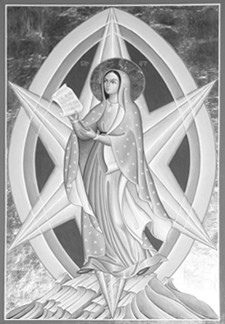 One of the most recent unofficial titles given to the Mother of God is “Mary, Star of Evangelization.”