Will greater emphasis and reliance on integrated delivery, care coordination, innovation, private-sector insurance, patient-centered medical homes, personal responsibility, prevention and wellness, and a cancel-that opt-out if the federal pledge changes, be enough to “WIN” at least 30 legislator votes for an alternative approach to Medicaid expansion in Nebraska?
Proponents of exercising the Obamacare option, and taking advantage of its funding to create access to health-care coverage for some 54,000 impoverished adults who cannot qualify now for either regular Medicaid or marketplace subsidies, are hoping so and working at it.
Wellness In Nebraska—WIN—is the tag created for the new plan. The compilation of ideas is in LB 887, which was introduced on the fifth day of the new Unicameral session by the chairperson of the Legislature’s Health and Human Services Committee, Sen. Kathy Campbell from Lincoln. She has eight co-sponsors so far: Senators Danielle Conrad, Tanya Cook, Sue Crawford, Ken Haar, Sara Howard, Amanda McGill, Jeremy Nordquist and Norm Wallman.
An initial reading of the WIN bill indicates it has four components for creating health-care coverage for currently ineligible individuals of ages 19 through 64, whose household income is between zero and 133 percent of the Federal Poverty Level. A reason this is regarded as an alternative is it would still leverage the federal funding pledged by Obamacare: 100 percent funding for the new eligibility in Fiscal Years 2014 through 2016; 95 percent for FY2017; 94 percent for FY18; 93 percent for FY19 and 90 percent for FY2020 and thereafter.
For those with income between 100 and 133 percent of FPL, there would be WIN Marketplace Coverage, dedicated to enrollee participation in the private Marketplace for Qualified Health Plans with premium assistance paid by the federal dollars. For those with income between zero and 99 percent of FPL, there would be WIN Medicaid Coverage, with participation in managed care, including primary-care enrollment, patient-centered medical homes, integrated-care, health assessments, preventive care and incentives for personal responsibility, wellness and healthy behavior. Such aspects might attract support from otherwise skeptical or reluctant legislators.
For any newly eligible with access to employer-sponsored health insurance, there would be the WIN Employer-Sponsored Insurance Private Premium Plan; if cost effective, the state would pay the employee-share using the federal dollars.
The fourth component would be for any newly eligible whose medical condition fits a category aptly described as the WIN Medically Frail and Exceptional Medical Needs. This would use a patient-centered medical home and coordinated chronic-care management.
There are other aspects as well. If the federal funding drops below the pledged minimum of 90 percent, that would trigger legislative authority to halt the program. Also, newly eligible with household incomes above 50 percent FPL would be required to make a two-per-cent-of-income monthly contribution, but it could be waived by fulfillment of wellness responsibilities. Also, the Legislature would have a WIN Oversight Committee to guide the process.
Senator Campbell’s committee will hold a public hearing on LB 887 Jan. 29. Subsequent to that, it is likely the bill will be advanced to the full Legislature. Then the outlook becomes much more uncertain. The Governor hasn’t signaled that the alternative softens his adamant opposition to trusting the federal pledge on funding. Although not directly on point with LB 887, his State-of-the-State address included this statement: “We have researched and studied the Medicaid expansion issue carefully, thoughtfully and methodically. The responsible choice is to reject this optional Medicaid expansion.”
There are more than a few legislators who agree with the Governor, some of whom have political motivations on top of philosophical and policy concerns. If they are strongly enough motivated to carry on a filibuster, LB 887 would need 33 votes to invoke cloture for a vote on advancement to the second stage of floor debate. Even the absence of a filibuster and ultimate passage of the bill with 25 votes would still leave the likelihood of a gubernatorial veto. An override would need 30 votes from among the 49 legislators.
A WIN won’t come easily.
On another legislative matter: Senator Ernie Chambers has introduced LB 675, which would terminate the traditional, longstanding exemption from taxation afforded by law to property that is both owned by a religious organization and used for religious purposes.
As a practical consideration, determining valuations for churches would cause an inappropriate, unwarranted governmental intrusion into and entanglement with religion.
But there is more to this longstanding policy as well.
Senator Chambers exclaims that religious organizations and religious people are called to “render unto Caesar what is Caesar’s.” They do, of course; if not in strict monetary terms then in the alternative of the substantial and significant contributions they make to the betterment of society, of family lives and of individual lives. Parishes and congregations are voluntary associations of citizens who assemble in and on church property for unity, support and humanitarian purposes as well as worship. But even more, churches help to affirm meaning in life and generate hope. Caesar benefits from the great value of that rendering unto God.
“Dad, what do you want for Christmas?” I would ask as a youngster. “Peace!” he would say. The same question was asked by many family members over the world before last Christmas, but for some, the answers were different and very edifying. The following are some examples.
“Dear Father Kubat, I am touched by all the good things you do, the people you all help and the love of God you pass on filled with hope. My husband, children and myself would like to forgo material gifts this year and help you help others instead. I know this is still not much but I’m sure you and CSS will use it and stretch it far. God bless you and all the volunteers at CSS. Give thanks to the Lord for he is great! His mercy endures forever!” Enclosed with this note was a nice check we used to help a needy family.
Around the same time, we received another beautiful card with these words, “Dear Father Kubat, when our family talked about what they would like at Christmas, we all agreed that you could put our funds and wishes to much better use at CSS than we ever could. Therefore, please accept the enclosed check … and include our family in your prayers. Thank you for all you do for the poor and needy … God bless you all!” With these funds, we were able to help another needy family.
Then came this note we received from a young woman: “Dear CSS, you will find enclosed $65 in cash. I work as a barista at a coffee shop … and as part of my Advent sacrifice, I decided to donate 50% of my tips from my shifts. I would like the money to serve whatever purpose necessary during the Christmas season.” She signed it, “Love in Christ.” I was amazed that a young woman would donate half of her tips during the Advent Season. I knew this was a sacrificial gift. Once again, we used it to help someone in need.
This happens every year and when I receive cards and letters such as these, I am always edified and moved. The light of charity that burns brightly in the hearts of the faithful is what moves them to donate to Catholic Social Services and St. Gianna Women’s Homes. People who donate to us know we will use the funds to help with emergency services, rent, utilities, food, clothing, vehicles, furniture, appliances, house hold items, grants for counseling services for those who are un-insured or under-insured (to name a few).
I not only would like to thank the above donors who remain anonymous but the countless other benefactors who donated their time, talent, material items and cash to Catholic Social Services of Southern Nebraska, for without your love we would not have been able to help those in need and will not be able to help the many individuals and families that will come to us in crisis. You have helped us give peace to countless people over the Christmas season – and are helping us give this peace to many going forward. Please know that we at Catholic Social Services and St. Gianna Women’s Homes will keep you, your families and intentions in our prayers – never forget that we pray for you on a daily basis.
“The Ice Skater: A Young Enthusiast’s Guide to Ice Skating” by Peter Morrissey. DK Publishing, Inc., New York, 1998, 37 pages, Grades 4-6.
Ice skating is one of the most beautiful and exciting winter sports. Skaters will glide across the glistening ice and then suddenly soar into the air before completing a graceful landing. It is a sport of both great strength, endurance and gracefulness. While both men and women perform in these elegant competitions, the Ladies Final always seems to hold the most appeal. There is something magical about these women spinning and landing difficult jumps. Peter Morrissey has written an excellent introduction to the sport in the book entitled “The Ice Skater: A Young Enthusiast’s Guide to Ice Skating.”
The book begins with the foreword written by six-time United States figure skating Todd Eldredge. Included are some photos of Todd’s beautiful skating moves. This is followed by an interesting history of ice skating. Here we see early Viking boot skates and Queen Victoria’s delicately crafted skates. At the bottom of the page is a picture of Sonja Henie, the most famous woman in ice skating history, performing one of her legendary jumps.
Morrissey then shows a young girl and boy getting ready to skate. All the equipment and terminology needed in ice skating is carefully explained. The author pays particular attention to the importance of having the proper ice skates and a knowledge of how to lace them properly. The laces must be snug, but not tight. If they are too tight, the laces will actually make the skater’s feet and ankles hurt.
Since ice skating is a demanding sport, readers will next see the skaters warming up before getting onto the ice. Among others, they practice deep knee bends, stretching exercises and side rotations. As well, some skaters jump rope before getting on the ice. Now thoroughly warmed up, the athletes begin skating forward practicing foot crossovers and stops. Morrissey states again and again the need to wear warm clothes and gloves. Because, as the saying goes, what goes up can come down. When young skaters fall, gloves will protect their hands from cuts.
The next part of the book is dedicated to skating backward. This is the most difficult type of ice skating but the most helpful to begin making ice-skating jumps. While many casual skaters are terrified about skating backward, competitors know it is the easiest way to build up the speed necessary for the famous jumps such as the Toe Loop, Lutz and Salchow.
The most acclaimed jump of all, the Axel, is not mentioned in the book. It is a dangerous jump and needs proper coaching to complete. Morrissey prudently leaves this out of the book, lest young skaters attempt it without the necessary instruction.
This section is followed by a series of stunning photographs of Olympic champions performing the incredible one-handed overhead lift and the spectacular death spiral. Morrissey concludes the book by discussing other forms of ice skating such as speed skating and hockey.
This is a delightful book to learn about the many wonders of ice skating. The photographs show young skaters learning the basic moves and positions of the sport and Olympic champions performing incredible lifts and jumps in competition.
While this book can be read together with your younger family members, it is equally enjoyable and beneficial for individual reading. With the Winter Olympics arriving in less than a month, Morrissey’s book can prove to be a helpful introduction to students wanting to learn about this fascinating and beautiful sport. Enjoy!
For more than thirty years, the Knights of Columbus in Nebraska has sponsored an annual fundraising project known as One Rose One Life (OROL). Conducted on or around the anniversary of Roe v Wade (Jan. 22), this project takes its name from the paper roses that were handed out by the Knights as part of this project.
Several years ago, the Knights replaced the paper roses with a prayer card. In addition to a pro-life prayer, this prayer card features a winning poster from the Knights-sponsored pro-life art contest for students in kindergarten through the eighth grade. According to the Knights, an impressive 94 percent of all the funds raised from OROL go to support various pro-life organizations and projects in Nebraska. My office, from its inception 23 years ago, is a major beneficiary of these funds. And, in the last six years, more than 50 other pro-life organizations, events and initiatives throughout Nebraska have received funding from OROL. These recipients include numerous pregnancy-help centers, Lincoln Right to Life, MavCatholics Students for Life (Univ. of Nebr. at Omaha), Pope Paul VI Institute, McCook Right to Life, Thomas More Society, Pro Life Billboards throughout Nebraska and the Virtue Media pro-life television ad campaign.
In addition, the Knights provide significant funding each year to help underwrite the cost for students going to the March for Life in Washington, D.C. And the Knights have recently funded the purchase of 4-D ultrasound machines for pregnancy-help centers in North Platte, Kearney, Grand Island and Omaha. The positive results of these new machines are extraordinary.
According to the Collage Center (Kearney and Grand Island), many lives have been saved because of the ultrasound machine. In fact, the Center has found that 90 percent of abortion-prone women who have an ultrasound decide against abortion.
There are no formal pro-life collections conducted by the Church. Consequently, the Knights’ OROL project provides an excellent opportunity to donate to not only the Church’s pro-life efforts, but many pro-life efforts outside the Church as well.
There are two ways that Catholics can give. First and foremost, those who attend Mass at a parish where a Knights of Columbus council is present should have an opportunity to donate at Masses on or around the 18th and 19th of January. Check with your parish KC Council for the exact dates when they will be conducting One Rose One Life.
If your parish does not have a Knights Council, it can still participate by requesting and distributing donation envelopes and prayer cards in the parish. Envelopes and prayer cards can be obtained from Bob and Anita Finger, the state Culture of Life Chaircouple for the Knights, at This email address is being protected from spambots. You need JavaScript enabled to view it. or 402-953-7181.
A second way to donate to One Rose One Life is to simply write a check payable to: Knights of Columbus Culture of Life Foundation of Nebraska and send it to: Knights of Columbus, One Rose One Life Campaign, PO Box 451157, Omaha, NE 68145. Please put One Rose, One Life on the memo line. The Knights of Columbus Culture of Life Foundation of Nebraska is a 501(c)3 charitable organization.
On behalf of the many pro-life organizations and projects that have and will receive funding from the Knights of Columbus, I extend our profound gratitude to the Knights for their extraordinary generosity and commitment to the pro-life cause. And I encourage everyone to be as generous as possible toward One Rose One Life.
One of the traditional mental exercises that accompany the start of a new year is that of making New Year’s resolutions. As Christians, it is hoped—if not expected—that among such resolutions are some new, or renewed, spiritual pledges to help us to become better Christians. The final promise in the traditional Act of Contrition that Catholics use when receiving the Sacrament of Penance states: I firmly resolve, with the help of Thy grace, to confess my sins, to do penance and to amend my life. What terrific spiritual pledges! With firm resolve the penitent makes a promise to God, first, to confess his sins, which for Catholics means going to Confession regularly; second, to do penance, which means living sacrificially; and finally, to amend his life, which means that authentic conversion is in the works. In effect, when we pray this Act of Contrition prayer seriously, we commit to an action plan that deepens our humility as we admit our sinfulness, strengthens our spirituality as we make sacrifices, and bolsters our character as we plan to improve ourselves morally. These are all great goals, but they are predicated on the fact that we actually know what sin is, that we appreciate the essence of authentic sacrifice and that we know what growth in holiness looks like. This is where faith formation resources are indispensable. They provide us with the essential information we need in order to be genuinely “in formation”—that is, growing in our faith. Fortunately, there are a wide variety of quality resources available to us in the area of faith formation. The accessibility of great Catholic books, CDs, movies and online resources continues to expand day by day. Even those who had little education in the faith while growing up can access a plethora of dynamic, user-friendly sources of true Catholic teaching with a few mouse-clicks on trusted internet sites. Parishes and diocesan offices also have offerings intended to form their members in the faith, such as classes, retreats and conferences, and those may also include offering Sacraments and devotions, which are part and parcel to faith formation as well. For basic information in the form of indexed teachings of the Church, Catholic Answers has a very comprehensive website: www.catholic.org. The web address is even quite easy to remember! Visitors can search for answers regarding virtually any topic and can also read current news stories from around the globe pertaining to the Catholic Church. There are also websites that offer free online talks or courses on a variety of faith topics. For example, the St. Paul Center for Biblical Theology, founded by Dr. Scott Hahn, provides a wide range of studies focused on Scripture (naturally!). Go to: www.SalvationHistory.com. Ascension Press has a website with very simple 10-minute (per day) bible studies. Go to: www.BibleStudyForCatholics.com. For easy-to-digest daily readings from the Catechism of the Catholic Church, go to: www.flocknote.com/catechism. For a full classical arts curriculum, one can visit this site: www.InstituteofCatholicCulture.org. If we have not done so already, we should make a New Year’s resolution to grow in our faith. Then we need to get to our parishes and to our computers to fulfill this pledge we made to ourselves and to our God. In time, we will most certainly be glad we did, because formation in the faith is so very necessary to all who call themselves disciples of Jesus. Now let’s get to work!
The most radical and unique aspect of our Catholic faith is that we are called not only no love our neighbors as ourselves, but our enemies, as well. This is only possible with the grace of God, which we get from the Sacraments.
I just finished a book entitled, “Edmund Campion, A Life,” by Evelyn Waugh, who was a convert to the Catholic faith. In 1936 he received the Hawthornden Prize for this masterpiece. St. Edmund was a highly educated man and scholar in 16th century England during the reign of Queen Elizabeth, when the practice of the Catholic faith was against the law. Priests and Catholics who harbored priests were arrested, tortured and executed in horrific ways.
St. Edmund was born in a Catholic family, but fell away and was on a trajectory to go far. He was a favorite of the queen after she heard one of his lectures at Oxford.
After a conversion to the faith, he spent some time at the seminary in Douai, France and then in Rome for the Jesuits. After his ordination to the priesthood and time in Bohemia, he and a small group of priests snuck into England and ministered to the Catholics in secret.
Always on the run and frequently never staying more than one night in any place, for spies abounded, he was eventually arrested, tortured and put to death. He was hung, his body mutilated, and finally he was disemboweled.
As with other executions, spectators were allowed to gather close to the condemned. Standing near out of curiosity was an ex-Catholic lawyer named Henry Walpole, who in some ways was living the life of Edmund Campion before his conversion. St. Henry was a Cambridge man who had previously heard Edmund speak. He heard Father Campion express his loyalty to the queen in temporal matters as he forgave and prayed for her just prior to the noose being slipped around his neck. As the executioner later tore out his intestines, a drop of blood flew onto Henry’s coat, whereupon he instantly converted back to the Catholic faith. He immediately left England, entered the seminary for the Jesuits, was ordained a priest, and 13 years later, died the same death as Father Campion as he loved and forgave is enemies. Both are canonized saints and examples to us all in the love of God, neighbors and our enemies.
If one drop of Father Campion’s blood had this effect on someone, imagine the effect one Holy Communion can have on someone who receives Jesus in the Eucharist at Mass when properly disposed. I see this on a daily basis in that the sacrificial monetary and material donations given to CSS by our donors are given for only one reason, for the love of God who is present in our neighbor.
May 2014 be a year where we all grow closer to God by our love and concern for the spiritual, psychological and material well-being of neighbors. Saints Campion and Walpole, pray for us!
As the second regular session of the 103rd Nebraska Legislature unfolds at the State Capitol in Lincoln over the next 13 weeks, multi-dimensional aspects of the law-making process will be on display. It is an institution that brings together unique personalities and varied motivations. It addresses public-policy issues of varying degrees of significance and impact. The new session began Jan. 8. This one is a “short session,” scheduled to operate over 60 legislative days, following the 90-day first session in 2013. Adjournment sine die is currently scheduled for April 17. On that last day, as per custom, ceremonies will be conducted to honor legislators known to not be returning the next year. The number so recognized will be at least 17. That’s the number of current legislators who face the impact of term limits. It is generally the Class of 2006. The number includes the Speaker of the Legislature, the Chairman of the Executive Board and seven chairpersons of standing committees. Another interesting twist is that five of the 49 legislators already have announced their candidacies for statewide elective office. Senators Beau McCoy, Charlie Janssen and Tom Carlson are announced candidates for Governor (Senator Annette Dubas initially did the same, but has since ended the quest), while Senators Pete Pirsch and Amanda McGill are announced candidates for State Auditor. These legislators will be dedicated to their responsibilities, but cannot help but be somewhat preoccupied by their campaigns The Legislature also began its new session with one new member. In mid-December, the Governor appointed Tommy Garrett of Bellevue to represent District 3, replacing Scott Price, who resigned during the interim between sessions. As the second of a Legislature’s two regular sessions, this is the segment when legislators “hit the floor running,” because legislative bills that were not finished last year carried over to this year. Approximately 400 bills are in this category, including a few issue-substantive resolutions, e.g., proposing constitutional amendments. Of the total, approximately 70 measures started the session on General File, the first stage of floor debate for the full body of legislators. During the first three days of this new session—Wednesday through Friday of the week just ended—the legislators met for short periods in the mornings, for the almost-exclusive purpose of introducing new bills; bills with 2014 dates, which add to the carry-over bills. With limited exceptions, new bills have to be introduced during the first 10 working days of a new session. The last day for bill-introductions is scheduled for Jan. 22. Full-day meetings focused on floor debate on the carried-over General File bills start Jan. 13. On Jan. 21, the floor sessions will begin to happen only in the mornings, while afternoons will be dedicated to public hearings on new bills in front of committees. This will be the process through the end of February. Full-day floor sessions will resume March 4. As the session opened, it appeared that the urgency and priority of reforming the overall tax system and of substantively changing the formula for distributing state aid to public school districts had waned some. Committee studies are urging more deliberation. There will be ideas and issues relating to these topics, but probably not anything that will shake foundations and make lobbyists frightful, as it once appeared might happen. Efforts to address prison overcrowding and to achieve an alternative to mere Medicaid expansion for making health care coverage accessible for Nebraska adults who do not qualify for subsidized coverage in the federal marketplace are likely to be undertaken. Attention will no doubt be given to legislation relating to agriculture and energy and environment issues. The FY 2013-2015 budget will get a review and some adjustments. There are those both inside and outside the Legislature who want to “modernize” the definition of family and/or change the definition or recognition of marriage by repealing or modifying Article I, Section 29 of the State Constitution (the Marriage Amendment) and/or add “sexual orientation” and “gender identity” as categories explicitly mentioned in anti-discrimination statutes. The level of resistance to these ideas will determine the outcomes. It is important for Catholic Nebraskans to stay informed about the public-policy debates and decisions that will be taking place at the State Capitol. An excellent starter source is the Legislature’s website, www.nebraskalegislature.gov. Also, there’s Unicameral Update, which is available both online and in hard copy. For the 38th consecutive year, we’ll be using the space graciously provided by the diocesan newspapers to update and comment on issues of interest and concern for the Nebraska Catholic Conference, which is the public-policy office operated jointly and cooperatively by the three dioceses covering the state, under the direction of the diocesan bishops. Information and action alerts will be available on the NCC website: www.nebcathcon.org. And finally…. Nebraska First District Congressman Jeff Fortenberry distributed a nice Fort Report recently, conveying his thoughts and feelings about attending the Army-Navy football game. It was an interesting, inspiring piece, which can be accessed at the Congressman’s website. It brought to mind a really good book of several years back: “A Civil War: Army Versus Navy” by acclaimed sports author John Feinstein.
Recently I received an e-mail message entitled “Praying for you.” It was from Tom Grenchik, the Executive Director of the U.S. Bishops’ Pro Life Office. He was announcing that his office staff would begin praying a Divine Mercy Chaplet every week at 3 p.m. (EST) and offering a monthly Mass on the third Thursday of each month for those of us who do pro-life work at the diocesan and parish level. Mr. Grenchik began his e-mail with this wonderful reminder of the importance of prayer from the USCCB Pastoral Plan for Pro-Life Activities: “Prayer is the foundation of all that we do in defense of human life. Our efforts—whether educational, pastoral, or legislative—will be less than fully fruitful if we do not change hearts and if we do not ourselves overcome our own spiritual blindness. Only with prayer—prayer that storms the heavens for justice and mercy, prayer that cleanses our hearts and our souls—will the culture of death that surrounds us today be replaced with a culture of life.”
As we labor day after day in the work of building a civilization of life and love, it is so easy to forget the importance—and efficacy—of prayer. Our human tendency is to overinflate our human efforts and to underestimate God’s supernatural efforts. But as the previous quote reminds us, “only with prayer… will the culture of death that surrounds us today be replaced with a culture of life.” Anyone who has seriously engaged the culture of death knows that this admonition about the importance of prayer is true. In the pro-life battle there are constant reminders of the limitations of our human efforts and the need for God’s grace. The offer of regular prayers for our pro-life efforts from Mr. Grenchik and his staff is a beautiful gift—and one of those reminders that prayer must be at the foundation of all our efforts. Mr. Grenchik encourages us to join our prayers with those of his staff asking this intention: “May our hearts and souls be cleansed and may God help us to remain faithful to the task of building up a culture that welcomes and protects life.” The U.S. Conference of Catholic Bishops (USCCB) is offering another opportunity to offer prayers for the pro-life cause on the occasion of the 41st anniversary of Roe v. Wade January 22, 2014. From Jan. 18-26, the USCCB is sponsoring Nine Days of Prayer, Penance and Pilgrimage in prayerful recognition of the more than 55 million children’s lives lost to abortion and the millions of parents whose lives have been shattered. Catholics across the country are invited to participate in this nine-day period of Prayer, Penance and Pilgrimage for the healing and conversion of our nation and people impacted by the culture of death. The USCCB has produced some excellent prayer, programmatic, and promotional resources to encourage participation in this nationwide prayer effort. According to the USCCB, the centerpiece of this prayer effort is a simple, youth-friendly novena with different intercessions, brief reflections and suggested acts of reparation that can be received directly each day by email, text message or through a new mobile application for smartphones (soon to be made available for both Android and iOS phones). Information about subscribing through any of these means is available on the 9daysforlife.com website. In addition to the novena, the prayer resources include a Holy Hour for Reparation and Healing, a Blessing of Pro Life Pilgrims, and Pro Life Rosary Prayer Intentions. These resources can be accessed at www.9daysforlife.com (under “Resources for Leaders”) or by calling my office. No matter what one’s limitations are in life, each of us is capable of offering prayers and penance for success in the effort to build a civilization of life and love. Please use these opportunities (and helpful resources) to commit yourself to this important and efficacious work.
When the snow begins piling up, travel becomes very difficult. In the lower 48 states, paved roads take people most places they want to go. While winter sports such as skiing require mountains, other sports such as dog sledding only require snow and can be done in most northern states. Dog sledding, or “mushing” as it is sometimes called, has become somewhat famous in recent years due to a grueling race named the Iditarod. Situated in Alaska, the Iditarod is easily the most famous dog race in the world. Started in the early 1970s, the Iditarod recalls the magnificent journey of mushers (sled drivers) in 1925 to bring vital diphtheria serum to the town of Nome. A savage outbreak of diphtheria was killing numerous children and adults during the winter of 1925 in Nome. The only supply of serum was in Anchorage. The few airplanes available in Alaska were being repaired and unable to fly the brutal 1,000 or so miles to the besieged city. The governor ordered a relief expedition and a train carried the serum for part of the 1,000 miles. With no railway left, teams of courageous mushers then wrapped up the serum and took the precious medicine over mountains, frozen rivers, ice packed lakes and through brutal winds. A few days later, they delivered the serum and saved the city. It is one of the most remarkable events in Alaskan history. The Iditarod Race is a recreation of this historic event, minus the diphtheria epidemic of course. Tricia Brown and Jeff Schultz have given readers a distinct feel for the race in this comprehensive book, “Iditarod Country.” Dozens of dog sled teams line up in Anchorage, to begin the frozen 1,100-mile trek to the city of Nome. The dogs are eager and jump about in the harnesses. Most people are bundled up in layers of clothes and warm hats. Some of the mushers themselves have fur hats that resemble those of mountain men in the early 1800s. The race begins with a countdown and then the dog teams lunge forward. The trail leads all the dog teams through rural Alaska and past rest areas. At these rest areas, sometimes only a cabin and a barn, the dogs and mushers can rest. The people living along the trail will frequently have large spaghetti dinners for the mushers, and will sometimes cook Thanksgiving meals for the participants. The further the teams go into the hinterland, the bleaker and more brutal are the weather conditions. Hundreds of miles from nowhere, the mushers and their dog teams can get into serious trouble. If the dogs get hurt, drivers can leave them at way stations to be flown to veterinarian hospitals. Mushers can also be assisted if they are injured. Whereas the dog teams usually start with about 16 dogs, it is not unusual to finish with only eight. Finally, Nome is close and the dog teams make a dash for the finish line. The city erupts as the teams cross the finish line. The pictures and text in the book give readers a real sense of the Iditarod. We see all the Alaskan people at the way stations helping the sled teams throughout their journey. Brown accurately describes the pride that Alaskan people of all ethnic groups take in the race. This is an excellent book for middle school students to learn about Alaskan geography and the sport of dog sledding. I enjoyed the book and think your children will as well. Wrap up; it is cold out there!
I recently received a phone call from a woman who is suffering from a chronic illness and the sequela associated with it. She is a remarkable woman whom I have known for years. She is in love with her Catholic faith and has a strong devotion to the Holy Rosary and the Chaplet of Divine Mercy. I can confidently say she is not a complainer. During a recent visit at her home, she handed me an envelope stuffed with cash and informed me she had been saving up for a rainy day and wanted me to have some of it for someone less fortunate. I knew she loved God but this was a confirmation of her love, for God is love and the evidence of our love of God is our love of neighbor, and the evidence of our love of neighbor is our sacrifices for them (see the first letter of John). Remember the parable of the rich man whose name is unknown and the poor man named Lazarus in chapter 16 in Luke’s gospel? Soon after our visit, I found myself in front of another Catholic grandmother and mother. Tears were streaming down her cheek for she was facing an eviction from her rental house. She had nowhere to turn. Her husband was unemployed and she was looking feverishly for a job. I remember thinking St. Joseph the Worker would help find employment, and the money in the envelope was about the same amount she needed for the back rent. Soon I was on the phone with the woman who made the donation and asked, “Do you know what you just did? You just helped a family stay in their home with your donation.” She was moved and quite pleased. In my ten years at CSS, I have found that fundraising is easier when those who donate know where their money is going. Whether it is assistance with rent, utilities, or other emergency services, food, furniture, clothing, cars, disaster relief, help with grants for counseling services for families and individuals young and old, we assist those across the 24,000 square miles that is the diocese of Lincoln. Now in our 82nd year, we are helping almost 30,000 people yearly from the Platte River north to the Kansas border south, from the Iowa and Missouri borders east to the Colorado border west, because of the help of our loving donors like the lady mentioned above. Your help is vital because nearly all the funds that come to us are from private individuals. My prayer is that you, your family and friends have a blessed and holy 2014. Please know that we at Catholic Social Services of Southern Nebraska pray for you daily, especially in our six chapels. I am happy to announce that we have highlighted our six chapels in our first ever calendar. If you would like us to send you one, please send me an email to my address listed here by my name. May we all grow closer to our Eucharistic King, Jesus Christ our Lord, High Priest, Savior and King. Happy New Year!
One of the questions I am often asked is “what can I do to help the pro-life cause?” Usually, those who ask this question are looking for some concrete form of activism they can embrace to fight abortion. Although I try to provide such concrete suggestions, I also challenge them to look at how they are living out their own vocation. The deepest root of the culture of death is alienation from God, Pope John Paul II tells us in Evangelium Vitae (EV). This means that the most important pro-life activity, whether we are clergy or laity, single or married, is to grow in our relationship with our Lord and to help others do the same. The depth of our understanding and regard for the purpose and dignity of human life is in direct proportion to the depth of our understanding and regard for the God in Whose image and likeness human life was made. In the shadows of the Feast of the Holy Family, I focus here on the particular role of the family in building a culture of life. John Paul II said in EV (#92) that the family is truly “the sanctuary of life: the place in which life—the gift of God—can be properly welcomed and protected against the many attacks to which it is exposed and can develop in accordance with what constitutes authentic human growth. Consequently, the role of the family in building a culture of life is decisive and irreplaceable.” So one of the most critical contributions we can make to the pro-life cause is to work at forming and promoting healthy and holy marriages and families. Holy marriages are the foundation to forming “domestic churches” within which the family is formed and “summoned to proclaim, celebrate and serve the Gospel of Life” (EV #92). Married couples are “called to be givers of life…In giving origin to a new life, parents recognize that the child, ‘as the fruit of their mutual gift of love, is in turn a gift for both of them, a gift which flows from them.’” But John Paul II says that it “is above all in raising children that the family fulfills its mission to proclaim the Gospel of life.” “By word and example, in the daily round of relations and choices, and through concrete actions and signs, parents lead their children to authentic freedom, actualized in the sincere gift of self, and they cultivate in them respect for others, a sense of justice, cordial openness, dialogue, generous service, solidarity…In raising children, Christian parents must be concerned about their children’s faith and help them to fulfill the vocation God has given them” (EV #92). Therefore, in addition to working for holy marriages, parents can make a significant contribution to a culture of life by raising virtuous children who know and love our Lord in an intimate way. Virtuous and faith-filled children will have a healthier understanding of the dignity of human life and its meaning. John Paul II also urges families to give special attention to the elderly by forming a “sort of ‘covenant’ between the generations, in fidelity to the divine commandment to honor one’s father and mother. In this way parents in their later years can receive from their children the acceptance and solidarity which they themselves gave to their children when they brought them into the world.” “But there is more,” John Paul says. “The elderly are not only to be considered the object of our concern, closeness and service. They themselves have a valuable contribution to make to the Gospel of life. Thanks to the rich treasury of experiences they have acquired through the years, the elderly can and must be sources of wisdom and witnesses of hope and love.” To be certain, forming holy marriages and families takes much prayer, sacrifice and effort. The Holy Family provides a model and source of strength for all Christian families. A custom in my family is to end the prayer before meals with this prayer: “Jesus, Mary, and Joseph, help us to be a holy family.” As we ask the Holy Family for help we should take solace in the fact that the Holy Family experienced and understands all the struggles of family life.
As many around us have stopped celebrating Christmas, we Catholics are still in the midst of our Christmas celebration which lasts until January 12- the Feast of the Baptism of the Lord Jesus by St. John the Baptist in the Jordan River. It has been a wonderful Advent and Christmas here at Catholic Social Services. On Monday, December 23, we celebrated our annual Toy store at the St. Joseph Center in Lincoln. As parents stood in line waiting to pick out toys for their children, I did my best to hand out candy and cookies and even took some of them into the chapel after asking, “Want to see our newly decorated chapel?” All who entered were surprised by the beauty of the chapel, the nativity set and flowers. While inside I prayed aloud for them and their families. I am sure by the reaction of some, it was the first time they ever darkened a door of a church or chapel. One of the volunteers told me as a little boy, his mother received toys for him at the Catholic Social Services Toy Store. He was here as a way to “give back.” Another said he was here because Curt Krueger, our director of social services of the eastern sector of the diocese was his “BoysTown dad.” After my prayer with our volunteers before the toy store opened, Curt pointed out that the toys were just instruments or tools we were using to love those who were coming for help. Then on Christmas Eve, a middle-aged man came in with a woman who appeared to be in her twenties. I thought at first he was her father. He was just doing her a favor by giving her a ride to CSS for her food pantry. I could tell by the age and condition of his truck and his appearance he, too, was in need. While praying in the chapel, I noticed he made the sign of the cross. He explained how he grew up Catholic. How easy it is for some to fall away. As we prepared to take the food to his truck, I asked him if he received anything. After replying, “No,” I slipped him a $50 gift card to a local grocery store someone had just slipped me. Immediately after exclaiming, “Wow!” His elderly dad called him on his cell phone. I remember wondering how old his father must be… “Hi dad …. I’m giving a young woman a ride to CSS for some food, and a nice man gave me a $50 gift card!!” They both drove off happy. I would like to thank everyone who helped assist the many individuals and families that came to us. Because of the generosity of our donors, around 3,000 needy children received toys this Christmas in conjunction with our multiple Christmas programs across the diocese. Thank you for helping them have a merry and blessed Christmas!
Human beings are communal creatures by their very nature. God made them so for a reason. His intention from the beginning was that marriage and the family would be a worldly reflection of the community of life and love that is characteristic of the Holy Trinity. Given that everybody is meant to be born into a family, the communal dimension of personhood is naturally provided for, at least in theory. When that aspect is missing, nearly everything goes awry. Recent reports indicate that more than half of the children born in our country do not begin their lives with the benefit of a mom and dad who are married to one another. This situation wreaks havoc on the elemental need of human creatures to grow up in a community of life and love that we call a family. Sadly, the very definitions of marriage and family are under assault by liberal-minded factions of our society who have little, if any, understanding of the irreparable damage done to a civilization when its most basic structure and foundation is redefined. The consequences of such societal erosion are no longer only evident in far-away places. They affect us all, and oftentimes the harm done is experienced within our own homes. An insight we need to accept and share is that what the Church proclaims regarding marriage and the family is a saving remedy for the world in which we live. The truths revealed by God in their fullness through Jesus Christ call for valiant efforts to protect and preserve these very structures that are crumbling right before our eyes. The establishment of marriage as one man being joined to one woman for the purpose of creating a family together is rooted in God’s revealed wisdom about humanity. Recent court cases about protecting the practice of polygamy or about declaring the “personhood” of chimpanzees indicate how far astray we have gone from reflecting God’s communion of life and love in our human relationships that make up a family. But not all is lost. The genealogy of Jesus Himself, proclaimed in one of the Christmas liturgies, was itself littered with familial irregularities. The primary message of Christmas is that we have been redeemed. No matter what our personal background, no matter how messed up our family life was or is, no matter how far we have drifted from reflecting God’s love in our own relationships, we have been saved by a Father’s love made manifest by the power of His Spirit in the wondrous birth of His Son. The original community of love, the Holy Trinity, strengthens each and every communion of love here on earth, if only we allow it. And we have the flawless unity of the Holy Family as a reminder of what true love should look like in our own homes. The Sacraments of the Church provide divine power and grace capable of repairing and restoring broken or strained relationships. The sadness and anxiety that many experience during the holidays can be mitigated by the worthy reception of Confession and Communion—Sacraments of love that bring us into more intimate union with our Lord, and ultimately with one another. May this Christmas season be a time during which we understand and appreciate more fully the true meaning of love between persons that sustains genuine communities of love, which we call families. Such divinely inspired structures are the basis of the parish family and also of the broader community, and they help to provide us with the peace and harmony we all desire and deserve to enjoy throughout this life, and into the next.
“Christmas in the Trenches” by John McCutcheon, illustrated by Henri Sorensen. Peachtree Publishers, Atlanta, 2006, 32 pages, Grades 1-3.
Nations usually declare war when there is no hope for negotiating peace. When war is declared, patriotism normally rises to fevered heights. A common refrain is “the troops will be home by Christmas.” Governments tell their people that the war will be short and that they will be triumph. When World War I broke out in July 1914, people in all European countries cheered the departing armies. Women kissed the new warriors as they marched off to the departing trains. Never in most men’s lives had they felt so important and valuable. Unfortunately, these illusions for both men and women will soon be destroyed. War is a brutal, terrible experience with massive suffering on all sides. The opposing soldiers are usually pictured to be barbarians which allows each side to attack the other. World War I, the war to supposedly end all wars, is the epitome of the tragedy of war. But one event occurs on Christmas Day 1914, that shows the power of love and friendship over death and hatred. This remarkable event is told by John McCutcheon in the fine picture book, “Christmas in the Trenches.” After months of constant battle with enormous causalities, the German and Austrian armies faced the combined forces of Great Britain and France. Hunkered down in trenches like prairie dogs, the soldiers of each side rarely raise their heads above the tops of the trenches. In front of the trenches were huge masses of barbed wire with buried land mines. Beyond this lay No Man’s Land, a stretch of ground ranging from several hundred yards to a half mile. Since all of No Man’s Land is in the field of fire, virtually every soldier caught in this deadly area is killed. As both sides faced each other on Christmas Eve 1914, familiar songs could be heard from the German trenches. As the warriors reflect, the Allied soldiers begin singing the same songs in English. Suddenly, the German begin singing “Stille Nacht.” The British soldiers respond with the corresponding song “Silent Night.” Finally, peace begins to descend over the hell on earth system of trenches. As the British soldiers look up, a German soldier climbs out of his trench with a Christmas tree filled with burning candles. How can you shoot a man holding a Christmas tree filled with candles? Soon soldiers from both sides are jumping out of their trenches and greeting the others in No Man’s Land. Each side sees the humanity in the “enemy” and they trade cigarettes, candy and food packages. When someone kicks a soccer ball into No Man’s Land, an enjoyable thought occurs to many. Both sides begin to sense the angels’ statement about peace on earth. What happens between the two armies? It seems that common soldiers have figured out the solution to this hideous conflict. What have they learned about each other? Why are the armies able to stop the destruction of World War I on Christmas 1914? To find out, go to the library and read this fine book, “Christmas in the Trenches,” by John McCutcheon. The Christmas Truce of 1914 is one of the finest moments of World War I. The High Commands of both sides feared that the Christmas season would bring out compassion in their armies and make them not want to continue the fight. The generals “solve” the compassion problems subsequently by ordering military offensives during the Christmas season. But the Christmas Truce of 1914 shows that a beautiful song like “Silent Night” can bring Our Lord into the hearts of warring soldiers and change them. I hope you get a chance to read this fine book.
The Nebraska Legislature’s specially created “Tax Modernization Committee” met the December 15 deadline and issued a report ahead of the upcoming session. A report on modernization and reform of a system as complex and broad in scope as taxation could have shaken some policy cores; it could have been stirring, a “wow” moment; an “ohmygosh” happening. It didn’t. It isn’t. It wasn’t. It’s relatively measured, perhaps even a bit underwhelming. And that’s probably a good thing. After six months of analysis and discussion by a 14-member special committee of legislators, one of the report’s findings is that Nebraska’s overall tax system is “comparable in design to most states.” It’s reasonable to understand this to mean that there isn’t anything about Nebraska’s taxation that is desperately bad or embarrassingly out of whack. The system needs some adjustments, as identified and discussed by the report, but “does not require significant changes.” And further study is invited as well. The report bears the signatures of its chairman, Senator Galen Hadley, and nine of its members: Senators Paul Schumacher, Kate Sullivan, Heath Mello, Kathy Campbell, John Harms, Burke Harr, Tom Hansen, Jeremy Nordquist and Kate Bolz. Four members of the committee declined to sign the report: Senators Pete Pirsch, Ken Schilz, Beau McCoy and Charlie Janssen. For them, apparently, the report doesn’t push forcefully enough or directly enough for relief on property tax and income-tax. Senators McCoy and Janssen are candidates for Governor and both made it clear that they will be offering proposals for more impactful changes. The TM committee’s report certainly doesn’t ignore the message that was heard the most during the committee’s process, which included public hearings in five locations across the state. By no surprise, the report’s findings include this: “Property taxes are too high compared to neighboring states.” Correspondingly, the report recommends increasing state financial aid to local governments—public-school districts especially—to reduce local reliance on property taxes. There are other property-tax-specific recommendations as well. The report’s treatment of sales tax caught our attention, because we were anxious about whether or not there would be specific recommendations for doing away with traditional church-school-and-charity exemptions. Such wrong-headed ideas aren’t presented. In fact, the tradition behind these exemptions is acknowledged. The Tax Modernization Committee’s report is easily accessible through the Legislature’s website: www.nebraskalegislature.gov. Reading it probably won’t rock your foundation, but it is a comprehensive review of a major policy structure. And then there’s health-care reform…. The little scrap of words and claims that has been playing out in the media between Governor Heineman and Senator Nordquist adds a bit of testy and zesty flavor to an otherwise intense public-policy issue. If this was not important, it’s unlikely the chief executive of the administrative branch and the legislative branch’s foremost proponent of universal coverage would be slinging barbs. The component issue began as a key provision of the Affordable Care Act and then was turned inside-out by a ruling of the U.S. Supreme Court, followed by the stalled outcome on LB 577 in the Legislature’s 2013 session. Now the issue is on the cusp of a new emphasis. It is likely to be prominent in the upcoming session; perhaps another donnybrook, with plenty of debate. The carried-over issue is whether or not to expand eligibility for Medicaid in a relatively simple way as a means of enabling greater access to health-care coverage. But the context of the debate in 2014 might be more specifically focused on finding a way to fill an illogical, unjust gap in access to coverage. In general, individuals and families whose household income is between 100 percent and 400 percent of the Federal poverty line are now eligible for subsidized health insurance made available through the government-facilitated marketplace. Other families are categorically eligible for Medicaid and meet income conditions that can be even somewhat above 100-percent FPL. But there are others, often childless adults and many who are legitimately the working poor, who have household incomes anywhere between zero and the Federal Poverty Line, who are not eligible for either Medicaid or the marketplace. They are impoverished; but current policy in Nebraska—albeit in part a result of both Obamacare and the Supreme Court’s ruling—has them in a coverage gap; perhaps better described as a hole. Simply expanding Medicaid eligibility as proposed by LB 577 would repair that gap. Other, alternative ideas are surfacing, however. The State of Iowa has one that received federal approval on December 10. Arkansas had one approved earlier in 2013. Arizona has had one for even longer. A new bill proposing a method other than Medicaid expansion is likely to be introduced. It will have a public hearing in front of the Legislature’s Health and Human Services Committee.
“At the dawn of salvation, it is the birth of a child which is proclaimed as joyful news: ‘I bring you good news of a great joy which will come to all the people; for to you is born this day in the city of David a Savior, who is Christ the Lord’ (Lk.2:10-11). The source of this ‘great joy’ is the birth of the Savior; but Christmas also reveals the full meaning of every human birth and the joy which accompanies the birth of the Messiah is thus seen to be the foundation and fulfillment of joy at every child born into the world (cf.Jn. 16:21).” As we prepare to celebrate the birth of our Lord, this introduction to Blessed John Paul II’s encyclical Evangelium Vitae provides a rich source of reflection on the God we serve and human life which He created in His image and likeness. It is truly extraordinary to contemplate the fact that we worship a God who has experienced every stage and aspect of the human condition (except sin of course). His Son was conceived in the Virgin Mary and took the form of a human being, beginning His life like every human being—as a single cell embryo called a zygote. According to Scripture, after the Incarnation of our Lord, Mary went in haste to visit her cousin Elizabeth, who was six months pregnant with John the Baptist. Experts say it would have taken two to three days for Mary to reach Elizabeth. Therefore, Jesus likely had not yet implanted in Mary’s womb (implantation usually occurs 5-7 days after conception) when His presence caused John to stir in Elizabeth’s womb: “The moment your greeting sounded in my ears, the baby in my womb leapt for joy” (Luke 1:44). Father Frank Pavone of Priests for Life offers these questions to ponder about the extraordinary reality of our Lord’s gestation in Mary’s womb: “How long is it possible for believers, who meditate on the unborn child who was God, not to see that unborn children are made in God’s image? Is it likely that those who ponder that our Almighty Protector was a baby in the womb will fail to see that babies in the womb merit protection? Would it happen that Christians, who acknowledge that their Lord and Brother was an embryo and a fetus, will fail to see that every embryo and fetus is a brother and sister in the Lord?” Another extraordinary source of reflection on human dignity comes from C.S. Lewis’s “The Weight of Glory”: “The dullest and most uninteresting person you can talk to may one day be a creature which, if you saw it now, you would be strongly tempted to worship. … There are no ordinary people. ... Next to the Blessed Sacrament itself, your neighbour is the holiest object presented to your senses.” Another way to celebrate Christmas is to recognize and support the amazing work being done by the more than 30 pregnancy-help centers and maternity homes in Nebraska. I never cease to be in awe and edified by the extraordinary work of these centers, which I believe represent the heart of the pro-life movement. Among the services these centers provide or facilitate are: housing, instructional programs, provision of maternity and baby clothes, furniture and other necessities, adoption through licensed agencies, parenting classes, job training, medical care including pregnancy testing, prenatal and obstetrical care, social services, including counseling, arrangement for transportation, child health care, assistance in applying for financial help before and after the birth, child support, and chastity education. A complete list of these centers with contact information is available from my office or online at www.nebcathcon.org (under “Pro-Life”). I can’t imagine a more appropriate way to celebrate the birth of our Lord in a humble stable in Bethlehem than to support your local pregnancy-help center or maternity home.
I admit as a small boy, there were a few presents under the tree where the wrapping was inadvertently torn to reveal ahead of time the contents. Oh how little children wish to receive and open gifts early! This year we priests of the diocese of Lincoln received an early Christmas present from Bishop Conley. It is a book entitled, Forming Intentional Disciples, by Sherry Weddell. We were told at a priest study day that there was something interesting in the first chapter I took to be shocking. I remember thinking, ‘I’ve heard it all, and nothing will surprise me!’ What shocked me was this statement, “The majority of adult Catholics are not even certain that a personal relationship with God is possible.” In addition, the majority of Catholics who leave the Church do so for this very reason. Furthermore, only 60% of Catholics believe in a personal God. Thanks to my parents, it was a given that we have a personal relationship with God. This is the whole point of prayer, talking with a God who loves us. This is the whole point of the Sacraments in which we personally encounter Jesus Christ. This is the whole point of the communion of saints. They are our brothers and sisters who from their place in heaven help us with their prayers. Why else would Almighty God become a baby at that first Christmas if not to have a personal relationship with us? When we have received such a treasure like our Catholic faith, we need to share it with those who do not have it. Tragically few Catholics feel the desire or need to spread the fullness of faith that is ours. This is not true, apparently, of non-Catholic Christians. The majority of them do feel the need to spread their faith with others. Recently we gave a car to a young mother at St. Gianna’s. I remember seeing her waiting in our lobby for her new car with her beautiful newborn baby girl. I introduced myself and asked her if she wanted to go into our chapel and thank Jesus for the gift of her car. As we both knelt down in front of the monstrance which contained Jesus in the Blessed Sacrament, I noticed she didn’t take her eyes off the monstrance. After saying to her, “That is Jesus!” I said a little prayer thanking God for her baby girl and of course the car. I heard her say in a low voice, “Beautiful!” She kept staring at Jesus … After kneeling for a while, we both left. A seed sown … While leaving, I noticed tears in the older gentleman’s eyes in the pew behind us. I knew he and his wife were praying for her too! I suppose it would have been easier to have walked by and ignored her. As we kneel before the nativity scene this Christmas, may we all spread the good news of Jesus Christ who personally loves us and never, ever conceal or hide it from others (Lk 8:16). Please know that we at Catholic Social Services wish you and your family a blessed Christmas!
Two weeks ago today, at the tender age of 49, I exchanged the single life for the married life. On Friday, Nov. 29, I married Jacqueline Halbig at St. Rita Church in Alexandria, Va. God’s timing—although sometimes hard to understand—is perfect. Both Jacqueline and I had discerned the marriage vocation throughout our adult lives and, despite pursuing relationships with others, never found the right person. Consequently, we were beginning to conclude that marriage was not God’s calling for our lives. A trip to Washington, DC on June 2, 2012 changed that conclusion for both of us. A few months previous, I had lunch in Lincoln with Austin Ruse, president of the Catholic Family and Human Rights Institute (C-FAM). Mr. Ruse was in Nebraska to speak at the Lincoln Diocesan Council of Catholic Women conference. When he returned home to the Washington D.C. area, Austin’s wife Cathy asked how I was doing and if I was married yet. I’ve known Cathy for many years, from the time when she worked in the U.S. Bishops’ Pro Life Office in Washington, D.C. Austin, who had asked me the same question at lunch, told Cathy that I was still single. A short time later, I received an e-mail from Cathy asking if I’d like to meet a friend of theirs (Jacqueline Halbig). Having begun to conclude that marriage might not be my calling, I was initially hesitant to say yes. Thanks to the wise counsel of my spiritual director, I agreed to pursue yet another relationship. On Saturday, June 2, 2012, I flew to Alexandria, and met the woman who a year and a half later would become my wife. I was scheduled to fly there the day before, but after boarding the plane and pulling out toward the runway, the plane was stopped and ultimately cancelled due to storms in the D.C. area. As a person takes the initial steps to pursue a dating relationship, such strange encounters lead one to wonder whether this is God’s way of saying no or the devil’s way of frustrating God’s will. I concluded the latter and rebooked a flight for the next day. One of the first things Jacqueline told me was that she recognized my name from some contract work she had done for Americans United for Life during the debate over Obamacare a couple years prior. She was assigned to call my office to discuss various pro-life concerns about the legislation and, for some reason (perhaps because she is German) she was intrigued by my name. This past connection over pro-life issues in addition to our common relationship with a couple involved in pro-life work was an initial indicator that God may be at work in bringing us together. I had always thought that if I was to be married that I’d most likely find my wife through my pro-life work, and this turned out to be the case. I share these personal details to encourage single persons (especially those in middle age) who may be discouraged in their pursuit of a good spouse. Both Jacqueline and I recognized that with as many common friends as we have, it was remarkable that we didn’t meet years ago. We also recognized that had we met at a different time in our lives, it is possible that we may not have connected the way we did at this time in our lives. Again, God’s timing is perfect! Furthermore, because marriage is a sacred institution and essential to a healthy society, I want to encourage those who are considering marriage to discern well whom God has chosen for their spouse. Jacqueline and I agreed that there are worse things than being single—like marrying the wrong person. If you are dating, don’t rush the courtship. Take plenty of time to really get to know your potential spouse, pray together and apart for God’s guidance in your discernment, and save sexual intimacy until marriage. Jacqueline’s and my commitment to chastity was critical to us discerning well our call to marriage. It made our relationship—before and after marriage—more special and beautiful. And we were blessed to be told that it inspired others around us who saw that chastity is possible and desirable. We cannot thank God enough!
“Peaceful Protest: The Life of Nelson Mandela” by Yona Zeldis McDonough, illustrated by Malcah Zeldis. Walker & Company, New York, 2002, 36 pages, Grades 2-4.
Great leaders need to have the virtues of fortitude and mercy. Fortitude allows leaders to fearlessly continue courageously toward a goal. In the history of the United States, George Washington kept the Continental Army functioning during the brutal winter spent at Valley Forge through his fortitude. After achieving a difficult goal, the next virtue needed is mercy. Broken wounds are healed through mercy, and leaders demonstrating this wonderful quality will build just and lasting societies. Last week the world lost one such great leader. Nelson Mandela died last week after a lifetime of heroic service to the country of South Africa. Through his insight, strength, determination and charity, Mandela performed a great service to mankind. Yona Zeldis McDonough has written an excellent biography of Nelson Mandel and has entitled the book, “Peaceful Protest: The Life of Nelson Mandela.” Born July 18, 1918, Mandela’s father is the well-known chief of the Thembu people. The child’s African name is Buti. Early in his life, Buti’s father refuses to go to a South African English court over a legal matter. Since the elder Mandela is a chief, he believes the English official should come to his village to settle the matter. For this act of refusal, the government strips the Mandela family of most of their possessions, which compels them to move to another village. Though now impoverished, Buti Mandela is very proud that his father stood up to the English official. He learns that courage does not just happen, but rather it is a virtue that one must find in oneself. Buti begins his education at an English school when he is 9 years old. There the teacher gives him an English name, Nelson. The school teaches the benefits of English culture and civilization and neglects African civilization and culture. Young Nelson quickly figures out that this is an unbalanced and biased type of education. In spite of this, the young boy works hard and learns a great deal. A number of years later, he moves to the capital of Thembuland and continues his education. There in the capital, Nelson sees beautiful houses and gardens and is astonished to see automobiles. But the racial injustice of South African society starts to weigh on him. He begins to study law and writing articles criticizing the South African government’s policy of apartheid (racial segregation). His writings and political actions infuriate the South African government and lead to his arrest. He is soon sentenced to life imprisonment on bleak Robbins Island. There, in the most desolate of circumstances, Nelson Mandela develops the virtue of fortitude which will carry him through all of his years of trial. Eventually his great character and courage will make him a towering international figure. Yona McDonough truthfully tells Mandela’s story. Readers will learn about his family life, his two marriages and his courageous challenging of the brutal racial bigotry endemic in South Africa through most of the 20th century. As well, readers are treated to the transforming quality of charity which alone can change hatred. With the death of this great man last week, the world lost a distinguished leader and wonderful human being. I hope you get the chance to read this fine biography of Nelson Mandela with your younger family members. The illustrations are very interesting and the story is important for children to learn. Nelson Mandela’s life proves that when justice is seasoned with mercy a country can be reborn. I hope you like this fine book.
Our last reflection highlighted the importance of regularly extending an invitation to Jesus to be more intimately a part of our lives. If sincere, it is an invitation that provokes only one possible response: Yes, of course! What we essentially are requesting is an encounter with the living God. The dictionary defines a human encounter in terms of meeting somebody unexpectedly or confronting somebody with hostility or aggression. The Catholic Church uses the term to describe a meeting between persons that is very positive and typically intentional. For us, the term usually suggests a certain level of intimacy in the meeting that transcends physical proximity. Indeed it implies an exchange of intangibles that can stimulate, rouse or even transform a person’s heart, mind and soul. Sadly, encounters of this sort between persons are becoming less frequent as modern technological modes of communication become more prominent, or even invasive, in our everyday lives. It was humorous when the famous Sergeant Joe Friday of Dragnet would cut short a woman sharing intimate details of her life with his signature line, “Just the facts, ma’am.” Nowadays, communication with another is too often relegated to “just the facts”, denying conversations of their potential of developing into encounters. An authentic encounter can only occur when a person shares his or her very self with another. It is so much more than a mere exchange of words. When Jesus walked the streets of Nazareth, Cana, Jericho or Jerusalem, seldom (if ever) did he encounter people in the sense of meeting them unexpectedly, and never did he do so with hostility or aggression. Either people were seeking out Jesus, or He was in search of them. There were and are no chance encounters with God. They are deliberate and grace-filled opportunities for God’s children to have their hearts, minds and souls changed for the better by coming into close personal contact with the Lord of Life. We are called to get to know Jesus at a very intimate level and He wants to touch us at the core of our being. He wishes ultimately to “encounter” each of us, even daily. Some very powerful retreat experiences, such as Teens Encounter Christ, Engaged Encounter and Marriage Encounter, all focus on creating an environment in which we are not only open to the possibility of encountering Christ; we deeply desire such a meeting with Him. And that desire often is expressed through a heartfelt confession of our sins, adoration of Jesus in the Blessed Sacrament and a worthy reception of Holy Communion. The resultant bond with the Lord opens up the potential for greater intimacy with others at all levels: companionship friendship, engagement and marriage. We can see the logic, then, of providing encounter weekends to stimulate such growth between individuals and God: it serves to strengthen and enrich human relationships as well. Allow the latter part of the Advent season to be a joy-filled anticipation of a new or renewed encounter with the Christ-child. May it deepen our love for Him and strengthen our love for others whom we should hope to “encounter” in more authentic ways in the future. Perhaps we might also deliberately make the coming Christmas season much more than simply a time when we have increased contact with family and friends. Let’s make this celebratory time a veritable feast of real encounters with all whom we hope to share the glories of heaven some day. And may our many Sacramental encounters with Jesus in Confession and Communion be the stimulus for such feasting.
After Mass one sunny Sunday morning, I met Jerry Witte as he exited St. John the Baptist Parish in Cambridge. He slipped me a donation saying, “Father, it was a good year!” Jerry and his wife Jean have been married 65 years. We gave him a table at our next Catholic Social Services “Bountiful Harvest Dinner” in Hastings. I was elated when I found out he and his wife Jean had purchased my gourmet dinner on the silent auction. Once purchased, they had a decision to make. They had to choose between a multicourse Spanish, Italian or Czech dinner. Decisions, decisions. They chose Czech. In scheduling dinner at their home, we had to do so around Jerry’s 90th birthday party. On Sunday, Nov. 24, Pat Walbrecht and I packed one of our CSS vehicles full of the food and beverages to be consumed at the home of Jerry and Jean, just south of Cambridge. The invited guests included their son Steve and his wife Connie, their daughter Brenda and her husband Mark (who is real handy at fixing broken garbage disposals), and their other daughters Sharon and Barb (with their husbands Kelly and Duane). As we pulled up the driveway, we were greeted with a beautiful snow shower which lasted less than 30 minutes followed by a beautiful sunset; a gift to all of us. The appetizers included an exotic sausage medley over baked wheat sesame seed crackers with cream cheese pickles wrapped in ham. Then came the main course of pork roast, dumplings, sauerkraut, gravy, corn and bread, followed by freshly baked kolaches and cinnamon rolls. Beverages included wine and beer. Our conversation that afternoon and evening covered many topics and themes including things which matter most, God, our Catholic faith and family. Jerry and Jean were so happy to inform us that most of the grandchildren were able to make Jerry’s 90th birthday just days before. It was wonderful we were all able to sing him happy birthday one more time. Jerry said he is so grateful to live so close to his church, as he attends Mass every morning with his wife Jean. They are a great example to us all. I was able to thank him for his generosity to CSS, for without him and the rest of our supporters, we would not be able to help the many individuals that come to us on a daily basis in need. I would like to thank Jerry and Jean for purchasing the dinner, and their guests for a wonderful evening. I would like them to know they are in our special prayers as well as all of our other benefactors who help us love Jesus who is present in the poor and needy. May God Bless you all now and in eternity!
Everyone likes receiving invitations. Getting one is something that makes us feel important and connected. Not getting one leaves us feeling insignificant and forgotten. Christians are entering into the most meaningful season of invitations. No, we are not referring to Christmas parties or family gatherings characteristic of this time of year. Rather, it is our invitations to Jesus that come to the fore in this grace-filled season of Advent. Salvation itself is predicated on the fact that God has invited each of us into a personal relationship with Him that is a requirement for entrance into heaven. We should recall how poignantly Jesus made it clear that only His friends would be welcomed into heavenly glory. “Not everyone who says to me, ‘Lord, Lord,’ will enter the kingdom of heaven, but only the one who does the will of my Father in heaven… Then I will declare to them solemnly, ‘I never knew you. Depart from me, you evildoers’” (Mt. 7: 21, 23). Jesus repeatedly defined a disciple and friend as “one who does the will of my Father.” Getting into heaven, then, is completely reliant upon our acceptance of an invitation to friendship with Jesus. Many Christians regrettably have allowed their religious practice to become little more than routinely going through the motions of participation in Sunday rituals, hoping to sneak through the pearly gates with no more than a modicum of effort. Jesus describes what happens to such “intruders” in the Parable of the Wedding Feast (Mt. 22: 1-14) when the king, representing Jesus, discovers the guest “without a wedding garment” and orders him to be bound and cast outside, “where there will be wailing and grinding of teeth.” The lesson Jesus was teaching His disciples was simple: “Many are invited, but few are chosen.” The “chosen ones” are those who accept and cultivate the friendship Jesus offers to each of us. Advent provides believers with the opportunity to take seriously the relationship we have with our Lord by strengthening it. In prayer and song we accept Christ’s invitation to us by inviting Him into our hearts. We often sing, “O Come, O Come Emmanuel,” “Come, Lord Jesus” or “O Come, Divine Messiah” as a prayer of invitation. Equally common is our acclamation of faith that Jesus indeed will come to us. We sing, “The King Shall Come,” “On Jordan’s Bank” (‘the Lord is nigh’) or “Proclaim the Joyful Message” (‘our God is coming’). Whatever the case, our acceptance of God’s invitation is itself in the form of an invitation, or better yet, a re-invitation that recognizes that a vibrant relationship with Jesus is what constitutes the acceptance of the gift of salvation. Once we recognize this reality, it then behooves us to give this relationship the attention it deserves, much as we would do for someone we consider to be our “very best friend.” In reality, should we not reserve such a distinction for Jesus alone? The ways that we can invite Jesus into our hearts, into our families, into our workplaces are limitless. But, as Pope Francis continues to demonstrate rather vividly, our friendship with Jesus is reflected most noticeably in the way we treat those around us. ‘Tis the season to practice generosity, kindness, patience, mercy and love. We Christians are called to raise the bar for ourselves and to set the standard for others in practicing these very things. In just this way we invite Jesus into our lives and welcome Him into our world.
Office for Evangelization, 402-488-2040 or This email address is being protected from spambots. You need JavaScript enabled to view it.
With its level of incarcerated criminals hovering around 150 percent of design capacity, and projected to keep climbing, Nebraska has a problem and a challenge. The overcrowding will be a matter of attention in the upcoming session of the Unicameral, which begins Jan. 8. State law says when the prison population reaches 140 percent of capacity, the Governor has discretionary authority to address the situation as an emergency. That authority hasn’t been implemented, but as the problem escalates—Nebraska’s number is already among the worst in the nation and moving in a direction opposite that of national trends—the possibility of lawsuits and federal court intervention grows. One approach for relieving overcrowding would be to build another prison. But with a construction cost estimated in the range of $150 million, and an additional $35 million in annual operating costs, no one in any decision-making capacity is interested in construction as a solution. The state budget for corrections already is about $160 million per year. The policy challenge is how to alleviate chronic overcrowding using alternatives to incarceration without compromising public safety. The challenge is complex. Believe it or not, initiatives and experiences in tough-minded Texas might suggest a strategy with possibilities for success. The strategy has come to be known as justice reinvestment. It means investing in community-based and rehabilitation-focused programs for non-violent offenders, typically those convicted of drug and property crimes. (About 58 percent of those incarcerated by the state Department of Corrections are in that situation because of crimes other than any form of homicide, first-degree assault, first-degree sexual assault and robbery.) In August, the Omaha World Herald editorially described the strategy as follows: “Prison alternatives are about saving money by investing instead in the treatment centers, drug courts, problem-solving courts, probation and parole officers needed to hold nonviolent criminals accountable…. It’s about giving people who might succeed a chance to do so with their support networks in tow….” In Texas, it is estimated that the justice-reinvestment strategy is resulting in $1.5 billion of construction cost savings and $340 million in averted operating costs annually. What’s more, the crime rate has fallen. The Nebraska Legislature’s Judiciary Committee already has enlisted assistance from the Council of State Governments’ Justice Center. Its in-depth analysis of Nebraska’s crime and corrections data is anticipated to result in recommendations for policy changes involving both administrative and legislative actions. The up-front element of the complexity could be addressed as well. That would involve sentencing reforms. For instance, the legislated policy of mandatory minimum sentences for some crimes could undergo re-thinking. Giving sentencing judges greater flexibility would likely affect chronic overcrowding to some extent. And finally… from a lighter side: A really good story about how “hitting Send” can result in an “uh oh’ moment was reported in Nebraska last month. It’s a hoot. A prominent attorney, himself a former president of the Nebraska State Bar Association, looked on as two of his colleagues in high levels of the association’s leadership argued a case on its behalf in front of the seven justices of the Nebraska Supreme Court. Not long after the oral arguments were concluded, the principal in this story crafted an e-mail message in which he congratulated and praised his friends for their skillful performances. But he also went a bit further and expressed some not-so-nice thoughts about the justices; as reported, referring to some of their questions as “ill-conceived and uninformed.” Okay; one man’s opinion; except for the fact that the “To” line didn’t include just the two attorneys who argued their case, but also others from a category of the address book. One of those others was the Chief Justice of the same Supreme Court. Uh-oh. Once you hit “Send”…. uh oh. An apology was issued.
“The Carpenter’s Gift: A Christmas Tale About The Rockefeller Center Tree” by Jim LaMarche, Illustrated by David Rubel. Random House, New York, 2011, 32 pages, Grades K-3.
Christmas is the most cherished day of the year for many people. On this day, the world received God the Father’s greatest gift, His Son, Jesus Christ. With unbounded charity, Our Lord leads us back to His Father in heaven. This has always inspired people to open their hearts to others during this beautiful holiday. Many times it is not the cost of the gift, but the love and sacrifice needed to attain the gift that touches hearts. Throughout the history of the United States there have been numerous times of grave distress. This was especially true during the 1930s when the terrible Great Depression lay like a crushing weight upon the nation. During this time, giving was difficult, and those receiving these blessings were very grateful. David Rubel has created a lovely story of one such gift. It is entitled “The Carpenter’s Gift: A Christmas Tale About The Rockefeller Center Tree.” Henry awakes the day before Christmas in a bitterly cold house in upstate New York. With both parents out of work, there is no heat in the house and the family makes out the best that it can. Henry’s father believes he can sell some Christmas trees in New York City, and calls his son to help. Henry and his father cut down some evergreens and drive to the city in a borrowed truck. There a group of carpenters help them unload the truck. The sales are brisk and needed money is made. Henry’s dad gives the remaining trees to the generous carpenters. They quickly decorate one tree with strings, ribbons and tin can lids and when the city lights strike the tree, beautiful colors flash off of the ornaments. Henry is amazed at the beauty of the tree and writes a wish and places it on one of the branches of the tree. He only asks that his family someday have a nice warm house. He sees an exquisite pine cone on the ground and takes it back home and plants it in the yard. On Christmas Day, Henry wakes up to the toot of a truck horn. Much to the family’s surprise, the carpenters have driven up from the city with a load of lumber. They are about to give the impoverished family a gift. As the years go by Henry’s pine cone grows into a majestic tree until one day, many years later, a man asks Henry if he can return the gift he was given. What did the carpenters do and why were they so charitable? Despite their poverty, why is Henry’s family so loving? Is Henry’s wish answered? How does a gift of a claw hammer play into the story? Who receives this hammer at the end of the story? And finally, why does the skating rink at Rockefeller Center look so spectacular because of Henry’s charity? To find out the answers to these questions, go to the library and check out this touching story, “The Carpenter’s Gift: A Christmas Tale About The Rockefeller Center Tree” by David Rubel. Reading this moving story with the younger members of your family will be a gift to them and to yourself. It is positive and uplifting and will inspire generosity. The pictures are beautiful and poignant. The final drawing of the Christmas tree in Rockefeller Center is simply stunning. I hope you get a chance to read this wonderfully told tale. It’s a great book. Enjoy!
Scripture (Luke 19:41-44) reveals Jesus weeping over Jerusalem. A daily commentary on each day’s Mass readings (“The Better Part”) says Jesus “looks down upon this city, chosen by God to be a lantern for the world, whose vocation is to be frustrated by the stubborn refusal of its leaders to admit God’s sovereignty. “Jesus weeps… because he knows that those who reject God’s rule and the peace it brings simultaneously submit themselves to Satan’s view (we only have two options), and that means destruction.” One can only imagine how bitterly our Lord must weep over the complete degradation of human sexuality in our culture. From music lyrics, to movies, to television programs, to advertisements, the objective seems to be to push the bounds of sexual degradation as far as possible. A recent example of such degradation, in the advertising realm, is a series of print ads promoting Obamacare in Colorado. One ad shows a woman holding a package of birth control pills standing next to a man. Underneath their picture are the words, “Susie and Nate Hot to Trot.” Next to their picture it says, “Let’s Get Physical, OMG, he’s hot! Let’s hope he’s as easy to get as this birth control. My health insurance covers the pill, which means all I have to worry about is getting him between the covers.” The ad concludes with “thanks obamacare!” There are lots of adjectives one could use to describe this ad and what it says about our culture. I’ll just go with “sad,” because it makes me want to weep for our culture and its objectification of human beings and their sacred gift of co-creating new human life. I’m confident this makes our Lord weep, too. After all, He made human beings “capable of a higher kind of love than concupiscence, which only sees objects as a means to satisfy one’s appetites; the person is capable rather of friendship and self-giving, with the capacity to recognize and love persons for themselves. “Like the love of God, this is a love capable of generosity. One desires the good of the other because he or she is recognized as worthy of being loved. This is a love which generates communion between persons, because each considers the good of the other as his or her own good.” [from the Vatican document Truth and Meaning of Human Sexuality] In “Married Love and the Gift of Life,” the U.S. Bishops say “married love is powerfully embodied in the spouses’ sexual relationship, when they most fully express what it means to become ‘one body’ (Gn 2:24) or ‘one flesh’ (Mk 10:8, Mt 19:6). The Church teaches that the sexual union of husband and wife is meant to express the full meaning of love, its power to bind a couple together and its openness to new life. “When Scripture portrays God creating mankind “in his image” (Gn 1:27), it treats the union of man and woman as joining two persons equal in human dignity (“This one, at last, is bone of my bones / and flesh of my flesh,” Gn 2:23), and as being open to the blessing of children (“Be fertile and multiply,” Gn 1:28). “Married love differs from any other love in the world. By its nature, the love of husband and wife is so complete, so ordered to a lifetime of communion with God and each other, that it is open to creating a new human being they will love and care for together. Part of God’s gift to husband and wife is this ability in and through their love to cooperate with God’s creative power. “Therefore, the mutual gift of fertility is an integral part of the bonding power of marital intercourse. That power to create a new life with God is at the heart of what spouses share with each other.” In 1959, the U.S. Bishops consecrated the United States to the Immaculate Conception. As we are about to celebrate the Solemnity of the Immaculate Conception, let us pray that our Blessed Mother will intercede for our nation that God would have mercy on our sins against purity and that our society will understand and live the true meaning and dignity of human sexuality.
On Saturday Nov. 16, Bishop James Conley celebrated the first annual White Mass with health professionals from the Diocese of Lincoln at Blessed John XXIII Center. After Mass, Father Matthew Gutowski, the national chaplain for the Catholic Medical Association (CMA) and chaplain for its Omaha Guild, spoke to those gathered. He spoke of the importance of incorporating the faith into all we do including the practice of medicine. Dr. David Hilger, a former Lincoln resident who now lives and works as a radiologist in Omaha, re-iterated this importance and his own spiritual journey. This was certainly true of the patron saint of Lincoln’s guild, St. Joseph Moscati, who was canonized in 1987 by Blessed John Paul II. It was thought that he would follow his father’s footsteps and become an attorney, but after taking care of a handicapped brother, he surprised all in his family by becoming a doctor. St. Joseph Moscati felt compelled to live as a celibate so as to dedicate his entire life to help his patients not only medically but spiritually. He had a reputation of never charging poor patients and was even known to send destitute patients away from his clinic with money attached to his prescriptions to ensure they were able to purchase the needed medications. Throughout his life, he never compartmentalized his faith in one area of his mind and the practice of medicine in another, a trap that many physicians fall into today. I would like to encourage all healthcare professionals in the Diocese of Lincoln to consider joining the Lincoln Guild of the CMA. Nationally, the CMA is the largest group in America composed of Catholic healthcare professionals. Formed in 1932, the CMA is devoted to helping its members grow in their faith so as to be better equipped to not only incorporate it into their practices but to better articulate it to others and to defend Catholic ethical principles in the public arena so desperately needed in this secular environment. I invite you to visit the website, www.cathmed.org to learn more. As stated therein, CMA members of the St. Moscati Guild of the Diocese of Lincoln are encouraged to serve the poor, are obliged to lead by example in their daily lives, to have a desire to grow closer to Almighty God through study and spiritual growth and to get involved when Catholic ethics are being threatened. You will find much interesting and useful information by studying this website. I would like to thank all of the members of the Moscati Guild of the CMA in Lincoln for all of their hard work and efforts in organizing not only the formation of this guild but for our White Mass and meeting. Thanks to our speakers and to all who attended. I would also like to thank Bishop Conley not only for his support but for offering our first annual White Mass. It was providential because he is taking over for Bishop Robert Vasa from the Diocese of Santa Rosa, Calif., as the next episcopal advisor of the CMA. Please be assured of our prayers for you. St. Joseph Moscati, pray for us!
“Jack’s Path of Courage: The Life of John F. Kennedy,” by Doreen Rappaport, illustrated by Matt Tavares. Hyperion Books, New York, 2010, 32 pages, Grades 2-4.
Fifty years ago this week, President John F. Kennedy was assassinated. This event shocked and stunned the nation and the entire world. Kennedy embodied hope and faith in the future of mankind. His eloquent speeches and appealing family seemed to speak to the best parts of the country’s heritage. The tragic events in Dallas stole the life of this promising president and shattered the innocence of the nation. Doreen Rappaport traces the life of John F. Kennedy in this fine biography. Readers will better understand the Kennedy family, the issues that motivated John Kennedy to succeed, and the physical challenges Kennedy endured to become president. John Kennedy was born into a wealthy Irish/American family in 1917. Growing up in Boston, Jack, as he was called within the family lived a privileged life that included beautiful homes in the city and on the seashore. With three brothers and five sisters, the Kennedy’s were a vivacious family. The father, Joseph Kennedy, is determined to have his family be exceptionally successful. The oldest brother, Joseph Jr., seems preordained to become a successful politician. He and Jack vie with each other in studies and sports, with Joseph usually besting his younger brother. Jack turns to reading and study as well as sports to develop himself. Unfortunately, Jack injures his back in sports and begins to suffer lifelong pain from the event. Jack takes his senior thesis in college and rewrites it. Assisted by a newspaper reporter, Jack produces the highly acclaimed book, Why England Slept. With the outbreak of World War Two, both Joe and Jack Kennedy enlist in the military. Joe is a bomber pilot and Jack is a PT attack boat commander. In August 1943 Joe is killed in a plane explosion, and Jack’s PT boat is rammed and sunk by a Japanese destroyer. Kennedy’s back is further injured in this attack on the PT boat. Demonstrating heroic courage, Kennedy saves the lives of a crewman by literally holding the man’s life belt line in his teeth and swimming some four miles to a nearby island. Luckily the island had not been occupied by the Japanese and Kennedy manages to keep his crew focused on being rescued. After a number of days, the PT crew is rescued and Jack Kennedy is awarded three medals for his valor. When the war ends in 1945, Jack returns to Boston and enters politics. He is quickly elected to the House of Representatives and later the United States Senate. His painful back injuries continue to plague Kennedy throughout his time in Congress. Once when recuperating from back pain, he writes the highly acclaimed book, “Profiles in Courage.” While receiving some editorial assistance from his speech writer, Ted Sorensen, the book is Kennedy’s creation. The book won the Pulitzer Prize for Literature. Interestingly enough, Sorensen is from Lincoln, Nebraska. Rappaport concludes this well written biography with an account of Kennedy’s presidency and a sympathetic treatment of the assassination. Most people over 60 years old have a snapshot memory of where they were when they heard news of John Kennedy’s assassination. I was in the seventh grade class of Sister Borgia at St. Patrick’s Grade School. We were shocked and stunned beyond words. It was like part of our lives had been torn away as well. Rappaport tells this story of John Kennedy with insight and compassion. The illustrations are realistic and illuminating. I hope you get a chance to read this fine biography with your family. It will be well worth your time and provide a needed historical bridge for the young people in your family. May you rest in peace President Kennedy.
At their annual November meeting, the United States Conference of Catholic Bishops issued a “special message” reaffirming their vow to fight the HHS contraception, sterilization, abortifacient mandate. “As the government’s implementation of the mandate against us approaches [January 1, 2014], we bishops stand united in our resolve to resist this heavy burden and protect our religious freedom,” the message says. The message begins with a quote by Pope Francis: “In the context of society, there is only one thing which the Church quite clearly demands: the freedom to proclaim the Gospel in its entirety, even when it runs counter to the world, even when it goes against the tide.” “We stand together as pastors charged with proclaiming the Gospel in its entirety,” the Bishops say. “That Gospel calls us to feed the poor, heal the sick, and educate the young, and in so doing witness to our faith in its fullness. Our great ministries of service and our clergy, religious sisters and brothers, and lay faithful, especially those involved in Church apostolates, strive to answer this call every day, and the Constitution and the law protect our freedom to do so. “Yet with its coercive HHS mandate,” the bishops’ continue, “the government is refusing to uphold its obligation to respect the rights of religious believers.” The Bishops then reiterated three basic problems with the HHS mandate that they first articulated in March 2012 in their statement “United for Religious Freedom”. First, “it establishes a false architecture of religious liberty that excludes our ministries and so reduces freedom of religion to freedom of worship.” Second, “it compels our ministries to participate in providing employees with abortifacient drugs and devices, sterilization, and contraception, which violates our deeply-held beliefs.” Third “it compels our faithful people in business to act against our teachings, failing to provide them any exemption at all.” “Despite our repeated efforts to work and dialogue toward a solution, those problems remain,” the bishops said. “Not only does the mandate undermine our ministries’ ability to witness to our faith, which is their core mission, but the penalties it imposes also lay a great burden on those ministries, threatening their very ability to survive and to serve the many who rely on their care.” The full statement can be seen online at http://usccb.org/HHS mandate. At the end of the statement, the Bishops mention their continued efforts in Congress and in the Courts to protect religious freedom. On the latter front, there was more good news recently in a couple of court cases against the HHS mandate. First, the Seventh Circuit Court of Appeals ruled in favor of two Catholic families and their businesses who filed lawsuits against the HHS mandate. In both cases, Korte v. Sebelius and Grote v. Sebelius lower courts had ruled against these families. In issuing an injunction prohibiting enforcement of the mandate against these plaintiffs, the court spoke clearly and strongly in support of religious liberties and the freedom of conscience. Second, a federal judge has ruled in favor of the Dioceses of Pittsburgh and Erie in Pennsylvania issuing a preliminary injunction prohibiting enforcement of the HHS mandate against these dioceses and their affiliated organizations. According to Matt Bowman, a legal expert involved in many of these HHS lawsuits, this is a huge victory for a couple of reasons. First, “it defeats the so-called ‘accommodation’ that President Obama has attempted to thrust on non-profit religious groups”, Bowman states. “That alleged compromise draws a bright line between churches and other non-profit religious groups, and it forces those groups to trigger contraceptive insurance coverage by means of a shell game where they are supposed to pretend they aren’t involved.” Second, “the injunction is the first one that has been thoroughly litigated for a Catholic non-profit organization, and only the second one so litigated for a non-profit entity of any kind (Geneva College, also in Pennsylvania, won a similar injunction earlier this year).” For a complete report on the status of all lawsuits against the HHS Mandate, check out www.becketfund.org.
You can contact Greg at:
The Nebraska Catholic Conference, 215 Centennial Mall South Suite 310, Lincoln, NE 68508;
This email address is being protected from spambots. You need JavaScript enabled to view it.
I recently received this thank you letter from someone who lives west of the Iowa/Missouri border, east of the Colorado border, north of the Kansas border and south of the Platte River. “Dear Father Kubat: I just wanted to say thank you for the help I received from Catholic Social Services to get my car repaired. I will always be grateful. It was our family’s only car, and my daughter had to get to school and work. I had no way to pay for such expensive repairs, and I felt hopeless … I will definitely tell people that we know that Catholic Social Services is a worthy place to donate money to, and that I felt the love of God through your organization. Hopefully someday I can pay you back, but in the meantime, I will pray for your efforts. May God bless you and the people you work with.” This is one of the many thank-you letters mailed to me outlining the love of Jesus Christ people receive because of our generous donors. Because of you, we are able to touch countless individuals and families that come to us in crisis. For this I will be eternally grateful. Whether it is help with rent, utilities, a grant for counseling services for someone who is un-insured or under-insured, food, clothing, or some other service that we provide, our goal is to love Jesus Christ who is present in them as they see the face of Christ in us. We recently gave a car to a woman at St. Gianna’s who was walking six miles round trip to work. It was donated by a generous and loving man. The car belonged to his late wife. When the young mother saw her ‘new’ car, she was overwhelmed with emotion and tears of joy. We were able to purchase her an auto insurance policy to get her started. She now is able to drive to work and take her two children to wherever they need to go. I know that when these two mothers sit down at the dinner table during Thanksgiving Day, they will thank God for the generous people who made the repairs to one vehicle and the gift of another possible. I would also like to re-iterate their gratitude as well. We at Catholic Social Services are most grateful and pray for our benefactors on a daily basis. I would like to thank those who donated the many turkeys and other food items either individually or through one of our many Thanksgiving food drives. Because of your love and generosity, many families will be able to enjoy a traditional Thanksgiving dinner with all of the trimmings. As we gather this upcoming holiday with family and friends, let us not forget to thank God the Father for the greatest gift ever given, the gift of His Son to us who came as a little baby at that first Christmas. He came to die so we could all live – eternally with Him and all of the angels and saints. Let us not forget to thank God for all He has given us and will give us.
From time to time it is well to take some time to reflect seriously about the most important things in life. For us Catholics and for our Catholic Church the most important of things is the sacred liturgy, and in a special way, the sacrifice and sacrament of the Holy Eucharist, which is the core of the liturgy. Although, as the Second Vatican Council teaches, “the sacred liturgy does not exhaust the entire activity of the Church; nevertheless the liturgy is the summit toward which the activity of the Church is directed. At the same time it is the fount from which all her power flows. For the aim and object of all apostolic works is that all who are made children of God by faith and Baptism should come together to praise God in the midst of His Church, to take part in the divine Sacrifice, and to eat the Lord’s Supper.”
The Council goes on to say, “The liturgy in turn moves the faithful, filled with the paschal sacraments, to be one in holiness. It prays that they may hold fast in their lives to what they have grasped by their faith. The renewal in the Holy Eucharist of the covenant between the Lord and our humanity draws the faithful into the compelling love of Christ and sets them afire. From the liturgy, therefore, and especially from the Eucharist as from a fountain, grace is poured forth upon us, and the sanctification of men in Christ and the glorification of God, to which all other activities of the Church are directed as toward their end, are achieved in the most efficacious possible way. But, in order that the liturgy may be able to produce its full effects, it is necessary that the faithful come to it with proper dispositions, that their minds should be attuned to what they are saying or singing, and that they should cooperate with divine grace lest they receive it in vain (2 Corinthians 6:1).”
Renewed Translation
Another reason, albeit a less important one, to reflect on the sacred liturgy particularly in the present time is that within another year or two a new English translation of the liturgical prayers for the Mass will be forthcoming, requiring some adjustments in the words that are used in the public worship of the Church, when done in our native tongue. For about 1700 years, after the change from the Greek, the Latin language was what was used in the liturgy in the entire Western Rite of the Catholic Church. It was the intention of the Second Vatican Council that, in large measure, this should be continued, since the Council proclaimed, “Particular law remaining in force, the use of the Latin language is to be preserved in the Latin Rites.”
However, the Council also decreed, “Since the use of the mother tongue, whether in the Mass, the administration of the sacraments, or other parts of the liturgy, frequently can be of great advantage to the people, the limits of its employment may be extended.” The translations into the vernacular languages, the Council decreed, like all matters liturgical, may be done only by those whom God the Holy Spirit has raised up to shepherd the flock of Jesus. “Regulation of the sacred liturgy depends solely on the authority of the Church, that is, on the Apostolic See and, as laws may determine, on the Bishop. Therefore, no other person, even if he be a priest, may add, remove, or change anything in the liturgy on his own authority.”
ICEL
During the Second Vatican Council, on October 17, 1963, the Bishops of the English speaking countries in the world present there in Rome, including the United States, agreed that English is generally an univocal language and that there should one English language version of the liturgy for all the English speaking lands on earth. In April of 1964, at the behest of the Holy See, they formed the International Commission on English in the Liturgy (ICEL) to assist them in the work of translation from Latin into English. In the meantime, the “Concilium”, a body of Bishops and scholars established by Pope Paul VI to implement the Constitution on the Liturgy of the Second Vatican Council, issued a document in French to guide all translations from the Latin into modern languages. It was called from its first words “Comme le Prevoit”. It basically provided for what was called “dynamic equivalence” or free translation as a guiding principle, so that a modern idiom might be used, and words, phrases, style, etc. of the original text could be freely altered or omitted by the translators.
Widespread discontent with the imperfections, errors, and other problematic items seen over the past 40 years in all translations, especially in the English, caused Pope John Paul II to issue in March-May 2001, a new and definitive guide to translation work in liturgical matters, entitled from its first words in Latin “Liturgiam Authenticam”, supplanting “Comme le Prevoit”. This new document of the Holy See rejects “dynamic equivalence” and now requires the liturgical translations from the Latin to be done in “formal equivalency”, that is, to be verbally exact without omissions or additions and without any paraphrases or glosses.
New Missal Edition
After the conclusion of the Second Vatican Council in April of 1969, Pope Paul VI approved and issued a new Roman Missal to replace that of Blessed Pope John XXIII (which dated from 1962). Pope Paul VI then issued in 1975 another revised Roman Missal. In the Year of the Great Jubilee (2000), Pope John Paul II issued yet another and the latest Roman Missal (called in Latin the “Editio Tertia Typica” of the Roman Missal). Unlike the two Missals issued by Pope Paul VI, this newest Roman Missal has been translated into English by the ICEL people according to “Liturgiam Authenticam” and now has been approved in that form by all the hierarchies of the English speaking countries. It awaits the approval (“recognitio”) of “Vox Clara” (a group of English speaking prelates from around the world appointed by the Pope to help the Holy See in this kind of work) and of the Holy See itself. This is foreseen to be forthcoming shortly, and then the publishers within a year should have the new English language Roman Missal ready for use (most likely by Advent of 2011), when we all should be able to use it after receiving some appropriate instruction and catechesis about the new words and expressions that we will experience. The book will be called again The Roman Missal. The previous (and current) use of the term “Sacramentary” has been shown to be inaccurate and incorrect.
This effort should significantly help implement what the Second Vatican Council taught: “Mother Church earnestly desires that all the faithful should be led to that full, conscious, and active participation in liturgical celebrations which is demanded by the very nature of the liturgy. Such participation by the Christian People as a ‘chosen race, a royal priesthood, a holy nation, a people set apart’ (1 Peter 2:4-9) is their right and duty by reason of their Baptism.”
The Bishop of Brooklyn, New York, once told me that on any given Sunday Holy Mass in the Roman Rite in his Diocese is offered in more than 30 languages. The Cardinal-Archbishop of Los Angeles went him even better and told me that in his Archdiocese on Sunday, Holy Mass in the Roman Rite is offered in more than 50 languages. (The Archdiocese of Los Angeles is numerically the largest U.S. Diocese with more than 5 million registered Catholics.) In our Diocese of Lincoln, here on the Great Plains of North America, we have far fewer language varieties. However, on every Sunday Masses are being offered regularly here in the Latin language (partly or entirely), and in the Spanish language and the Vietnamese language. Occasionally too Masses are offered here in French, Czech, and German, as well as in other tongues. We also have Masses in other languages in other Rites than the Roman Rite in our diocesan territory, (the Melkite and Ukrainian Rites, for instance), although these are not under the jurisdiction of the Bishop of Lincoln, but rather under the authority of Bishops appointed by the Holy See to take pastoral care of those Eastern Rites.
These realities in our country alone confirm not only that the effects of the Babel event (Genesis 11:1-9) continue to remain with us on earth, but also that, in Christ and in the Church He founded, which is Catholic or universal, through the Pentecost event (Acts of the Apostles 2:6-12), the Babel disaster is beginning to be undone (an undoing that only will be completed at Weekthe Christ’s Second Coming at the end of time). Despite differences in the languages used, the Catholic Mass is the same everywhere, and, in the Roman Rite, all the Roman Missals used in these various languages have been translated from the official, standard Latin Missal by the Bishops of the respective countries where those languages are used (with subsequent approval by the Holy See).
English
Although there are various accents, pronunciation varieties, and differing slang and commonly used expressions throughout the English speaking world, our language is basically the same everywhere. This is why the Holy See, after the Second Vatican Council when the vernacularization of the Roman Rite liturgy began, strongly urged that the Bishops of the English speaking countries make a united effort to have one English language translation of the Roman Missal for the whole world. The result was the formation of the International Commission for English in the Liturgy (ICEL).
There are 11 countries (including the United States) which have English as the primary or exclusive language. There are an additional 17 countries which use English extensively together with their native languages. This is especially those countries, former British colonies, (such as India and Nigeria), which have a number of various official languages. Because of this difference (some countries in the 11 category and others in the 17 category) , there is a two tier voting system in the ICEL arrangements. Each hierarchy involved elects a Bishop to be a representative to ICEL. Since the enactment of the document “Liturgiam Authenticam” the Holy See exercises some control over who are named to be the staff members of that group.
Formidable Task
Translation work is always complicated and difficult, particularly when it involves going from Latin into English, because English is a very large language, (about one third larger than other modern languages). The use of contemporary English is widespread throughout the world and only Mandarin Chinese is spoken or used by more people on earth. Liturgical translation requires, of course, theological orthodoxy, accuracy, and precision. It also requires language which is comprehensible, noble, beautiful, “speakable”, and “singable”. When about one thousand English speaking Bishops from various countries are involved in translating or overseeing a translation, the task becomes huge, since selections of syntax, adverbs, adjectives, sentence structure, and synonyms can sometimes occasion quarrels even about taste and appropriateness.
In regard to the new Roman Missal (issued in the year 2000 by the Holy See in Latin), the ICEL staff, following the document “Liturgicam Authenticam”, did a draft of a translation section by section of the Missal. These drafts then were sent over the past several years to the Bishops’ Conferences for comments and amendments. These comments and amendments were returned to the ICEL staff from all the Conferences. This process went on back and forth over the past few years several times. Finally, ICEL, having taken into account as much as possible the Bishops’ views and having tried to reconcile the differences of opinions from one Episcopal Conference to the next, sent the final drafts to the Bishops’ Conference, which then voted on them. Now that all the English speaking Conferences have approved them, they have been sent on to the Holy See to obtain final approval (“recognition”) from there, so that the new Missal translated into English can be published soon. To help in this work of approval, Pope John Paul II had invented a group of English speaking prelates from various countries, headed by Cardinal Pell of Sydney, Australia, to help him and his successor along with the department of the Holy See concerned with these matters (Congregation for Divine Worship and the Discipline of the Sacraments) in their duty of evaluation and oversight. This group is called “Vox Clara” and meets regularly in Rome.
New Missal
In the Preamble to the General Instruction of the Roman Missal, we read: “When He was about to celebrate with His disciples the Passover Meal in which He instituted the Sacrifice of His Body and Blood, Christ the Lord gave instructions that a large furnished upper room should be prepared (Luke 22:12). The Church has always regarded this command as applying also to herself when she gives directions about the preparation of people’s hearts and minds and of the places, rites, and texts for the celebration of the Most Holy Eucharist.”
Last January 6th, Monsignor Guido Marini, the current Pope’s Master of Liturgical Ceremonies and Head of the College of Masters of Pontifical Ceremonies, delivered a discourse in the Vatican to a large group of English speaking priests from the United States and Australia. Monsignor Guido Marini, from Genoa, Italy, succeeded in that office Archbishop Piero Marini (same last name but no relation), who had been the Master of Ceremonies for Pope John Paul II for many years, but now has been promoted by Pope Benedict XVI to be the President of the Papal Commission for International Eucharistic Congresses. The discourse of Monsignor Guido Marini is entitled “Introduction to the Spirit of the Liturgy”, the “Spirit of the Liturgy”, of course, being the English title of the Holy Father’s famous book on that subject, written when he still was Cardinal Josef Ratzinger.
The Marini discourse touched many themes, but two of the most prominent were “continuity” and “reverence” in regard to liturgical issues. He says, “There is an urgent need to reaffirm the authentic spirit of the liturgy, such as it is present in the uninterrupted tradition of the Church, and attested, in continuity with the past, in the most recent magisterial teachings, starting with the Second Vatican Council up to the present pontificate. I purposefully used the word “continuity”, a word very dear to our present Holy Father. He has made it the only authentic criterion whereby one can correctly interpret the life of the Church, and, more specifically, the conciliar documents, including all the proposed reforms contained in them. How could it be any different? Can one truly speak of a Church of the past and a Church of the future as if some Neumannhistorical break in the body of the Church had occurred? Could anyone say that the Bride of Christ had lived without the assistance of the Holy Spirit in a particular period of the past, so that its memory should be erased and purposely forgotten? Nevertheless, at times it seems that some individuals are truly partial to that way of thinking, which is justly and properly defined as an ideology, or rather a preconceived notion applied to the history of the Church which has nothing to do with the true faith.”
Continuity
Monsignor Marini goes on to say, “An example of the fruit produced by that misleading ideology is the recurrent distinction between the pre-conciliar and post-conciliar Church. Such a manner of speaking can be legitimate, but only on condition that two Churches are not understood by it, the preconciliar Church that has nothing more to say or to give because it has been surpassed, and a second Church, the post conciliar Church, a new reality born from the Council and, by its presumed spirit, not in continuity with its past. This manner of speaking and more so of thinking must not be our own. Apart from being incorrect, it is already superseded and outdated, perhaps understandable from a historical point of view, but nonetheless connected to a season in the Church’s life that is by now concluded, over with.”
Monsignor Marini then shows how “continuity” is involved in the true spirit of the liturgy. “The authentic spirit of the liturgy does not abide when it is not approached with serenity, leaving aside all polemics with respect to the recent or remote past. The liturgy cannot and must not be an opportunity for conflict between those who find good only in that which came before us and those who, on the contrary, almost always find wrong in what came before. The only disposition which permits us to attain the authentic spirit of the liturgy, with joy and true spiritual relish, is to regard both the past and the present liturgy of the Church as one patrimony in continuous development. A spirit, accordingly, which we must receive from the Church and that is not a fruit of our own making, a spirit, I add, which leads to what is essential in the liturgy, precisely to prayer inspired and guided by the Holy Spirit, in Whom Christ continues to become present for us today to burst forth into our lives, truly the spirit of the liturgy is the liturgy of the Holy Spirit (Romans 8:26-27).”
Reverence
It is the vitally important “adoration aspect” of the sacred liturgy that, Monsignor Marini explains, should condition the absolutely necessary reverence which ought to characterize always all liturgical actions. “My Lord and my God, we have been taught to say from childhood at the moment of the consecration in Mass. In such a way, borrowing the words of the Apostle Saint Thomas (John 20:28), we are led to adore the Lord, made present and living in the species of the Holy Eucharist, uniting ourselves to Him and recognizing Him as our all. From there it becomes possible to resume our daily way, having found the correct order of life, the fundamental criterion by which to live and to die.”
“Here is the reason why everything is the liturgical act, through the nobility, the beauty, and the harmony of the exterior sign, must be conducive to adoration, to union with God. This includes the music, the singing, the periods of silence, the manner of proclaiming the Word of the Lord, and the manner of praying, the gestures employed, the liturgical vestments and the sacred vessels and other furnishings, as well as the sacred edifice in its entirety.” Pope Benedict XVI says, “The Eucharistic celebration is itself the Church’s supreme act of worship. For this reason, everything in the liturgy, and more specifically in the Eucharistic liturgy, must lead to adoration, everything in the unfolding of the rite must help one enter into the Church’s adoration of her Lord.”
Adore First
Pope Benedict XVI, cited by Monsignor Marini, says, “During the early phases of the reform, the inherent relationship between Mass and the adoration of the Blessed Sacrament was not always perceived with sufficient clarity.” However, “as Saint Augustine put it: ‘No one eats that Flesh without first adoring It. Were we to eat without first adoring, we would be committing sin’. In the Eucharist the Son of God comes to meet us and desires to become one with us. Eucharistic adoration is simply the natural consequence of the Eucharistic celebration.... Receiving the Eucharist means adoring Him Whom we receive. Only in this way do we become one with Him and are given, as it were, a foretaste of the beauty of the heavenly liturgy. Everything in the Eucharistic liturgy must lead to adoration. Everything in the unfolding of the rite must help one enter into the Church’s adoration of her Lord.”
“Adoration is recognition filled with wonder, the recognition of the infinite might of God, of His incomprehensible majesty, of His love without limit which He offers us absolutely gratuitously, of His omnipotent and provident Lordship.”
Following the loose translation technique allowed by the Holy See’s postconciliar instruction “Comme le Prevoit”, a number of approved vernacular translations of the liturgical texts of the Mass in the Roman Rite (including English) carried the “interpretative translation” of the Latin words “pro multis”, used in the consecration formula in the Mass, as “for all”, although the Latin words plainly do not say “pro omnibus” but rather say “for many”. As a matter of fact, the ICEL translation from more than thirty years ago actually said at first “for all men”, outraging a small but noisy group of feminists, who were impervious to the fact the first meaning of “man” in English dictionaries is “a human being, a member of the human race” and only the second or third meaning is “a male of the human race”. Under pressure from the ICEL group of those days who themselves were pushed by feminist extremists, the Bishops’ Conferences of the English speaking world agreed to drop the word “men” and simply say “for all”, and this was approved by the Holy See. About a third of the vernacular translations into various languages from the Latin in the Roman Rite used the words “for all”, while about two thirds of the countries used the words “for many.”
The Catholic Church has always held and taught that the term “for many”, used by our Lord in instituting the Holy Eucharist (Matthew 26:28 and Mark 14:24) was an inclusive term and truly means all human beings. The formula “for all” would undoubtedly correspond to a correct interpretation of our Lord’s intention expressed in the text. When various Sewardschismatics, heretics, and other malcontents had attacked that usage when the vernacular began to be used more frequently in the liturgy after the Second Vatican Council , the Holy See’s Congregation for the Doctrine of the Faith (January 25, 1974) authoritatively asserted the sacramental validity of the use of the words “for all”. It is a dogma of the Catholic Faith that Christ died on the cross for all men and women, although there are those who, because of their own serious misuse of their free will, do not profit from this divine salvation and mercy from God (John 11:52; 2 Corinthians 5:14-15; Titus 2:11; 1 John 2:2; 1 Timothy 2:4). One of the propositions of the Jansenist heresy, condemned by Pope Innocent X in 1653, was the heretics’ assertion that Christ did not die for all but only for the elect.
Back to Many
However, there are many good arguments in favor of a more precise and exact rendering of the Latin words “pro multis”. “For all” is not so much a translation as an explanation which should be left to catechetics and homiletics. At the instructions of the Pope in 2005 the Roman Congregations for the Doctrine of the Faith and for Divine Worship and the Discipline of the Sacraments wrote to all the Bishops’ Conferences of the world to ask their considered opinion about the “all or many” question for the consecration formula in the Masses of the Roman Rite celebrated in the vernacular. The results of the survey were conveyed to Pope Benedict XVI, who in 2006, then decided that in all the new translations of the New Roman Missal (that of 2000) the words “for all” would be dropped and all would use the exact words “for many” in their place. Thus, when the new Missal comes into force for the English speaking countries (probably some time next year), the consecration formula will read “for many”. This is in line with the new authoritative document “Liturgiam Authenticam” which now has replaced “Comme le Prevoit”.
Reasons
The Holy See notes that the Roman Rite has never, until about 40 years ago, ever used the words “for all”. The Eastern Rites of the Catholic Church (Greek, Syriac, Slavic, Armenian, etc. all and always use “for many” and none use “for all”. The Greek word in the New Testament (“pollon”) clearly says “for many” and is plainly linked with an important Messianic passage (53:11-12) in the Book of the Prophet Isaiah. This is the clear meaning too in the Gospel according to Saint Luke (12:41) and in Saint Paul (1 Corinthians 11:25).
Also, the Holy See points out that the expression “for many” remains “open to the inclusion of each human person. Yet, it reflects the true fact that this salvation is not brought about in some mechanistic way without one’s will or participation. The believer is invited to accept in faith the gift that is being offered and to receive the supernatural life that is being given to those who participate in this mystery, living it out in their lives as well so as to be numbered among “the many” to whom the text refers.”
The Holy Father, the Supreme Pontiff, has determined that “in the next one or two years” all the translations of the Mass texts of the Roman Rite into the various languages of the world will translate the Latin words “pro multis” as “for many”. This will be one of the many changes that we will note when the new Roman Missal will begin to be used in our country, and it will be helpful to have some knowledge of why this is going to happen.
The GIRM
The General Instruction of the Roman Missal (GIRM) says, “Because, however, the celebration of the Eucharist, like the entire liturgy, is carried out through perceptible signs that nourish, strengthen, and express faith, the utmost care must be taken to choose and to arrange those forms and elements as set forth by the Church that, in view of the circumstances of the people and place, they will more effectively foster active and full participation and more properly respond to the spiritual needs of the faithful.”
“The new Missal, therefore, while bearing witness to the Roman Church’s rule of prayer (“lex orandi”) also safeguards the deposit of faith handed down by the more recent Ecumenical Councils and marks in its own right a step of great importance in liturgical tradition. The Holy Spirit endows the People of God with a marvelous fidelity in preserving the unalterable deposit of faith, even amid a very great variety of prayers and rites.”
It is mainly in the sacred liturgy that Christ comes to us in a real and substantial way. It is in the liturgy, especially in the holy sacrifice of the Mass, that we are enabled, as Pope Benedict XVI remarks, to recognize Him and to say: ‘It is the Lord!’ (John 21:7).
In the ancient Mass text for the blessing, dedication, and consecration of a Catholic church building as well as the Mass text for the annual anniversary-celebration of that event, the opening words of the entrance antiphon (the “Introit”) are those spoken by the Patriarch Jacob (whose name was changed by God to Israel) recorded in the Book of Genesis (28:17): “How awesome is this place. It is the house of God and the gate of heaven.” These words, of course, are applied to the Catholic Church building.
The Catechism of the Catholic Church explains, “The worship in spirit and truth (John 4:24) of the New Covenant is not tied exclusively to any one place. The whole earth is sacred and entrusted to the children of men. What matters above all is that, when the faithful assemble in the same place, they become the living stones gathered to be built into a spiritual house (1 Peter 2:4-5). For the Body of the risen Christ is the spiritual temple from which the source of living water springs forth. Incorporated into Christ by the Holy Spirit, we are the temple of the living God ( 2 Corinthians 6:16).”
Yet, says the Catechism, “Christians (when they are not being persecuted) construct buildings for divine worship. These visible churches are not simply gathering places but signify and make visible the Church living in this place, the dwelling of God with men who are reconciled and united in Christ.” This is why not only the altar, but the walls of the church are anointed with sacred chrism at its consecration. A Catholic church building is “a house of prayer in which the Eucharist is celebrated and reserved, where the faithful assemble, and where there is worshipped the presence of the Son of God, our Savior, offered for us on the sacrificial altar for the help and consolation of the faithful. Therefore, this house ought to be in good taste and a worthy place for prayer and sacred ceremonial. In this house of God the truth and harmony of the signs that make it up should show Christ to be present and active in this place.”
Furnishings
The central furnishing of every Catholic church is always the altar, without which there can be no Catholic Church. It is the supreme symbol of Christ Himself. Therefore, it is anointed, kissed, incensed, clothed in beautiful linens, surrounded with lights and flowers, etc. Also, “the altar of the New Covenant is the Lord’s cross, from which the sacraments of the paschal mystery flow.” The Catholic altar is the stone of sacrifice upon which the dying and rising of Jesus are made present at every Mass. It is also “the table of the Lord to which the People of God are invited. In the liturgies of some Eastern Rites it is, as well, a symbol of the empty tomb of the risen Christ.”
The tabernacle is next in importance in Catholic churches where our Lord’s abiding presence rests for the sick and for those others who were unable to be present during Mass, as well as for the worship of His continued presence in the Eucharistic species. It should always be situated in such a way that its connection with the altar and the sacrifice of the Mass is apparent and be locked in a place that is most worthy and is of the greatest honor. The dignity of its location and its security should be such as to foster adoration before Jesus, truly present in the most Blessed Sacrament of the altar. The Catechism says, “A church must also be a space that invites us to the recollection and silent prayer that extends and internalizes the great prayer of the Eucharist.”
Other Signs
The Catechism teaches, “Finally, the church has an eschatological significance. To enter the house of God, we must cross over a threshold, which symbolizes passing from the world wounded by sin to the world of the new Life to which all men are called. The visible church is a symbol of the Father’s house toward which the People of God are journeying and where the Father will wipe every tear from their eyes (Revelation 21:4). For this reason, the Catholic Church herself is the house of all God’s children, open and welcoming.”
Pews and other accommodations for the faithful to be able to kneel, stand, or sit in the course of the liturgy or when making private visits to the church are important. However, other furnishings are usually needed too. One of these is the lecturn (ambo, pulpit, etc.). Since it is the place from which the word of God is proclaimed and from which the preaching of the Church takes place, it should have a worthiness and dignity in keeping with its high function and ought to be situated “so that the attention of the people may be easily directed toward it, during the liturgy of the word.” A church should also have a prominent chair to be used by the priest celebrant of such a type that it expresses clearly that in the liturgy the priest is the “icon of the living Christ” and exercises his office of presiding over the liturgical action and of directing and leading the prayers. The chair should also suitably be seen as associated with the chair (cathedra) of the Bishop in the diocesan Cathedral, since the priests are commissioned to stand in the Bishop’s place in those Eucharistic celebrations when he himself is not present. As Saint Ignatius of Antioch wrote, “Without the Bishop, there can be no liturgy which is licit.”
Holy Water
The Catechism notes that “The gathering of the People of God begins with Baptism. A church then must have a place for the celebration of Baptism, a baptistry, and also a place for fostering the remembrance of the baptismal promises (holy water fonts). “The blessed water is a sacramental. Touching it and making the sign of the cross with it, if done with contrition and devotion, can remit venial sins and make one less unworthy to participate in the sacred liturgy. Also the building called ‘a church’ symbolizes the People of God, called the Church. Touching the holy water upon entering the church building is meant to remind a Christian that he or she entered the Family of God, the Catholic Church, through the sacred waters of Baptism and that he or she has a lifelong responsibility to keep the vows and commitments which flow from Baptism.
The Catechism also says, “The renewal of baptismal life requires penance. A church building then must lend itself to the expression of repentance and the reception of forgiveness, which requires an appropriate place to receive penitents.” On the first Easter Sunday evening, Jesus confided to His Catholic Church the pardon for human sins which He won for humanity on the cross, and solemnly instituted the Sacrament of Reconciliation, commissioning His Apostles to give to people His own divine forgiveness (John 20:22-23). Confessionals are the usual places where this Sacrament can be properly and suitably celebrated.
Catholic churches from the grandest cathedrals and basilicas to the humblest missionary huts in the jungle truly are on earth awesome places, the houses of God, and the gates of heaven.
Our Holy Father, Pope Benedict XVI, says, “Ash Wednesday is the liturgical door opening unto Lent. The texts chosen for the celebration of Mass on (this coming) Wednesday sketch for us, but only in outline, the structure of the entire season of Lent. The Church takes care to indicate to us the necessary orientation for Lent we should have, and she provides for us the divine assistance to make decisively and courageously the special spiritual journey which we begin each year on Ash Wednesday so that this annual trip of ours is illuminated along the way by the brilliance of Christ’s paschal mystery.”
The Successor of Saint Peter teaches, “Lent is a propitious time in which the Church invites us Christians to be more intensely aware of Christ’s redeeming work and to live our Baptism more profoundly. With its duration of forty days, Lent tries to recall some of the events that marked the life and history of ancient Israel, presenting us again its paradigmatic value. The Lenten season too is an invitation to relive with Jesus the forty days He spent in the desert praying and fasting, before undertaking His public mission. This is the authentic and central program of the Lenten season: to listen to the word of truth, to live, speak, and do the truth, to reject the lies that poison humanity and are the door to all evils. It is urgent, therefore, during these forty days, to listen again to the Gospel, the Lord’s word, the word of truth, so that in every Christian, in each one of us, the awareness will be reinforced of the truth that has been given to us, which Christ, the incarnate Word, has given to us, that we might live this truth and be witnesses to Him. Lent stimulates us to let the word of God penetrate our life and in this way to know the fundamental truths of who we are, where we come from, where we must go, and what path we must take in life. Thus, the Lenten season offers us an ascetic and liturgical journey that, helping us to open our eyes in the face of our weaknesses, makes us open our hearts to the merciful love of Christ.”
Preparation
The Supreme Pontiff remarks, ”In the forty days of preparation for Easter, we endeavor to get away from the heathenism that weighs us down, that is always driving us away from God, and we set off toward Him once again.” The Pope says that we can, if we want, find an entire program for Lent in the words written in Saint Paul’s Epistle to the Romans. Saint Paul, he notes, teaches that everything in us that is good is the work of divine grace. Yet, the Apostle to the Gentiles is also clear that a Christian must also freely adhere continuously to the supernatural life that has been gratuitously bestowed on us by God, “in accordance with the baptismal perspective which marks the Lenten season.” “Let not sin, therefore, reign in your mortal bodies to make you obey your passions. Do not yield your members to sin as instruments of wickedness, but yield yourselves to God as people who have been brought from death to life, and give your members to God as instruments of righteousness” (Romans 6:12-13). The Holy Father suggests too that we take personally the exhortation of Saint Paul we hear in the second reading in the Ash Wednesday Mass: “We implore you on behalf of Christ, be reconciled to God!” (2 Corinthians 5:20).
The Gospel passage proclaimed every Ash Wednesday is also of importance for us who should be resolved to take Lent seriously and sincerely each year. In it “Jesus warns us against the canker of vanity that leads to ostentation and hypocrisy, to superficiality and self-satisfaction, and He reasserts the need for us always to foster uprightness of heart in our Lenten practices. At the same time, Christ shows in those words in that Scripture pericope the principal way to grow in purity of intention, that is, by cultivating a continuous intimacy with the heavenly Father.”
Penitential Time
For some centuries, the arrangement of the order observed in the Sacrament of Reconciliation was different from what it is today in the Catholic Church. In those olden times people would examine their conscience, be sorry for their sins and transgressions, and then confess them to an authorized priest. However, then they would usually receive their penance to do, only returning afterwards to receive absolution after completing their penance. The penances imposed in those days were often lengthy and more severe than the token and symbolic penances that are usual today. Even when this arrangement of the order for Confession changed to what is more familiar to us today, the penances continued for many years to be rather lengthy and severe. This is why the custom arose in many places for the faithful to go for their Easter confession in the period before Lent began, which was called “Shrovetide”, the Tuesday before Ash Wednesday being called “Shrove Tuesday”. Then, the penitents would use the fasts, almsgiving, and extra prayer time designated in Lent to carry out the penances imposed on them.
Even now Lent provides Christians with a grace-filled opportunity to make reparation to God for the damage, visible or invisible, material or spiritual, to oneself or to others, that may have been done by our sins, damage that needs to be repaired, either in this life or in purgatory, even though our sins which caused the damage may have been absolved and we are forgiven for them. A fresh awareness of sin and its baleful effects in our personal lives and in our culture and in larger society, of its residual and destructive force, as well as for the urgent need to oppose and eliminate it, should be one of the great spiritual benefits that could be obtained from a devout and persevering practice of Lenten mortification and self-denial. This should, of course, be balanced by an emphasis on the love God has for humanity despite its sinful condition and by our special Lenten meditations and reflections on the suffering and death of Jesus Christ, our divine Lord, for our salvation.
Not Forty-Six
Although there are forty-six days between Ash Wednesday and Easter Sunday, Sundays have never been counted as days of Lent, since every Sunday, even if in Lent, is considered a celebration of the Lord’s resurrection in some way, and thus sorrow and penance are excluded. Pope Clement XIII wrote that Bishops should see to it that the faithful observe the holy fast of Lent, because this is recommended by the law and the prophets, consecrated by the practice the Lord Jesus Himself (Matthew 4:2) and handed down to the Church by the Apostles (Mark 2:18-20; Acts of the Apostles 14:22). In Lent we are called to walk together with Christ through His fasting toward His cross and resurrection. These days, says Peter Celano, are the fullest expression of what it means to be a disciple, a follower, of Jesus.
The biblical Book of Ben Sirach (also called “Ecclesiasticus”) says at the beginning of its second chapter: “My son, if you intend to serve God, prepare your soul for temptation” (Sirach 2:1). The great, learned, and holy Bishop, Saint Francis de Sales, preaching on the First Sunday of Lent, (when the liturgy always uses a Gospel passage about Christ’s temptations after His fast of forty days and nights in the desert), notes that this biblical verse proclaims the infallible truth that no one who has truly resolved to serve God is exempt from temptation. “This being the case, our Lord Himself chose to be subjected to temptation in order to show us how we ought to resist it” (Matthew 4:1; Mark 1:12; Luke 4:1).
However, Saint Francis de Sales points out that, although all Christians are subject to temptation, still no one may morally “seek it out and go of his own accord to the place where it may be found, since that same Book of Ben Sirach warns that “He who loves danger will perish in it” (3:27). Jesus Himself, in His human nature, was tempted not by His own choice, but by the action of the Holy Spirit, to which He submitted in obedience to His heavenly Father. Pope Saint Leo the Great said that “because of the frailty of human nature and the manifold attention demanded by the concerns of this life, even the hearts of the saintly become tainted with the dust of this world. Therefore, dearly beloved, the kindly providence of God has provided us a holy retreat of forty days (the Lenten season) during which we are to regain purity of soul and by pious works and chastening fasts blot away and atone for the sins of Cathedralother times.” Lent is the time to arm ourselves spiritually for the battles against temptation we are inevitably to encounter (Ephesians 6:10-17).
Saint Francis de Sales reminds his listeners that “it is a very necessary practice to prepare our soul for temptation. Wherever we may be and however perfect we may be, we must rest assured that temptation sooner or later will attack us, and perhaps persistently and relentlessly do so. Hence, we ought to be so disposed as to provide ourselves with the weapons necessary to fight valiantly in order to carry off the victory, since the crown of a heavenly triumph is reserved for the brave combatants who, with the help of divine grace, will conquer (2 Timothy 2:5; James 1:12). In this matter we should consider the weapons which our Lord made use of to repulse the Devil who came to tempt Him in the desert.”
Catechism
The Catechism of the Catholic Church teaches that the temptations of Jesus in the desert “recapitulate the temptations of Adam in Paradise and of Israel in the desert... The Evangelists indicate the salvific meaning of this mysterious event: Jesus is the new Adam Who remained faithful just where the first Adam had given in to temptation. Jesus fulfills Israel’s vocation perfectly. In contrast to those who had once provoked God during forty years in the desert, Christ reveals Himself as God’s Servant, totally obedient to the divine will. In this Jesus is the Devil’s Conqueror. He binds the strong man to take back his plunder (Psalm 95:10; Mark 3:27). Jesus’ victory over the Tempter in the desert anticipates His victory at His passion, the supreme act of obedience in His filial love for the Father.”
The Catechism goes on to say, “Jesus’ temptation reveals the way in which the Son of God is the Messiah, contrary to the way Satan proposes to Him and the way men wish to attribute to Him. This is why Christ vanquished the Tempter for us (Hebrews 4:15). By the solemn forty days of Lent, the Church unites herself each year to the mystery of Jesus in the desert.”
Resistence
The traditional Lenten triad of more intense prayer, personal mortification, and generous charity to others, which the Church perennially sets out as the pre-Easter program for all her children, are the effective and well-tried means to put on anew truth, justice, Gospel doctrine, faith, and all that equipment that Saint Paul (Ephesians 6:10-17) indicates is necessary for the soldiers of Christ to don for the struggle against temptation, which comes, of course, from our fallen human nature (the flesh), our sin-filled surroundings (the world), and the fiendish archenemy of our true happiness (the Devil).
The Catechism relates, “Whoever wants to remain faithful to his baptismal promises and resist temptations will want to adopt the means for doing so: self-knowledge, the practice of an ascesis (self-denial) adapted to the situations that confront him, obedience to God’s commandments, exercise of the moral virtues (prudence, justice, fortitude, and temperance), and fidelity to prayer..... Self mastery is a long and exacting work. One can never consider it acquired once and for all. It presupposes renewed effort at all stages of life.” The days of Lent are the ideal time for us to renew our baptismal vows, promises, and commitments.
Baptism Season
It is during Lent that, following centuries of traditional practice, catechumens and candidates are catechetically prepared for Baptism and-or for entrance into the Catholic Church. One of the most important intentions for which the faithful should pray during this season is for those “elect”, who, by our prayer, should be helped into the loving embrace of Christ and His Bride.
At the same time, we must always remember that for us who have already been baptized, Lent, in the words of Father Pius Parsch, is also the period for a second Baptism, the Baptism of penance, the time for interior purification. By prayer, fasting, and almsgiving God should be beseeched to send His grace upon us so that we might, at Easter, have been restored once again to our baptismal innocence. In the baptismal water used to bless us at the Solemn Easter Vigil and on Easter Sunday itself we should be able to see again in full splendor that participation in the very nature of God, which is His sanctifying grace in our souls (2 Peter 1:4). At the great Easter proclamation sung at the Great Vigil on Holy Saturday evening, the Lenten observances that we will conclude will assist us to understand better and put into our lives what we hear: “It profits us nothing to be born if we are not saved. Father, how wonderful Your care for us! How boundless Your merciful love! To ransom a slave, You gave away Your Son! O happy fault! O necessary sin of Adam which gained for us so great a Redeemer!”
In the year 1457, a large Christian army, led and inspired by Saint John of Capistrano, achieved a great victory at Belgrade in the Balkans over an even larger Muslim horde, which was determined, as had many previous Islamic armies, to conquer Europe for the religion of Islam and to kill and enslave all Christians. The Muslim Religion, of course, considers Christians, Jews, and other non-Muslims to be “wicked infidels”. To commemorate the Christian victory, Pope Callistus III instituted for the liturgical calendar of the Universal Church on August 6th, each year (the victory date), a feast of the Transfiguration of the Lord, a feast that already was being celebrated locally since the fifth centuries in various places. Pope Callistus made it clear, however, that he did not intend by this undertaking to supersede or override the ancient commemoration of Christ’s transfiguration which had been and continues to be traditionally remembered on the Second Sunday of Lent in the Latin Rite.
A liturgical remembrance of the transfiguration during the first part of Lent was probably made in the Church from the earliest times for two principal reasons. All three synoptic accounts of the event (Matthew 17:1-8; Mark 9:1-7; Luke 9:26-36) relate how, immediately after the transfiguration, Jesus, coming down from the mountain, encountered His disciples who found themselves incapable of exorcising an epileptic boy ( Luke 9:37-44; Mark 9:13-26; Matthew 17:9:14-15). After our Lord Himself did so, he explained to the Apostles that certain devils could only be cast out “by prayer and fasting” and by persons of profound faith (Matthew 17:18-20; Mark 9:27-28). This exhortation was always seen as a beautiful synopsis of an appropriate Christian Lenten program.
The second reason is that the transfiguration is easily seen as Christ’s preparing the Apostles for the coming scandal of the cross. Both before and after the transfiguration event our Savior spoke to his Apostles predicting His coming passion, death, and resurrection, to their great consternation and perplexity (Matthew 16:21-28; Luke 9:44-45; Mark 9:29-31). Thus, recounting the transfiguration helps prepare Christ’s present day disciples for their crosses of penance to be carried in the Lenten season.
Mountain Meaning
In the New Testament Gospel narratives we can notice seven significant mountains which are mentioned by the Evangelists in connection with the life of Jesus. It always has been maintained by Catholic biblical commentators that the mention of these mountains and their association with various special events ( the mountain of temptation, the mountain of the sermon, the mountain of prayer, the mountain of the transfiguration, the mountain of anxiety, the mountain of the crucifixion, and the mountain of the ascension) was not simply some realistic geographic information being provided to the Bible reader, but has an important and deeply spiritual significance as well.
In the first volume of his great work, “Jesus of Nazareth”, our Holy Father, Pope Benedict XVI, in his treatment of the transfiguration, comments on this matter, noting that “in the background” of the “high mountain” (Mark 9:2) of the transfiguration, “we also catch sight of Sinai, Horeb, and Moriah, the mountains of Old Testament revelation. They are all at one and the same time mountains of passion and of revelation..” The Pope also remarks that our Lord’s taking Peter, James, and John with Him for the transfiguration foreshadowed His later taking the same three with Him into the Garden of Olives (Mark 14:33), inextricably linking these events, and all of this in turn was foreshadowed much earlier in the Old Covenant by Moses climbing a mountain in company with Aaron, Nadob, and Abihu (Exodus 24).
The Holy Father writes, “When we inquire into the meaning of the mountain, the first point, of course, is the general background of mountain symbolism. The mountain is the place of ascent not only outward, but also inward ascent. It is a liberation from the burden of everyday life, a breathing in of the pure air of creation. It offers a view of the broad expanse of creation and its beauty. It gives one an inner peak to stand on and an intuitive sense of the Creator. History then adds to all this the experience of the God Who speaks, and the experience of the passion, culminating in the sacrifice of Isaac, in the sacrifice of the lamb that points ahead to the definitive Lamb sacrificed on Mount Calvary. Moses and Elijah were privileged (in the Old Testament) to receive God’s revelation on a mountain. Now (at the Transfiguration of Jesus) they are conversing with the One Who is God’s Revelation in Person.”
Prayer Event
Pope Benedict XVI writes, “Luke is the only one of the Evangelists who begins his account (of the transfiguration) by indicating the purpose of Jesus’ ascent. He went up the mountain to pray (Luke 9:28). It is in the context of prayer that Luke now explains the event that the three disciples are to witness. “And as He was praying, the appearance of His face altered, and His clothing became dazzling white” (Luke 9:29). The transfiguration is a prayer event. It displays what happens when Jesus talks with His Father, the profound interpenetration of His Being with God, which then becomes pure Light. In His oneness with His Father, Jesus is Himself “Light from Light”. The reality that He is in the deepest core of His Being, which Peter tried to express in his confession, that reality becomes perceptible to the senses at this moment. Jesus’ Being in the Light of God shows His own divine Being in Light as the Son.”
The Holy Father, writing about the appearance of Moses and Elijah with Jesus at the transfiguration event, mentions that what the risen Lord will later explain to the disciples on the road to Emmaus (Luke 24:27) is seen here in visible form.
The Law and the Prophets speak with Jesus and speak about Jesus. “Only Luke tells us, at least in a brief allusion, what God’s two great witnesses were talking about with Jesus. They appeared in glory and spoke of His exodus (departure) which He was about to accomplish at Jerusalem (Luke 9:31). Their topic of conversation was the cross, but understood in an inclusive sense as Jesus’ exodus, which had to take place in Jerusalem. Jesus’ cross is an exodus, a departure from this life, a passage through the Red Sea of the passion, and a transition into glory, glory, however, that forever bears the marks of Jesus wounds” (John 20:27).
The Cloud
The climax, so to speak, of the event of the miraculous transfiguration of the Lord was the enveloping cloud (Mark 9:11) from which God’s voice was heard instructing the Apostles to “listen to Him”, which follows “the solemn proclamation by the Father of Christ’s divine Sonship.” As the Pope observes, “This one command brings the theophany to its conclusion and sums up its deepest meaning. The disciples must accompany Jesus back down the mountain and learn ever anew to listen to Him.” This is our lesson too, renewed annually each Lent.
One of the many benefits of our annual spiritual journey of Lent should be a renewed sense of humanity’s need for a Savior, along with our own personal conviction of that absolute necessity in our life in order to fulfill our purpose for existing, and so that we might in the end achieve ultimate and long lasting happiness. Lent can and should bring us back from the peril of what Archbishop Charles Chaput, the Archbishop of Denver wrote in his recent outstanding book, “Render unto Caesar”: “By our actions many of us witness a kind of practical atheism, paying lip service to God, but living as if He didn’t exist. Many of us don’t really believe we need a Savior. In fact, we don’t see anything we need to be saved from.”
The good Archbishop then quotes Father John Hugo: “Even in the case of those who are wholly faithful to the external obligations of religion, there is often little evidence, apart from their devotions, that they are living Christian lives. Large areas of their lives are wholly unilluminated by their faith. Their ideas, their attitudes, their views on current affairs, their pleasure and recreations, their tastes in reading and entertainment, their love of luxury, comfort and bodily ease, their devotion to success, their desire for money, their social snobbishness, racial consciousness, nationalistic narrowness, and prejudice, their bourgeois complacency and contempt for the poor...in all these things they are indistinguishable from the huge sickly mass of paganism that surrounds them.”
Wounded
Our Catholic faith teaches us that, because of Adam’s sin and our own sins, our fallen human nature is seriously wounded and the entire natural order of things has become subject to perversion and turbulence. Unlike the original false doctrine of primitive Protestantism, Catholic truth maintains that our human nature is wounded by original sin but not completely and hopelessly corrupt. Nevertheless, the wounds from sin found in every human soul are spiritually fatal unless we receive desperately and essentially needed supernatural help from God in order to be saved. Saint Augustine, in this context, often spoke of the whole human race as a “massa damnata” (a horde of people destined for damnation) before Christ intervened to save mankind. And, this salvation from our Lord is an utterly gratuitous and undeserved gift. God never owes us anything, but we owe Him everything.
In next Sunday’s Gospel passage, Jesus vividly tells us in parable form how close we all had come to eternal destruction. He speaks of God the Father as an orchard Owner Who finds no fruit on a fig tree that He planted in His garden and therefore orders it to be cut down and burned. Our Lord then depicts Himself as a pleading Gardener Who begs the Owner to permit the tree to live for at least for another year, promising to cultivate the ground around it and manure it. If it does not respond to this treatment, this last chance, and bear fruit, however, the Gardener tells the Owner that then, after that last try, He could cut down that tree and destroy it (Luke 13:6-9). Our Lord also reminds us about our vital need to cooperate with that Gardener, taking His advice seriously always, but especially in Lent: “If you do not repent, you will all perish…”(Luke 13:5).
Angry God
Without that divine Gardener pleading for us and providing us by His saving death and resurrection a possibility for our eternal happiness, our ultimate fate would be horribly and everlastingly dismal instead. The possibility of such a fate is described in what is one of the most famous New England sermons, preached in the 18th century by the Puritan divine, Jonathan Edwards, entitled: “Sinners in the Hands of an Angry God”.
“God holds you over the pit of hell, much as one holds a spider or some loathsome insect over the fire, abhors you, and is dreadfully provoked. His wrath towards you burns like fire. He looks upon you as worthy of nothing else but to cast into the fire. He is of purer eyes than to bear to have you in His sight. You are ten thousand times more abominable in His eyes than the most hateful venomous serpent is in ours. You have offended Him infinitely more than ever a stubborn rebel did his prince, and yet it is nothing but His hand that holds you from falling into the fire at any moment.”
“O sinner! Consider the fearful danger you are in. It is a great furnace of wrath that you are held over in the hand of that God, Whose wrath is provoked and incensed as much against you as against any of the damned in hell. You hang by a slender thread, with the flames of divine wrath flashing about it, and ready every moment to singe it and burn it asunder And, you have.....nothing to lay hold of to save yourself, nothing to keep off the flames of wrath, nothing of your own, nothing that you have ever done, nothing that you can do to induce God to spare you even one moment.”
Filling In
Jesus, the visibility of God’s unlimited kindness and generosity to our human family, not only keeps God’s wrath from damning us all eternally by His pleading, (much as Moses did for the Chosen People of the Old Covenant in the anthropomorphic description found in the Book of Exodus 32:11-14), but Christ voluntarily and obediently (Philippians 2:5-11) substitutes Himself for us in His human nature, accepting, although utterly innocent, the just punishment sinful humanity deserves: “....Who Himself bore our sins in His Body upon the tree, that we, having died to sin, might live to justice, and by His stripes you were healed...”(1 Peter 2:24; Isaiah 53:4-10).
Saint Luke, who tells about that sympathetic divine Gardener, also tells us about how, when, after our sins had tortured and crucified Him, He still continued to plead for us in that terrible moment on Golgotha with His first words from the cross: “Father, forgive them, for they do not know what they are doing”(Luke 23:34). Lent is preeminently the season to remember vividly our need for a Savior. We human beings cannot save ourselves, but we must cooperate with God’s grace, reaching up and taking and keeping in our souls the redemption and salvation Jesus provides for us. It is the time to recall how He thought of us as He died, and how at least we must think of Him with unfettered gratitude and show this in our Lenten practices of more devout prayer, self-denial and penance, charity to the poor and to the Church.
In the Gospel passage for Mass next Sunday (Cycle C in the Lectionary) we shall hear again the beautiful parable of Jesus about the prodigal son, (Luke 15:1-32), about the evil lifestyle and life of dissipation the son had at first adopted, and then about his repentance, his return to his senses and then to his home, his experience of the forgiveness of the father that he sorely offended, and about the efforts of that loving father to have his elder son join him in giving pardon to the wayward brother. The parable follows two other parables of Jesus recounted previously in that chapter by Saint Luke, about the lost sheep and the lost coin, and both parables ending with similar sayings of our Lord: ....“there will be more joy in heaven over one sinner who repents than over ninety-just who have not need of repentance”(15:7); “Even so I say to you there will be joy among the angels of God over one sinner who repents” (15:10). Those sayings are an important leitmotif for every Lent.
Lent is the special time of the year when sinners, which, of course, includes all of us (I John 1:8), are urged by God’s grace to be again like the prodigal son, who “came to himself” and then “arose and went to his father”. Acknowledging our sinfulness in thought, word, deed, and omission, and returning anew to God our Father, so that at our celebration of our Savior’s resurrection on Easter we might again be spiritually clothed in the festive robe, ring, and sandals of our baptismal innocence, is what should be the culmination of our careful observance of this beautiful time of the year.
Saint Luke, in his Gospel account, seems to have gone out of his way to recount our LincolnLord’s concern for the salvation of repentant sinners. The parable of the prodigal son, for instance, appears to foreshadow the forgiveness and promise made by Jesus to the Good Thief, Saint Dismas, which is recounted later by Saint Luke in his narrative of Christ’s passion (Luke 23:39-43).
Second Word
Many splendid meditations have been written and spoken over the centuries about the seven last sayings (sometimes called “words”) of Jesus from the cross. One of these sets of meditations, done by Father Robert Hugh Benson, and speaking about the “second word” of our Redeemer from His cross (Luke 23:43), makes it easier to see how the forgiveness and promise of Jesus in that “word” could be related to the parable of the prodigal son.
‘The screams and blasphemies of the two tortured thieves have died to moans and the moans to the silence of exhaustion. In that silence the grace of God and the habits of the past have been at work together. The one thief is absorbed in his own pain...the other is aware that there is something in the universe besides his own pain, that his pain is not the beginning and the end of all things. He caught glimpses of Another who hangs in their midst. His friend has seen Him too but has seen His patience only as a reproach to his own torment: “If You are the Christ, save Yourself and us too.” Yet this other thief sees more than a failure and a tragedy. He has heard, maybe, that first “word”(Father forgive them...) groaned out as the nails went through...”
Grace
“Grace has been at work in its mysterious operation.... that darkened mind (of the thief who at first had joined in the chorus of blasphemy) began to catch glimpses... facts and truth the cultivated Pharisees overlooked: that the criminal was not wholly a criminal, that the thorns were not wholly a mockery, that the title above the cross was something besides a sneer. At least we know that the thief spoke at last-a greater miracle than Balaam’s ass- that a murderer recognized the Lord of life, that a liar spoke the truth, that an outlaw submitted to a King: Lord remember me when You come into Your kingdom.”
“He asks, therefore, for the least thing for which he could ask, that a King Who will someday enter into a kingdom will not wholly forget that there is such a creature as Dismas, who once suffered at His side. He no longer doubts-if You are the Christ-but he calls Him Lord outright and one day, whenever that may be, begs to be remembered! Forget not that I exist. Remember me when Your supreme achievement of love has been wrought and human nature has been made conformable to the divine. Dear Jesus, remember me and, in that day, be to me not a Judge but a Savior!”
“And then, upon the thief turning and speaking (his two good works, cooperating with grace), the miracle happens, the same miracle which always happens when a soul begins with shame to take the lower place and be a humble servant..he is changed to a friend: Friend, go up higher... I will no longer call you servants but friends...He, Jesus, is the One, Whom to serve is to reign, Whose service is perfect freedom: Today you will be with Me in paradise!’
“Oh! this friendship of Jesus for the penitent! Just now there were three of Christ’s intimates round His cross: the Immaculate Mary and the stainless Disciple whom Jesus loved, upon the one side, with the purified, weeping Magdalene upon the other. Now the quaternion of His lovers is complete, for the broken-hearted thief has joined them, he who desired to serve and therefore merited to reign. Now he too is in paradise!”
Sinners’ Special
Whether our sins are slight or grievous, few or many, recent or long-standing, the holy season of Lent has been historically and liturgically designed for sinful penitents like us. Inspired by the history of the Good Thief and by the parable of the prodigal son, we can easily remember the words of Saint Joseph Cafasso: Jesus is a Friend Who will not terrify you, Who will not abandon you. Hope in Him and heaven is yours.” On the first Easter Sunday night, Christ gave the forgiveness of sins that He merited on the cross for all of humanity into the keeping of His Catholic Church to distribute down the centuries (John 20:22-23), until He comes again. Thus, Saint Isidore said, “Confession heals, confession justifies, confession grants pardon for sins. In confession there is always a chance for mercy.”
The Catechism of the Catholic Church says, “Christ instituted this sacrament for all the sinful members of His Church.... it goes by the names sacrament of conversion, sacrament of penance, sacrament of confession, sacrament of pardon, sacrament of reconciliation.” By means of it our heavenly and forgiving Father enables us to get back to our home awaiting us in heaven, where there will be dancing, and music, and laughter, and feasting forever.
The last two weeks before Easter, that is, Holy Week and the week before, traditionally and liturgically have been called “passiontide”, a period of time when devout Christians, putting aside to a large extent their worldly distractions, try to give as much attention and time as possible to the greatest event in all of human history, the salvation and redemption of our human race wrought by the suffering and death of Jesus Christ. Consideration of and meditation on Christ’s passion, of course, cannot be done without the word and thought of “the cross” being brought to the fore from its deep engravement on the heart and in the imagination of Jesus’ fervent and true disciples.
Saint Paul wrote, “But as for me, God forbid that I should glory save in the cross of our Lord Jesus Christ, through Whom the world is crucified to me and I to the world” (Galatians 6:14). He wrote about Jesus, “He humbled Himself, becoming obedient unto death, even to death on a cross” (Philippians 2:8). The Apostle to the Gentiles said, “The doctrine of the cross is foolishness to those who are perishing, but to those who are saved, that is, to us, it is the power of God. We preach Christ crucified, a stumbling block to the Jews and an absurdity to the Greeks, but to those who are called, Jews and Gentiles alike, Christ, the Power of God and the Wisdom of God” (1 Corinthians 1:18-24).
The cross always looms large in Saint Paul’s writings, as it must have done in all his preaching. He told the Colossians, for instance, “And you, when you were dead by reason of your sins and the uncircumcision of your flesh, He (Jesus) brought you to life along with Him, forgiving you all your sins, cancelling the decree against us which was hostile to us. Indeed, He snatched it away completely, nailing it to the cross” (Colossians 2:13-14).
Fathers & Doctors
The Fathers and Doctors of the Church always have made the theme of the cross the centerpiece of much of their preaching and writing. Saint Andrew of Crete said, “Had there been no cross, Life itself could not have been nailed to the tree. And, if Life had not been nailed to it, there would be no streams of immortality pouring from Christ’s side, blood and water for the world’s cleansing. The legal bond of our sin would not be cancelled; we should not have obtained our freedom; we should not have enjoyed the fruits of the tree of life and the gates of paradise would not stand open. Had there been no cross, death would not have been trodden underfoot, nor hell despoiled. Therefore, the cross is something wonderfully great and honorable. It is great because through the cross the many noble acts of Christ found their consummation, very many indeed, for both His miracles and His sufferings were fully rewarded with victory. The cross is honorable because it is both the sign of God’s suffering and the trophy of His victory....it was the means by which the Devil was wounded and death conquered. The cross is called Christ’s glory. It is saluted as His triumph.”
Saint John Chrysostom proclaimed, “Impress this sign upon your hearts, therefore, and embrace this cross to which we owe the salvation of our souls. It is indeed the cross that has saved and converted the entire world, banished error, reestablished truth, made the earth into heaven, and made men into angels. Thanks to the cross, demons have ceased to be so much cause for fear and have become detestable, and dying is no longer death but sleep. Through the cross everything that has fought against us has been knocked to the ground and trampled over. So, if someone asks you whether you adore a Man Who was crucified, respond with a clear voice and a joyful mien: Yes, I adore Him and I will never cease adoring Him.”
Pope Saint Leo the Great remarked, “Thus, when our Lord was carrying the wood of the cross, wood that He later turned into a scepter of power, it seemed greatly degrading to the eyes of unbelievers, but it appeared as a wonderful mystery to believers, because the glorious Victor over the Devil and the Conqueror of the forces of hell was carrying the beautifully symbolic trophy of His triumph. And, on His shoulders with tireless patience, He displayed the sign of salvation so that all would adore it, almost as though He were trying to encourage all of His followers from that very moment. O marvelous power of the cross! O ineffable glory of the passion! In it we find the tribunal of the Lord, the judgment on the world, and the kingdom of the Crucified One.
Liturgical Words
With lovely and ancient words, the sacred liturgy, especially in the weeks before our Easter celebration of the resurrection of our Savior from the dead, extols the cross of Christ. “O faithful cross, most beautiful among the trees. No forest has ever produced such a leaf and flower and fruit as this! How sweet the wood and sweet the nails and sweet the burden they sustain! You are higher than all the cedar trees of Lebanon.” “By a tree we were brought into bondage in Eden, but by the tree of the holy cross on Mount Calvary we have been set free. The fruit of the tree in the garden seduced us. By the fruit of the tree of the cross, the Son of God has redeemed us!”
“We adore You, O Christ, and we praise You, because by Your holy cross You have redeemed the world!” When the cross, the pledge of our redemption, is raised on high, our faith in Christ is confirmed and divine prodigies occur, foreshadowed by the rod of Moses and the serpent of bronze (Numbers 21:6-9). “O holy cross, you are our only hope!” “O great work of Love Himself! Death itself died when Life died on that tree!”
On top of the gigantic obelisk that now stands in the middle of Saint Peter’s Square in Rome, is a gold-plated hollow bronze cross containing a large piece (relic) of the true cross. Underneath these words are carved on one side of the marble base: “Behold the cross of Christ! Flee all you His enemies for the Lion of the tribe of Judah and the Root of David has conquered.” On the other side of the base are carved the words now used by Vatican Radio and Television as their call letters: “Christus vincit, Christus regnat, Christus imperat!” (“Christ conquers, Christ reigns, Christ rules!”)
Saint Therese of Lisieux said, “Look at Jesus on the cross. See His adorable face, His glazed and sunken eyes, His wounds. There you see how He loves us!” Saint Rose of Lima said, apart from the cross, there is no other ladder by which we may go to heaven.” Thomas a’Kempis wrote: “In the cross is salvation, peace, life, protection, heavenly sweetness, wisdom, and spiritual joy.”
Our Holy Father, Pope Benedict XVI, says, “Holy Week, which for Christians is the most important week of the year, gives us the opportunity to immerse ourselves in the central events of the redemption, to relive the paschal mystery, the great mystery of faith. How marvelous and at the same time surprising this mystery is! We can never sufficiently meditate on this reality.” Holy Week, which begins with Palm Sunday, “helps us to meditate more vividly on the passion, death, and resurrection of the Lord, especially during the sacred Triduum of Easter, the cornerstone of the entire liturgical year.”
On each Palm Sunday, we remember that “at the gates of Jerusalem, when Jesus sat upright on a donkey, an animal symbolizing the Davidic kingship, there spontaneously arose among the pilgrims, (who were going up to Jerusalem for the Jewish celebration of the annual Passover Feast), the joyful conviction: This is He, the Son of David!” (Mark 11: 9-10). “We do not know exactly what the enthusiastic pilgrims imagined that the coming kingdom of David would be like.” However, on Palm Sunday, the Pope says, we must ask ourselves, “What about us? Have we truly understood the message of Jesus, the Son of David? Have we grasped what He means by His kingdom of which He speaks during His interrogation by Pilate? (John 18:33-37) Do we understand what it means to say that His kingdom is not of this world? Or would we actually prefer that it were of this world?”
Chrism Mass
The Sovereign Pontiff says, “The prelude to the sacred Triduum consists of the evocative rites of the Solemn Chrism Mass, which the Bishop celebrates with his priests, during which their priestly promises, made on the day of their ordination, are renewed, a gesture of great value, an especially favorable opportunity for priests to reaffirm their personal fidelity to Christ, Who has chosen them to be His ministers.” Holy Thursday, after all, when Jesus instituted the Holy Eucharist, was also the occasion when He instituted the Sacrament of Holy Orders, ordaining His Apostles as the first Catholic priests. It is the Sacrament of Holy Orders that, in the providence of God, alone makes possible the Sacrament and Sacrifice of the Holy Eucharist.
“During the Chrism Mass the oil of the sick and the oil of catechumens will be blessed and the sacred Chrism will be consecrated. These are rites that symbolically signify the fullness of Christ’s priesthood and that ecclesial communion which must always inspire the Christian people who are gathered for the Eucharistic sacrifice and enlivened in their unity by the Gift of the Holy Spirit.”
Lord’s Supper
On Holy Thursday, in the Solemn Liturgy we hear, from Saint Paul’s writing, the oldest account we have of what happened in the Upper Room on the vigil of the Lord’s passion (1 Corinthians 11:23-25). The Pope remarks that our special liturgy on Holy Thursday “constitutes a renewed invitation to give thanks to God for the supreme Gift of the Eucharist and to receive the Body and Blood of our Savior with particular devotion and then to adore His sacramental presence with living faith. For this reason the Church encourages the faithful to keep vigil in the presence of the Blessed Sacrament after the celebration of the Holy Thursday Mass, to recall the sorrowful hour that Jesus spent in Gethsemane before being arrested and then sentenced to death.”
In the ceremonies of Holy Thursday, we are reminded too “that the Lord of the world comes to us and undertakes the slave’s task of foot-washing. God, Who is absolute power, kneels before us to exalt us. The mystery of the greatness of God is seen precisely in the fact that He can be small.”
Friday Called Good
“Every year on Good Friday, standing before the image of Jesus hanging on the wood of the cross, we feel how full of love are His very words” and even more His saving deeds, in contrast to the wickedness, ugliness, selfishness, and horror of our own sins and those of the world, which He created and now dies to save! “The mystery eludes reason. We are placed before a thing which, humanly-speaking, may appear senseless. God, Who is not only a Man with all the needs of a man, not only suffers to save men, taking upon Himself the whole tragedy of humanity, but also actually dies for mankind. Christ’s death recalls the accumulation of sorrows and evils that weigh upon the humanity of every age, the crushing weight of death, the hatred, the violence, the blood!”
“If Good Friday is a day full of sorrow, it is also at the same time a propitious time to reawaken our faith and to consolidate our hope and courage so that each one of us can carry our crosses with humility, trust, and abandonment to God, certain of His support and of His ultimate and inevitable victory. The liturgy of Good Friday each year proclaims: Hail holy cross! Our only hope!” In that liturgy we see Christ once more as the paschal Lamb of the New Testament, Whose blood on the doorposts of our souls causes the angel of death to “pass over “ us so we can live eternally in joy and be happy one day forever.
Holy Saturday
“The recollection and silence of Holy Saturday will usher us into the night of the Easter Vigil, “the mother of all vigils”, when the hymn of joy in Christ’s resurrection will burst forth once more in all our churches and communities. Once again, the victory of light over darkness, of life over death will be proclaimed, and the Catholic Church will rejoice in her renewed encounter with her risen Lord.” The new fire of Easter, struck from flint or kindled from the sun by a crystal, “is a symbol of what we celebrate in that vigil. Through His radical love for us, in which the heart of God and the heart of Man touched, Jesus Christ truly took light from heaven and brought it to earth, the light of truth and the fire of love that transform man’s being. Thus, we can now know Who God is and what He is like!”
The Holy Father says, “Dear brothers and sisters, let us prepare to live the holy Triduum intensely in order to share ever more deeply in the mystery of Christ. We are accompanied in this itinerary by the Blessed Virgin, who silently followed her Son, Jesus, to Calvary, taking part with deep sorrow in His sacrifice and thus cooperating in the mystery of redemption and so becoming the mother of all believers (John 19:25-27). Together with her we shall enter the Upper Room, we shall remain at the foot of the cross, and we shall watch in spirit beside our dead Christ, waiting with hope for the dawn of the radiant day of the resurrection!”
The greatest, most beautiful, and most important night of the year liturgically has always been the night of the “mother of all sacred vigils”. There are documents from the middle of the first century (140 A.D.) that tell us that the sacred night from Holy Saturday to Easter Sunday was already at that time universally observed by Christians as an ancient tradition. The Easter Vigil was praised by such Church Fathers as Saint Augustine (354-430 A.D.), Saint Paulinus of Nola (353-431 A.D.), and Saint Jerome (343-420 A.D.). Saint Asterius of Amasea said of it: “O night brighter than day; O night brighter than the sun; O night whiter than snow; O night more brilliant than torches; O night more delightful than paradise; O night which knows not darkness: O night which banishes sleep; O night in which we keep vigil with angels; O night terror of demons; O night most desirable of all the year; O night mother of the newly baptized; O night when the devil was stripped; O night in which the Inheritor brought the beneficiaries into their inheritance, an inheritance without end.” The night for Christians is always associated with the hour of the Bridegroom’s arrival in the parable of the ten virgins (Matthew 25:1-13).
For various reasons the vigil and its ceremonies gradually were moved up earlier over the centuries, until they become generally held on the morning of Holy Saturday. However, Pope Pius XII, in 1951, allowed Bishops, at their discretion, to restore the ancient vigil to its olden position of being held at night. Then this arrangement subsequently was made permanent, universal, and obligatory by that Pope in 1955. The vigil itself consists of four basic elements: a service of light, a service of the word, a service of Baptism, and a service of the Holy Eucharist.
Light
The early Christians often held nighttime vigils, especially on Saturdays into Sundays. These almost always were initiated by a “lucernarium”, a lengthy time when torches and candles were held and set along the walls and hung from the ceiling, while passages from Sacred Scripture were read, psalms were sung, and prayers were recited, the whole activity culminating in the offering of the Sacrifice of the Mass. This practice resonated for them with many parts of the Old Testament (Exodus 27:20-21; 30:1-8; Zechariah 14:6-7). They also saw in the dawning of the sun in the east on Sunday morning, the supreme symbol of Christ’s eventual return to earth (Matthew 24:27), as they saw this happening symbolically and really in the Eucharist Itself.
Our Holy Father, Pope Benedict XVI, speaking of the “candelora” or “lucinaria” of the Easter Vigil says, “As we wait in the night dark church for the Easter light to be struck, we should experience the consoling realization that God is fully aware of the night by which we are surrounded. In fact, He has already struck His light at the heart of it. The night enables us to appreciate what the light really is. It is brightness or luminousness that enables us to see, that shows the way and gives direction, that helps us to know both others and ourselves.” Caryll Houselander wrote, “Light warms, it heals, it penetrates, it gives life, it gives color and beauty to everything that it touches. It is the light of the sun that renews the earth. It is light that guides ships to safety through deep seas; it is light from the window of our home that welcomes us from afar. It is Jesus Christ Who calls us to be the light of the world (Matthew 5:14), and to reflect Him Who calls Himself the world’s Light (John 8:12).
Victory
The Pope notes that, “on Easter the symbolism of light fuses with the symbolism of night...The Church uses the interplay of night and light to show in a symbolic manner..the victorious entry of God into the world....On Easter the drama reaches its central act and climax. The darkness has used its ultimate weapon, death, but the resurrection effects the great reversal. Light has won the victory and now lives unconquerably. It has made a bit of the world its own and transformed into itself. Of course, this is not the end of the drama. The end is still awaited. It will arrive with the Second Coming of the Lord. At present the light continues, but it is a night in which the light has been lit. When the Lord comes again, a day will dawn that will last forever.”
The Bishop of Rome remarks that in the service of light at the beginning of the Easter Vigil, “we are not only celebrating the resurrection of Jesus, but we are also being given a distant glimpse of the Second Coming of the Lord, Whom we are advancing to meet with lamps lit. Something of the joy that marks a wedding should be ours on this night so bright with candles. The world is indeed dark, but even a single candle suffices to bring light into the deepest darkness. Did not God give us a candle at our Baptism and the means of lighting it? We must be courageous enough to light the candle of our patience, our trust, our love. Instead of bewailing the night, we must light the little lamp that God has loaned us. The Light of Christ! Thanks be to God!”
Easter Message
Not only during the Easter Vigil, but at the Mass on Easter Day we should keep in mind the fact that “the resurrection of Jesus gives us the certainty that God exists and that, as the Father of Jesus Christ, He is a God for human beings. The resurrection of Jesus is the definitive theophany and the triumphant answer to the question of which really reigns, death or life. God exists and that is the real message of Easter. Anyone who grasps what this means also knows what it means to be redeemed. He knows why in her prayers on the blessed day of Easter, the Church sings endless Alleluias, thus giving expression to the wordless jubilation that is too intense to be articulated in everyday language, because its object is our life in its entirety, with all that is effable and ineffable in it. Celebrating Easter means experiencing some of this joy. The Alleluia is like a first revelation of what can and shall someday take place in us. Our entire being shall turn into a single immense joy.”
Pope John Paul II once said, “The exclamation of the Alleluia that rings out during the Easter Vigil in that sacred night already brings with it the joy of Easter morning. It brings the certainty of the resurrection. That which at the first moments after their discovery of the empty tomb the lips of the holy women in front of the sepulcher or the mouths of the astounded Apostles did not have the courage to utter, now the Church, thanks to their testimony, expresses with her Alleluia. The song of joy announces the Great Day. In some Slavic languages the Easter Vigil is called the Great Night, after which there arrives the Great Day, the day the Lord has made” (Psalm 117-118:24).
Dear esteemed readers, may your Easter celebration, our Christian Passover, be a grace-filled time of happiness for you and your loved ones. Happy Easter!
Catholic theologians note that “the resurrection of Jesus has two major aspects, the one historical which can, therefore, be studied for the historical value of the narratives contained in the New Testament about the empty tomb and the many apparitions of the risen Lord, and the other spiritual and supernatural, exploring the place the resurrection of Christ, as a saving event carried out by God for the redemption of humanity, occupies in the history of salvation.”
The Catechism of the Catholic Church teaches that “the mystery of Christ’s resurrection is a real event, with manifestations that were historically verified... (1 Corinthians 15:3-4; Acts of the Apostles 9:3-18; Luke 24:5-6; John 20:13; Matthew 28:11-15). The faith of the first community of believers is based on the witness of concrete men known to the early Christians and for the most part still living among them. Peter and the Twelve are the primary witnesses to His resurrection, but they are not the only ones. Paul speaks clearly of more than five hundred persons to whom Jesus appeared on a single occasion and also of James and of all the Apostles (1 Corinthians 15:4-8; Acts of the Apostles 1:22).”
The Catechism remarks: “Given all these testimonies, Christ’s resurrection cannot be interpreted as something outside the physical order, and it is impossible not to acknowledge it as an historical fact. It is clear from the facts that the disciples’ faith was drastically put to the test by the Master’s passion and death on the cross which He had foretold (Luke 22:31-32). When Jesus reveals Himself to the Eleven on Easter evening, ‘He upbraided them for their unbelief and hardness of heart’ because they had not believed those who saw Him after He McCookhad risen (Mark 16:14). Even when faced with the reality of the risen Jesus the disciples were still doubtful. So impossible did the thing seem that they thought they were seeing a ghost (Luke 24:38-41; Matthew 28:17; John 20:24-27). Therefore, the hypothesis that the resurrection was produced by the Apostles’ faith or credulity will not hold up. On the contrary, their faith in the resurrection was born, under the action of divine grace, from their direct experience of the reality of the risen Jesus.”
Very Special
However, as Pope Benedict XVI points out, “We must say that Jesus, after he rose from the dead, did not live like a reanimated corpse, but He lived in virtue of His divine power, beyond the region of what is physically and chemically measurable.” The Catechism says, “Christ’s resurrection was not a return to earthly life, as was the case with the raisings from the dead that He had performed before Easter: Jairus’ daughter (Mark 5:22-43), the young man of Naim (Luke 7:11-17), and Lazarus (John 11:1-44). These actions were miraculous events, but the persons miraculously raised returned by Jesus’ power to ordinary earthly life. At some particular moment they would die again. Christ’s resurrection is essentially different. In His risen Body He passes from the state of death to another life beyond time and space. At Jesus’ resurrection, His Body is filled with the power of the Holy Spirit. He shares the divine life in His glorious state, so that Saint Paul can say that Christ is the Man of heaven (1 Corinthians 15:35-50).”
“Although the resurrection was an historical event that could be verified by the sign of the empty tomb and by the reality of the Apostles’ encounters with the risen Christ, still it remains at the very heart of the mystery of faith, as something that transcends and surpasses history. This is why the risen Christ does not reveal Himself to the world, but to His disciples, to those who came up with Him from Galilee to Jerusalem and who are now His witnesses to the people (Acts of the Apostles 13:31; John 14:22).”
“Christ’s resurrection is an object of faith in that it is a transcendent intervention of God is creation and history.” The resurrection of Jesus was a work of the Three Persons of the Blessed Trinity. He was “raised from the dead” by God the Father at the same time that He “effects His own resurrection by virtue of His divine power (Mark 10:34; John 10:17-18; Romans 1:3-4; Acts of the Apostles 2:24; 2 Corinthians 13:4; Philippians 3:10; Ephesians 1:19-22; Hebrews 7:16).
Meaning
The Easter event has multiple layers of meaning and significance. It constitutes “above all the confirmation of all Christ’s works and teachings, all truths He taught, even those most inaccessible to human reason... It is “the fulfillment of the promises both of the Old Testament and of Jesus Himself made during His earthly life (Luke 24:6-7;Mark 16:7).” It vindicates Christ’s claims of divinity (John 8:28; Acts of the Apostles 13:32-34). It is the source of our own justification and righteousness (Romans 6:4; 1 Peter 1:3; Matthew 28:10; John 20:17). The risen Christ Himself in His glorious and triumphant resurrection also “is the source and principle of our own future resurrection (1 Corinthians 15:20-22; Hebrews 6:5; 2 Corinthians 5:15; Colossians 3:1-3).
Pope Benedict XVI says, “Anyone professing the resurrection of the body is not affirming an absurd miracle but affirming the power of God Who respects His creation without being tied to the law of its death. Indubitably death is the typical form of things in the world as it actually exists. But, the overcoming of death, its real and not simply its conceptual elimination, is still today, as it was then, the object and desire of the human quest.”
Pope’s Words
The Holy Father writes, “The resurrection of Jesus says that this victory (over human death) is in effect possible, that death does not belong principally and irrevocably to the structure of the creature, to matter. Certainly it also says that to overcome the confines of death is not possible definitively by sophisticated clinical methods, through technology. This comes about through the creative power of the Word and of love. Only these powers are sufficiently strong to modify so fundamentally the structure of matter, to make it possible to overcome the barrier of death. God’s power does not end at the confines of matter. It embraces everything. This is what faith in the resurrection is concerned with, the real power of God and the importance of human responsibility. That power of God is hope and joy. This is the liberation revealed at Easter. In the Pasch God reveals Himself, His power, superior to the power of death, the power of the love of the Trinity. So the paschal revelation gives us the right to sing Alleluia in a world overcast with the cloud of death. The Catholic Church communicates the hope that Easter placed in her heart to the world, proclaiming that the resurrection of Christ is our hope and joy, and we wish to share these treasures of ours with all the world.”
One of the very foolish slogans so often used today in our modern western culture is: “Worship God in the Church of your choice”. The correct expression should be: “Worship God in the Church of His choice!” For Christians the only proper way to pray to our heavenly Father, according to the instructions given to us by our Savior, Jesus Himself, is by saying to God, “Thy will be done”, and never “my will be done.” Of course, it is right and desirable not to accept being coerced by any secular external, especially civil, forces in matters of religious worship. But, every responsible human nevertheless has a most serious moral obligation, fraught with the alternative consequences of either eternal happiness or everlasting misery, to learn what God has revealed about His will and to follow that will, especially as to how humanity is to approach Him, learn from Him, believe in Him, and adore and worship Him.
For us Catholics, when exercising our happy privilege and duty of daily private prayer (Matthew 6:5-13), it is perfectly legitimate to use either formal prayers or to engage, if we wish, in prayerful spontaneity, creativity, freedom, and Christian common sense when speaking to God, either mentally or vocally, even though our personal prayer ever should be seen as a spillover and prolongation of our participation in the liturgy, which is the public and official prayer of the Catholic Church and which the Second Vatican Council calls “the work of Christ, the Priest, and of His Body, the Church”.
However, that same liturgical prayer- worship, which the Second Vatican Council calls “a sacred action surpassing all others”, as distinct from private and individual prayer, always requires clear norms, regulations, and directives in order to adequately protect and properly express the Eucharistic mystery and the attendant and derivative mysteries, as well as to manifest the unity and orthodox doctrine of the Universal Church, founded by Christ (Matthew 16:18), which celebrates the august sacrifice, and sacraments, along with the devotional life of God’s Chosen People of the New Testament. Unlike private prayers and devotions, the official public prayer of the true Church always must be marked by objectivity, universality, and proper church-order.
Norms Needed
Therefore, as Cardinal Francis Arinze has noted, “No one should be surprised if, with the passage of time, our Holy Mother Church has developed words and actions, and therefore directives, for her supreme act of worship.” As Pope John Paul II phrased it, “These (liturgical) norms are a concrete expression of the authentically ecclesial nature of the Eucharist. This is their deepest meaning. Liturgy is never anyone’s private property, be it of the celebrant or of the community in which the mysteries are celebrated. Communities which conform to these norms quietly but eloquently thus demonstrate their love for the Church.”
Our present Holy Father, Pope Benedict XVI, remarks, “Man himself cannot simply “make” worship. If God does not reveal Himself, man is clutching empty space. Moses says to Pharaoh: “We do not know with what we must serve the Lord” (Exodus 10:26). These words display a fundamental law of all liturgy. When God does not reveal Himself, man could, of course, from a sense of God within him, build altars to an unknown god (Acts of the Apostles 17:23). He can reach out toward God in his thinking and try to feel his way toward Him. But, real liturgy implies that God responds and reveals how we are to worship Him. In any form, liturgy always must include some kind of “institution”. It cannot spring from imagination, from our own creativity, for then it would remain just a cry in the dark or mere self-affirmation. Liturgy implies a real relationship with Another, Who reveals Himself to us and gives our existence a new direction.”
The Calf
The Pope then goes on to write: “In the Old Testament there is a series of very impressive testimonies to the truth that the liturgy is not a matter of doing “what you please”. Nowhere is this more dramatically evident than in the narrative of the golden calf (strictly speaking, the “bull calf”).” The Holy Father notes that this ”falling away from the worship of God to idolatry” comes about because “the people cannot cope with the invisible, remote, and mysterious God. They want to bring Him down into their own world, into what they can see and understand. Worship is no longer going up to God, but drawing God down into one’s own world. He must be there when He is needed and He must be the kind of God that is needed. Man is using God, and in reality, even if it is not outwardly discernable, he is placing himself above God.”
The Supreme Pontiff then says, “The worship of the golden calf is a self-generated cult. Worship becomes a feast that the community gives itself, a festival of self-affirmation. Instead of being the worship of God, it becomes a circle closed in on itself, eating, drinking, and making merry. The golden calf is a symbol of this self-seeking worship. It is a kind of banal self-gratification. The narrative of the golden calf (Exodus 32:1-35) is a warning about any self-initiated and self-seeking worship. Ultimately it is no longer concerned with God, but with giving oneself a nice little alternative world, manufactured from one’s own resources. Then liturgy really does become pointless, just fooling around. Or worse, it becomes an apostasy from the living God, an apostasy in sacral disguise. All that is left in the end is frustration, a feeling of emptiness. There is no experience of that liberation which always takes place when man encounters the living God.”
Two Laws
An ancient axiom of Catholic theology is “lex orandi est lex credendi”. (“The way we pray proclaims what we believe.”) The reason, therefore, why the Second Vatican Council reaffirms our Catholic law, that the norms of the liturgy are not at the discretion of priests and lay people, but are the exclusive responsibility of the Magisterium of the Catholic Church (the Pope and the Bishops, who are the legitimate successors of Peter and the Apostles), is not only for the purposes of decorous ceremonies and decent world-wide church-order in worship, but also because the liturgy is involved profoundly with the very “deposit of faith”, that is, the fullness of God’s revelation contained in Sacred Tradition and Sacred Scripture. It is the duty of the Magisterium, with the help of God the Holy Spirit and through the abiding presence of Jesus (John 16:7-13; Matthew 28:19-20), to preserve, guard, and proclaim “the faith delivered once and for all to the saints” (Jude 1:3), and to keep that “deposit of faith” unmutilated, undistorted, and completely inviolate down the centuries until Christ returns to earth. Supervising and regulating the sacred liturgy is an important part of that solemn duty.
The recitation of the Nicene-Constantinople Creed at Mass, which is done currently in the Ordinary Form of the Roman Liturgy on Sundays and on Solemnities, consists, of course, of affirming the unchanging dogmas of our Catholic Faith given to us by God’s revelation and infallibly taught and proclaimed by the Catholic Church down the ages, from Christ and the Apostles to our own time and place. The contents of that Creed are what Saint Vincent of Lerins said are doctrines held “by all Catholics everywhere and always” (“quod semper, quod ubique, quod ab omnibus”). When we recite that Creed, we devoutly should remember what rubrically is said in some of our present day sacramental celebrations: “This is our faith. This is the faith of the Church. We are proud to profess it in Christ Jesus our Lord.” As the General Instruction of the Roman Missal says, “By means of the Creed or Profession of Faith ( said or sung during Mass), the whole gathered People of God respond to the word of God proclaimed in the Sacred Scriptures and expounded in the homily, recalling and confessing the great mysteries of the faith by means of a formula approved for liturgical use.”
The Creed we recite at Mass is a compilation, summarizing the beliefs authoritatively taught by the Ecumenical Councils of Nicea (325 A.D.) and Constantinople (381 A.D.). The actual formula and precise words that we use in its recitation date from the Ecumenical Council of Chalcedon (451 A.D.). Father Josef Jungmann notes, “The character of this symbol (creedal formula) is distinguished by one trait, namely its theological clarity.” The original language of this Creed was Greek, and then it was translated into Latin, at the time when Latin became the normal and official language of the Roman Liturgy. Now, since the permitted vernacularization introduced into the liturgy by the Second Vatican Council, it also may be sung or recited in translation in many various languages. Because, however, some of the translations from the Latin into those languages occasionally have been imprecise, the Holy See recently has decreed (in the document “Liturgiam Authenticam”) that “The Creed is to be translated according to the precise wording that the tradition of the Latin Church has bestowed upon it....”
Therefore, sometime next year when the new Roman Missal (“Missale Romanum-editio typica tertia”) officially will begin to be used in its approved English translation, we will notice some changes in the wording of the Creed, not changing the immutable doctrines, of course, but rendering the words and meaning more exactly and thus more correctly than in our current imprecise English version.
First Person
One of the first changes we will notice is that the Creed will be recited or sung, as it always had been for previous ages in the liturgy, in the first person singular. No longer will we say “we believe”, but rather “I believe.” The Holy See says that using the first person singular “clearly makes manifest that the confession of faith handed down in the Creed is coming, as it were, from the person of the whole Church united by means of the faith.” English is the only major language that translated “credo” as “credimus” (“we believe”). This was done by the old ICEL organization of forty years ago (International Commission on English in the Liturgy) as a kind of free translation with some ideological purpose, but now this is being corrected by the modern and current ICEL group in conjunction with and in obedience to the Holy See.
The second part of the Mass, the service of Eucharist, used to be called in many places the Mass of the Faithful, in contrast with the first part, the service of the word, which was called the Mass of the Catechumens. This was because the catechumens were not allowed to remain for the second part, which was reserved only to the baptized. The bridge between the Mass of the Faithful and the Mass of the Catechumens (the two parts of the one and the same Mass) was the recitation of the Creed. It recalled the Sacrament of Baptism on the part of the faithful, and in this recollection, each of the faithful renewed his or her baptismal commitment, along with the accompanying vows and promises. In some periods of the Church’s history (the time of the so-called “disciplina arcani”) only the baptized knew the words of the Creed, which thus served as a kind of password for admission to the most sacred part of the Eucharistic sacrifice.
In the ancient Ecumenical Councils, the Fathers often signed joint creedal statements which, to be inclusive, used the first person plural. However, in the liturgy, historically there is no evidence of such usage, and there the use of the first person singular was (and is) almost universal. There may have been some arguments for the old ICEL translation which will now be discarded, but they have been overridden by modern research, solid theological reasoning, and liturgical correctness.
Other Changes
Currently, in addition to the opening words “we believe”, we repeat those words three more times while saying the Creed . In the new English Missal, only at the beginning will we say “I believe” and then the simple copulative “and” will be used in the other places. A more accurate translation in the new Missal will give us the words “ of all things visible and invisible” in place of “all that is seen and unseen”. The words “only Son” will be replaced by “the Only-Begotten Son”. “Eternally begotten of the Father” will become “born of the Father before all ages”.
One of the most important words in the Creed, which is historically and theologically essential and vital, is the Greek word “omoousios”, which is currently translated “one in Being with”, but which will be translated in the future closer to the Latin “consubstantialis” by rendering it in English as “consubstantial with the Father”. To make the English conform better to the Latin, the central incarnational words also are changed. We will say “...and by the Holy Spirit was incarnate of the Virgin Mary...” and we will say “...He suffered death and was buried, and rose again on the third day in accordance with the Scriptures.”
Regarding the Holy Spirit instead of “With the Father and the Son He is worshipped and glorified. He has spoken, etc.”, we will say ..”Who with the Father and the Son is adored and glorified, Who has spoken, etc.” Instead of saying, as we do now “We acknowledge one Baptism...” we will say “I confess one Baptism, etc.” Also, instead of saying “We look for the resurrection...” we will say “...and I look forward to the resurrection of the dead, etc.”
There can be little doubt that the introduction of the better English translation of the new edition of the Roman Missal will cause some initial discomfort and perhaps perplexity to some people. However, there will be widespread catechetical efforts through the English-speaking world to explain the newer translations for all our Catholic people. After doing and using something for forty years, change will not be easy for many people, but in a reasonably short time, we should be able to become accustomed to the new words and expressions and learn to love and appreciate them.
Pope Benedict XVI recently wrote, “What we previously knew only in theory has become for us a practical experience. The Church stands and falls with the liturgy. When the adoration of the divine Trinity declines, when faith no longer appears in its fullness in the liturgy of the Church, when man’s words, his thoughts, his intentions are suffocating him, then faith will have lost the place where it is expressed and where it dwells. For that reason, the true celebration of the sacred liturgy is at the center of any renewal of the Church whatever.”
The Second Vatican Council teaches, “The liturgy in its turn moves the faithful, filled with the paschal sacraments, to be one in holiness. It prays that they may hold fast in their lives to what they have grasped by their faith. The renewal in the Eucharist of the covenant between the Lord and mankind draws the faithful into the compelling love of Christ and sets them afire. From the liturgy, therefore, and especially from the Eucharist, as from a fount, grace is poured forth upon us, and the sanctification of men in Christ and the glorification of God, to which all other activities of the Church are directed as toward their end, is achieved in the most efficacious way possible. Mother Church earnestly desires that all the faithful should be led to that full, conscious, and active participation in the liturgical celebrations which is demanded by the very nature of the liturgy. Such participation by the Chosen People as “a chosen race, a royal priesthood, a holy nation, a redeemed people” (1 Peter 2-9) is their right and duty by reason of their Baptism.”
The Council goes on to instruct us, “Christ is always present in His Church. Christ indeed always associates the Church with Himself in the great work wherein God is perfectly glorified and men are sanctified. The Church is His beloved Bride who calls to her Lord and through Him offers worship to the eternal Father. Rightly, then, the liturgy is considered as an exercise of the priestly office of Jesus Christ. In the liturgy, the sanctification of men is signified by signs perceptible to the senses, and is effected in a way which corresponds with each of these signs. In the liturgy the whole public worship is performed by the Mystical Body of Jesus Christ, that is, by the Head and members.”
Great Care
Because of the sublime importance of the liturgy, it is not surprising that those whom the Holy Spirit has raised up to guard and shepherd the Church are deeply concerned about the celebration of the Sacrifice of the Mass, the sacraments, the Liturgy of the Hours, the sacramentals, and all other things that are involved in the sacred liturgy. Celebrating the liturgy with the highest beauty and the most exact correctness possible is absolutely necessary because the liturgy of the Catholic Church on earth is a shadow and pale reflection of the glorious and eternal liturgy going on in heaven. As the Second Vatican Council states, “In the earthly liturgy we take part in a foretaste of that heavenly liturgy which is celebrated in the holy city of Jerusalem toward which we journey as pilgrims, where Christ is sitting at the right hand of God, a minister of the holies and of the true tabernacle (Revelation 21:2; Colossians 3:1; Hebrews 8:2). We sing a hymn to the Lord’s glory with all the warriors of the heavenly army. Venerating the memory of the saints, we hope for some part and fellowship with them. We eagerly await the Savior, our Lord Jesus Christ, until He, our Life, shall appear and we too will appear with Him in glory (Philippians 3:20; Colossians 3:4).”
After the Council concluded forty years ago, the translations into vernacular languages from the Latin language, which had been used almost exclusively in the Roman Rite for more than the 1800 previous years, were sometimes done hurriedly and carried out under some defective rules permitting a freer system of translation, which often resulted in inaccuracy and linguistic omissions. This why the Holy See noted in 2001, that “translations of liturgical texts in various localities stand in need of improvement through correction or through a new draft. The omissions or errors, which affect certain existing vernacular translations, especially in the case of certain languages, have impeded the progress of inculturation that actually should have taken place. Consequently, the Church has been prevented from laying the foundation for a fuller, healthier, and more authentic renewal. It seems necessary to consider anew the true notion of liturgical translation in order that the translations of the sacred liturgy into the vernacular languages may stand secure as the authentic voice of the Church of God.”
The issuance of the newly revised Roman Missal has provided the opportunity for this to be done for the English speaking part of the world. Probably next year, either at the beginning of Lent or Advent, the new English translation of the Missal will come into use in our country.
Changes
Most of the changes in the English translation of the Mass texts will affect and involve the priest-celebrant of the Mass, but there will be some that also will touch the faithful in their participation in the sacred liturgy. For instance, the one that will be most immediately noted will most likely be the response given by the congregation to the priest’s greeting: “The Lord be with you.” Instead of saying “And also with you”, the response will be changed to a correct translation of the Latin: “And with your spirit”. Saint John Chrysostom preached and wrote about how this response of the people in the liturgy has reference to a special presence of God the Holy Spirit in those who have received the Sacrament of Holy Orders, that is, Bishops, priests, and deacons. That special presence is particularly actual and real when the greeting and response is undertaken in the course of any sacred liturgical action, when the Bishop, priest, or deacon is using the power and authority received in Holy Orders and is a acting “in the person of Christ, the High Priest, Whose priesthood is the only one in the New Testament.”
Another change will be noted in the words of the “confiteor” in the penitential rite of the Mass. “that I have sinned” will become “that I have greatly sinned” , and “through my own fault” will become “through my fault, through my fault, through my most grievous fault”. The “and I ask” following will be replaced by “therefore I ask etc.”
While some of these changes will not be immediately understood by all, may be misunderstood as trivial or frivolous, and may be somewhat annoying to carry out initially, they should be seen as having significance and importance so that, as the Holy See puts it, we might better find in the sacred liturgy as abundant source of graces and a means for our own continual formation in the Christian mystery. They are the means by which “the indefectible faith of the Church is efficaciously transmitted by way of human language to prayer and becomes worthy worship offered to God, the Most High!”
On next June 11th, the Solemnity of the Most Sacred Heart of Jesus, we will celebrate the conclusion of the special Year for Priests (Year of the Priest), which was proclaimed by our Holy Father, Pope Benedict XVI. It is always appropriate at this time of the year to reflect prayerfully once again on the priesthood of Jesus Christ, when ordinations to the transitional diaconate and to the priesthood will be taking place in our Cathedral of the Risen Christ. On Saturday morning, May 22nd, deacons of the Priestly Fraternity of Saint Peter (FSSP) will be ordained priests there, using the Extraordinary Form of the Roman Rite in the Latin language. On Friday evening, May 28th, three of our seminarians (who are destined to be ordained priests for our Diocese of Lincoln next year) will be ordained as transitional deacons, using the Ordinary Form of the Roman Rite, and then on Saturday morning, May 29th, four present deacons from our Diocese will be ordained as new priests for the Diocese of Lincoln, also in the Ordinary Form of the Roman Rite. Of course, all the faithful are invited and urged to pray for the ordinands, and as many as find it possible are also urged and cordially invited to attend and participate in the ordination liturgies. On Thursday evening, next May 27th, there will be a Holy Hour of Prayer for our diocesan ordinands at Saint Thomas Aquinas Church at the Newman Center on the UNL Campus, to which all are invited as well.
The old ordination ritual has an ancient exhortation for all the faithful in this regard, reminding them that not only the captain and crew of a ship must be concerned about the safety of a vessel, but all the passengers as well need to be involved in this concern. This applies certainly to the Bark of Peter, especially in these days, when the privileged participation in the one and only priesthood of the New Testament, the priesthood of Jesus Christ, is under severe attack from both inside and outside the Church and when there is such Judas-like betrayal of our Lord even from some (although fortunately a very few) of His present day disciples.
This should not be too surprising to us. As Pope Pius XI expressed it, “A tribute to the priesthood is given by the enemies of the Church. They show that they fully appreciate the dignity and importance of the Catholic priesthood, by directing against it their first and fiercest blows, since they know full well how close is the tie that binds the Church to her priests. The most rabid enemies of the Catholic priesthood today are the very enemies of God Himself, a homage indeed to the priesthood, showing it all the more worthy of honor and veneration.” Saint Anthony of Padua preached about the need to pray for priests, since the devils tempt them more ferociously and continually than they do the laity, because the powers of hell know that when they conquer a priest, they take many more souls into hell with him. Jesus said to His first priests, “It is because you do not belong to the world, because I singled you out from the world, that the world hates you. If the world hates you, remember that it hated Me before you” (John 15:18-20).
From Christ
A call to the priesthood and the bestowal of its authority and power come from Christ. The Catholic community has a duty to pray for vocations to the priesthood (Matthew 9:38), and to urge and suggest to appropriate young men that they might consider whether Christ might be inviting them to share in His priesthood. However, the call itself does not come from the community but from Christ Himself. Granted that a priest represents the community before God, he nevertheless cannot undertake that task before first of all representing the divine Person of Christ. Pope Pius XII said: “Only to the Apostles and therefore to those on whom their successors have imposed hands is granted the power of the priesthood, in virtue of which they represent the Person of Jesus Christ before their people, acting at the same time as representatives of their people before God. It (the priesthood) does not emanate from the Christian community. It is not a delegation from the people. Prior to acting as a representative of the community before the throne of God, the priest is an ambassador of the divine Redeemer.”
Pope Benedict XVI says, “No man can dare to take to himself the “I” and the “my” of Jesus Christ ( Hebrews 5:4; Matthew 26:26-28; Mark 14:22-23; Luke 22:19-20; 1 Corinthians 11:23-26). Yet, those words must be said if the saving mystery is not to remain something in the distant past. So authority to pronounce them is needed, an authority which no one can assume and which no congregation, nor even many congregations together, can confer. Only Jesus Christ Himself, in the sacramental form He has committed to the whole Church can give this authority.”
An internal vocation to the priesthood, a perception that Christ is summoning a man to be a priest, which is examined and prayed about and is the object of spiritual counseling and advice over a suitable number of years, only becomes genuine, certain, and authentic, when, on the day of ordination itself, the Bishop externalizes that previously internal vocation and authenticates it in the name of the Church, saying in the ritual: “I chose this man (these men) for the order of priesthood.” The Council of Trent teaches that only those can be sure they are called to the priesthood by Christ who are called by the Bishops of the Church.”
Twofold Power
The Second Vatican Council teaches, “By sacred ordination and by the mission they receive from their Bishops, priests are promoted to the service of Christ, the Teacher, Priest, and King. They share in His ministry of unceasingly building up the Church on earth into the People of God, the Body of Christ, and the Temple of the Holy Spirit.” Priests are called upon to undertake this lifelong work in many and various ways. However, the principal exercise of their priesthood consists in two overwhelmingly awesome and supernatural powers: first, to confect the Holy Eucharist, making present under the species of bread and wine the dying and rising of Jesus, His one, enduring and eternally redeeming sacrifice (“Do this in memory of Me”), and His true and substantial presence; and second, to transmit to human and contrite souls the pardon and forgiveness of sins that our Savior obtained for our world on His cross (“Whose sins you shall forgive they are forgiven and whose sins you shall retain are retained”).
Also, the Second Vatican Council says, “Bishops legitimately handed on to different members of the Church various degrees of participation in their ministry. Thus the divinely established ecclesiastical ministry is exercised in different ranks by those who from the earliest times have been called Bishops, priests, and deacons. Although priests do not possess the highest degree of the priesthood and depend upon the Bishops in the exercise of their power, they are nevertheless united with the Bishops in sacerdotal dignity.”
In my view one of the most interesting women in the last century was Catherine Kolyschkine, the Baroness de Hueck, also known as Catherine Doherty. She was a very fascinating convert to our Catholic Faith, and her work involving the Madonna Homes and Friendship Homes in our country and elsewhere, as well as in dozens of other enterprises and undertakings, makes her already wonderfully stirring biography even more edifying to read. Her deep and personal concern for the Catholic priesthood too can serve for fine reading, especially as we draw to the conclusion of the Year for Priests (Year of the Priest). She said, “I wish I could tell every priest that I share his pain and joy, whatever it may be, because I love the priesthood so passionately.”
One day many years ago, her husband Eddie Doherty came into her office where she was typing and told her that he had received a communication asking “What is a Catholic priest?” He asked what he should say to reply. Without a word she picked up a pencil and wrote the following on a piece of scrap paper. It seemed to Eddie at first to be something superficial, but, as time went on, he, and many others, especially many priests, have treasured her words:
“A priest is lover of God. A priest is lover of men. A priest is a holy man because he walks before the face of the All-Holy. A priest understands all things. A priest forgives all things. A priest encompasses all things. The heart of a priest is pierced like Christ’s with a lance of love. The heart of a priest is open, like Christ’s, for the whole world to walk through. The heart of a priest is a vessel School of compassion. The heart of a priest is a chalice of love. The heart of a priest is the trysting place of human and divine love. A priest is a man whose goal is to be another Christ. A priest is a man who lives to serve. A priest is a man who has crucified himself so that he too may be lifted up and draw all things to Christ. A priest is a man in love with God. A priest is a gift of God to man and of man to God. A priest is a symbol of the Word made flesh. A priest is the naked sword of God’s justice. A priest is the hand of God’s mercy. A priest is the reflection of God’s love. Nothing can be greater in the world than a priest, nothing but God Himself.” Writing once to a seminarian about his future priesthood, she said, “You will pray and heaven will listen, hell will tremble, and death will hear. At your word a child of sin will become a child of God, a youth will become a soldier of Christ, a sinner a saint. Hungry men will be filled and dying ones sped homeward in peace. You will open your mouth and teach and the fullness of truth will come out of it. The Word will take flesh again and walk among men and many shall arise and follow Him.”
Bishop Grady
Bishop Thomas Grady, who died in 2002, as the retired Bishop of Orlando, Florida, once wrote what he entitled “The Priest”: “Like Jonah by God’s will spilled up on the shore from the belly of a whale to convert Nineveh, by the providence of God the priest is spilled up from the bosom of the community to preach the truth and call for repentance. Like Jonah he is an imperfect messenger, a mere man with a message of infinite authority, to govern with humility and gentleness, to walk with his fellow pilgrims on the journey of life, feeding them with the divine and priceless food that looks like Bread and Wine.”
“He is celibate and so he needs a friend like Jesus and a mother like Mary, as well as the response and affirmation of the people he serves. At the altar, conscious of his unworthiness, he stands in the Person of Christ, the Head of the Mystical Body, gathering around him the great choirs of heaven, the souls in purgatory, the people present and all the people of the world with all their tears and cries, first leading and then joining them in their worship, giving voice to all creation - to the silent mountains, the restless sea, the elephants and mice, the flowers and birds, and all of God’s creatures. By Christ, with Christ, and in Christ, in the unity of the Holy Spirit, he says Amen to the glory of God the Father. Chosen not choosing, he is forged a priest in the infinite fires of the Holy Spirit, an ordinary man, walking ordinary streets among ordinary people, but always remembering and always strengthened by the call he has heard” Come follow Me.”
From the Pope
Earlier in this month of May, Pope Benedict XVI, speaking to lay people said, “Dear friends, be conscious of the great gift that priests are for the Church and for the world. Through their ministry the Lord continues saving men, making Himself present, sanctifying. Know how to thank God, and, above all, be close to your priests with your prayer and your support, especially in difficulties, so that they will be increasingly shepherds according to the Heart of God.” The Pope reiterates what the Second Vatican Council said was the threefold mission of every priest: to teach, to sanctify, and to govern.
Speaking of the priest’s mission to sanctify, the Holy Father notes, “To sanctify a man means to put him in contact with God, Who is absolute Truth, Love, Beauty, Pure Light. No man on his own, by his own strength, can put another in contact with God. An essential part of the grace of the priesthood is the gift, the task to create this contact. This is done in the proclamation of the word of God, in which He comes to meet us. It is done in a particularly profound way in the sacraments. Immersion in the paschal mystery of the death and resurrection of Christ happens in Baptism, is reinforced in Confirmation and Reconciliation, and is nourished in the Eucharist, the sacrament that builds up the Church as the People of God, the Body of Christ, Temple of the Holy Spirit.”
“It is Christ Himself Who can and does make us saints. But, in an act of His infinite mercy, He calls some to be with Him in this work (Mark 3:14), and to become, through the Sacrament of Holy Orders, participants in His one priesthood, to become ministers of sanctification, dispensers of His mysteries, bridges of the encounter with Him, and sharers in His one and only mediation between God and men and between men and God ( 1 Timothy 2:5).”
Archbishop Fulton Sheen observed, “Jesus knew the extent of His Father’s power, but He was also one with His Father’s divine plan to sanctify men by human means. In the prolongation of His incarnation, He uses priests as His instruments. Though He could reap the harvest without men, He will not.”
As the special Year for Priests (Year of the Priest) winds down to its close and as the approaching days of priestly ordinations for our Diocese come nearer, it is most useful and suitable to give some thought and reflection to the great and precious gift that Jesus gave to us in His Catholic Church, when, in that Upper Room in Jerusalem, He instituted the Blessed Sacrament of the Most Holy Eucharist, and then, to make its perpetuation possible to the end of time, He instituted the sacrament of Holy Orders, ordaining His Apostles as His first priests, the first men to share in His unique and eternal priesthood (Luke 22:19). It was in that same Upper Room also that our Savior later instituted the Sacrament of Penance, giving to His newly ordained priests the power and authority to distribute or withhold all the forgiveness of sins which He merited for our human race on His cross (John 20:22-23).
Blessed Columba Marmion, the saintly Benedictine Abbot, wrote: “Remember what happens on the day of ordination. On that blessed morning, a young levite, overwhelmed by the sentiments of his own unworthiness and weakness, prostrates himself before the Bishop who represents the heavenly Pontiff. He bows his head under the imposition of hands by the consecrating Prelate. At this moment the Holy Spirit descends upon him and the eternal Father is able to contemplate with ineffable complacency this new priest, a living reproduction of His Beloved Son: This is My Beloved Son! While the Bishop holds his hands extended and the whole assembly of priests imitate his gesture, the words of the Archangel addressed to Mary are accomplished anew: The Holy Spirit shall come upon you and the power of the Most High shall overshadow you (Luke 1:35). At this moment, full of mystery, the Holy Spirit takes possession of this chosen one of the Lord and effects between Christ and him an eternal resemblance. When he rises, he is a man transformed: You are a priest forever according to the order of Melchisedech (Psalm 110:4; Hebrews 7:11-24).
The Character
Father Charles O’Connor explains that the “eternal resemblance” mentioned by Blessed Columba Marmion is “another way of describing the character (indelible mark) of Holy Orders.” Along with Baptism and Confirmation, Holy Orders is an unrepeatable sacrament, “able to be received only once in the course of a lifetime.” He says, “The priestly seal or character (2 Corinthians 1:22; Ephesians 1:3 & 4:30) is separate from, yet much related to, the baptismal one. It too may be received only once, imprints something permanent on the soul, and follows naturally from the characters given in Baptism and Confirmation. Saint Augustine was the first to write about the sacramental character of Holy Orders, and he viewed its permanence as completely unaffected by one’s leaving the priestly ministry, sinning mortally, or in any way separating oneself from Christ’s Mystical Body (the Catholic Church). A priest is always (at the very least ontologically, in the depth of his being) a priest.”
The fine christological expert and theologian, Father Jean Galot S.J., notes, “The mark is indelible. Its permanency is not dependent on whether this or that priest has what it takes to carry out an activity. Nothing can erase it. Nothing can cause it to vanish. The indelibility, affirmed by the Council (of Trent) applies at least to our earthly life during which the sacrament may never be repeated. As to its permanence in the next life, nothing has been explicitly declared. The Council’s own declaration was not intended to address this issue, which is rather speculative and without direct relevance to the life of the Church here and now. However, since the character is a spiritual mark, it is difficult to see how death could prevail against it.”
Father Galot goes on to teach, “Once the priestly character is again set in this original perspective, it can be understood as the Father’s imprint on the Son, an imprint which, at the incarnation, makes of the Man-Jesus the image of the Supreme Shepherd. This constitutive imprint of Christ’s fundamental priesthood goes on to impress itself on each one of those who receive a participation in His pastoral ministry. The Father, Who inscribes His own Self on the Son, inscribes that same Self on priests in a very special way. What Jesus was in His own priesthood, as the Word made Flesh, namely the Father’s inscription and signature on human life, an inscription that recounts the ineffable (John 1:18) and renders visible the One that no one has ever seen, this is what priests are called to be in their turn by virtue of the priestly character. Their mission as heralds of the Word rests upon the same foundation, upon the Father’s self-revelation imprinted on their own human selves.”
St. Thomas Aquinas
One of the most learned American commentators on the writings of the Angelic Doctor was Father Walter Farrell O.P. He once paraphrased some of Saint Thomas’ views on the priesthood: “When a man becomes a priest, he becomes another Christ. Before his ordination, he received a grace from others, but after ordination he can communicate grace to others. He is the active, human instrument through which the grace of Christ passes to men. This makes it apparent that Holy Orders is a social sacrament. Baptism, Confirmation, Holy Communion, Penance, and Extreme Unction sanctify the individual for his own advantage. But, Holy Orders sanctifies a man for the benefit of others. It makes him holy so that he can communicate holiness to others.”
“A priest is a man of power and authority. By his preaching, example, and counsel, he directs the lives of his parishioners in accordance with the revealed wisdom of God and the laws of the Church. In his administration of the sacraments and the blessings of the Church, he is the human channel through which the power of the passion of Christ is transmitted to men for their salvation. No man could ever give himself such power or arrogate to himself such authority. No mere man could even dare to choose himself for so stupendous a role in the life of men. Only God can make a man a priest and He does so in the Sacrament of Holy Orders.”
Other Comments
Cardinal Avery Dulles wrote: “Sacramental ordination to priestly office confers the power to pronounce the words of consecration at Mass in such a way that Christ is the principal Speaker and Actor. Only in this way is it possible for the Eucharist to be identically the same sacrifice that was offered on Calvary. As the Council of Trent clearly taught, the priest and the victim are the same. Only the manner of offering is different.”
Archbishop Fulton Sheen reminded Christians: “Some things are too beautiful to be forgotten...Arnold Toynbee reminds us that we have roses in June so that we may have memories in December. Our blessed Lord came not to live but to die. He would not, therefore, leave to the chance recollection of men the memory of His victimhood. He Himself would institute the precise means of its recall: Do this as a memorial of Me (1 Corinthians 11:24).” This is basically what the Catholic priesthood is all about!
The International Synod of Bishops, meeting in Rome in 1991, gave to Pope John Paul II the account of their deliberations, from which he drew up an extensive document about the Catholic priesthood which he entitled "I Will Give You Shepherds" ("Pastores Dabo Vobis" - Jeremiah 3:15). In that document, as well as in many other papal teachings, of course, there is an abundance of reflections and considerations very suitable for all as we go toward the close of the special Year for Priests (Year of the Priest).
The Pope said, "The truth of the priest, as it emerges from the Word of God, that is, from Jesus Christ Himself and from His constitutive plan for the Church, is thus proclaimed with joyful gratitude by the Preface of the Liturgy of the Chrism Mass: By Your Holy Spirit You anointed Your only Son as High Priest of the new and eternal covenant. With wisdom and love You have planned that this one priesthood should continue in the Church. Christ gives the dignity of a royal priesthood to the people He has made His own. From these, with a brother’s love, He chooses men to share His sacred ministry by the laying on of hands. He appointed them to renew in His name the sacrifice of redemption as they set before Your family His paschal meal. He calls them to lead Your holy people in love, nourish them by Your word, and strengthen them through the sacraments. Father, they are to give their lives in Your service and for the salvation of Your people, as they strive to grow in the likeness of Christ and honor You by their courageous witness of faith and love."
The Holy Father noted: "In their final message (to the world about the priesthood) the Synod Fathers summarized briefly but eloquently the truth, or better, the ‘mystery and gift’ of the ministerial priesthood, when they stated: We derive our identity ultimately from the love of the Father. We turn our gaze to the Son, sent by the Father as the High Priest and Good Shepherd. Through the power of the Holy Spirit we are united sacramentally to Him in the ministerial priesthood. Our priestly life and activity continue the life and activity of Christ Himself. Here lies our identity, our true dignity, the source of our joy, and the very basis of our life.”
Church Related
The Bishop of Rome states, “The priest’s fundamental relationship is to Jesus Christ, the Head and Shepherd of the Catholic Church. But, intimately linked to this relationship is the priest’s relationship with the Church. It is not a question of relations which are merely juxtaposed, but rather of ones which are interiorly united in a kind of mutual immanence. The priest’s relation to the Church is inscribed in the very relation which a priest has to Christ, such that his sacramental representation of Christ serves as the basis and inspiration for the relation of the priest to the Church.”
The Synod itself said, “Inasmuch as he represents Christ, the Head, Shepherd, and Spouse of the Church, the priest is placed not only in the Church but also in the forefront of the Church. The priesthood, along with the word of God and the sacramental signs which it serves, belongs to the constitutive elements of the Church. The ministry of the priest is entirely on behalf of the Church. It aims at promoting the exercise of the common priesthood of the entire People of God. It is ordered not only to the particular Church, but to the Universal Church in communion with the Bishop, with Peter and under Peter. Consequently, the ordained priesthood ought not be thought of as existing prior to the Church, because it is totally at the service of the Church. Not should it be considered as posterior to the ecclesial community, as if the Church could be imagined as already established without the priesthood.”
Hierarchical
While the priesthood is profoundly and intrinsically related to the Church, it must not be held, however, that the call to the priesthood, the priestly vocation, comes from the community of the Church. The call can only validly come, as an invitation, from Christ, although He occasionally can use others, such as parishes, family, friends, school situations, and the like as external actual graces to accomplish His purposes. This is why the Second Vatican Council said that the entire Christian community is responsible for praying for priestly vocations, helping young men to discern the authenticity of a call from Christ to the priesthood, and then supporting the formation, education, and development of such a call. The final decision about the authenticity of a priestly vocation rests, according to Catholic doctrine, with Bishops of the Church.
The Pope said, “The sacramental priesthood is a hierarchical priesthood and at the same time a ministerial priesthood. It constitutes a special ‘ministerium’, that is to say, ‘service’ in relation to the community. It does not, however, take its origin from that community, as though it were the community that ‘called’ or ‘delegated’ a man to be a priest. The sacramental priesthood is truly a gift for the community and comes from Christ Himself, from the fullness of His priesthood. This fullness finds expression in that fact the Christ, while making everyone capable of offering the spiritual sacrifice, calls and enables some men to be ministers of His own sacramental sacrifice, the Eucharist, in the offering of which all the faithful share, but only the ordained priest confects. Conscious of this reality, we can understand how the ministerial priesthood is ‘hierarchical’, that is to say, connected with the power of forming and governing the priestly people, and precisely for this reason is ‘ministerial’. It is an office carried out through Christ, Who unceasingly serves His Father in the work of our salvation.”
Sign of Grace
The Synod remarked, “By his very nature and sacramental mission, the priest appears in the structure of the Church as a sign of the absolute priority and gratuitousness of the grace given to the Church by the risen Christ. Through the ministerial priesthood the Church becomes aware in faith that her being comes not from herself but from the grace of Christ in the Holy Spirit. The Apostles and their successors, inasmuch as they exercise an authority which comes to them from Christ, the Head and Shepherd, are placed with their ministry in the front of the Church as a visible continuation and sacramental sign of Christ in His own position before the Church and the world, as the enduring and ever new source of salvation (Ephesians 5:23).
Therefore, by its nature the ordained ministry can be carried out only to the extent that the priest is united to Christ through sacramental participation in the priestly order, and thus to the extent he is in hierarchical communion with his own Bishop. Reference to Christ is thus the absolutely necessary key for understanding the reality of the priesthood. Priests are called to prolong the presence of Christ, the one High Priest, embodying his way of life and making Him visible in the midst of the flock entrusted to their care.”
Our divine Lord said, “Woe to the world because of scandals! For it must needs be that scandals come, but woe to that man through whom scandal does come!” (Matthew 18:7). The reality of evil continues in our world even after Jesus conquered wickedness, sin, and death by His own dying and resurrection. Until Christ comes again at the end of time, for some mysterious reason known in full only to God Himself, He permits evil and sin to continue on earth, and allows the affliction of the human race by temptations deriving from our fallen human nature, from the sinful aspects of the world that surrounds us, as well as from the archenemy of our happiness and salvation, that is, from Lucifer and his fallen angels, the devils of hell. Our Savior never promised that by His coming “the gates of hell” would be immediately exterminated, but only that they would not ultimately prevail everywhere against the Catholic Church which He founded (Matthew 16:18). Indeed, over the centuries they have prevailed, but only in certain times and places on the earth. Christ’s promise and guarantee for His Church, because He is a divine Person Who makes it, always abides.
The enemies of Christ and the enemies of His Church (actually always the same) know quite well the old saying, that the only possible way to destroy the Church would be to destroy the priesthood. Cardinal Suhard wrote, “There has been nothing more belittled, nothing more misunderstood, nothing more attacked in all history than the priesthood.” The attacks often come, unfortunately, not exclusively from the fiendish devils and from people outside the Church, but also occasionally from some of her own disloyal children, including sometimes wicked priests themselves. Perhaps one of the reasons why Jesus, Who conducted the most perfect priestly formation program possible on earth, nevertheless permitted Himself to be betrayed by Judas Iscariot, one of His own Apostles, was to keep us from being excessively shocked by the (fortunately rare) scandalous behavior of some few priests, which in our time is being endlessly screamed at us by the pagan and hostile media. In this world why “it must needs be that scandals come” will probably never be completely answered. That complete answer to the mystery of evil and the reason for God’s permitting it will only be known to us in eternity.
Cardinal Suhard wrote, “Christ’s enemies well know that destroying the priesthood is the only way to banish God’s Church forever from the world. Until the end of time the priest then will be the most beloved and the most hated of men, the most incarnate and the most transcendent, their dearest brother and their archenemy. Priests know as they go to the altar that they will be a sign of contradiction, a light for the children of light and darkness for the sons of night.”
Pray for Priests
Saint Therese, the Little Flower, recalling her childhood pilgrimage to Rome accompanied by a group of priests, wrote, “I came across many holy priests, and I saw that their sublime dignity raised them above the angels, but that they were nonetheless men, weak and fragile. If then, holy priests, whom Jesus names in His Gospel as the salt of the earth, are in such need of prayers, what must be thought of those who are tepid?” Cardinal Richard Cushing wrote, “Catholics must beg God to shield their priests from every danger, to drive far from them the onslaughts of the infernal enemy. They should ask that each priest may daily increase in virtue and that his imperfections be melted away in the heat of divine love. They should pray that the way of the Lord may be made smooth for the blessed feet of those who preach and bring the good news of peace.”
Boyd Barrett wrote, “Catholics should instinctively pray for their priest that he might persevere to the end as their priest and shepherd. They know the road before him can be steep and beset with danger. Their prayer should be touched with pity and tenderness, for their priest belongs to them, and they have a duty toward him. They pray because they know he needs the help of prayer to fulfill his high vocation, and because they know that, even as Saint Peter and Saint Thomas stumbled, he too could fail. And what if, after some years of faithful service, he should fail? Will the prayers for him then cease? Will pity and tenderness turn to ill will and hate? Should there not be feelings of charity even for a stray shepherd?” The Epistle to the Hebrews says (5:2-3), “He is able to have compassion for the ignorant and erring because he himself is also beset with weakness, and by reason thereof is obliged to offer for sins on behalf of the people so also for himself.”
Latin Saying
There is a Latin saying from the Middle Ages to the effect that the corruption of the best always results in the worst (“corruptio optimi pessima”). This certainly proves true especially for fallen priests. One thinks of the incredible amount of damage done to Christendom, for instance, by such ex-priests as Martin Luther, and how the scandalous sins of some Catholics in his times had provided the tinder in which flames of his errors could catch fire and spread.
Evidently, in the immediate past, not so much in the present or the remote past, there have been acts of sexual misconduct by a relatively very small number of priests, which can only be called heinous, vile, abominable, abhorrent, and unspeakably evil. Next to the innocent victims those detestable crimes have hurt, the Church herself and the reputation of the overwhelming majority of priests, who are good, holy, pure, and selfless, have been most harmed. Attempts, of course, must be made to provide restitution and reparation for those crimes, although we realize that this probably can never be adequately accomplished.
Also, it is important never to forget the vast number of priest-saints who have in the past and continue in the present to embellish our lives and our world, being channels of God’s grace, forgiveness, and joy to us all. In the words of Father John O’Brien, “For centuries the ambassadors of Jesus Christ, our priests, have marched in the vanguard of civilization. They have made contributions to literature, science, medicine, art, sculpture, music, and to all the cultures which enrich the mind of man and emancipate the spirit from the thralldom of the material. They have fought for the poor and downtrodden against the tyranny of kings. They have enriched the moral and spiritual life of man and enshrined in the hearts of the masses a new and deeper reverence for the sanctities of the spirit and the verities of the Eternal. They have been sculptors of human character and the molders of the ideals of the human race They have stood as a beacon on the mountain top, proclaiming to humanity the supremacy of God and the nobility of the human soul.” Pope Pius XI said, “A final tribute to the priesthood is given by the enemies of the Church. They show that they fully appreciate the dignity and importance of the Catholic priesthood by directing against it their first and fiercest blows. The rabid enemies of the Catholic priesthood are today the very enemies of God, a homage indeed to the priesthood!”
A week from next Sunday we Americans will be celebrating the 234th signing of the embossed copy of the Declaration of Independence, a day we have always considered the birthday of our nation, although the joint resolution of independence for the United Colonies had been really passed days earlier by the Continental Congress, and a first copy of the plain and simply written Declaration actually was signed on July 2nd, 1776. This annual civil holiday of ours, the 4th of July, always furnishes a good occasion to remind ourselves to pray for our beloved country and for our state, and to invoke the blessing of God upon our national future, while we also should thank Him for His gifts and benefits given to our United States in the past, thanking our “Creator” Who “endowed” us with “certain inalienable rights”.
In recent times, due to a widespread distortion of a correct understanding of religious freedom, due to a sometimes misreading and misinterpretation of the first amendment to our national constitution, due to a false irenicism that is always frightened to offend people who do not share one’s religious faith, and due to the growth of religious indifferentism and relativism in the general population, we have been experiencing an onslaught, indeed a juggernaut of secularism in the public square, determined to exclude all religion and all reference to God in the government and in any and all public mention, and a striving to make “non-religion” or even “anti-religion” the officially established “religion” of our country. To accomplish this nefarious goal, of course, the militant secularists, who are often the disciples of the ACLU, not only regularly threaten with lawsuits and adverse publicity those with whom they disagree, but also undertake to rewrite and restyle the realities of our country’s history. Celebrating the Glorious Fourth each year can provide an opportunity to look back at where we have come from and to see how alien to our national origins are the designs of the militant and anti-religious secularists, and their close allies, the atheists and agnostics.
Some Books
In our historic “look-back” there fortunately are some newly published books that can be of assistance for our purposes. Three which deserve mention and which I have recently read are:
“The Founders on Religion” edited by James Hutson, published by Princeton University Press, “One Nation Under God” by Father Eugene Hemrick, published by Our Sunday Visitor Publishing Division, and “Washington’s God” by Michael and Jana Novak, published by Basic Books.
Father Hemrick, whose book is a survey of religious symbols, quotes, images found in our official buildings on Capitol Hill in Washington, D.C., mentions that he could not come up with the exact number of crucifixes and references to God that he found, because, he writes, “every time I begin to count them, I find more. My guess is that they are equal to or greater than those found in many of our biggest churches in this country.” In the Capitol Building itself he found statues of Saint Damien of Molokai and Blessed Junipero Serra, also of Father Jacques Marquette, Father Eusebio Kino, and Mother Joseph Pariseau, as well as carved medallions of Pope Innocent III, Pope Gregory IX, and Saint Louis IX of France.
Father Hemrick found the image of Christopher Columbus on the front doors showing Franciscan Friars with him with rosaries and crucifixes. In the Rotunda there is a picture of De Soto’s discovery of the Mississippi River depicting priests erecting a cross on its banks, and there is also a picture of DeSoto’s body being carried into the river for burial with Holy Mass being celebrated on the barge and a priest holding a crucifix over the body of the explorer. Also all over the House and Senate Chambers and throughout the building he notes innumerable inscriptions of the national motto: In God We Trust.
Carroll
Charles Carroll of Carrollton, Maryland, was the only Catholic to sign the Declaration of Independence. (There were very few Catholics in any of the English colonies in those days because of anti-Catholic laws and persecutions.) He wrote: “Remember your God. The fear of the Lord, says the wise man, is the beginning of wisdom. Without virtue there can be no happiness and without religion no virtue.” In another place he wrote, “Being persuaded that there can be but one true religion taught by Christ and the Roman Catholic Church is that religion, I conceive it to be my duty to have my grandchildren brought up in it. I feel no ill will or illiberal prejudices against sectarians who have abandoned that faith....I even have hope they might be rewarded with eternal happiness, although they entertain erroneous doctrines....”
Carroll once wrote to his son, “Do not forsake the faith in which you have been educated. I am no bigot and I have charity for all men, but if the Christian Religion be true, it can be but one. For if revealed by God, He could not reveal different and inconsistent doctrines and variant truths. All the reformed Churches have varied and departed from the doctrine with which they set out. The Catholic, Roman and Apostolic Church is the only one whose doctrine has been uniform from the beginning. I have said this much on the subject to induce you to study the grounds of our Catholic Faith.”
Washington
The Novak book with its extensive research shows that Washington was sincerely religious in his convictions. Although only a nominal Anglican, his writings and speeches demonstrate beyond any doubt that he was no secularist and far from being an anti-religious fanatic. For example, in his general orders for May 15, 1776, he said, “The General commands all officers and soldiers to pay strict obedience to the orders of the Continental Congress, and by their unfeigned and pious observance of their religious duties, incline the Lord and Giver of victory, to prosper our arms.”
In his first inaugural address, Washington said, “No people can be bound to acknowledge and adore the Invisible Hand Which conducts the affairs of men more than the people of the United States. Every step by which they have advanced to the character of an independent nation seems to have been distinguished by a token of a Providential Agency.” When he resigned his military commission to the Continental Congress at the end of the Revolutionary War, on December 23, 1783, he said, “Glorious indeed has been our contest. Glorious if we consider the prize for which we have contended and glorious in its issue. But, in the midst of our joys, I hope we shall not forget that to divine Providence is to be ascribed the glory and the praise.” He also wrote: “The All-wise Dispensor of human blessings has favored no nation on the earth with more abundant and substantial means of happiness than the United States of America. May we not be so ungrateful to our Creator, so wanting to ourselves, so regardless of posterity, as to dash the cup of beneficence which is thus bountifully offered to our acceptance.”
For more than a decade I had been assigned, in my younger years as a priest, to work in the Holy See as an official in the Congregation for Catholic Education, from 1969 through 1980. Most of that time was during the very significant pontificate of Pope Paul VI, whose many writings and talks, for that reason, are strongly impressed on my memory. As I personally approach, in these coming days, the 50th anniversary of my ordination to the priesthood, and as I thank God in a very special way for the innumerable undeserved and infinitely generous gifts He has bestowed on me in my more than 74 years of life, in the half century of my priestly ministry, and in my more than 18 years as a Bishop, some words of Pope Paul VI come into my mind: “What a wonderful thing it is to be a priest! Experience gained by the vicissitudes of the years increases our sense of the intrinsic relationship between the priesthood and the Lord’s cross. Yet, that never exhausts the priesthood’s beauty and its happiness. Every day, every year, every anniversary renews the enjoyment of that beauty and happiness and brings greater knowledge and inner experience of them to priests. The strength of Christ’s passion and resurrection is in His priests and, therefore, His grace supports them so they always can remain in His love.”
Pope Paul VI said, "A priest’s title makes him both lowly and sublime. He is the vessel of clay that nevertheless contains a treasure of eternity (2 Corinthians 4:7). He is the shepherd of God’s People, the worker of charity, the guardian of orphans and little ones, the advocate of the poor, the consoler of the suffering, the father of souls, the confidant, the counselor, the guide, the friend of all, the man for others, and, if need be, the willing and silent hero. If you look closely at the anonymous countenance of this solitary man with no home of his own, you will see that he is incapable of any love which is merely human, because he has given his heart, without keeping back any portion of it, to that Christ Who gave Himself for him, even to the cross (Galatians 2:20), and to that neighbor whom he has resolved to love to the extent that Christ Himself does (John 13:15). This is the meaning of his intense and happy sacrifice in celibacy. To put it in a single phrase, he, the priest, is another Christ." My Adventure
As I finished my college seminary work and prepared to graduate from Saint Francis Seminary’s college division with the customary bachelor’s degree in philosophy in the spring of 1957, I was summoned to the office of the Rector, Monsignor Frank Schneider, who told me that Archbishop Albert Meyer (who later become the Cardinal-Archbishop of Chicago) was coming to the seminary on some business and wanted to talk to me, informing me that he had decided that I was to finish my seminary studies in Rome. The Archbishop arrived, gave me $50 for spending money, told me what a privilege it would be to study in the Eternal City, said that he was disappointed to learn that I was ethnically only one quarter German, and informed me that he himself would be in Rome the following October and would then take me into a private audience with Pope Pius XII. So I sailed, business class, on the Giulio Cesare, with another seminarian from Milwaukee (from then on my ever very good friend, now Father Richard Breitbach) and two priests from Milwaukee going for graduate studies in Canon Law. I docked in Naples, and eventually got to Rome. I lived and studied at the Pontifical North American College, with most of the classes and work, however, at the Pontifical Gregorian University (where Latin was the language of instruction and of the administration). Archbishop Meyer was true to his word. The audience with Pope Pius XII was the first that I had with a Pope, little suspecting then that I one day would have similar private audiences with Popes Blessed John XXIII, Paul VI, John Paul I, John Paul II, and Benedict XVI. At the beginning of my second year of Roman studies (second theology) Pope Pius XII died and Angelo Roncalli (John XXIII) was elected the Bishop of Rome. He was the Pontiff during most of my seminary studies and when I was ordained a priest. His esteem and love of the priesthood and his jolly good nature were a particular inspiration to all of us seminarians in those days, and, of course, we were overwhelmed with happy anticipation when he announced that he was going to summon a new Ecumenical Council, the first since the conclusion of the First Vatican Council in 1870.
Early Ordination
Sometime in 1959, I was called to the office of the Vice Rector of the North American College and told, to my astonishment, that the Rector and faculty had decided that I was to be ordained ahead of my class and that they had procured all the necessary dispensations from the Holy See for this. So I rapidly went up the ladder of Holy Orders. (The ladder has been changed from what it was in those days.) I received holy Tonsure on February 28, 1959, in the Basilica of Saint John Lateran, from Cardinal Luigi Traglia, the Vicar General of Rome, then received the Minor Orders of Porter and Lector, on March 14, 1959, in the Church of Saint Marcellus from Archbishop Ettore Cunial, then the Minor Orders of Exorcist and Acolyte on November 29, 1959, from Bishop Cesar Benedetti, in the Church of Saint Teresa, then ordained Subdeacon in the Church of San Andrea della Valle on March 12, 1960, by Bishop Roberto Ronca, ordained a Deacon on May 8, 1960, in the Church of Saint Marcellus, by Archbishop Martin J. O’ Connor, and finally ordained a priest on July 17, 1960, in the Church of the Twelve Apostles (Dodieci Apostoli) by Cardinal Luigi Traglia.
A dear friend of our family, originally from Milwaukee, Cardinal Aloysius Muench, the former Nuncio to West Germany and Bishop of Fargo, was living in Rome in retirement. He honored me by attending my ordination reception and so I had my First Mass at the Motherhouse of the Salvatorian Sisters, where he was residing. My second Mass was in the Chapel of the Popes in the Catacomb of Saint Callixtus next to the tomb of my patron Saint Fabian. He was the 21st Pope, martyred by the Emperor Decius, and the inscription on the slab over his grave says: “Fabianus Episcopus” (Fabian the Bishop). My third Mass was at the Sisters’ Chapel at the College Villa of Santa Catarina. The Superior of the Swiss nuns who worked at the College was Madre Pasquilina, who had been for many years the housekeeper of Pope Pius XII. She wanted me to celebrate Mass wearing his favorite vestments, using his favorite chalice, etc., which, of course, I gladly did.
Before my parents and family members and friends who came to Rome for my ordination returned to the United States (after visits to Spain, France, Belgium, and England) I had the opportunity to celebrate Mass with them at the tombs of Saints Peter and Paul, at Lourdes, at Assisi, and at many other shrines in Italy and western Europe. I remained in Rome for a year after my ordination in order to obtain my Licentiate degree in Sacred Theology, and this also gave me the chance for many beautiful experiences of offering Mass in some of the countless churches and shrines of Rome. It happened fifty years ago! The Italians would say “magari” (wow)! Please pray for me. “What can I offer to the Lord for all that He has given to me?” (Psalm 116:12)
An authority on the life and work of the recently beatified Blessed John Henry Newman has noted that “Most readers today will find his “Apologia” an obscure work without a considerable apparatus of explanatory matter”. However, once that apparatus or a substantial part of it is in hand, a reader will be in possession of a splendid and memorable treasure. Philip Hughes, the famous church historian, remarked about this work of Newman, the official and full title of which is: “Apologia pro Vita Sua, being a History of His Religious Opinions”, that it is “unquestionably one of the literary and spiritual classics of all time. In it one of the finest masters of the English language tells in majestic and eloquent prose the story of his change of religious opinions from his first childhood experiences until finally, after years of study and deliberation, all doubts resolved, in perfect peace and contentment, he entered the Catholic Church.” “Such are its (the book’s) force and power that people of every religious persuasion have acknowledged this dynamic account of spiritual conversion as an extraordinary record of self-revelation and as a superb piece of controversial writing. Its sheer power of style, its remarkable absence of pose, its simple dignity as it reveals the intimate self of a very sensitive and reserved man, its almost unrivaled logical powers, the meticulous care for accuracy, all combine to make this a masterpiece of autobiography and a powerful defense of Catholicism. Cardinal Newman was a thinker of the first rank who has influenced the course of English thought more perhaps than any of his contemporaries. His intellectual gifts have made the “Apologia” one of the most influential (English language) religious books of Western civilization.”
How Began
The occasion for the writing The ‘Apologia’ An authority on the life and work of the recently beatified Blessed John Henry Newman has noted that “Most readers today will find his “Apologia” an obscure work without a considerable apparatus of explanatory matter”. However, once that apparatus or a substantial part of it is in hand, a reader will be in possession of a splendid and memorable treasure. Philip Hughes, the famous church historian, remarked about this work of Newman, the official and full title of which is: “Apologia pro Vita Sua, being a History of His Religious Opinions”, that it is “unquestionably one of the literary and spiritual classics of all time. In it one of the finest masters of the English language tells in majestic and eloquent prose the story of his change of religious opinions from his first childhood experiences until finally, after years of study and deliberation, all doubts resolved, in perfect peace and contentment, he entered the Catholic Church.” “Such are its (the book’s) force and power that people of every religious persuasion have acknowledged this dynamic account of spiritual conversion as an extraordinary record of self-revelation and as a superb piece of controversial writing. Its sheer power of style, its remarkable absence of pose, its simple dignity as it reveals the intimate self of a very sensitive and reserved man, its almost unrivaled logical powers, the meticulous care for accuracy, all combine to make this a masterpiece of autobiography and a powerful defense of Catholicism. Cardinal Newman was a thinker of the first rank who has influenced the course of English thought more perhaps than any of his contemporaries. His intellectual gifts have made the “Apologia” one of the most influential (English language) religious books of Western civilization.”
How Began
The occasion for the writing and publishing of Newman’s “Apologia” arose from a vicious 1864 written attack upon him and upon the Catholic Church by Charles Kingsley, an Anglican vicar, professor of modern history at Cambridge University in England, and something of a writer. His works include “Hypatia”, “The Water Babies”, and “Westward Ho”. Kingsley gratuitously (in a published magazine book review) said that Newman, like other Catholic priests, promotes and practices lying. In a published exchange of letters between Kingsley and Newman about the Kingsley’s slander in his book review, Newman easily got the better of him and clearly won the argument in public opinion. Kingsley then published a pamphlet entitled “What Then Does Doctor Newman Mean ?” Newman noted that the pamphlet’s “ultimate point is an attack upon the Catholic Religion.” Newman said that although “it is indeed I whom he is immediately insulting, he desires to impress upon the public mind the conviction that I am a crafty scheming man, simply untrustworthy; that in becoming a Catholic I have found just my right place...” Newman noticed, he said, that Kingsley is throwing dirt upon him. “Some dirt sticks longer than others, but no dirt is immortal.” He said that Kingsley’s “foul calumnies” and “base and cruel method of controversy” did not deserve his attention, but that he owed it to the Catholic Church and to the Catholic priesthood to contradict the accusation of untruthfulness and systematic lying. As Newman describes Kingsley’s view, it was a claim, Newman wrote, “that I was secretly a Catholic while I was openly professing to be a clergyman of the Established Church, that so far from bringing, by means of my conversion, when at length it openly took place, any strength to the Catholic cause, I am a burden to it, an additional evidence of the fact that to be a pure, genuine Catholic, a man must be either a knave or a fool.” But Newman describes how carrying out what he saw to be his obligation in refuting Kingsley would have its pains. “It is not pleasant to be giving to every shallow and flippant disputant the advantage over me of knowing my most private thoughts...but I do not like to be called to my face or to my name a liar and a knave, not should I be doing my duty to my faith or my name, I were to suffer it. I know I have done nothing to deserve such an insult and if I prove this, as I hope to do, I must not care for such incidental annoyances as are involved in the process.”
The Work
Newman said initially that he would only concern himself with refuting the Kingsley charge of untruthfulness. However, as the publication of his defense went forward, it was met with so much approval not only by Catholics but by the English public in general that at the end he presented a “General Answer to Mr. Kingsley” as well as a “Detailed Answer to Mr. Kingsley’s Accusations.” He also added an Appendix with a collection of quotations from Catholic moral teachers and authors with other information that not only vindicated his own conduct and views but also presented in an unexpectedly beautiful and respectable light Catholic history and teaching in many areas. The sincerity and honesty of Newman won people over and his book became in those days, what would be called today a “best-seller”. The autobiographical section of the work was the most appealing and delightful to read, but the way Newman then politely but clearly demolished the writing of Kingsley, with a series of precise and logical refutations destroying what he called the “blots” in those Kingsley writings, was a source of amusement for the public in England and a source of satisfaction and contentment for the Catholics of that time and place. As he began his own work, Newman wrote: “And now I am in a train of thought higher and more secure than any which slanders can disturb. Away with you, Mr. Kingsley, and fly into space. Your name shall occur again as little as I can help, in the course of these pages. I shall henceforth occupy myself not with you, but with your charges.” After his public conflict with Newman, Kingsley, who was obviously and totally defeated, retreated into deserved oblivion, denounced by all, except a tiny following of hateful and irrational anti-Catholics, as an ignorant bigot.
The Book
Newman divided the autobiographical part of his work according to a timetable of years. He began with “History of My Religious Opinions Up to 1833”, then went on to sections from 1833 to 1839, then 1839 to 1841, then 1841 to 1845. He noted for the first years to 1839, “I honestly wished to benefit the Church of England at the expense of the Church of Rome. For the second four years I wished to benefit the Church of England without prejudice to the Church of Rome. At the beginning of 1843 I began to despair of the Church of England and gave up all clerical duty.....and was influenced by a mere wish not to injure (the Church of England) it.” Then Newman wrote he contemplated leaving the Anglican Church and told his friends about his intention. Finally, it was only when he was writing his “Essay on the Development of Christian Doctrine” that he began in his intentions to be in favor of the Roman Church and indirectly against the Anglican Church. He said of Kingsley’s pamphlet, “It is as slovenly and random and futile in its definite charges as it is iniquitous in its method of disputation.” However, it did occasion a great work of literature as all now agree.
Many lads in Catholic high schools in years past, including this writer in his youth, were required to study and even memorize Cardinal John Henry Newman’s famous “definition of a gentleman”, which is found in his book “The Idea of a University”. Not so much a definition, however, it is rather a description, being, as he called it, “the lineaments of the ethical character which the cultivated intellect will form apart from religious principle.” Newman remarks, that these lineaments “are seen within the pale of the Church and without it, in holy men and in profligate. They form the “beau ideal” of the world. They partly assist and partly distort the development of the Catholic. They may subserve the education of a Saint Francis de Sales or a Cardinal Pole. They may be the limits of the contemplation of a Shaftesbury or a Gibbon. Basil and Julian were fellow students at the schools of Athens, and one became a saint and Doctor of the Church, the other her scoffing and relentless foe.” In other words, Newman says that there are some aspects of his description of a gentleman of the Victorian era that can be useful and even important in an educational enterprise, but a true Catholic education and formation must involve much more and far greater spiritual things. as well as discarding those aspects of secular esteem which might be adverse to the Catholic Faith.
Definition
Newman writes, “Hence it is that it is almost a definition of a gentleman to say that he is one who never inflicts pain. This description is both refined and, as far as it goes, accurate. He is mainly occupied with removing the obstacles which hinder the free and unembarrassed action of those about him, and he concurs with their movements rather than takes the initiative himself. His benefits may be considered as parallel to what are called comforts or conveniences in arrangements of a personal nature, like an easy chair or a good fire, which do their part in dispelling cold and fatigue, though nature provides both means of rest and animal heat without them. The true gentleman in like manner carefully avoids whatever may cause a jar or a jolt in the minds of those with whom he is cast, all clashing of opinion, or collision of feeling, all restraint or suspicion or gloom or resentment, his great concern being to make one at ease and at home. He has eyes on all his company. He is tender towards the bashful, gentle towards the distant, and merciful towards the absurd.”
“He can recollect to whom he is speaking. He guards against unseasonable allusions or topics which may irritate. He is seldom prominent in conversation and never wearisome. He makes light of favors while he does them and seems to be receiving when he is conferring. He never speaks of himself except when compelled, never defends himself by a mere retort. He has no ears for slander or gossip, is scrupulous in imputing motives to those who interfere with him, and interprets everything for the best. He is never mean or little in his disputes, never takes unfair advantage, never mistakes personalities or sharp sayings for arguments, or insinuates evil which he dare not say out. From a long-sighted prudence, he observes the maxim of the ancient sage that we should ever conduct ourselves towards our enemy as if he one day were to be our friend.”
Disputes & Tolerance
Newman continues, A true gentleman “has too much good sense to be affronted by insults. He is too well employed to remember injuries and too indolent to bear malice. He is patient, forbearing, and resigned on philosophical principles. He submits to pain because it is inevitable, to bereavement because it is irreparable, and to death because it is his destiny. If he engages in controversy of any kind, his disciplined intellect preserves him from the blundering, discourtesy of better, perhaps, but less educated minds, who, like blunt weapons, tear and hack instead of cutting clean, who mistake the point in argument, waste their strength on trifles, misconceive their adversary, and leave the question more involved than they find it. He may be right or wrong in his opinion, but he is too clear-headed to be unjust. He is as simple as he is forcible and as brief as he is decisive. Nowhere shall we find greater candor, consideration, indulgence. He throws himself into the minds of his opponents. He accounts for their mistakes. He knows the weakness of human reason as well as its strengths, its province, and its limits.”
Newman then writes with irony, “If he be an unbeliever, he will be too profound and large-minded to ridicule religion or to act against it. He is too wise to be a dogmatist or fanatic in his infidelity. He respects piety and devotion. He even supports institutions as venerable, beautiful, or useful, to which he does not assent. He honors the ministers of religion, and it contents him to decline its mysteries without assailing or denouncing them. He is a friend of religious tolerance, and that, not only because his philosophy has taught him to look upon all forms of faith with an impartial eye, but also from the gentleness and effeminacy of feeling which is the attendant on civilization. Not that he may not hold a religion too, in his own way, even when he is not a Christian. In that case, his religion is one of imagination and sentiment. It is the embodiment of those ideas of the sublime, majestic, and beautiful without which there can be no large philosophy. Sometimes he acknowledges the Being of God; sometimes he invests an unknown principle or quality with the attributes of perfection. And this deduction of his reason, or creation of his fancy, he makes the occasion of such excellent thoughts, and the starting point of so varied and systematic a teaching that he even seems like a disciple of Christianity itself. From the very accuracy and steadiness of his logical powers, he is able to see what sentiments are consistent in those who hold any religious doctrine at all, and he appears to others to feel and to hold a whole circle of theological truths, which exist in his mind not otherwise than as a number of deductions.”
Additional
Newman adds several other elements that characterize a Victorian English gentleman: “neatness, decency, uprightness, manliness, and generosity.” Other elements consist in “being an enemy of extravagances of any kind and shrinking from what are called scenes, having no mercy on the mock-heroic, on pretence or egotism, on verbosity in language, or on what is called prosiness in conversation.” A true gentleman “detests gross adulation...sees the absurdity of indulging it, and understands the annoyance thereby given to others.” Good manners “teach men to suppress their feelings, to control their tempers, and to mitigate the severity and the tone of their judgments.”
In another place Newman said, “I want a laity, not arrogant, not rash in speech, not disputatious, but men who know their religion, who enter into it, who know just where they stand, and who know their creed so well that they can give an account of it and who know so much of history that they can defend it.”
One of the best ways to begin to encounter the profound thought as well as to begin to touch the wonderful spirituality of Blessed John Henry Newman is simply to sample some of the vast quantity of written material that he left behind, and which is ours to treasure and enjoy. For instance, he wrote, "There is only one Oracle of God, the Holy Catholic Church and the Pope as her head. To her teaching I have ever desired all my thoughts, all my words to be conformed." Again he wrote, "Herein is the strength of the Church. She professes to be built upon facts, not opinions, on objective truths, not on variable sentiments, on immemorial testimony, not on private judgment, on convictions or perceptions, not on conclusions. None else but she can make this profession. She makes high claims against the temporal power, but she has that within her which justifies her. She merely acts out what she says she is. She does not more than she reasonably should do. If God has given her a specific work, no wonder she is not under the superintendence of the civil magistrates in doing it. She is the organ and oracle, and nothing else, of a supernatural doctrine, which is independent of individuals, given to her once for all, coming down from the first ages."
He wrote, "Right reason, that is, reason rightly exercised, leads the mind to the Catholic Faith, and plants it there, and teaches it in all its religious speculations to act under its guidance. But reason, considered as a real agent in the world and as an operative principle in man’s (fallen) nature, with a historical course and with definite results, is far from taking so straight and satisfactory a direction. It considers itself from first to last independent and supreme. It requires no external authority. It makes a religion for itself." Again he remarks, "This is glory of the Church, to speak, to do, and to suffer with that grace which Christ brought and diffused abroad. Not the few and the conspicuous alone, but all her children, high and low, who walk worthy of her and her divine Lord, will be shadows of Him. All of us are bound, according to our opportunities, first to learn the truth, and moreover we must not only know but we must impart our knowledge. Not only so, but next we must bear witness to the truth."
More on Church
In one of his meditations, Cardinal Newman wrote this prayer to Jesus: "Let me never for an instant forget that Thou has established on earth a kingdom of Thy own, that the Church is Thy work, Thy establishment, Thy instrument, and that we are under Thy will, Thy laws, and Thy eye, and that when the Church speaks, Thou dost speak. Let not familiarity with this wondrous truth lead me to be insensitive to it. Let not the weakness of Thy human representations lead me to forget that it is Thou Who dost speak and act through them." Addressing the Catholic Church in a poetic apostrophe, he wrote: "O long sought after, tardily found, desire of the eyes, joy of the heart, the truth after many shadows, the fullness after many foretastes, the home after many storms! Come to her, all poor wanderers, for she it is, and she alone, who can unfold the meaning of your being and the secret of your destiny. She alone can open to you the gate of heaven and put you on your way."
In another place he wrote, "The general sense of right and wrong, which is the first element in religion, is so delicate, so fitful, so easily obscured or perverted, so subtle in its argumentative methods, so impressed by education, so biased by pride and passion, so unsteady in its flight, that in the struggle for existence amid the various exercises and triumphs of the human intellect, this sense is at once the highest of all teachers, yet the least luminous, and, therefore, the Church, the Pope, and the hierarchy are in the divine purpose the supply of an urgent demand." He once exclaimed , The Catholic Church "coming to you from the very time of the Apostles, spreading out into all lands, triumphing over a thousand revolutions, exhibiting so awesome a unity, glorifying in so mysterious a vitality, so majestic, so imperturbable, so bold, so saintly, so sublime, so beautiful! O you sons of men, can you doubt that she is the divine messenger for whom you seek?"
Liberalism
In his "biglietto speech" on the occasion when he was officially notified that he was to be named a Cardinal of the Holy Roman Church, in 1879, Blessed John Henry Newman said, "For 30, 40, and 50 years, I have resisted, to the best of my powers, the spirit of liberalism in religion, an error overspreading the whole earth. Liberalism in religion is the doctrine that there is no positive truth in religion, but that one creed is as good as another, and this is a teaching which is gaining substance and force daily. It is inconsistent with any recognition of any religion as true. It teaches that all are to be tolerated, for all are matters of opinion." He said, "Liberalism, then, is the mistake of subjecting to human judgment those revealed doctrines which are in their nature beyond and independent of it, and of claiming to determine on intrinsic grounds the truth and value of propositions which rest for their reception simply on the authority of the divine Word. It is the view that revealed religion is not a truth but a sentiment and a taste, not an objective fact, not miraculous, and it is the right of each individual to make it say what strikes his fancy. It is the view that the Governor of the world does not intend that we should gain the truth, that we are not more acceptable to God by believing this than by believing that, that no one is answerable for his opinions, that it is enough that we sincerely hold what we profess, that it is a duty to follow what seems to be true without any fear lest it should not be true, and that we may safely trust to ourselves in matters of faith and need no other guide."
Newman noted that Catholic truth, which is the fullness of correct Christianity, opposed to these errors, "teaches that there is a truth then, that there is one truth, and religious error is in itself of an immoral nature, that its maintainers, unless involuntarily such, are guilty in maintaining it, that the mind is below the truth and not above it, and is bound not to descant upon it, but to venerate it, that truth and falsehood are set before us for the trial of our hearts, that our choice is an awful giving forth of lots on which salvation or its rejection is inscribed, and before all things, it is necessary (as the Athanasian Creed proclaims) to hold the Catholic Faith, and that he who would be saved must think thus and not otherwise." Newman remembered that even when he was still a Protestant he thought that, "Liberalism was the badge of a theological school, of a dry and repulsive character, not very dangerous in itself, although dangerous as opening the door to evils which it did not in itself either anticipate or comprehend."
Pope’s Words
At the Newman beatification Mass last September 19th, Pope Benedict XVI talked about Newman’s "long life and priestly ministry of preaching, teaching, and writing." In Newman "the tradition of gentle scholarship, deep human wisdom, and profound love for the Lord has borne rich fruit, as a sign of the abiding presence of the Holy Spirit deep within the heart of God’s people, bringing forth abundant gifts of holiness."
The vast knowledge of history which Cardinal Newman possessed at the time of his conversion to the Catholic Faith prevented him from any "pollyanna" (i.e. over optimistic) misunderstanding the holiness of the Church. He knew quite well the extraordinary paradox that the Church, founded by Jesus Christ, is sinless and intrinsically holy, while at the same time she is composed of sinners and sometimes contains people who were and are far from holy. The Catholic Church is always holy in her doctrine, the unmutilated and incorrupt teaching she possesses from and about Jesus, and forever holy in her liturgy, the Mass and sacraments, which do not depend for their supernatural efficacy on the holiness of the priest or other minister, and holy and the cause of holiness in her laws, her devotional life, and her hierarchical, ecclesiastical discipline. She has produced, down more than twenty centuries, an enormous throng of saints, including martyrs, virgins, confessors, married and widowed saints, and holy men and women of every kind and from every age. Nevertheless the reality of the weeds and wheat growing together in God’s kingdom (Matthew 13:24-30) was always apparent to Newman, not only from his deep historical studies, but also from his later labors in what Pope Benedict XVI calls "his profoundly human vision of priestly ministry at the Oratory he founded, visiting the sick and poor, comforting the bereaved, and caring for those in prison." Thus, Newman always realized and rejoiced in the irrevocable promise of Christ to be with His Catholic Church always, (Matthew 28:20) and Jesus’ glorious reassurance that God, the Holy Spirit, would be her divine Guide and Companion in her entire journey through history (John 14:26-31 & 16:7-14) until His return to earth.
Observation
Already when he was not yet a Catholic, but coming close, Newman wrote about the Catholic Church: "It is true there have been seasons when from the operation of external or internal causes, the Church has been thrown into what was almost a state of deliquium, but her wonderful revivals while the world was triumphing over her is further evidence of the absence of corruption in the system of doctrine and worship into which she has developed. If corruption be an incipient disorganization, then surely an abrupt and absolute reoccurence to the former state of vigor after an interval is even less conceivable than a corruption that is permanent."
Newman goes on to say, "Now this is the case for the revivals I speak of. After violent exertion, men are exhausted and fall asleep. They wake the same as before, refreshed by the temporary cessation of their activity, and such has been the slumber and such the restoration of the Church. She pauses in her course, and almost suspends her functions. She rises again, and she is herself once more. All things are in their place and ready for action. Doctrine is where it was and usage and precedence and principle and policy. There may be changes, but they are consolidations or adaptations. All is unequivocal and determinate with an identity which there is no mistaking. Indeed, it is one of the most popular charges against the Catholic Church at this very time that she is incorrigible. Change she cannot, if we listen to Saint Athanasius or Saint Leo. Change she never will, if we believe the controversialist or alarmist of the present day."
Almost Like Now
Looking into the past of the Church, Newman also described in his book "The Idea of a University" what could be a picture of some aspects of our contemporary Catholic Church: "It is a miserable time when a man’s Catholic profession is no voucher for his orthodoxy, and when a teacher of religion may be within the Church’s pale, yet external to her faith. Such as been for a season the trial of her children at various eras of her history. It was the state of things during the dreadful Arian ascendancy, when the flock had to stay aloof from the shepherd, and the unsuspicious Fathers of the Western Councils trusted and followed some consecrated sophist from Greece or Syria. It was the case in those passages of medieval history when simony resisted the Supreme Pontiff, or when heresy lurked in universities. It was longer and more tedious trial while the controversies lasted with the Monophysites of old and with the Jansenists in modern times. A great scandal it is and is a perplexity to the little ones of Christ to have to choose between rival claimants upon their allegiance, or to find a condemnation at length pronounced upon one whom, in their simplicity, they have admired. We too in this age have our scandals, for scandals there must be..."
After mentioning the possibilities of "rampant infidelity" and "false teachers", Newman cites Sacred Scritpure, in which he notes, "The Apostle says, ‘They went out from us but they were not of us, for if they had been of us, they would have continued with us, but they left in order to make manifest that not one of them was of us.’ (1 John 2:19)." Then Newman goes on to describe an internal attitude or prejudice, sometimes subtle and unspoken, but often present in a non-Catholic university: "I have already said that its fundamental dogma is that nothing can be known for certain about the unseen world. This being taken for granted as a self-evident point, undeniable (to such a university) as soon as stated, it goes on to argue that, in consequence, the immense outlay, made of time, anxiety, and toil, of health , bodily and mental, upon theological researches has been simply thrown away. Nay, has been, not merely useless, but even mischievous, inasmuch as it has indirectly thwarted the cultivation of studies of greater promise and of an evident utility. This is the main position of the school I am contemplating (describing -the non-Catholic university), and the result, in the minds of its members, is a deep hatred and a bitter resentment against the Power which has managed, as they consider, to stunt the world’s knowledge and the intellect of man for so many hundred years."
Reeling But Erect
Had he know the expression later used by Chesterton (in his book "Orthodoxy"), there is little doubt that Cardinal Newman would have seen it as encapsulating his view of the Catholic Church throughout human history: "The heavenly chariot flies thundering through the ages, the dull heresies sprawling and prostrate, but the wild truth reeling but erect." Following her incarnate Founder, the Catholic Church is both visible and invisible, human and divine. Unlike Jesus, Who was like us in all things but sin, however, the human element in His Church still bears the pull of original sin in her members and, thus, can be and often is a source of disappointment, hurt, and even scandal. But He is always with His Church to forgive when necessary, to ever call for repentance, and eternally to proclaim the truth "that makes one free" (John 8:32). Knowing and living in that attitude after his conversion to the Catholic Church enabled Newman, in the words of the hymn he composed, to sing with the angels of heaven to God: "Praise to the Holiest in the height and in the depth be praise. In all His words most wonderful, most sure in all His ways. O loving wisdom of our God, when all was sin and shame, a second Adam to the fight and to the rescue came."
One of the fabled seven hills of Rome, the Coelian, has some interesting places, which indirectly touched on the life and destiny of Blessed John Henry Newman, and which directly touched on the life and destiny of the priest who received him into the Catholic Church, Passionist Father Dominic of the Mother of God. On the crest of that hill stands an ancient Basilica, the Church of Saints John and Paul, whose names are mentioned in the Roman Canon. They were officers, rich and influential, in the household of the Princess Constantia, the daughter of the Emperor Constantine. When the Emperor Julian the Apostate came to the throne he tried to persuade them to offer sacrifice to idols, but they refused, saying, "Our lives are at the disposal of the Emperor, but our souls and faith belong to God." Julian, fearing people’s outrage over a public execution and frightened that their example might persuade other Christians to fortitude in their Catholic Faith, had them beheaded privately in their own house, where they were buried. That house is the basis of the present day Basilica. The church was the titular church of Pope Pius XII when he was a Cardinal and is now the titular church of retired Cardinal Edward Egan of New York.
Centuries later the church and the adjoined gardens were given to Saint Paul of the Cross, the Founder of the Passionist Order, for the headquarters of his order. It continues to serve that purpose to the present, and Saint Paul of the Cross is entombed beneath one of the altars in that building. I made my retreat before ordination to the diaconate in the Passionist Monastery next to the church in May of 1960. The retreat and accommodations, I recall, were very austere and penitential. It was to that monastery that a humble Italian man from Viterbo came in 1814 and was received into the Passionist Community there. His name was Dominic Barberi. He later professed his vows as a Passionist and then was ordained a priest there on March 1, 1818. He became a lecturer in philosophy and theology to Passionist clerics there and subsequently was named the religious superior of various Passionist houses in different parts of Italy.
The Slope
Nearby, down on the slope of the Coelian Hill is a very ancient monastery. It originally was part of the ancestral property of Gregory (who later became Pope Saint Gregory the Great). It adjoined the house and gardens of his mother, Saint Silvia. He built the monastery, named it after Saint Andrew (one of his all time favorite saints), then abandoned all his worldly possessions (except for his pet cat), and with some monk companions lived for many years the life of a Benedictine Monk. The Monastery continues today, but it belongs to the Camoldolese Order and is no longer Benedictine. Saint Gregory’s cell and chair, however, are still preserved there.
The connection with Father Dominic, the Passionist who lived nearby, was most likely because of the great historical event that had occurred on the steps of that Monastery back in the seventh century, but was vividly and continuously remembered on the Coelian Hill. After Gregory had become the Pope, he sent one of the monks, Saint Augustine, with thirty other of the monks from there to England to convert the heathen Angle and Saxon German invaders of that land, who had driven the Celtic Catholics out to the north and west of the island. Deeply affected by the fact that England had largely fallen away from that Catholic Faith brought there by those monks, Dominic, in the Passionist Monastery, set about to fast and pray for the conversion of England.
His Call
Dominic became convinced that he was called by God to go to England for the purposes of its conversion back to the Catholic Religion. He wrote in his diary in 1813, "I was on my knees before God, praying and beseeching Him to provide for the necessities of the Church, when I heard an interior voice, which told me.... I was destined to announce the truths of the Gospel and to bring stray sheep back to the way of salvation" After much difficulty, he persuaded his religious superiors to allow him to go to England to establish a Passionist Monastery in that land. He arrived in 1841 and in 1842 established a house in Ashton in Staffordshire. He prayed constantly and begged others to pray for the conversion of England.
Initially, however, he met with no visible success. In the streets he often was pelted with mud, hit and kicked, and called names such a "the stuttering papist" and the "Demon Friar" Like all Passionists, he went about barefoot and physically he was ugly and ungainly in appearance, all of which lent itself to his being disdained. Catholics themselves often mistrusted him as a foreigner who spoke imperfect English, and the Protestants, once they knew he had come to convert them, treated him with scorn and persecution.
Ironically, when Newman was still a Protestant, he once wrote about Catholics, "If they want to convert England, let them go barefooted into our manufacturing towns...let them be pelted and trampled on and then I will own that they can do what we cannot."
Newman’s Words
Blessed Dominic Barberi fasted often and was visibly a priest who loved an ascetic lifestyle (as did Newman himself). Perhaps it was that which began to attract Newman to him and why Newman chose to go to him for his entry into the Catholic Church. Newman wrote about him, "Father Dominic was a marvelous missioner and preacher, filled with zeal. He had a great part in my conversion and that of others. His very look had about it something holy. When his form came within sight, I was moved to the depths in the strangest way. The gaiety and the affability of his manner in the midst of all his sanctity was in itself a holy sermon. No wonder that I became his convert and his penitent. He was Dominic of the Mother of God, a great lover of England."
Dominic only lived for four more years after he received Newman into the Church on October 9, 1845. He was on a train in England on Friday, August 27, 1849, on his way to another Passionist House when he collapsed with a heart attack. The passengers, thinking he had cholera, insisted that he get off the train, which he did despite excruciating pain. A kindly medical doctor saw him and helped him into a nearby train station. All the while Dominic kept saying "Thy will be done". He died that very afternoon. He was 58 years old. He was beatified on October 27, 1963.
Famous Letter
Apart from his bringing Newman into the Catholic Church, probably his most famous act, Dominic is also known for his public letter "To the Professors of Oxford", welcoming their Catholic spirit in the "Oxford Movement", but telling them with powerful arguments that they can only achieve what God wants for them by coming into full communion with the See of Rome and obedience to the Pope. Blessed John Henry Newman and Blessed Dominic Barberi, pray for us!
Our Holy Father, Pope Benedict XVI, both before and after his election to the See of Rome, has written and spoken extensively about the sacred liturgy. His work in this field derives from his theological expertise as well as from his extensive pastoral experience, supplemented by what he learned from his world-wide travels and international discussions. He has made his own the words of the Second Vatican Council: "From the liturgy, and especially from the Eucharist as from a fountain, grace is channeled to us, and the sanctification of men in Christ and the glorification of God, to which all other activities of the Church are directed as toward their goal, are most powerfully achieved."
The Pope says, "What we previously knew only in theory has become for us a practical experience: the Church stands and falls with the liturgy. When the adoration of the divine Trinity declines, when the faith no longer appears in its fullness in the liturgy of the Church, when man’s words, his thoughts, his intentions are suffocating him, the faith will have lost the place where it is expressed and where it dwells. For that reason, the true celebration of the sacred liturgy is the center of any renewal of the Church whatever."
The Holy Father states, "Theology of the liturgy means that God acts through Christ in the liturgy, and that we cannot act but through Him and with Him. Of ourselves, we cannot construct the way to God. This way does not open up unless God Himself becomes the way. And again, the ways of man which do not lead to God are non-ways. In the liturgy the Word Himself speaks to us, and not only does He speak, He comes with His Body and His Soul, His Flesh and His Blood, His Divinity and His Humanity, in order to unite us to Himself, to make of us one single body. In the Christian liturgy, the whole history of salvation, even more, the history of all human searching for God is present, assumed, and brought to its goal. The Christian liturgy is a cosmic liturgy. It embraces the whole of creation which ‘awaits with impatience the revelation of the sons of God’ (Romans 8:9)."
Kneeling
The Pope uses the gesture of kneeling to draw attention to the cosmic nature of our Catholic liturgy. "I would like to refer the gesture which is central to worship... namely, the practice of kneeling. We know that the Lord knelt to pray (Luke 22:41), that Stephen (Acts of the Apostles 7:60), Peter (Acts of the Apostles 9:40, and Paul (Acts of the Apostles 20:36) did so too. The hymn to Christ in Philippians (2:6-11) speaks of the cosmic liturgy as bending of the knee at the name of Jesus, seeing in it a fulfillment of the Isaian prophecy (Isaiah 45:23) of the sovereignty of the God of Israel. In bending the knee at the name of Jesus, the Church is acting in all truth. She is entering into the cosmic gesture, paying homage to the Victor and thereby going over to the Victor’s side. For in bending the knee we signify that we are imitating and adopting the attitude of ‘Him, Who, though He was in the form of God...yet humbled Himself unto death.’ In this way, by combining the prophetic word of the Old Covenant and the manner of life of Jesus Christ, the Letter to the Philippians has taken up the sign of kneeling, which it regards as the appropriate posture for Christians to adopt at the name of Jesus, and has given it a cosmic significance in salvation history. Here the bodily gesture attains the status of a confession of faith in Christ. Words could not replace such a confession."
Cosmic
Pope Benedict XVI says, "If we can describe the central meaning of the Christian liturgy as the ‘Feast of the Resurrection’, its formative core is worship. In worship death is overcome and love is made possible. Worship is truth. It follows that the liturgy has a cosmic and universal dimension. The (Catholic) community does not become a community by mutual interaction. It receives its being as a gift from an already existing completeness, a totality. This is why liturgy cannot be ‘made’. This is why it simply has to be received as a given reality and continually revitalized. This is why its universality is expressed in a form binding on the whole Church, committed to the local congregation in the form of a ‘rite’. As a `Feast’ liturgy goes beyond the realm of what can be made and manipulated... The obligatory character of the essential parts of the liturgy guarantees the true freedom of the faithful. It makes sure that they are not victims of something fabricated by an individual or a group, that they are sharing in the same liturgy that binds the priest, the Bishop, and the Pope."
"Christian liturgy is cosmic liturgy, as Saint Paul tells us in the Letter to the Philippians. It must never renounce this dignity, however attractive it may seem to work with small groups and construct home made liturgies. What is exciting about Christian liturgy is that it lifts us up out of our narrow sphere and lets us share in the truth. The aim of all liturgical renewal must be to bring to light this liberating greatness."
Active Participation
The Holy Father at many times and places has spoken and written about the words "active participation" which the Second Vatican Council borrowed from Pope Saint Pius X, who, in his encyclical "Tra le solicitudine", declared that "the primary and indispensable source of the true Christian spirit is active participation in the public worship of the Church (the liturgy)." The Pope, however, says this concept often is "fatally narrowed down, giving the impression that active participation is only present where there is evidence of external activity-speaking, singing, preaching, other liturgical action." Even the Second Vatican Council, he points out, claims that silence too is a mode of active participation, as are receptivity, perception, being moved, etc. Claiming otherwise produces, he notes, a "diminished view of man which reduces him to what is verbally intelligible."
Pope Benedict XVI, in reference to the laity’s participation in the sacred liturgy, frequently cites Saint Paul’s saying, "I exhort you, therefore, brethren, by the mercy of God to present your bodies as a sacrifice, living, holy, pleasing to God, your spiritual service." He notes that the laity (and the clergy as well) in the words of Saint Paul (1 Corinthians 6:17) are to be in the liturgy "united to the Lord" thus becoming "one spirit with Him". Liturgically then, "there is only one action, His and ours, ours because we become one body and spirit with Him. The uniqueness of the Eucharistic liturgy lies precisely in the fact that God Himself is acting and that we are drawn into that action of God. Everything else is secondary. The liturgy derives its greatness from what it is, not from what we make of it. The liturgy is not an expression of the consciousness of a community... It is a revelation received in faith and prayer, and its measure is consequently the faith of the Church in which that revelation is received. What is essential is the link to the Church which, for her part, is united in faith in the Lord. The obedience of faith guarantees the unity of the liturgy beyond the frontiers of place and time, and so lets us experience the unity of the Church, the Church as the homeland of the heart."
It was in 1925 that Pope Pius XI instituted the Solemnity of Christ the King and inserted that celebration into the universal liturgical calendar of the Latin Rite. However, in commenting on this feastday, our present Holy Father, Pope Benedict XVI noted that its elements are not new but are deep in history. He said, "On the last Sunday of the liturgical year, we celebrate the Solemnity of Christ the King, a feast established relatively recently, but which has deep biblical and theological roots. The title "king" designating Jesus is very important in the Gospels and makes possible a complete interpretation of the figure of Jesus and of His mission of salvation. In this regard a progression can be noted. It starts with the expression "king of Israel" and extends to that of "Universal King, Lord of the cosmos and of history," thus exceeding by far the expectations of the Jewish People. It is yet again the mystery of Jesus Christ’s death and resurrection that lies at the heart of this process of the revelation of His kingship."
"When Jesus is hung on the cross, the Jewish priests, scribes, and elders mocked Him, saying, ‘He is the king of Israel. Let Him come down now from the cross and we will believe in Him’ (Matthew 27:42). In fact it is precisely as the Son of God, that Jesus freely gives Himself up to His passion. The cross is the paradoxical sign of His kingship, which consists in the loving will of God the Father in response to the disobedience of sin (John 19:19-22). It is in the very offering of Himself in the sacrifice of expiation that Jesus becomes King of the universe, as He Himself was to declare to the Apostles after the resurrection: ‘All authority in heaven and on earth has been given to Me’ (Matthew 28:18). Jesus of Nazareth, the Son of a carpenter, is so intrinsically king that the title ‘king’ has actually become His name. The ‘subject’ of the liturgy’s intrinsic beauty is Christ Himself, risen and glorified in the Holy Spirit, Who includes the Church in his work."
Power
The Holy Father goes on to rhetorically ask, "In what does the power of Jesus Christ the King consist? It is not the power of the kings or of the great people of this world. It is rather the divine power to give eternal life, to liberate from evil, to defeat the dominion of death. It is the power of love that can draw good from evil, that can melt a hardened heart, that can bring peace amid the harshest conflict, and kindle hope in the thickest darkness. Jesus Himself is the son of David, the king. God entered mankind in Him and espoused the cause of mankind in Him. If we look closely at this matter we can see that this is the fundamental form of God’s activity regarding humanity. By calling ourselves Christians, we label ourselves as followers of this King, as people who recognize Him as their King."
The Holy Father goes on to draw an important conclusion from those premises, a conclusion that should become more vivid for us each year on the Solemnity of Christ the King. Each human being "must make a choice. Who do I want to follow, God or the evil one, truth or falsehood? Choosing Christ, of course, does not guarantee success according to the world’s criteria, but assures the peace and joy that He alone can give. This is demonstrated in every epoch by the experience of numerous men and women who, in Christ’s name and in the name of truth and justice, are able to oppose the enticements of earthly powers with their different marks, to the point that some sealed their fidelity with martyrdom. The feast of Christ the King is not a feast for those who are subjugated but rather a feast of those who know they are truly free (John 8:32 & 18:37) and are in the hands of the One Who writes straight with crooked lines."
Echo
Pope Benedict XVI, in his writing and speaking about Christ the King, beautifully echoes what his predecessors in the See of Peter had previously declared. Pope Pius XII said, "In the recognition of the royal prerogatives of Christ and in the return of individuals and of society to the law of His truth and His love lies the only way to salvation." The Pope also echoes what many of the Fathers and Doctors of the Church have remarked about our Lord’s kingship. For instance, the old and holy Bishop of Smyrna in the second century, Saint Polycarp, when he was told that he had to revile Jesus or be killed, said, "Eighty-six years I have served Him and He has done me no wrong. How can I blaspheme my King Who has saved me?"
Saint Augustine of Hippo preached, "Christ became our King not to exact tribute, not to equip armies, not to subdue visible foes, but rather that He might rule over men’s souls, counsel them about eternity, and lead to the kingdom of heaven those who would believe in Him, hope in Him, and love Him." Saint Cyril of Alexandria wrote, "Christ has dominion over all creatures, a dominion not seized by violence nor usurped from anyone, but one that is His by His essence and by His nature." Pope Pius XI observed, "Since Jesus unites in His divine Person a total and complete human nature with His eternal divine nature, in what is technically called the hypostatic union, He is not only to be adored as God by angels and men, but He is also to be obeyed and worshipped by angels and men as Man."
Through Scripture
The kingship of Christ is proclaimed throughout the New Testament, beginning with the annunciation, when Gabriel told Mary He was to have the "throne of David His father," and would be "king over the House of Jacob forever" (Luke 1:32-33).
The Magi came looking for "the king of the Jews" (Matthew 2:2). While He walked on earth He was called "the son of David", and the proclamation of His kingship was especially apparent on the first Palm Sunday. On the first Good Friday He explicitly told Pontius Pilate "You have said it. I am a King" (John 18:37). He explained that the beginning of His kingdom was underway in His Church, but the Catholic Church is only the kingdom in embryonic form. Therefore, we, His disciples, must pray daily "Thy kingdom come" (Matthew 6:10).
Our Savior told us that, although His kingdom is "not of this world" (John 18:36), nevertheless its music can and should be heard from that other and better world which is our true homeland and where He reigns seated at the right hand of God the Father.. So that music from heaven can be heard more clearly, we pray and beseech God at Mass on our annual celebration of Christ the King that He will bring about the completeness of His kingdom in our midst, "a kingdom of truth and life, a kingdom of holiness and grace, a kingdom of justice, peace, and love." As we recite in the Creed at our Sunday Masses, based on what He has promised us will happen at end of time: "Of His kingdom there will be no end".
Our Holy Father, Pope Benedict XVI, preaching about the First Sunday of Advent, says that, as we begin a new liturgical year, "this season invites us to reflect on the dimension of time, which always exerts great fascination over us. We all say we do not have enough time because the pace of daily life has become frenetic for everyone. In this regard, the Church has some good news to bring. God gives us His time. We always have little time, especially for the Lord. We do not know how (or sometimes we do not want) to find it. Well, God has time for us! This is the first thing that the beginning of the liturgical year makes us rediscover with ever new amazement. Yes, God gives us His time, because He entered our history with His Word and with His works of salvation to open it to eternity, to make it become a covenantal history."
"In this perspective, already in itself time is a fundamental sign of God’s love, a gift that man, as with everything else, is able to make the most of, or, on the contrary, to waste, to take in its significance or to neglect with obtuse superficiality."
Three Time Points
The Successor of Saint Peter notes, "There are three great points in time which delineate the history of salvation: at the beginning, creation; then the incarnation-redemption at the center; and at the end the "parousia". The final coming that also includes the last judgment. However, these three moments should not be viewed merely in chronological succession. In fact, creation is at the origin of all things, but it also continues and is actuated through the whole span of cosmic becoming until the end of time. So too, although the incarnation-redemption occurred at a specific moment in history, the period of Jesus’s journey on earth, it nevertheless extends its radius of action to all preceding time and to all that is to come. And, in their turn, the final coming and the last judgment, which were decisively anticipated precisely in the cross of Christ, exercise their influence on the conduct of the people of every age."
"The liturgical season of Advent celebrates the coming of God in its two moments. It first invites us to reawaken our expectation of Christ’s glorious return. Then, as Christmas approaches, it calls us to welcome the Word made Man for our salvation. Yet, the Lord comes into our lives continually. How timely then is Jesus’ call which, on the First Sunday of Advent, is powerfully proposed to us: "Watch" (Mark 13:33-37). It is addressed to the disciples but also to everyone, because each one, at a time known to God alone, will be called to account for his life. This involves a proper detachment from earthly goods, sincere repentance for one’s errors, active charity to one’s neighbor, and, above all, a humble and confident entrustment to the hands of God, our tender and merciful Father."
Waiting
The Bishop of Rome, in words that one can find useful in meditating around a family Advent wreath, also remarks, "One aspect of Advent is a waiting that is full of hope. In this, Advent enables us to understand the content and meaning of Christian time and history as such. Man is always waiting in his life. Mankind has never been able to cease hoping for better times. Christians have always hoped that the Lord will always be present in our history and that He will gather up all our tears and all our troubles so that everything will be explained and fulfilled in His kingdom. At the same time, however, we discover how many different ways there are of waiting. When time itself is not filled with a present that is meaningful, waiting becomes unbearable. If we look forward to something that does not touch us now in any way, if , in other words, we have nothing here and now and the present is completely empty, every second of our life seems too long. Waiting itself becomes too heavy a burden to bear when we cannot be sure whether we have anything at all to wait for. When, on the other hand, time itself is meaningful and every moment contains something especially valuable, our joyful anticipation of the greater experience that is still to come, makes what we have in the present even more precious and we are carried by an invisible power beyond the present moment. Advent helps us to wait with precisely this kind of waiting. It is the essentially Christian form of waiting and hoping."
"Thus Advent means commemorating the first coming of the Lord in the Flesh, with His definitive return already in our minds, and at the same time it means recognizing that Christ is present in our midst making Himself our travelling Companion in the life of the Catholic Church, which celebrates His mystery. In this perspective, Advent becomes for all Christians a time of expectation and hope, a privileged time for listening and reflection, as long as we let ourselves be guided by the liturgy, which invites us to advance to meet the Lord Who comes."
Prepare a Welcome
The Pope says that in Advent we should be "nourished by the word of God in order to be helped to see the world with different eyes, to interpret the individual events of life and history as words that God addresses to us, as signs of His love that assure us of His closeness to every situation. This awareness should prepare us to welcome Him when He will come again in glory to judge the living and the dead and His kingdom will have no end."
"Come, Lord Jesus (Revelation 22:20) is the ardent invocation of the Christian community of the early days and it must also become the aspiration of the Church in every epoch, which longs for and prepares herself for the encounter with her Lord. Come today, Lord, we should pray. Come to enlighten us, to give us peace, to help us triumph over violence. Come precisely in these weeks of Advent. Let us see Your face, Lord, and we shall be saved! (Psalm 79:3)."
"Advent is the season of the presence and expectation of the eternal. For this reason it is in a particular way a period of joy, an interiorized joy that no suffering can diminish. It is joy in the fact that God made Himself a Child. This joy, invisibly present within us, encourages us to journey on with confidence. The Lord Jesus came in the past, comes in the present, and will come again in the future. He embraces all the dimensions of time because He died and rose. He is the Living One. While He shares our human precariousness, He remains forever and offers us the stability of God Himself. He is Flesh like us and Rock like God."
The Holy Father has often urged us not to become slaves to consumerism and to keep from making our Christmas preparations nothing but "a marketer’s paradise." Listening to him and heeding his words can assist us in restoring to some extent the season of Advent to its proper and appropriate spiritual dimension in our lives, to heading off the encroaching and enveloping secularism that seems to be, like an evil cancer, eating into the reality of our annual celebration of the Solemnity of the Nativity, and to making our Christmas not superficially, but profoundly and supernaturally merry. May it be so.
Historically and traditionally the sacred liturgy in the Latin Rite presents the figure of Saint John the Baptist, the son of Saint Elizabeth, the Virgin Mary’s cousin, (Luke 1:5; 2:36), and Saint Zachariah, the Jewish priest, (Luke 1:8-9), as one of the most significant Advent personalities, to be pondered and listened to across the centuries by Christians of every time and place, when they annually prepare themselves for the coming of Christ anew by grace at Christmas and wait for His ultimate coming at the end of time. As John once prepared the world for our Lord’s first coming, so his words and intercession are meant to prepare us Catholics for these other "comings" of our Savior to us.
Our Holy Father, Pope Benedict XVI, remarks about the precision with which the Evangelists situate John the Baptist in human history, citing as they do the imperial reign of Tiberias Caesar, the governorship of Pontius Pilate, the kingship of the three sons who succeeded Herod the Great (Herod, the namesake, in Galilee, Philip in Ituraea and Traconitis, and Lysania in Abilene), and the time of the high-priesthood of Annas and Caiphas. The Pope says "Two things attract our attention here. The first is the abundance of references to all the political and religious leaders of Palestine in the years 27-28 A.D." The Evangelists "wanted to warn those who might read or hear about it, that the Gospel is not a legend but an account of a true story, that Jesus of Nazareth is an historical figure Who fits into that precise context."
"The second noteworthy element is that, after ample historical introductions, the subject (of these Gospel passages) becomes the Spirit of God, presented as that Power Which comes down from heaven and settles through John the Baptist on Jesus."
Precursor
The Holy Father says, "John appears in the wilderness as a man dedicated to God. First of all, he preaches repentance, purification, and the gathering of the people for the coming of God. In a sense, this proclamation summarizes the whole of prophecy at the very moment when history is reaching its goal. His mission is to open the door for God, so that Israel is ready to welcome Him and to prepare for this hour in history. The important things are first his call to repentance, which continues what all the prophets said, and second his witness to Christ, which again makes prophecy concrete in the image of the lamb, which is the Lamb of God. Let us recall the stories of Abraham, the stories of Isaac, the sacrifices that involve a lamb, especially the paschal sacrifice, in which a lamb is sacrificed. These substitutes now find their fulfillment. Basically, the paschal lamb stands in the place of us men. Now Christ is sent by God to become the Paschal Lamb, and He shares our fate and thereby transforms it. John says that Christ is not just some historical personage, but is the One Who goes before us all, Who comes forth from the eternity of God and is an intimate Part of that eternity" (John 1:29).
The Bishop of Rome goes on to suggest that in Advent, "Let us gaze on John the Baptist. Challenging and active he stands before us, a type of the manly vocation. In harsh terms he demands "metanoia", a radical transformation of attitudes. Those who would be Christians must be transformed ever again. Our natural disposition, indeed, finds us always ready to assert ourselves, to pay like with like, to put ourselves at the center. Those who want to find God need, again and again, that inner conversion, that new direction. And, this applies also to the total outlook on life. Day by day we encounter the world of visible things. It assaults us through billboards, broadcasts, traffic, and all the activities of daily life, to such an enormous extent that we are tempted to assume there is nothing else but this."
"Yet, the truth is that what is invisible is greater and much more valuable than anything visible. One single soul, in Pascal’s beautiful words, is worth more than the entire visible universe. But, in order to have a living awareness of this, we need conversion. We need to turn around inside, as it were, to overcome the illusion of what is visible and to develop the feeling, ears, the eyes, for what is invisible. This has to be more important than anything that bombards us day after day with such exaggerated urgency. "Metanoite"! Change your attitude so that God may dwell in you and, through you, in the world. John the Baptist himself was not spared this painful process of change, of turning around."
Advent Advice
Pope Benedict XVI, who recently beatified Cardinal John Henry Newman in Birmingham, England, very often has cited and quoted him in his own works. Speaking of Advent, Newman said, "Year passes after year, silently. Christ’s coming is ever nearer than it was. O that as He comes nearer the earth, we may approach nearer to heaven. O my brethren, pray Him to give you a heart to seek Him in sincerity. Pray Him to make you in earnest. You have one work only, to bear your cross after Him. Resolve in His strength to do so. Resolve to be no longer beguiled by mere "shadows of religion", by words, by disputings, or by notions, or high professions, or by excuses or by the world’s promises or threats."
"Pray Him to give you an honest and good heart.... and without waiting begin at once to obey Him with the best heart you have. Any obedience is better than none. Any religious profession which is disjoined from obedience is mere pretence and deceit. All your duties are obediences. You have to seek His face and obedience is the only way of seeking Him. If you believe the truths He has revealed, if you are to regulate yourselves by His precepts, are to be frequent in His ordinances, are to adhere to His Church, what is it, except because He bid you? And, to do what He bids is to obey Him and to obey Him is to approach Him. Every act of obedience is an approach, an approach to Him Who is not far off, though He seems so, but is close behind the visible screen of things which hide Him from us. Earth and sky are but a veil going between Him and us. The day will come when He will rend that veil and show Himself to us. And then, according as we have waited for Him, will He recompense us. But, if we have forgotten Him, He will not know us. But, ‘blessed are those servants whom the Lord when He comes will find watching. He will gird Himself and make them sit down to eat and will serve them Himself. If He comes in the second watch or the third and finds His servants watching, blessed will those servants be’ (Luke 12:37-38). May this be the portion of every one of us. It is hard to attain, but woeful to fail. Life is short, death is certain, and the world to come is everlasting."
Each year, as we in the Church celebrate the weeks before Christmas in the beautiful and spiritually enriching liturgical season of Advent, our journey toward the Solemnity of our Savior’s Nativity is enlivened and assisted by two special feasts of the Blessed Virgin Mary. While neither of them are directly related to Advent and Christmas, they, like all Marian feasts, cannot but be related to the Christmas mystery and the reality of the incarnation of God’s eternal Word, because God chose Mary to be an important instrument and part of that mystery and reality. After Christmas, on its Octave Day the liturgical calendar celebrates the Solemnity of Mary’s Divine Maternity. But it is before Christmas when we celebrate what a little boy in his CCD class once called "the two big ones", the Solemnity of her Immaculate Conception on December 8th, and her apparitions in Mexico in 1531, to Saint Juan Diego, the Feast of Our Lady of Guadalupe, December 12th.
The words which the Blessed Virgin Mary addressed to Saint Juan Diego contain also for us, especially during some of the pre-Christmas stress and strain that many undergo at this time of the year, a measure of consolation and reassurance: "My dear little son, I love you. I desire you to know who I am. I am the ever-virgin Mary, Mother of the true God Who gives life and maintains its existence. He created all things. He is in all places. He is Lord of heaven and earth. I am your merciful Mother, the Mother of all those who live in this land, and of all mankind, and of all who love me, who cry to me, of those who have confidence in me. Here I will see their tears. I will console them and they will be at peace. Do not be distressed, my little son. Am I not here with you, I who am your Mother? Are you not under my protection? Am I not one of your own kind?"
Pope Benedict XVI said, "What an immense joy to have Mary as our Mother! She is our guiding star in the storms of life. Every time we experience our frailty and the promptings of evil, we can turn to her and our hearts will receive light and comfort. Even in the trials of life, in the storms that cause faith and hope to vacillate, let us recall that we are her children and that she will help us to remember that our existence is deeply rooted in the infinite grace of God." The Pope notes, "Mary is a Mother whom anyone can dare to address in any kind of need in weakness or in sin, for she has an understanding for everything and is for everyone the open power of creative goodness. In her, God has impressed His own image."
Immaculate
Nine months before her birthday on September 8th, we also celebrate Mary’s conception in the womb of her mother, Saint Ann. This celebration, which always occurs in Advent because of the nine month interval, happens because God has revealed that from the first moment of Mary’s existence He decided to keep her free from all stain of sin, redeeming her in anticipation of Christ’s saving death and resurrection. Thus, it would only be the ever sinless Mary who would then be worthy to become the Ark of the New Covenant, the "Theotokos", the Mother of God, "our tainted nature’s solitary boast", the very special vessel and instrument for the miraculous and virginal conception and birth of Christ.
Blessed John Henry Newman said, "Who can estimate the holiness and perfection of her who was chosen to be the Mother of Christ? If to him that has, more is given, and holiness and divine favor go together, what must have been the transcendent purity of her, whom the Creator-Spirit condescended to overshadow with His miraculous presence? What must have been her gifts, who was chosen to be the only earthly relative of the Son of God, the only one He was bound by nature to revere, and who had the privilege of instructing Him day by day in His human nature as He grew in wisdom and stature? (Luke 2:51-52)."
Advent Connection
Saint Katharine Drexel said, "Our Lady, while she awaits the birth of her Child, appears to us as a perfect mystery of recollection and absorption in God. She bears the wonder of God below her heart. She is conscious that He dwells within her and she is full of tranquil faith in the angel’s message, in the signs of the nearness of the approaching Savior, Whom even she does not yet behold."
Caryll Houselander wrote, "Advent is the season of the secret, the secret growth of Christ, of divine Love growing in silence. For nine months the Baby grew within His Mother. By His own will she formed Him. She had nothing to give Him but herself. She carried Him and prayed. Washing, weaving, kneading, sweeping, she carried Him and prayed. Breaking and eating the bread and drinking of wine of the country, she gave Him nourishment. Jesus depended on Mary. He made Himself absolutely helpless. Her breathing was His breathing. Her heartbeat was His heartbeat. She herself was to be His food, His warmth, His shade, His home, His cradle, and His rest." A holy priest observed that "this means we must be conscious especially in Advent that we are called to be true to Christ, carrying Him in our hearts as He was with Mary. He depends on us to spread His love among men. As Christ’s followers we are obliged to bring Him to others in our world, as Mary brought Him to Elizabeth, her cousin, and so as well to Elizabeth’s yet unborn baby, John the Baptist" (Luke 1:39-45).
Saint Katharine Drexel said of Advent, "Our inner world conceals a wealth of sacred mysteries. We bear God within our souls by grace and with Him the kingdom of heaven and eternal life. All this dwells within us although it is invisible. Yet we must not yield to doubt and wavering because we cannot see God. His traces are there for us to see in the whole of creation, giving fresh life and growth everywhere. We live in the midst of innumerable mysteries which are known by faith alone. This fact should constantly spur us to Christian activity and increase our joy in God, while banishing all melancholy and dejection. Saint Paul instructs us and the Church during Advent reminds us that joy is one of the fruits of the Holy Spirit (Galatians 5:22-23) and it our duty to "rejoice in the Lord always" (Philippians 4:4). "Serve the Lord with gladness. Come into His presence singing with exceeding great joy!" So we are commanded by Sacred Scripture.
Speaking of Mary
Archbishop Fulton Sheen, speaking of Mary, said, "Here was a Mother, a Madonna, who did not look up. She looked down to heaven, for This Child was heaven in her arms. This Child came not to save people from insecurity or to make them rich and powerful, but to save them from their sins. Hence, He was given the name Jesus, which means Savior. It was an irreplaceable name, before which the heavens and the earth tremble and before which our knees must bend and bow. God preexisted His own Mother...so we can understand that, when He took on human flesh and became a Baby, He climbed upon her as an ivory tower to kiss upon her lips a mystic rose."
From the most ancient times, it has been the custom in the Latin Rite of the Catholic Church for priests to offer three Masses on Christmas and to use a distinctly different prescribed liturgical text for each of those Masses. Pope Benedict XVI remarks that "in the Gospel of the third Christmas Mass, (called the Mass During the Day, in contrast with the second Mass, called the Mass at Dawn, and the first Mass, called the Mass at Midnight), the lovable and familiar elements of the story of Jesus Christ’s birth in the stable at Bethlehem seem to have been caught up into the foreign immensity of the mystery. We do not hear about the Child and His mother or about the shepherds and their sheep or about the song of the angels that proclaims to men the peace that comes from God’s glory. And yet, there are common elements. This Gospel too speaks of the light that shines in the darkness. It speaks of the glory of God, which we can see as grace in the incarnate Word, and it speaks of the Lord Who was not welcomed in His own home."
The Gospel passage for the third Mass of Christmas consists of the first eighteen verses of the Gospel according to Saint John, which is called the Prologue to his Gospel narrative. The great saints and doctors of the Church have said that the Gospel according to Saint John is the pearl of great price among the New Testament texts and the Prologue is the priceless heart of that pearl within that Gospel. Saint Augustine and Saint John Chrysostom both said that it is totally beyond the ability or power of any human being to have written such glorious words as are in the Prologue, and, therefore, they could only have come directly from God Himself. The Prologue is an utterly splendid poem and an extremely beautiful hymn. Because of its beauty, it had been a long standing custom from the earliest times for the priests of the Church to read it over sick people after anointing them and over newly baptized infants. It often was written down and placed in lockets which the early Christians then would wear around their necks, especially in times of danger or when travelling. For many centuries it was the final prayer (called the "last Gospel" - as it still is in the Extraordinary Form of the Latin Rite) in the Latin Rite Mass, where it served as a blessing for people as they exited the church at the conclusion of Mass and as a form of thanksgiving after the Eucharistic sacrifice.
The Same
Our Holy Father notes, "If we listen more closely, we can perceive that the Gospel of the third Mass on Christmas Day is telling us exactly the same story as the Gospel of the first Mass on Christmas night, and we see that all the evangelists are relating one and the same Gospel, but approaching it from different angles. Luke and Matthew relate the earthly story, on the basis of which they allow us to see God’s hidden action. John, the eagle, looks from the vantage point of the mystery of God and shows how this mystery penetrates the stable and enters the flesh and blood of man. What does he wish to tell us? And, what does the Church intend to tell us about Christmas Day and, on the basis of this feast, about the entire year and, indeed, about our life as a whole, when she presents us with this solemn and hieratic text, although we rather might have expected the warm words of the story of Jesus’ birth?" Of course, as the Pope says, "This Gospel belongs from the earliest centuries to the Christmas liturgy because it contains the sentence that expresses the very reason for our joy and the real contents of the feast: ‘The Word became Flesh, and dwelt among us’ (John 1:14)."
Deep Celebration
The Supreme Pontiff preaches, "What we are celebrating at Christmas is not the birthday of some great man or other. There are many great men. Nor are we simply celebrating the mystery of what it is to be a child. It is, of course, true that the freshness, the purity, and openness of a child give us hope. We find the courage to trust that new possibilities lie ahead of man. But, if we cling too tightly to this aspect alone, seeing nothing more than the new beginning of life in a child, we risk ending up disillusioned and sad, for this newness too will be used up.... If all we had to celebrate was the idyll of a birth and a childhood, we would, in the last analysis, have no idyll at all. All that would remain would be the perennial cycle of death and birth, and one may ask whether in that case being born is not in fact rather a cause for sadness, since it leads only to death. This is why it is so important to realize that something more has happened here: the Word has become Flesh. Here, something utterly immense, something we could never have thought up for ourselves has happened: God has become one of us. He has united Himself to a human being so inseparably that this Man is genuinely God from God, Light from Light, while remaining true Man."
"The eternal Meaning of the world has come to us in so real a manner that we can touch Him and see Him (1 John 1:1). For what John calls ‘the Word’ also means in Greek ‘the Meaning’...and this Meaning addresses us, knows us, leads us. This Meaning is Itself a Person, the Son of the living God, Who was born in a stable in Bethlehem. Many people, indeed in some sense all of us, find this too good to be true. The Meaning has power. It is God and God is good, and is not some remote highest Being forever inaccessible. He is very close to us. We can call to Him. We can always reach Him. He has time for me, so much time that He lay as a Man in a crib and remains a Man for all eternity."
His Glory
The Bishop of Rome says, "He came a Child in order to break down our pride. Perhaps we would have capitulated before power and wisdom, but He does not want our capitulation. He wants our love. He wants to free us from our pride and thus make us truly free. Let us then allow the joy of Christmas to penetrate our souls. It is no illusion. It is the truth. The ultimate and genuine truth is beautiful and good. When men encounter it, they become good. The truth speaks to us in a Child Who is God’s own Son. The Gospel closes with the words: ‘We have beheld His glory’ (John 1:14). These could be the words of the shepherds and the words of Mary and Joseph describing their memory that night in Bethlehem." The Pope suggests these should be our words as we leave church after the Mass or Masses (many Catholics try to attend more than one Mass) on Christmas. ‘We have beheld His glory’. Pope Benedict says "These words explain what believing means. It means seeing His glory in the world."
There is probably no more appropriate time in the liturgical calendar than the annual Advent-Christmas period to read again and meditate on the wonderful and divinely inspired words of the magnificent Prologue to the Gospel according to Saint John.
It would not be surprising if the mythical visitor from another planet, who comes to visit America at Christmas time, were to surmise that Christmas itself was nothing but a national holiday which is secular, sentimental, and commercial. He would be sure to note that elements of the pagan past, when heathen celebrations of the winter solstice annually took place, continue to abound in the current culture. And, still, in the words of the lovely Christmas essay of Therese Ickinger in "The Wanderer", he might also note that, despite such obstacles, even now "the wind remembers Eden".
"For men of bad will Christmas remains a story told by the fire for children and old women. Greed has exploited it. Avarice ever buys and sells the Christ in a hundred treacheries. Yet to it all, the eloquent stillness of the Child, the kind and beautiful face of His mother are answers to the world’s profanities. Let vanity wear her emerald eyes. Let ambition build a throne of alabaster. Let talent boast and knowledge preen her purple plumes. Let strength array its arms of might, charms beguile, wealth secure. Love comes in straw, a ragged Prince with a court of oxen, breathing low the ancient anthem of life. Love comes in whispers, a Presence Which invites without urging, a Reality, Which compels by appeal. Before the stable of Bethlehem the world shrinks to its true proportions. Before the manger man comprehends without words the futility of cave and castle alike, the tyranny of possession, the weakness of power, the meagerness of domain, the shortness of time, the all of God."
"It is the utterly confounding reality of the incarnation, totally without pretense, which appalls the non-believers. It is a Gift so enormous, yet so simple, that gratitude can only speak with tears. Silence is the hymn of adoration. Before the Word of God, the words of men fail. Learning seeks dispute, but faith kneels. Pride loses all its passion before the humility of God. A dark night, a single star, and Love is born."
What Happened
Saint Augustine, the great Bishop of Hippo in North Africa in the 5th century, preaching on Christmas, said, "Let no one believe that the Son of God was changed or transformed into the Son of Man, but rather let us believe that He, remaining the Son of God, was made the Son of Man, without loss of His divine substance but by the perfect assumption of the human substance. When the Word of God took on Flesh in the fullness of time that It might appear in our temporal life, Its eternity was not lost in the flesh, but It came to confer immortality on human flesh!"
Saint Augustine goes on, "Brethren, today, on Christmas, let us be happy. Let the nations rejoice and exult. Not the visible sun, but the sun’s invisible Creator gave us this Holy Day, when the Virgin Mother, from the fruitfulness of her womb and with her virginity preserved, brought forth Him Who was made visible for us and by Whom, invisibly, she herself had been created. Before He was made, He was. His was the power, because He is all-powerful, to be made and to remain as He always was. Abiding with His Father, He made for Himself a mother, and when He was made in the womb of His mother, He remained in the Heart of His Father. In short, It was One and the Same Who, from all time and forever, is the Son of God, begotten of the Father, but Who began to be the Son of Man by His birth of the Virgin Mary. Thus, was human nature added to the Son’s divine nature, united in one divine Person."
Other Fathers
Saint John Chrysostom said in a Christmas homily, "How shall I describe this birth to you? For, this wonder fills me with astonishment. The Ancient of days has become an Infant. He Who sits upon the sublime and heavenly throne now lies in a manger. He Who cannot be touched, Who is simple, without complexity and incorporeal, now lies subject to the hands of men. He Who has broken the bonds of sinners is now bound by an infants’ bands. He has decreed that ignominy shall become honor, infamy be clothed with glory, and total humiliation the measure of goodness. He assumed my body that I may be capable of His Word. Taking my flesh, He gives me His Spirit, and so, He bestowing and I receiving, He prepares for me the treasure of life. He takes my flesh to sanctify me. He gives me His Spirit that He might save me.
Pope Saint Leo the Great, speaking of Christmas, said, "What mind can comprehend this mystery? What tongue can describe this wondrous grace? Iniquity returns to the ways of innocence, old age to newness, strangers receive adoption as sons, and they without a claim enter upon an inheritance; the evil begin to live as righteous, the stingy become generous, the impure chaste, and earthly people heavenly minded. The descent of God to what was human has brought about the raising of man to what is divine."
Ickinger
Therese Ickinger writes of Christmas, "Upon our poverty He rests awhile. To the passerby the world is the same, but the clean of heart behold the splendor, and the humble hear the angels’ wings. Virtue becomes more compelling, vice more unthinkable. Human souls become more valuable, human sins more horrible. Love, born in silence and apart, calls us to a divine embrace."
"For we are the wheat of God, buried but alive. Darkness cannot harm us nor cold nor sometime friend nor tyrants’ heel nor terrors terrible. We are the grass of the resurrection, the children of springtime, the sons of summer. We sleep till He calls and then we shall arise and inherit the earth. Winds shall sing through us. Angels shall harvest us. On a golden sabbath upon the altar of His creation the eternal Priest shall pronounce His consecration upon us and pour His life into us. This is My Body He shall say to the Father. This is My Loved One, My Bride (the Catholic Church). Angels shall bend to us; stars shall descend to us, all the bells shall ring for us; all the earth sing for us. For Christ shall consume us and gather us into God. Christ was born on Christmas. Let us glorify Him and lift up our hearts, for we too were born on Christmas." And so, at Midnight Mass let us remember in faith that "the crib and the cross are now cups of gold which truly hold Christ as they did yesterday" in Bethlehem and on Golgotha. Mass, "the greatest miracle of all, is at once Christmas and Calvary, the hope of the huddled cave and the triumph of the empty tomb. It is for believers alone. Faith alone can perceive it."
This is the promise of Christmas and the meaning of Christ’s Mass. Dear readers, may your Christmas be for you and your loved ones, holy, blessed, and really merry!
Years ago, when I was a parish priest, I was approached by a lady who complained that her children did "not seem to get anything out of the Mass". It turned out that she had two children who were aged four and five. I was somewhat taken aback by her lament, but then it occurred to me that her basic problem was that she really had no idea what the liturgy was about. She evidently considered it to be nothing more than some form of entertainment for her amusement and that of her children. Unfortunately, her mistaken attitude, especially in the past forty years in the Church’s history, seems to have crept into the minds, perhaps sometimes subconsciously, of too many Catholics.
Particularly in America and in the whole of our Western culture, abundant and mostly passive entertainment has overtaken an exceptionally large portion of our human activity and time. Television and movie films have probably made the biggest contribution in pushing people in that direction. It is no wonder then that for some such people going to Mass is simply like having to watch a non-exciting and highly uninteresting television presentation without the possibility of a "remote" to change channels. Since modern parents also often use television as an inexpensive diversion for children, even those who have not reached the use of reason, the attitude and complaint of that lady, upon reflection, were not all that surprising.
Another contributing factor toward this misapprehension about Catholic liturgical practice is the heavy influence of Protestantism. In many, perhaps most, of the Protestant denominations the worship service, sometimes shown on television, takes on the character of a type of performance. The sermon of the minister is the main feature and the musical performers and singers are located and considered by the "audience" as being "on stage". Even the architectural construction of the church buildings gives the impression of a sort of theater which is meant to draw attention to people and not really at all to God.
Pope’s Words
In his recent book-length interview with the German journalist, Peter Seewald, (in English, "Light of the World", published by Ignatius Press), our Holy Father, Pope Benedict XVI remarked, "The liturgy is something that is given in advance. It is not about our doing something, about our demonstrating our creativity, in other words, about displaying everything we can do. Liturgy is precisely not a show, a piece of theater, a spectacle. Rather it gets its life from the Other. This has to become evident too. That is why the fact that the ecclesial form has been given in advance is so important. It can be reformed in matters of detail, but it cannot be reinvented every time by the community. It is not a question of self-production. The point is to go out of and beyond ourselves, to give ourselves to Him and to let ourselves be touched by Him."
The Pope goes on to say, "In this sense it’s not just the expression of this form that is important, but also its communality. This form can exist in different rites, but it must always contain that element that precedes us, that comes from the whole Church’s faith, from the whole of her tradition, from the whole of her life, and does not just spring from the fashion of the moment." The Holy Father says this does not mean that we have to remain in a state of passivity. "Because it’s precisely this approach, you see, that really challenges us to let ourselves to be snatched out of the mere momentary situation, to enter into the totality of the faith, to understand it, to take part in it interiorly, and, on that basis, to give the liturgy the worthy form that makes it beautiful and a source of joy. ....Of course, it is important that we give the whole (liturgical celebration) a beautiful form (especially in music), but always in the service of what precedes us, and not as something we ourselves are first supposed to produce."
Religion
The sacred liturgy (the Mass, the sacraments, the sacramentals, the Divine Office, etc.) must always be seen as the supreme act of our Catholic Religion. Religion can be theologically categorized in various ways. One way for Saint Thomas Aquinas was to see religion as the highest form of the virtue of justice. The virtue of justice moves us to give to everyone what is due to him. Religion is giving to God what is His due, namely worship and adoration, thanksgiving and gratitude, contrition and sorrow for sin, along with appropriate petitions, humbly begging and beseeching Him for supernatural and spiritual needs and desires, as well as for those which are temporal, physical, and material.
This is why Pope Benedict says, "The Church becomes visible for people in many ways, in charitable activity or in missionary projects, but the place where the Church is actually experienced most of all as Church is the liturgy. And, that is also as it should be. At the end of the day, the point of the Church is to turn us toward God and to enable God to enter into the world. The liturgy is that act in which we believe that He enters our lives and that we touch Him. It is the act in which what is really essential takes place. We come into contact with God. He comes to us and we are illumined by Him."
The Bishop of Rome teaches, "The liturgy gives us strength and guidance in two forms. On the one hand, we hear His Word, which means we really hear Him speaking and receive His instructions about the path we should follow. On the other hand, He gives us Himself in the transformed Bread. Of course, the words can always differ, the bodily attitudes can differ. The Eastern Church, for instance, uses certain gestures that differ from the ones familiar to us.... The essential point is that the Word of God and the reality of the sacrament really occupy the center stage, that we don’t bury God underneath our words and our ideas, and that the liturgy does not turn into an occasion to display ourselves."
Continuity
Recently, the Holy Father has emphasized the "hermeneutic of continuity" in all of Catholic life, including the liturgy. He states emphatically, "The (Second Vatican) Council has not created any new matter for belief, let alone replaced an old belief with a new one. Fundamentally, the Council sees itself as continuing and deepening the work of earlier Councils, in particular those of Trent and Vatican One. Its sole concern is to facilitate the same faith under changed circumstances, to revitalize it. That is why the reform of the liturgy aimed at making the faith’s expression more transparent. But, what we have is a renewed expression of the one same faith, not a change in faith." The Second Vatican Council stated, "The liturgy is the outstanding means by which the faithful can express in their lives and manifest to others the mystery of Christ and the real nature of the true Church." We attend Mass to pray and worship God, not to be amused or entertained.
Because of liturgical translation problems, especially in the English-speaking part of the world, where "political correctness" and some ideological distortions unfortunately had crept into certain liturgical texts, Pope John Paul II had sent a mandate on February 1, 1997, to the Congregation for Divine Worship and the Discipline of the Sacraments (the department of the Holy See that assists the Holy Father in liturgical matters) to draw up a new set of regulations for those who would be commissioned to translate liturgical texts into the vernacular languages. These new regulations would replace a document entitled "Comme le prevoit", which had been in use since the conclusion of the Second Vatican Council in December of 1965. The result, after widespread international consultation, was a document in Latin entitled "Liturgiam Authenticam", finished on March 20, 2001, which the Pope then approved and ordered published and placed into effect on March 28, 2001. "Liturgiam Authenticam" now must guide and direct all liturgical translations in the Church.
When, at the beginning of next Advent, the new official English language edition of the Roman Missal ("editio tertia typica") will begin to be used in the United States, the ICEL (International Commission of English in the Liturgy) translation will be seen as conforming to the rules set out in "Liturgicam Authenticam". One of those rules (31-d) states: "Insofar as possible in a given vernacular language, the use of the feminine pronoun, rather than the neuter, is to be maintained in referring to the Church." While this rule and usage will affect primarily the priest-celebrant at Mass, it is good for all to reflect on the theological and catechetical significance of requirement.
‘She’ Not ‘It’
As symbolized supremely by the Blessed Virgin Mary, the Catholic Church is a virgin and mother, the Body and the Bride of Christ (Ephesians 5:22-32). Therefore, it is most inappropriate to use the pronoun "it" when talking about the Church, but most suitable to use the feminine "she" when doing so. This usage conforms much better to our Catholic traditions and customs, and obviously it also was the way the Doctors and Fathers of the Church spoke and wrote about her. It also is a more accurate and correct translation of the official Latin text.
Honorius of Autun wrote, "The glorious Virgin Mary stands for the Church, Who is both virgin and mother. She is mother because every day she presents God with new children in Baptism, being made fruitful by the Holy Spirit. At the same time, she is virgin because she does not allow herself to be in any way corrupted by the defilement of heresy, preserving inviolate the integrity of the faith. In the same way Mary was mother in bringing forth Jesus and virgin in remaining intact after bearing Him. The one gave salvation to the people while the other gives the people to their Savior. The one carried Life in her womb, while the other carries Him in the wellspring of the sacraments. What was once granted in the flesh to Mary now is granted spiritually to the Church, Who conceives the Word in her unfaltering faith, bears Him in a spirit freed from all corruption, and contains Him in a soul overshadowed by the power of the Most High. Everything that is written of the Church may also be read as applying to Mary, and what is written of our Lady can also, as to essentials, be read as applying to the Church."
Mother Church
Cardinal Henri de Lubac writes, "The Church is a community, but in order to be that community she is first of all a hierarchy. The Church, which we call our mother, is not some ideal and unreal Church, but this hierarchical Church herself, not the Church as we might dream her but the Church as she exists in fact, here and now. Thus, the obedience which we pledge her in the persons of those who rule her cannot be anything else but a filial obedience. She has not brought us to birth only so as to abandon us and let us take our chance on our own, but rather she guards us and keeps us together in her maternal heart. We continually live by her Spirit, as children in the womb of their mothers live on the substance of their mothers. And every true Catholic will have a feeling of tender piety towards her. He will love to call her "mother", the title that sprang from the hearts of her first children, as the texts of Christian antiquity bear witness on so many occasions." The Cardinal tells us to repeat with Saint Cyprian and Saint Augustine, "He who has not the Church for mother cannot have God for Father."
When in the future celebrations of the liturgy we use or hear used that feminine pronoun for the Church, we might use the occasion to recall the beautiful words of Cardinal de Lubac: "The Church is the mother of love at its most lovely, of healthy fear, of divine knowledge, and of holy hope. Without her our thought is diffuse and hazy, but she gathers it together into a firm unity. She scatters the darkness in which men either slumber or despair or pitifully shape as they please their fantasies of the infinite. Without discouraging us from any task, she protects us from the deceptive myths of the churches made by the hands of men and spares us from the aberrations and revulsions that follow them."
"She saves us from destruction in the presence of God. She is the living ark, the gate of the east. She is the unflawed mirror of the activity of the Most High. As the beloved of the Lord of the universe, she is initiated into His secrets and teaches us whatever pleases Him. Her supernatural splendor never fades, even in the darkest hours, and it is thanks to her that our darkness is bathed in light. Through her the priest goes up every day to the altar of God Who gives joy to our youth. The glory of Lebanon is in her under the obscurity of her earthly covering. Each day she gives us Him Who is the Way and the Truth, and it is through her that we have hope of Life in Him. The memory of her is sweeter than honey, and he who hears her shall never be put to confusion. For she is the holy mother, the unique mother, the immaculate mother, the great mother. She is the holy Church, the true Eve, sole true mother of all the living." She is "the pillar and ground of truth" (1 Timothy 3:15).
Gelasian
Speaking of Baptism. the old Gelasian Sacramentary says, "As Mary thrilled with joy at the birth of God-made-Man, so the Church thrills with joy in the mystery of the birth of her children in Baptism." Eusebius, the first church historian, said that already early in the second century, the Christians of Vienne and Lyons spoke of the "holy Church as our virginal mother". Inscribed on the wall of the great baptistry next to the Cathedral of Rome, the Basilica of Saint John Lateran, are the words: "At this fountain-spring the Church, our mother, bears in her virginal womb the children she has conceived under the Breath of God." The use of the feminine pronoun for the Catholic Church in the new and better translation in the liturgy can have profound implications for us and should perhaps cause us to reflect more deeply on the meaning of what we say in the Creed: "I believe in the holy Catholic Church!"
Last September 30th, on the Feast of Saint Jerome, our Holy Father, Pope Benedict XVI, issued a "Post-synodal Apostolic Exhortation on the Word of God in the Life and Mission of the Church", to which he gave the title in Latin "Verbum Domini" ("The Word of the Lord"). This exhortation he directed to the world’s "Bishops, Clergy, Consecrated Religious, and Lay Faithful". The splendid document is the result of the work of the Twelfth Ordinary General Assembly of the International Synod of Bishops. In composing the document, the Pope, along with adding his own comments and ideas, summarized and synthesized the work of that gathering of Catholic Bishops, elected by Bishops’ Conferences from around the world. This included the general outline ("lineamenta"), the working paper ("instrumentum laboris"), the presentations ("relationes"), the speeches and written presentations of the Synod Fathers, their final "Message to the People of God", and the specific proposals that the Bishops gave to the Pope ("propositiones"), for his consideration.
One very important and central part of the Holy Father’s document is entitled "The Liturgy, Privileged Setting for the Word of God". In it, the Supreme Pontiff says, "In considering the Church as the home of the word, attention must first be given to the sacred liturgy, for the liturgy is the privileged setting in which God speaks to us in the midst of our lives. He speaks today to His people, who hear and respond. Every liturgical action is by its very nature steeped in Sacred Scripture. The Bishop of Rome then cites the Constitution on the Liturgy of the Second Vatican Council ("Sacrosanctum Concilium"): Sacred Scripture is of the greatest importance in the celebration of the liturgy. From it are taken the readings, which are explained in the homily, and the psalms that are sung. From Scripture the petitions, prayers, and liturgical hymns receive their inspiration and substance. From Scripture the liturgical actions and signs draw their meaning. Even more, it must be said that Christ Himself is present in His word, since it is He Who speaks when Scripture is read in Church."
The Liturgy
The Pope then quotes the introduction in the Lectionary used in the Masses of the Latin Rite: "The liturgical celebration becomes the continuing, complete, and effective presentation of God’s word. The word of God, constantly proclaimed in the liturgy, is always a living and effective word through the power of the Holy Spirit. It expresses the Father’s love that never fails in its effectiveness towards us." The Holy Father notes, "Thanks to the Paraclete, the word of God becomes the foundation of the liturgical celebration, and is the rule and support of all our life. The working of the same Holy Spirit brings home to each person individually the fact that everything which is in the proclamation of the word of God is spoken for the good of the whole gathering. In strengthening the unity of all, the Holy Spirit at the same time fosters a diversity of gifts and furthers their multiform operation." He remarks, "To understand the word of God then, we need to appreciate and experience the essential meaning and value of the liturgical action. A faith-filled understanding of Sacred Scripture must always refer back to the liturgy in which the word of God is celebrated as a timely and living word. In the liturgy the Church faithfully adheres to the way Christ Himself read and explained the Sacred Scriptures, beginning with His coming forth in the synagogue and His urging all to search the Scriptures (Luke 4:16-21; 24:25-35; 44-49)".
Pedagogy & Silence
Pope Benedict XVI says, "Here one sees the sage pedagogy of the Church, which proclaims and listens to the Sacred Scriptures following the rhythm of the liturgical year. This expansion of God’s word in time takes place above all in the Eucharistic celebration and in the Liturgy of the Hours. At the center of everything the paschal mystery shines forth, and around it radiate all the mysteries of Christ and the history of salvation which become sacramentally present. By recalling in this way the mysteries of redemption, the Church opens up to the faithful the riches of the saving actions and merits of her Lord and makes them present in all times, allowing the faithful to enter into contact with them and to be filled with the grace of salvation."
The Holy Father also writes about the "importance of silence in relation to the word of God and its reception in the lives of the faithful. The word, in fact, can only be spoken and heard in silence, outward and inward. Ours is not an age which fosters recollection. At times one has the impression that people are afraid of detaching themselves, even for a moment, from the mass media. For this reason, it is necessary nowadays that the people of God be educated in the value of silence. Rediscovering the centrality of God’s word in the life of the Church also means rediscovering a sense of recollection and inner repose. The great patristic tradition teaches us that the mysteries of Christ all involve silence. Only in silence can the word of God find a home in us, as it did in Mary, woman of the word and, inseparably, woman of silence. Our liturgies must facilitate this attitude of authentic listening. The importance of all this is particularly evident in the "liturgy of the word", which should be celebrated in a way that favors meditation. Silence, when called for, should be considered part of the celebration."
Holy Eucharist
The Pope remarks, "The profound unity of word and Eucharist is grounded in the witness of Scripture, attested to by the Fathers of the Church, and reaffirmed by the Second Vatican Council." To illustrate this the Holy Father cites a number of appropriate scriptural passages (John 6:22-69; Exodus 33:11; Psalm 119; Luke 24:13-35; etc.) He goes on to write, "From these accounts it is clear that Scripture itself points us towards an appreciation of its own unbreakable bond with the Eucharist. It can never be forgotten that the divine word, read and proclaimed by the Church, has as its one purpose the sacrifice of the New Covenant and the banquet of grace, that is, the Eucharist. Word and Eucharist are so deeply bound together that we cannot understand one without the other. The Word of God sacramentally takes flesh in the event of the Eucharist. The Eucharist opens us to an understanding of Scripture just as Scripture for its part illumines and explains the mystery of the Eucharist. Unless we acknowledge the Lord’s real presence in the Eucharist, our understanding of Scripture remains imperfect. For this reason the Church has honored the word of God and the Eucharistic mystery with the same reverence, although not with the same worship, and has always and everywhere insisted upon and sanctioned such honor."
The Fathers of the Second Vatican Council considered music to have such a high importance in the sacred liturgy that they devoted an entire chapter to that subject in the Council’s Constitution on the Sacred Liturgy ("Sacrosanctum Concilium"), placing it prior to and separate from their treatment of other sacred art and sacred furnishings. The Council declared, "The musical tradition of the Universal Church is a treasure of immeasurable value, greater even than that of any other art. The main reason for this pre-eminence is that, as sacred melody united to words, it forms a necessary or integral part of the solemn liturgy." Pope Benedict XVI, who, when still a young priest, was present at the entire Council as a "peritus" ("expert"), observed, "The Constitution on the Sacred Liturgy does not see music as merely an addition or ornamentation on the liturgy, but as liturgy itself, an integrating part of the complete liturgical action." The Council teaches, "Sacred music increases in holiness to the degree that it is intimately linked with liturgical action, winningly expresses prayerfulness, promotes solidarity, and enriches sacred rites with heightened solemnity."
The GIRM (The General Introduction to the New Roman Missal, which will come into obligatory use in the United States at the beginning of next Advent) states, "Great importance should be attached to the use of singing in the celebration of Mass, with due consideration for the culture of the people and the abilities of each liturgical assembly. Although it is not necessary (e.g. in weekday Masses) to sing all the texts that are of themselves meant to be sung, every care should be taken that singing by the ministers and the people is not absent in the celebrations that occur on Sundays and on Holy Days of obligation. In choosing of the parts to be sung, however, preference should be given to those that are of greater importance, and especially to those to be sung by the priest or the deacon or the lector, with the people responding, or by the priest and people together."
Biblical
Our Holy Father notes, "The importance of music in biblical religion is shown very simply by the fact that the verb "to sing" (with related words such as "song") is one of the most commonly used words in the Bible. It occurs 309 times in the Old Testament and 36 times in the New Testament. When man comes in contact with God, mere speech is not enough. Areas of his existence are awakened that spontaneously turn into song. Indeed, man’s own being is insufficient for what he has to express, and so he invites the whole of creation to become a song with him (Psalm 57: 8 etc.)."
The GIRM tells us about our attendance at Mass: "The Christian faithful, who gather together as one to await the Lord’s coming, are instructed by the Apostle Paul to sing together psalms, hymns, and spiritual songs (Colossians 3:16). Singing is the sign of the heart’s joy (Acts of the Apostles 2:46). Thus Saint Augustine says rightly: ‘Singing is for one who loves!" There is also the ancient proverb: One who sings well, prays twice." The Council says to us: "Holy Scripture has bestowed praise upon sacred song (Ephesians 5:19), and the same may be said of the Fathers of the Church and of the Roman Pontiffs, who in recent times, led by Saint Pius X, have explained more precisely the ministerial function rendered by sacred music to the service of the Lord."
The Lord Himself
Our Christian ancestors in the early Church never forgot (nor should we) that Jesus Himself was recorded as singing. It was after He instituted the Holy Eucharist at the Last Supper, and what He sang was most probably the "Great Hallel", which usually was sung by devout Jews after their annual celebration of the Passover Meal (Matthew 26:30; Mark 14:26; Psalms 120-136). Historians and scientists have determined also that in the time of Jesus it was customary to have singing in Jewish synagogues, and it was most likely that this brought singing into the liturgical practice of the Catholic Church from her earliest years, as the art in the catacombs illustrates. The Holy Father, following Saint Thomas Aquinas, remarks that the continuous use of the psalms in the Church’s liturgy means that whole wealth of feeling of Israel’s prayer was always present in the Church.
In this connection various biblical scholars and exegetes have pointed out how Saint Paul’s New Testament writings indicate that he used hymns in his preaching and teaching which were already well-known to the Christian communities to whom he was communicating in his Epistles (1 Corinthians 14:25-26; Colossians 3:16; Ephesians 5:18-20). They also show how the New Testament contains the texts of some actual early Christian hymns (Philippians 2:5-11; Ephesians 2:14-16; 2 Timothy 2:11-13). It is in the line of this long continuity of tradition that the Second Vatican Council asserts: "Liturgical action is given a more noble form when sacred rites are solemnized in song with the assistance of the sacred ministers and the active participation of the people."
Pope Benedict XVI points out how, from the Book of Revelation, we learn that in the end times those who conquer the "beast, its image, and the number of its name" will then, "standing beside the sea of glass with the harps of God in their hands, sing the song of Moses, the servant of God (Exodus 15:1-21), and the song of the Lamb" (Revelation 15:2-4). The sacred liturgy is always, among other things, a symbol and anticipation of what is yet to come. Thus, liturgical singing is seen as an already existing anticipation of Christian destiny in eternity.
Chant and Organ
The Second Vatican Council proclaims: "The Church acknowledges Gregorian Chant as proper to the Roman liturgy. Therefore, other things being equal, it must be given pride of place in liturgical services. But, other kinds of sacred music, especially polyphony, are by no means excluded from liturgical celebrations, so long as they accord with the spirit of liturgical action...." This kind of music is called "Gregorian" because it was codified, polished, and synthesized by Pope Saint Gregory the Great at the beginning of the 7th century in Rome. Some of those chants, however, are called Ambrosian, because of the work of Saint Ambrose when he was the Archbishop of Milan a century earlier.
The Holy Father points out too how the Second Vatican Council produced "a positively enthusiastic panegyric upon the pipe organ, causing J.A. Jungmann to remark that this most ancient instrument of church music is praised in terms markedly different from the usually sober, juridical language." The Council states: "In the Latin Church the pipe organ is to be held in high esteem, for it is the traditional musical instrument and one that adds a wonderful splendor to the Church’s ceremonies and powerfully lifts up a man’s mind to God and to heavenly things. But, other instruments also may be admitted for use in divine worship with the knowledge and consent of competent territorial authority... This may be done, however, only on condition that the instruments are suitable for sacred use, or can be made so, that they accord with the dignity of the temple, and truly contribute to the edification of the faithful."
Our Holy Father, Pope Benedict XVI, has discussed in his writings the interesting link between being rescued from water and subsequent triumphant and victorious singing, applying this to our Christian situation in the sacred liturgy. Foreshadowed by a water event, the rescue of Moses as an infant from the River Nile, which saved his life, so the Chosen People of the Old Testament, led by Moses were later, in another water event, enabled by "an overwhelming experience of God’s saving power" to pass safely through the Red Sea, a passage that "definitively delivered them from slavery" and that drowned their enemies. It is after the account of that deliverance, the Pope notes, that we see the first mention of singing in the Bible: "Then Moses and the People of Israel sang this song to the Lord" (Exodus 15:1).
Each year during the Great Easter Vigil, "Christians join in the singing of this song. They sing it in a new way as their song, because they know that they have been taken out of the water (Baptism) by God’s power and set free by God for authentic life." This song of Moses, the servant of God, and of God’s People, will become, in the future of eternity as the Book of Revelation states (15:3), the song also of the Lamb. "It is the sacrificed Lamb Who conquers. And so, once again definitively, there resounds the song of God’s servants which has become now the song of the Lamb." The Supreme Pontiff remarks, "Liturgical singing is established in the midst of this great historical tension."
"For Israel the event of salvation in the Red Sea will always be the main reason for praising God, the basic theme of the songs it sings before God. For Christians, the resurrection of Christ is the true Exodus. He has striven through the Red Sea of death itself, descended into the world of shadows, and smashed open the prison door. In Baptism the Exodus is made ever present. To be baptized is to be made a partaker, a contemporary of Christ’s descent into hell and of His rising up from there, in which He takes us up into the fellowship of new life. Here then is the theological basis for liturgical singing."
U.S. Bishops
In 2007 (published in 2008) the Catholic Bishops of the United States issued a document entitled "Sing to the Lord, Music in Divine Worship". They compiled this document from the the works of the Second Vatican Council, from the writings of the Popes and from previous documents of the Bishops’ Conference, as well as from a large number of instructions from history and from various official sources, that is, from the Holy See and from Conferences of Bishops in other countries. The Bishops note how Saint Paul and Saint Silas sang together while they were in prison for the faith "while the other prisoners listened" (Acts of the Apostles 16:25). They also cite the Epistle of Saint James (5:13) where he says, "Is anyone among you suffering? He should pray. Is anyone in good spirits? He should sing praise."
The Bishops say, "Obedient to Christ and to the Church, we gather in a liturgical assembly week after week. As our predecessors did, we find ourselves singing psalms, hymns, and spiritual songs with gratitude in our hearts to God (Ephesians 5:18-19). This common sung expression of faith within liturgical celebrations strengthens our faith when it grows weak and draws us into the divinely inspired voice of the Church at prayer. Faith grows when it is well expressed in celebration. They go on to say, "Our participation in the liturgy is challenging. Sometimes our voices do not correspond to the convictions of our hearts. At other times, we are distracted or preoccupied by the cares of the world. Christ always invites us, however, to enter into song, to rise above our own preoccupations, and to give our entire selves to the hymn of His paschal sacrifice for the honor and glory of the Most Blessed Trinity."
Questions
In a chapter of their document entitled "Judging the Qualities of Music for the Liturgy", the American Bishops speak about three judgments forming one evaluation, with each of the judgments associated with a specific question. They say, "In judging the appropriateness of music for the liturgy, one will examine its liturgical, pastoral, and musical qualities. Ultimately, however, these three judgments are but aspects on one evaluation, which answers the question: Is this particular piece of music appropriate for the use in this particular liturgy? All three judgments must be considered together and no individual judgment can be applied in isolation from the other two. This evaluation requires cooperation, consultation, collaboration and mutual respect among those who are skilled in any of the three judgments, be they pastors, musicians, liturgists, or planners.
The question from liturgical judgment that must be answered is: Is this composition capable of meeting the structural and textual requirements set forth by the liturgical books for this particular rite? The pastoral judgment must answer: Does a musical composition promote the sanctification of the members of the liturgical assembly by drawing them closer to the holy mysteries being celebrated? Does it strengthen their formation in faith by opening their hearts to the mystery being celebrated on this occasion or in this season? Is it capable of expressing the faith that God has planted in their hearts and summoned them to celebrate? Musical judgment must ask whether the composition has the necessary aesthetic qualities that can bear the weight of the mysteries celebrated in the liturgy. It asks: Is this composition technically, aesthetically, and expressively worthy?
Of course, the strict orthodoxy of the composition has to be a paramount consideration, an orthodoxy which must be accompanied by a spirit of meditation and contemplation. In all Catholic Church music, it also should be noted that the text must predominate over the melody, so that the words are always assumed to be more important than the music that carries them. In addition, it is an important principle of Catholic liturgical music that during Mass or other liturgical actions attention is never to be drawn to the singers and musicians themselves, who, in the liturgy are expected to be self-effacing and humble, never giving an impression of "a performance" or a theatrical show detracting from the attention that is due to God alone in the sacred liturgy. This is one of the reasons why, in traditional Catholic Church architecture, choirs and musicians were customarily situated in a loft in the rear of the church.
Other Thoughts
The Bishops assert, "God has bestowed upon His People the gift of song. God Himself dwells in each human person in the place where music takes its source. Indeed, God, the Giver of song, is present whenever His People sing His praises. As a cry from deep within our being, music is a way for God to lead us to the realm of higher things. By its very nature song has both an individual and a communal dimension. Thus it is no wonder that singing together in church expresses so well the sacramental presence of God to His People. Music is a sign of God’s love for us and of our love for Him. In this sense it is very personal. But unless music sounds, it is not music, and whenever it sounds, it is accessible to others.
By means of the sacred liturgy God makes time holy. In and through the liturgy, which is the sublime and divinely instituted worship given by the "whole Christ", Head and members, to God the Father through the Holy Spirit, the space-time continuum into which creation is inserted is sanctified. Each day, each week, each season of the year, and each year in itself is made holy by the liturgy. Then too, the lifetime of each Catholic is touched by the liturgy, especially by the sacraments and sacramentals, and thus the "time" allotted to each Christian’s existence on earth too is sanctified and made holy.
Pope Benedict XVI explains in his book "The Spirit of the Liturgy": "All time is God’s time. When the eternal Word assumed human existence at His incarnation, He also assumed temporality. He drew time into the sphere of eternity. Christ Himself is the bridge between time and eternity. At first it seems as if there can be no connection between the "always" of eternity and the "flowing away" of time. But now the eternal One Himself has taken time to Himself. In the Son time co-exists with eternity. God’s eternity is not mere time-lessness, the negation of time, but a power over time that is really present with time and in time. In the Word incarnate, Who remains man forever, the presence of eternity with time becomes bodily and concrete. All time is God’s time. On the other hand...the time of the Church is a "between" time, between the shadow and the reality, and so its special structure demands a sign, a time specially chosen and designated to draw time as a whole into the hands of God."
Malachi
About four hundred years before the era of Christ on earth, one of the last of the Old Testament prophets, a man named Malachi (whose name means the messenger of the Lord) appeared on the scene. He foretold the rejection of the Jewish temple sacrifices (and to some extent of the Jews themselves) and then told of the coming call of the Gentiles (the "goyim", that is, the non-Jews) and of their future sacrifice that God would find acceptable. "For from the rising of the sun even to its going down, My Name is great among the Gentiles and in every place there is sacrifice, and there is offered to My Name a clean oblation, for My Name is great among the Gentiles, says the Lord of hosts" (Malachi 1:11).
Almost immediately the first Christians saw in those prophetic words a foretelling of the sacrifice of the Mass, making present again and again the once-and-for-all saving sacrifice of Jesus on Mount Calvary. The words of the prophet were taken to mean two things, time and space. Holy Mass is always offered through the day throughout the world from dawn to dusk. However, the expression in Hebrew "from the rising of the sun to its setting" also can be understood geographically, that is, "from east to west". Our English language does not have the capacity in a translation to include both of those meaning at the same time. This sometimes requires the translator to chose one or the other, that is, time or space.
This is why in the Third Eucharistic Prayer (Third Canon), where there is a clear reference to that prophecy of Malachi, the original ICEL translators chose to make the expression geographic (..."from east to west"). The newer translation, however, which will come into use at the beginning of Advent this year (November 27, 2011) will be a more accurate translation from the Latin and will say "from the rising of the sun to its setting a pure sacrifice will be offered to Your Name..." Those modern translators wanted to mirror more precisely the prophecy of Malachi and to retain the possibility of those words being understood both ways by the hearers, that is, as concerning time as well as concerning geographic space.
Days and Weeks
The sacred liturgy sanctifies each day first and foremost by the sacrifice of the Mass. Then the hours of the day are made holy by the Church’s prayers contained in the Divine Office (the Liturgy of the Hours). These prayers are recited by all priests and transitional deacons and by others, especially consecrated religious, who are deputed by the Church to pray for all of mankind. The hours of prayer are Readings (Matins or Vigils), Morning Prayer (Lauds), Daytime Prayers at 9 AM, noon, and 3 PM, Evening Prayer (Vespers) and Night Prayer (Compline). Many lay people often also recite some or all of these prayers which are found in the prayerbook commonly called the Breviary.
Every week is made holy by the sacred liturgy because of the importance of Sunday, the Lord’s Day, which is called either the first or the eighth day of the week. It is the day of the week in which the most important events in world history occurred, the day that creation began, the day on which Christ rose from the dead, to begin the new creation of Christianity, and the day on which the Holy Spirit descended upon the nascent Catholic Church, beginning her manifestation to the world. Every Sunday is considered an Easter. (This is why Sundays in Lent are not calculated as part of the traditional forty days of that liturgical season.) Pope Benedict XVI remarks, "For Christians it (Sunday) is the weekly returning of the resurrection... It is called the eighth day because it looks forward and not backward, looking toward the final consummation. With the day of the resurrection coming after the Sabbath, Christ, as it were, strode across time and lifted it up above itself... The eighth day signifies a new time that has dawned with the resurrection. In the liturgy we already reach out to lay hold of it, but at the same time it is ahead of us. It is the sign of God’s definitive world in which shadow and image are superseded in the final indwelling of God and His creatures."
The Holy Father notes that "It was to reflect this symbolism of the eighth day that people liked to build baptistries with eight sides. This was meant to show that Baptism is birth into the eighth day, into the resurrection of Christ and into the new time that opened up with the resurrection. Sunday is thus for the Christian, time’s proper measure, the temporal measure of his life. It is not based on an arbitrary convention that could be exchanged for another, but contains a unique synthesis of the remembrance of history, the recalling of creation and the theology of hope."
The Pope notes also that in the Church’s liturgy "we do participate in the heavenly liturgy, but this participation is mediated to us through earthly signs which the Redeemer has shown us as the place where His reality is to be found. The liturgy is the means by which earthly time is inserted into the time of Jesus Christ. The Shepherd takes the lost sheep onto His shoulders and carries it home."
Pope Benedict XVI, our Holy Father, writing about the sacred liturgy, has said, "Throughout the years of the Liturgical Movement, as well as at the outset of the Second Vatican Council’s reform of the liturgy, it appeared to many as if striving for the correct liturgical form were a purely pragmatic matter, a search for the form of worship most accessible to the people of our time. Since then it has become increasingly clear that the liturgy involves our understanding of God and the world, our relationship to Christ, to the Church, and ourselves. How to attend to liturgy determines the fate of the faith and the Church. For this reason liturgical matters have acquired an importance today that we were unable to envision before."
In his very recent book-length interview with the German journalist, Peter Seewald, the Pope also commented in reply to various questions on liturgical matters: "The essential point is to avoid celebrating the liturgy as an occasion for the community to exhibit itself, under the pretext that it is important for everyone to involve himself, though in the end, then, only the "self" is really important. Rather, the decisive thing is that we enter into something much greater. That we can get out of ourselves, as it were, and into the wide open spaces. For that same reason, it is also important that the liturgy itself not be tinkered with in any way."
The Successor of Saint Peter went on to remark: "Liturgy in truth is an event by means of which we let ourselves be introduced into the expansive faith and prayer of the Church. This is the reason why the early Christians prayed facing east, in the direction of the rising sun, the symbol of the returning Christ. In so doing, they wanted to show that the whole world is on its way toward Christ and that He encompasses the whole world. This connection between heaven and earth is very important. It was no accident that ancient churches were built so that the sun would cast its light into the house of God at a very precise moment. Nowadays we are rediscovering the importance of the interactions between the earth and the rest of universe, and so it makes perfect sense that we should also relearn to recognize the cosmic character of the liturgy, as well as its historical character. This means recognizing that someone didn’t just one day invent the liturgy, but rather that it has been growing organically since the time of Abraham. There are various kinds of elements from the earliest times which are still present in the liturgy."
Seasons
One of the most notable aspects of the sacred liturgy is that it sanctifies time, making holy not only each day and each week, but every time of the year. The liturgical year is marked by sacred seasons in which one finds a significant number of solemnities, feasts, and commemorations. The pivot and most important solemnity of the liturgical year is, and always has been, the celebration of Easter and its glorious aura of accompanying feasts. The liturgy of Christ’s resurrection is the highest and greatest feast of the year for Catholics. The forty days before Easter and the fifty days after that most important of all liturgical events help us to appropriately situate it in our own regular and annual journey through the calendar.
Second in importance is the Christmas cycle of the liturgical year. Pope Benedict XVI notes: "The cross and resurrection presuppose the incarnation. It is only because the Son, and in Him God Himself, came down from heaven and became incarnate from the Virgin Mary that Jesus’ death and resurrection are events that are contemporary with us all and touch us all, delivering us from a past marked by death and opening up the present and the future."
The liturgical year and its cycles and celebrations are all structured toward Christ and, hence, toward the one true God. The liturgical year also contains feasts of the Blessed Virgin Mary, "whose person is so closely interwoven with the mystery of Christ." Then, as the Pope says, "In addition there come the commemorations of the Apostles and martyrs, and finally the memorials of the saints of every century. One might say that the saints are, so to speak, new Christian constellations, in which the richness of God’s goodness is reflected. Their light, coming from God, enables us to know better the interior richness of God’s great light, which we cannot comprehend in the refulgence of its glory."
Individual Lives
Not simply the general days, weeks, and years in which all of humanity is situated are made holy by the liturgy, but also the time of every Christian’s individual life is sanctified by the series of encounters with the risen Christ which are made real and efficacious through the sacramental system. Centered around and ordered to the most Blessed Sacrament, the Holy Eucharist, the other six sacraments are arranged by God’s providence to sanctify Christ’s disciples at the significant stages of their lives. This means, at life’s beginning, a new and second birth in Baptism, a strengthening and spiritual growth toward maturity in Confirmation, a worshipping and constant nourishing in the sacred and sacrificial banquet of Holy Communion, a deepening of friendship with God and even a restoration of the adoption process of being a child of God in Penance and Reconciliation, an anointing at the time of physical decline and danger to prepare for the possible entrance into another and better world and readiness to appear before the throne of the divine Judge of the living and dead, in Extreme Unction or Anointing of the Sick. Sometimes too there is Matrimony, witnessing to the perpetual and life-giving union of Christ and the Catholic Church or Holy Orders enabling men to stand in the Person of Christ and to be the vehicles of His mercy and His grace.
As the Second Vatican Council indicates it is the Catholic Church which is the great sacrament ("an outward sign instituted by Christ to give grace") into which the seven great and efficacious signs, called sacraments are inserted. Two are called "sacraments of the dead, which means they may licitly be received even when one is spiritually dead, that is, not in the state of grace. These are Baptism and Penance (The Anointing of the Sick can be in this category in certain circumstances). The other five require their recipients to be in the state of grace for liceity. Three are unrepeatable because they involve the indelible mark of Christ’s priesthood (Baptism, Confirmation, and Holy Orders). Two (Holy Orders and Matrimony) are called social sacraments since they have as their purposes things beyond individual lives, but pertain to the building up of the community of the Church. Three (Baptism, Confirmation, and Holy Eucharist, when received as First Holy Communion) are referred to as the sacraments of Christian Initiation, since they are the means by which a person enters the Catholic Church and thus finds the possibility of eternal salvation.
The sacraments in the sacred liturgy are the way that Christ chooses to come to us and to allow us to encounter Him. They are acts of our worship with Him of God the Father, but they are also His acts of love and tender pity for us who still live in a "valley of tears" touching us with what He won for us on the cross. As Pope Benedict XVI says, "With this particular human form Christ comes to us and precisely thus does He make us His brethren beyond all boundaries. Precisely thus do we recognize Him: It is the Lord (John 21:7)."
The late date (April 24th) for the celebration of the Solemnity of the Lord’s Resurrection this year (the second latest day that Easter could be) lends itself to some interesting history and facts about the dating of the most important and greatest of all the feasts of the liturgical year. As Blessed John Henry Newman observed, "Easter is for Christians down the centuries the Queen of all Festivals". However, from the earliest days of the Church there were controversies and disputes about when to celebrate Easter, precisely because its celebration was considered so very important. The question was more or less definitely resolved, however, by the First Ecumenical Council of the Catholic Church, the Council of Nicea, which took place in 325 A.D and which decreed that Easter should be celebrated on the first Sunday after the first full moon after the vernal equinox. Although this is what has been generally observed in the Church since that time, there had been and continue to be discussions and even disagreements about this issue even up to the present time.
When the Eastern Orthodox (after centuries of on-and-off schisms) finally separated themselves from the Catholic Church in 1054 A.D., one of the many pretended causes (although a very minor one) was a dispute about the date of Easter. The Orthodox added another "after" to the decree of Nicea (the first Sunday after the first full moon of springtime - after the Jewish Passover). This is why usually (but this year 2011 is one of the exceptions) the Eastern Orthodox Easter is celebrated on a different Sunday than that of the Catholic Church. Many Protestants still follow the Catholic calculation for the celebration of Easter, but there are some Protestant denominations (Christian Science, Jehovah Witness, Salvation Army, etc.) which do not celebrate Easter at all.
Vatican Two
The twenty-first Ecumenical Council of the Catholic Church, the Second Vatican Council (from October of 1961 to December of 1965), also discussed and to some extent debated the issue of the possibility of changing the appropriate date for the celebration of Easter. The Council Fathers, with the approval of Pope Paul VI, who was the Supreme Pontiff at the time, added what they called "an appendix" to their Constitution on the Sacred Liturgy (entitled "Sacrosanctum Concilium"), dealing with a fixed Sunday for Easter and with the possibility of a fixed and perpetual civil calendar for human society. What the Second Vatican Council said in its "Appendix Declaration" about these matters was obviously influenced by the "ecumenical euphoria" of those conciliar days.
The document says: "The most sacred Second Ecumenical Council of the Vatican recognizes the importance of the wishes expressed by many concerning the assignment of the Feast of Easter to a fixed Sunday and concerning an unchanging calendar. Having carefully considered the effects which could result from the introduction of new calendar, the most sacred Council declares as follows: 1. It would not object if the Feast of Easter were assigned to a particular Sunday of the Gregorian Calendar, provided that those whom it may concern give their consent, especially the brethren who are not in communion with the Apostolic See. 2. The most sacred Council likewise declares it does not oppose efforts designed to introduce a perpetual calendar into civil society. But, among the various systems which are being devised for establishing a perpetual calendar and introducing it into civil life, the Church has no objection only in the case of those systems which would retain and safeguard a seven-day week including Sunday, without the introduction of any days outside the week. In other words, the sequence of seven-day weeks should remain unbroken. Only the weightiest of reasons, acknowledged as such by the Apostolic See, would make the contrary acceptable."
Of course, nothing so far has come from this "Appendix Declaration", and it does not look too promising for the immediate future. Nowadays most of the Eastern Orthodox even refuse to use or accept our present Gregorian Calendar (because it was introduced by Pope Gregory XIII), but they still use the old defective Julian Calendar (which was invented by Julius Caesar). Also, since the Orthodox Churches are quite independent of each other and "autocephalous", it is difficult to see how they could come to an agreement about such matters until or unless they were to hold some kind of "Pan-Orthodox Synod", which might be possible, but not very likely. Since there are more than 30,000 known Protestant sects and denominations in the world today, coming to an agreement about Easter with all or most of them seems even more utopian and close to completely impossible.
Lunar and Solar
Until the Council of Nicea, there were two major conflicts in the celebration of Easter. In the eastern part of the Church there was a strong emphasis on the Jewish Passover, and, therefore, the usual observance of the Christian Easter was on the first month of the Hebrew lunar calendar, the 14th of the month of Nisan, the date of the Passover. In Rome and the west on the other hand there was an emphasis on Sunday as the day of the Resurrection and "this was the determining factor". Pope Benedict XVI noted that through the ruling of the Council of Nicea "the solar and lunar calendars were interconnected and the two great cosmic forms of ordering time were linked to each other in association with the history of Israel and the life of Jesus."
Another aspect of the Easter date disputes, emphasized by Pope Leo the Great in the 5th century, was the theory that the first month of the year, when Easter should be celebrated in accordance with the Jewish Passover celebration, had to do most of all with the first part of the stellar zodiac, that is, the sign of Aries, which is the ram or the lamb. Pope Leo said the Jewish Passover was put deliberately into that sign of the zodiac because of the lamb and its sacrifice and its blood that enabled the Hebrews to escape their Egyptian enslavement, and thus "that constellation in the heavens seemed to speak, in advance and for all time, of the Lamb of God Who takes away the sins of the world (John 1:29), the One Who sums up in Himself all the sacrifices of the innocent and gives them their meaning."
"Also the mysterious story of the ram caught in the thicket and taking the place of Isaac as the sacrifice decreed by God Himself (Genesis 22:13-14) is now seen as the pre-history of Christ. The fork of the tree in which the ram was hanging is seen as a replica of the sign of Aries, which in turn was the celestial foreshadowing of the crucified Christ. These cosmic images enabled Christians to see, in an unprecedented way, the world embracing meaning of Christ and so to understand the grandeur of the hope inscribed in Christian faith." Pope Benedict then observes, "It seems clear to me that we have to recapture this cosmic vision if we want once again to understand and live Christianity in its full breadth."
For many centuries the English-speaking world has used the word "Lent" to designate the penitential period of the year in preparation for the annual celebration of Easter, our Lord’s glorious resurrection from the dead. That word comes from the Anglo-Saxon word "lengton" or "lencton", which means springtime. This is an appropriate term, since, as Father Pius Parsch observes, "Lent is the springtime of the ecclesiastical year. From the dying kernels of divine wheat a wonderful harvest will come: first, souls ripe for Baptism, second, an interior purification of cleansing by means of penance, a sort of second Baptism for sinners, and third, an opportunity for all the faithful to be reinforced and strengthened by necessary mortification and self-denial in their life’s journey toward the final happiness that awaits them in heaven."
The official liturgical term which the Church uses for this period of time that begins with Ash Wednesday is the Latin term "Quadragesima" ("Forty Days"). Our Holy Father, Pope Benedict XVI, points out how the Church by this term "uses a typological exegesis to enclose us in a spiritual context. Israel wandered forty years in the desert. Elijah walked forty days to Mount Horeb, the mountain of God. Jesus fasted forty days in the desert. What is the meaning of this series of forties?"
The Pope explains, "At a later date in its history, Israel came to regard the forty years of its wanderings in the desert as the time of first love between God and Israel. The years in the desert seemed to them to be a time of special election. But, the Bible also depicts those years as a time of extreme danger and temptation, a time when Israel murmured against its God, when it was dissatisfied with Him and wanted to return to paganism." The Holy Father asks, "Is this not also a description of our own time? The Church today finds herself relegated once again and in an entirely new way to the forty days, to a time in the desert... The Church of our day is also threatened by the mirages of the desert, by its temptations." Like the Chosen People of the Old Testament in biblical times, so there are certain Christians, the Chosen People of the New Testament, who sometimes think "the distant God is beyond reach" and so they "must cooperate with a nearer god and (falsely) declare worldliness itself as Christianity and immersion in the world as the true service of Jesus Christ." However, each Lent gives to the Church and her children, if they "wander on with patience and faith, a new day" dawning "out of darkness, and then God’s bright world, the lost world of images and sounds, will be bestowed upon us anew, and we shall experience a new morning of God’s creation" at Easter.
Prefaces
Pope Benedict XVI has mentioned that one of the fine ways to enter into the spirit of Lent according to the mind of the Church is to notice the words of some of the Lenten prefaces currently in use in the Latin Rite and to use those words as the starting point for some Lenten reflections and meditations. Addressing God the Father, for instance, we say: "Each year You give us this joyful season, when we prepare to celebrate the paschal mystery with mind and heart renewed. You give us a spirit of loving reverence for You, our Father, and of willing service to our neighbor. As we recall the great events that gave us new life in Christ, You bring the image of Your Son to perfection within us." Again we say, "This great season of grace is Your gift to Your family to renew us in spirit. You give us strength to purify our hearts, to control our desires, and so to serve You in freedom. You teach us how to live in this passing world with our heart set on the world that will never end."
Other prefaces state to the Almighty Father: "You ask us to express our thanks (to You) by self-denial. We are to master our sinfulness and conquer our pride. We are to show to those in need Your goodness to ourselves. Through our observance of Lent You correct our faults and raise our minds to You. You help us grow in holiness and offer us the reward of everlasting life through Jesus Christ our Lord."
Those words of the Lenten prefaces help us "to come to realize our need for that reality this is expressed in the word "fasting". Granted certainly people fast today in many different ways, for medical, aesthetic, and other reasons. And that is good. But such fasting is not of itself sufficient for Lent because the purpose of such fasting is always one’s self. It does not free the individual from self because it is for the self that it is done. But men need unselfish fasting, a renunciation that frees them from themselves, that frees them for God, that frees them also for other people. The demand that this fasting makes upon us is certainly uncomfortable, but anyone who is even slightly aware of the situation of the human race today, and of his own situation, also knows how much we need this call to a genuine fasting that does not have self as its object."
Special Time
Father Parsch says, "Lent then is the time of salvation "par excellence", not only for the catechumens and penitents, but for all the faithful as well. The catechumens are getting ready for their reception of Baptism on Holy Saturday, while the penitents are preparing for a good Confession and are already doing penance to repair the damage they have done by their sins to the Church, to themselves, and to many others. However, all the faithful are given a commission in this season to enhance, enrich, and perfect the divine life within them, an opportunity to draw nearer to the cross of Jesus so that they, along with the catechumens and penitents, will be able once more to stand on Holy Saturday evening clothed in their baptismal innocence, free from all attachments to sin, cleansed of all guilt, in the unsullied perfection of sanctifying grace." The Catechism of the Catholic Church remarks, "By the solemn forty days of Lent the Church unites herself each year to the mystery of Jesus in the desert (Matthew 4:1-11; Mark 1:12-13; Luke 4:1-13)."
Warned against vanity and egomania in carrying out our Lenten practices by the Gospel passage proclaimed during the Ash Wednesday Mass (Matthew 6:1-6), we must go forward each Lent to work on gathering and amassing heavenly treasures for ourselves through more intense and devout prayer, fasting and other forms of spiritual and bodily penance, and through almsgiving, not only in money, but also in smiles, cheer, and in sharing our faith (Matthew 6:19-21). Saint Benedict, long ago, told his monks, "In these days of Lent let us add something beyond our usual measure of service... Let each one, over and above doing what is prescribed for him, offer to God something extra of his own free will in the joy of the Holy Spirit."
Each year the Gospel passage liturgically proclaimed on the First Sunday of Lent is one of Synoptics’ accounts of the temptations experienced by our Savior after His desert retreat, which followed upon His baptism by Saint John the Baptist, His public investiture on that occasion as the Messiah, the Christ, by the words of God the Father and the descent of the Holy Spirit, and then His forty days and nights of fasting. This narrative, of course, is not simply about the temptations of Christ, but, even more importantly, about the great victory of Jesus against the wiles and snares of Lucifer, the Prince of devils. It is important that we annually hear and ponder this Gospel pericope because, as Jesuit Father William Dalton, explains, "It would be to our own (spiritual) peril to neglect the emphasis of the New Testament on Christ’s victorious battle with the hostile angelic powers" (Mark 1:12-13; Luke 4:13).
The Catechism of the Catholic Church says, "The Evangelists indicate the salvific meaning of this mysterious event. Jesus is the new Adam Who remained faithful just where the first Adam had given in to temptation. Jesus fulfills Israel’s vocation perfectly, in contrast to those who had once provoked God’s wrath during forty years in the desert. Christ reveals Himself as God’s Servant, (Isaiah 53: 3-12), totally obedient to the divine will. In this Jesus is the Devil’s Conqueror. He binds the strong man to take back his plunder (Mark 3:27; Psalm 95:10). Jesus’ victory over the Tempter in the desert anticipates His victory at His passion, the supreme act of His obedience, of His filial love for the Father."
The Catechism goes on to remark, "Jesus’ temptations reveal the way in which the Son of God is the Messiah, contrary to the way Satan proposes to Him and the way men wish to attribute to Him. This is why Christ vanquished the Tempter for us. ‘For we have not a High Priest Who is unable to sympathize with our weaknesses, but One Who in every respect has been tested as we are, yet without sinning’(Hebrews 4:15). By the solemn forty days of Lent the Church unites herself each year to the mystery of Jesus in the desert."
Application
In the first volume of his splendid work, "Jesus of Nazareth", which he calls "my personal search for the face of the Lord", our Holy Father, Pope Benedict XVI, devotes an entire chapter to "The Temptations of Jesus". In his biblical and theological reflection, the Pope points out how this Lenten Gospel narrative applies to our present cultural situation. He writes, "At the heart of all temptations is the act of pushing God aside because we perceive Him as secondary, if not actually superfluous and annoying, in comparison with all the apparently far more urgent matters that fill our lives. Constructing a world by our own lights, without reference to God, building on our own foundation, refusing to acknowledge the reality of anything beyond the political and material, while setting God aside as an illusion, that is the temptation that threatens us in many varied forms."
"Moral posturing is part and parcel of temptation. It does not invite us directly to do evil, no, that would be far too blatant. It pretends to show us a better way, where we finally abandon our illusions and throw ourselves into the work of actually making the world a better place. It claims, moreover, to speak for true realism. What’s real is what is right there in front of us, power and bread. By comparison the things of God fade into unreality, into a secondary world that no one really needs. God is the issue. Is He real, Reality Itself, or isn’t He? The God question is the fundamental question, and it sets us down right at the crossroads of human existence. What must the Savior of the world do or not do? That is the question the temptations of Jesus is about."
Mockery
The Bishop of Rome points out how the first temptation (according to Saint Matthew) begins, "If You are the Son of God, command these stones to become loaves of bread" (Matthew 4:3). These words again are found in the mouths of the mocking bystanders at the foot of the cross, "If You are the Son of God, come down from the cross" (Matthew 27:40). The Pope says, "Mockery and temptation blend into each other here. Christ is being challenged to establish His credibility by offering evidence for His claims. This demand for proof is a constantly recurring theme in the story of Jesus’ life. Again and again He is reproached for having failed to prove Himself sufficiently, for having hitherto failed to work that great miracle that will remove all ambiguity and every contradiction, so as to make it indisputably clear for everyone Who and What He is or is not."
Now the Pope says that mankind continues these blasphemies and demonic acts of evil pride: "We make this same demand of God and Christ and His Church throughout the whole of human history. If You exist, God, we say, then You’ll just have to show Yourself. You’ll have to part the clouds that conceal You and give us the clarity we deserve. If You, Christ, are really the Son of God and not just another of the enlightened individuals who keep appearing in the course of history, then You’ll just have to prove it more clearly than You are doing now. And, if the Church is really supposed to be Yours, You’ll have to make it that much more obvious than it is at present. The issue is that God has to submit to experiment. He is to be tested as products are tested. To think like that is to make oneself God, and to do so is to abase not only God, but the world and oneself too."
Damned Error
In his play "The Merchant of Venice" Shakespeare says, "In religion what damned error, but some sober brow will bless it and approve it with a text." Especially in the second temptation (Matthew 4:5-7) does the Devil, like a Protestant citing "proof texts" to persuade people to adopt his doctrinal mistakes and religious innovations, present himself as a Scripture scholar and theologian to dispute arrogantly with Jesus. Pope Benedict says realizing this fact "is not a rejection of scholarly biblical interpretation as such, but an eminently salutary and necessary warning against its possible aberrations." Just as we know that the devils in hell believe but that their faith alone certainly was not enough to save them (James 2:19), so those fallen angels evidently also know the Bible, but that knowledge too is not enough for their salvation.
The Holy Father mentions that after the episode of the temptations, "Jesus emerged victorious in His battle with Satan. To the Tempter’s lying divinization of power and prosperity, to his lying promise of a future that offers all things to all men through power and through wealth, He responds to the fact that God is God, that God is man’s true Good. To the invitation to worship power, the Lord answers with a passage from Deuteronomy, the same book the Devil himself had cited: ‘You shall worship the Lord your God and Him only shall you serve’ (Matthew 4:10; Deuteronomy 6:13). This fundamental commandment of Israel is also the fundamental commandment for Christians. God alone is to be worshiped."
There are four accounts in the New Testament about the miraculous and mysterious event which we call the transfiguration of Jesus on a high mountain (Matthew 17: 1-8; Mark 9:1-7; Luke 9:28-36; 2 Peter 1:16-18). This transfiguration of the Lord is recalled each year in the Gospel proclamation on the Second Sunday of Lent in the Latin Rite liturgy ( and now as well in the fourth luminous mystery of the rosary). It is clear that the account of this event is connected with many various elements found throughout divine revelation and in the sacred liturgy. For instance, the transfiguration is linked with Saint Peter and his profession of faith in Christ’s divine sonship, with the Jewish festival of Tabernacles, with the tent of Moses and the cloud of God described in the Book of Exodus, with the Hebrew celebration of atonement on the great feast of Yom ha-Kippurim, with the story of Moses ascending a mountain with Aaron, Nadab, and Abihu, with the theophany at our Savior’s Baptism in the Jordan River, with Peter, James, and John accompanying Jesus into the Garden of Gethsemane on the Mount of Olives, with Christ’s promise that some bystanders would not see death until they saw God’s kingdom in all its glory, and with His discussion about the law and the prophets which He held after His resurrection with the two disciples on the road to Emmaus.
However, the biggest and most important connection of the transfiguration has to do with the redemptive suffering and death of Jesus. This makes hearing about it annually during Lent so very appropriate. Our Holy Father, Pope Benedict XVI, writes, "The appearance of His glory is connected with the passion motif. Jesus’ divinity belongs with the cross. Only when we put the two together do we recognize Jesus correctly. John expressed this intrinsic interconnectedness of the cross and glory when he said that the cross is Jesus’ exaltation, and that His exaltation is accomplished in no other way than in the cross." The Gospel according to Saint John echoes the transfiguration event in several places where the Evangelist recounts how God the Father interacts with His divine Son (John 12:28-30 & 17:1-4).
Catechism
The Catechism of the Catholic Church, in its section about the transfiguration, quotes a beautiful prayer customarily addressed to Jesus in the Byzantine liturgy: "You were transfigured on the mountain, and Your disciples, as much as they were capable of it, beheld Your glory, O Christ, our God, so that when they should see You crucified, they would understand that Your passion was voluntary, and then they could proclaim to the world that You truly are the Splendor of the Father." The Catechism explains, "For a moment Jesus discloses His divine glory, confirming Peter’s confession. He also reveals that He will have to go by the way of the cross at Jerusalem in order to enter into His glory (Luke 24:26). Moses and Elijah had seen God’s glory on a mountain. The law and the prophets had announced the Messiah’s sufferings. Christ’s passion is the will of the Father. The Son acts as God’s Servant (Isaiah42:1)." Saint Thomas Aquinas notes, "The whole Trinity appeared: the Father in the voice, the Son in the Man, and the Holy Spirit in the shining cloud."
Pope Benedict XVI remarks about how "Moses and Elijah appear (during the transfiguration) and talk with Jesus. What the risen Lord will later explain to the disciples on the road to Emmaus is seen here in visible form. The law and the prophets speak with Jesus and they speak of Jesus. ‘They appeared in glory and spoke of His departure (His exodus) which He was about to accomplish at Jerusalem’ (Luke 9:31). Their topic of conversation is the cross, best understood in an inclusive sense as Jesus’ exodus, which had to take place in Jerusalem. Jesus’ cross is an exodus. a departure from this life, a passage through the Red Sea of the passion, and a transition into glory, a glory, however, that forever bears the mark of Jesus’ wounds. This is a clear statement that the law and prophets are fundamentally about the hope of Israel, the exodus that brings definitive liberation. But, the content of this hope is the suffering Son of Man and Servant of God, Who, by His suffering, opens the door into freedom and renewal." The correct understanding of the transfiguration event will help us to see that it displays "the irruption and inauguration of the messianic age", with the witnesses of the Old Covenant speaking with Jesus about His passion as the way to His glory."
Cloud and Tent
In the Prologue of his Gospel, Saint John says in well-known words, "The Word was made Flesh and dwelt among us" (John 1:14). However, the last phrase says literally in Greek that "He pitched His tent among us." To a Bible reading Hebrew, the phrase recalls the "Tent of the Meeting" in the desert wanderings of the Jews. It was over that tent that "the holy cloud (the "shekinah" in Hebrew) often hovered as a sign of God’s presence." That cloud with God’s voice within it hovered over the disciples and over Jesus at the transfiguration (Mark 9:7). This indicates, the Holy Father notes, that now "Jesus is the holy tent above which the cloud of God’s presence stands and spreads out to overshadow the others as well. The scene repeats that of Jesus’ Baptism..."
At both Christ’s Baptism and at His transfiguration God the Father announces that Jesus is His Beloved Son. However, in the baptismal event the Father says that He (the Father) is "well-pleased" with Jesus, while at the transfiguration the Father concludes His words with a command: "Listen to Him!" The Pope, quoting a German author, says God is telling the disciples that Jesus Himself has become the Word of divine revelation. Jesus Himself is now the Torah of the New Covenant. "This one command brings the theophany to its conclusion and sums up its deepest meaning. The disciples must accompany Jesus back down the mountain and learn ever anew to listen to Him."
Augustine and Leo
Noting how Saint Peter at the transfiguration, in a kind of trance, proposes building huts or tents on the mountain top for Jesus, Moses, Elijah, and the three disciples, Saint Augustine of Hippo says that Peter did not yet realize that "it is only through many persecutions that we must enter the kingdom of God" (Acts of the Apostles 14:22). The great Bishop and Doctor of the Church said, "Peter did not yet understand this when he wanted to remain with Christ on the mountain. It has been reserved for you, Peter, but after death. For now, Jesus says, Go down to toil on earth, to serve on earth, to be scorned and crucified on earth (as I Myself now do). Life goes to be killed. Bread goes down to suffer hunger. The Way goes down to be exhausted on His journey. The Fountain goes down to suffer thirst, and you refuse to suffer?"
Pope Saint Leo the Great said the whole Church, learning what those three disciples saw and heard in the transfiguration, is inspired "never to be ashamed of the cross of Christ or fear to suffer for Him. Provided we persevere in faith and love, the transfiguration teaches us that through toil we come to rest and through death we cross over to life. And so, Beloved, that we may do what He told us to do and bear our trials in patience, we should have ever in our ears the voice of the Father telling us: Listen to Him."
This year the prescribed readings for the Gospel passages for the Sundays of Lent in the Latin Rite are in "cycle A" of the Sunday Lectionary. The passages for the Third, Fourth, and Fifth Sundays of Lent in this cycle are especially appropriate for making Lent the season of preparation for Baptism for the catechumens, as well as for all of us faithful to be preparing for the renewal of our baptismal commitments and vows at Easter. Those next three Sunday Gospel pericopes have to do with water, light, and life. Our reflecting on those Gospel passages, Pope Benedict XVI tells us, can be "an opportunity to return to the foundation of Christian life in a baptismal itinerary." Those passages from the New Testament "are the great announcement of what God carries out in this sacrament, a stupendous baptismal catechesis directed at each of us."
The Third Sunday passage gives us the fascinating story of Jesus and the Samaritan woman at the well of Jacob (John 4:5-42). That incident reminds us that in our Baptism "we too were touched by the water that saves." At the end of the account, the Samaritans of the town of Sichar, after listening to Jesus, told that woman, "We no longer believe because of what you have said for we have heard for ourselves and know that this in truth is the Savior of the world." The passage to be heard on the next Sunday, the Fourth of Lent this year, is Saint John’s account of the healing of the man born blind (John 9:1-41). The account also has a significant baptismal theme in that, after Christ anointed the man’s eyes with clay, the man had to bathe in the pool of Siloe to obtain his sight. With typical Johannine irony, the passage relates how the man born blind in innocence is enabled by our Savior to obtain his sight both physically and spiritually, while the Pharisees, although sighted physically, are in reality spiritually blind. Our Lord proclaims, "For judgment have I come into this world, that those who do not see may see, and that they who do see may become blind."
The liturgical Gospel passage for the Fifth Sunday of Lent this year is the account of the raising of Lazarus from the dead (John 11:1-45). It is one of three resurrections from the dead worked by Christ which are related in the New Testament. (the daughter of Jairus and the son of the widow of Naim: Mark 5:21-43; Luke 7:11-17). Lazarus lived with his sisters, Mary and Martha, in the village of Bethany and was evidently very much loved by Jesus. Pope Benedict XVI says, "Jesus, raising Lazarus from the dead, teaches us about life. In Baptism we pass from death to life and become capable of pleasing God, of causing the old man to die so as to live in the Spirit of the Risen One." The Holy Father exhorts us, "On this Lenten journey, let us be attentive to welcoming Christ’s invitation to follow Him more decisively and coherently, (Matthew 16:24: Mark 8:34; Luke 9:23), renewing the grace and commitments of our Baptism so as to clothe ourselves in Christ and thus reaching Easter renewed, and being able to say with Saint Paul: It is no longer I who live, but Christ Who lives in me" (Galatians 2:20).
Obedience
As the penitential season of Lent progresses toward our celebration of Christ’s triumphant and glorious resurrection, it is also appropriate to meditate on His saving obedience and, following His example and with the help of His grace, to renew our own humble "obedience to faith" (Romans 1:5), which must accompany our work of Lenten baptismal renewal in order to make it efficacious. Many saints have written and spoken about the importance of obedience. Saint Francis de Sales, for instance, said, "The Devil does not fear austerity, but he fears holy obedience. When God puts inspirations into a human heart, the first that He gives is obedience. Blessed are the obedient, for God will never allow them to go astray!" Saint Benedict wrote in his rule, "Humility before God is the fundamental virtue and the first degree of humility is obedience."
Pope Benedict XVI has written that God makes it necessary that "the New Covenant must be founded on an obedience that is irrevocable and inviolable. This obedience, now located at the very root of human nature, is the obedience of the Son, Who made Himself a Servant and took all human disobedience upon Himself in His obedience even unto death, suffering it right to the end and conquering it. God cannot simply ignore man’s disobedience and all the evil of history. He cannot treat it as if it were inconsequential or meaningless.... That which is wrong, the reality of evil, cannot simply be ignored. It cannot just be left to stand. It must be dealt with. It must be overcome. And, the fact is that God now confronts evil Himself, because men are incapable of doing so. Therein lies the unconditional goodness of God, which can never be opposed to truth or to the justice that goes with it. "If we are faithless, He remains faithful, for He cannot deny Himself" (2 Timothy 2:13).
Empowering Example
Saint Peter explained that the passion and death Jesus not only provides us with possibility of obtaining the grace from God without which we cannot be saved, but also gives us a most precious model. ""Unto this indeed you were called because Christ has suffered for you, leaving you an example that you may follow in His steps" (1 Peter 2:21). Our Lord saved us not only because He was the most innocent of innocent victims, a spotless Lamb Who suffered pain and death utterly unjustly due to the multiplicity and wickedness of human sins and out of His unbounded love, but most of all because He did this voluntarily in obedience to His Father’s divine will. "He humbled Himself, becoming obedient to death, even to death on a cross" (Philippians 2:8). Saint Paul explains, "For as by one man’s disobedience many were made sinners, so by one Man’s obedience many will be made righteous" (Romans 5:19). The Catechism of the Catholic Church teaches that "by His obedience unto death, Jesus accomplished the substitution of the Suffering Servant, Who makes Himself an offering for sin, when He bore the sins of many, and Who shall make many be accounted righteous, for He shall bear their iniquities" (Isaiah 53:10-12). Saint Peter reminds us that Jesus "bore our sins in His Body upon the tree that we, having died to sin, might live to justice and by His stripes you were healed" (1 Peter 2:24).
In the Garden of Gethsemane we hear how the human will of our Savior was in perfect conformity with His divine will regarding His passion and death. When He taught us to pray to the Father: "Thy will be done..", He made those human words the guiding light of His conformity to the Father’s command, saying in His agony, "Not My will, but Yours be done..."(Luke 22:42).
C.S.Lewis notes that heaven is populated by souls who in their lifetime repeated the words to God "Thy will be done", while hell is peopled with souls who said instead, "My will be done". "Obedience is submission to the authority of God, obeying the divine law, the laws of the Catholic Church in those things that pertain to salvation, and obeying legitimate civil authority which has its origin in God for the sake of the common good and the order of society." Obedience undertaken in grace is an imitation of Christ and a source of true freedom and grand joy. In Lent let us commit ourselves anew to obedience and thus draw closer to His cross and to our renewal of baptismal innocence.
Each year the entire season of Lent liturgically tends toward its finality in Holy Week and Easter Week. The beginning of that part of the liturgical year is marked by our recollection of the triumphant and messianic entry of Jesus into Jerusalem. However, it is spiritually helpful to begin to keep this in mind even during the earlier weeks of Lent. Gilbert Keith Chesterton once managed to place some of the memory of that event into the mouth of a beast in his poem "The Donkey": "I also had my hour, one far fierce hour and sweet. There was a shout about my ears that day and palms before my feet".
Treating the importance of that entry of our Savior into the holy city, the Catechism of the Catholic Church says, "Although Jesus had always refused popular attempts to make Him king, He chooses (before His passion) the time and prepares the details for His messianic entry into the city of His father, David (Luke 1:32; Matthew 21:1-11; John 6:15). Jesus’ entry into Jerusalem manifested the coming of the kingdom that the King-Messiah was going to accomplish by the passover of His death and resurrection. Jesus went up to Jerusalem voluntarily, knowing well that there He would die a violent death because of the opposition of sinners (Hebrews 12:3). (He is) welcomed into His city (on that occasion) by children and by the humble of heart."
José Granados notes, "The scene certainly presents a novelty with respect to the rest of the public life of Christ. Having repeatedly refused to be acclaimed, having pledged to silence many of those He healed to prevent them revealing that He was the Messiah, the Master now orchestrates this triumph of palm branches and hosannas. This new way of proceeding must not, however, lead us to forget the continuity of the scene with the rest of Jesus’ life. The tenor continues to be that of profound obedience to His Father, expressed in attentive listening to the ancient Scriptures in which the voice of God is revealed. What Jesus effects in entering the city is in fact a prophetic sign that recapitulates key Old Testament themes. Only by reference to these can we make sense of certain enigmatic aspects of the scene: the donkey on which Jesus is mounted and the cry of hosanna with which the people receive Him. All attempts to interpret the heart of the preaching of Jesus, need to take into account this episode."
In his new book, his second volume of "Jesus of Nazareth", (published in English by Ignatius Press), our Holy Father, Pope Benedict XVI, begins that work by a rather extensive treatment of the triumphal entry. He follows most commentators in seeing that Saint John in his Gospel relates three passover feasts celebrated in Jerusalem by Jesus in His earthly life (John 2:13-25; 12:1; 13:1), the last being the "great passover, the reason for our celebration of Easter, which is the Christians’ passover". The three Synoptics, however, "contain just one passover feast, that of the cross and resurrection. Indeed, in Saint Luke’s Gospel Jesus’ path is presented as a single pilgrim ascent from Galilee to Jerusalem." "He steadfastly set His face to go to Jerusalem" (Luke 9:51).
Jerusalem
From the time of King David who founded the city, devout Jews, including those of our Lord’s time, always have had a profound, sentimental, and theological attachment to Jerusalem. Psalm 137, recited by the Hebrews in the years of their Babylonian exile, represents this attitude: "If I forget you, O Jerusalem, let my right hand be forgotten. Let my tongue cleave to my jaws if I do not remember you, if I make not Jerusalem the beginning of my joy." To this day, Orthodox Jews at the conclusion of their annual passover "seder" say to each other: "Next year in Jerusalem!"
It is clear that our Savior, God incarnate as a devout descendant of Abraham, shared in His human nature that great Jewish love for the city of His ancestor, David. Our Lord on one occasion said, "Nevertheless, I must go my way today and tomorrow and the next day, for it cannot be that a prophet perish outside Jerusalem. O Jerusalem, Jerusalem! You who kill the prophets and stone those who are sent to you, how often would I have gathered your children together as a hen gathers her young under her wings, but you would not! Behold your house is left desolate to you, and I say to you that you shall not see me until the time comes when you shall say: Blessed is He Who comes in the name of the Lord" (Luke 13:33-35; Matthew 23:37-39).
There is an old Jewish midrash which says of Jerusalem: "The Creator allotted ten measures of beauty to the world, and of them Jerusalem received nine. The Creator allotted ten measures of wisdom to the world, and of them, Jerusalem received nine. The Creator then allotted ten measures of suffering to the world, and of them too, Jerusalem received nine!" Granados remarks, "History seems to have confirmed this special joint assignment of glory and pain to the capital of Judea. The city has become a symbol of impossible aspirations and an icon of peace that is forever being disrupted by political and religious conflicts. In fact it was already thus when Jesus entered that city mounted on a donkey and acclaimed by the multitude. An analysis of this moment can help not only to bring us closer to the mystery of Christ, but also to enable us to interpret the significance of His action in the political and religious heart of the Jewish society of His day, and thus illuminating our own cultural situation."
The Donkey
In the time of Christ there was a general law in force in the Roman Empire called "angaria", which empowered higher public officials to requisition an animal or demand manual labor from anyone if those authorities were to need it to carry out their official duties. (See the Simon of Cyrene incident -Luke 23:26.) Evidently our Savior invoked this law in His own regard when He gave His two disciples instructions to requisition the colt of an ass for His purposes (Luke 19:29-35). As He began to fulfill the prophecy of Zachariah (9:9; Isaiah 62:11; Matthew 21:4-5), Jesus first paused to weep over Jerusalem as he caught sight of the city on His trip there from the Mount of Olives near Bethphage and Bethany. In poignant and moving words He addressed His holy city in a most touching way: "If you had known this in your day, even you, the things that are for your peace, but now they are hidden from your eyes. For days will come upon you when your enemies will throw up a rampart about you and surround you and shut you in on every side, and will dash you to the ground and your children within you, and will not leave one stone upon another, because you did not know the time of your visitation!" (Luke 19:41-44).
The Prophet Zachariah identified the horse with warrior power (Zachariah 9:10). It was in contrast with this that "the long awaited Messiah does not come into Jerusalem on a horse, a sign of power, but on a donkey, an emissary of peace. He is not a warrior Christ, but One Who will preach the kingdom of God as tranquility and peaceful order. The humility of His triumphant entry proclaims that His is the kingdom of the little ones, the meek who imitate His own divine meekness" (Matthew 5:4; 11:29; 21:5; 2 Corinthians 10:1; Psalm 45:4; etc.).
In reflecting on the beginning of Holy Week each year, it is spiritually enriching also to always remember how "the decisive sayings and events of Jesus’ life", commemorated in that special week, continue in our liturgical worship throughout the year. Pope Benedict XVI says of Christ’s triumphal entry into Jerusalem before His passion, "The early Church was right to read this scene as an anticipation of what she does in her liturgy. The ‘benedictus’ entered the liturgy at a very early stage. For the infant Church Palm Sunday was not a thing of the past. Just as the Lord entered the Holy City that day on a donkey, so too the Church saw Him coming again and again in the humble form of bread and wine. The Church greets the Lord in the Holy Eucharist as the One Who is coming now, the One Who has entered into her midst. At the same time she greets Him as the One Who continues to come, the One Who leads us toward His coming. As pilgrims we go up to Him. As a Pilgrim He comes to us and takes us up with Him in His ‘ascent’ to His cross and resurrection, to the definitive Jerusalem that is already growing in the midst of this world in the Communion that unites us with His Body."
Jose’ Granados writes, "The cry of hosanna can be seen to sum up the pilgrimage to the New Temple, that of the Body of Christ. As a petition for help or an exclamation of jubilation, hosanna attests that the Christian preaching of the word is always rooted in the body. The hosanna is part of what Gabriel Marcel called the exclamatory quality of existence. As incarnate beings, we are not just placed in front of the world, as if it were an external object at our disposal, but we are immersed in the world and we participate in it with wonder and passion. This is the hosanna that is heard by all who journey alongside Jesus from the glory of the palm branches to the suffering of Golgotha. This is said before each Eucharist in the ‘sanctus’, at the making present of the mystery of the Body, dead and risen. And, from time immemorial it was used to express hope for the second coming of Christ, ‘when our bodies will be transfigured into the image of His glorious Body’ (Philippians 3:21). Thus we find written in the Didache (one of the earliest non-scriptural Christian documents, which dates from about the year 60 A.D.), ‘Let grace come and let this world pass away. Hosanna to the Son of David. If anyone is holy, let him approach (to receive Holy Communion) . If anyone is not, let him repent. Maranatha! Amen!’." (Father Granados teaches patrology and philosophy at the Pontifical John Paul II Institute for Studies on Marriage and the Family at the Catholic University of America in Washington, D.C.)
Hosanna
The Hebrew term "hosanna" was clearly important in the "happening" of our Lord’s triumphal entry into Jerusalem. Its importance is indicated not only because it was retained in its original Hebrew form by the Evangelists, but also because, as Pope Benedict XVI observes, "the Christian liturgy had adopted this greeting, interpreting it in the light of the Church’s Easter faith." What does it mean? The term’s meaning seems to have undergone an evolution over several centuries.
It is related to Psalm 117, (118), where it was used originally in the Jewish temple liturgy as a sort of dialogue with two choirs. At that time it was addressed to God and meant something like "save us soon" or "save us now" or "come to our aid". The Jewish priests mantra-like would "repeat it in a monotone on the seventh day of the Feast of Tabernacles, while processing seven times around the temple altar of sacrifice." However, the Jewish Feast of Tabernacles gradually morphed from a time and season of petition to God for His favors, especially for rain in time of drought, into a feast of jubilation, and so the word itself turned into a shout of triumph. Pope Benedict tells us that "By the time of Jesus, the word had also acquired messianic overtones. So then we find in it an expression of the complex emotions of the pilgrims accompanying Jesus and of His disciples: joyful praise of God at the moment of the processional entry, hope that the hour of the Messiah had arrived, and at the same time a prayer that the Davidic kingship and hence God’s kingship over Israel would be reestablished." Saint Augustine observed that "in Hebrew the cry of hosanna was an interjection, a shout coming from the very heart of man where the emotion of the one who speaks matters more than the meaning of the sounds."
Similarly, the other expression "blessed is he who comes in the name of the Lord" originally was a blessing that the Jewish priests would pronounce over each pilgrim when he or she would arrive in the Jerusalem temple for some act of worship. But, later it too "acquired a messianic significance, a designation of the one promised by God, and so, from being an ancient pilgrim-blessing, it became the praise of Jesus, a greeting to Him Who comes in the name of the Lord, the One awaited and proclaimed by all the promises."
Secret Finished
The so-called "messianic secret" is a significant element in all the Gospel narratives of the New Testament. Jesus confided gradually but clearly to His closest followers His identity as the Messiah and, ultimately, the divine Son of God, but demanded that they keep this confidential. It was only on the verge of His passion and death that He permitted others to so acclaim Him, in effect ending His messianic secret, and doing this obviously by His entry into Jerusalem. Our Redeemer knew that, on that occasion, there would be no further misunderstanding. He is acclaimed a King, but "His kingdom will be different from every other that has been or will be. He comes as a humble King to transform spears into pruning shears. His claim, however, is more daring than that of any previous king, for He proclaims Himself a King in a universal and eternal sense, Who reaches the very core of human identity" (John 18:33-37). He foresaw that "the necessary acclamation of hosanna" was going to be "united with the accusation of blasphemy by Caiphas (Matthew 26:63-66), and that the palm branches of glory were to be united to His cross." Only when those things come together "does Jesus’ royalty cease to be at risk of misunderstanding and He permits Himself to be acclaimed as the King of Israel by the crowd."
Saint John Chrysostom preached that it was only when Jesus "had given sufficient proof of His power and the cross was at the very doors, that He revealed Himself more clearly and did publicly whatever might foreshadow the things to come." He came as a King Who would soon be crowned with thorns and wrapped in the royal purple of His Blood, Whose throne would be a wooden cross and Whose spiritual kingdom would allow its citizens one day to rise from the dead and enjoy eternal and unbounded happiness before the face of God.
Palm Sunday annually ushers in the most sacred and important week of the year for us who are Catholics. Although the secular world largely ignores this week, filling it with its ordinary entertainment, normal sporting events, every day television news and amusements, and the usual commercial life, we, who are privileged to be Christ’s disciples, should strive to set aside to the greatest extent possible our worldly affairs and occupations in this coming week in order to participate in the sacred liturgy, particularly in what are called "the very holy three days". The phrase in Latin is the Sacred "Triduum", that is, Holy Thursday, Good Friday, and, most important of all, the Easter Vigil on Holy Saturday evening, "the mother of all vigils", as the Pope calls it. Of course, the Chrism Mass on Monday of Holy Week invites us all, along with the urgent custom of making a devout Easter Confession. We also have an invitation to attend as well the many para-liturgical or extra liturgical devotions which take place in our parish churches during this special week, such as Stations of the Cross, Liturgy of the Hours, Devotions at the Sepulcher, Devotions to the Five Wounds and Last Words of Jesus, Tenebrae, Tre Ore Services, the Blessing of Easter Food on Holy Saturday, etc. It is in the sacred liturgy and in its accompanying halo of prayers and devotions that the events of our salvation are made present for us, pushing aside the veils of time and space. It is in the liturgy that Jesus touches us with what He merited for us on His cross and in the Garden of the Resurrection.
Holy Week is when we not only remember but actually relive in sign, symbol, word and sacrament the history of our salvation. We recall the betrayal of Judas, the denial of Peter, the cowardice of Pilate, the fickle and manipulated crowds, the time when the King of Ages is crowned with thorns, the Holy Strong One is fastened with nails to a cross, and the Holy Immortal One dies. Each year we are requested, for our spiritual benefit and enrichment, to weep with Mary, to be vigilant with the Beloved Disciple, to be deeply thankful for the Eucharist and the priesthood of the New Covenant instituted in that Upper Room, to mourn our sins, and to see in the bloody sweat, the scourging, and the stab of the lance, what is our own doing by our sins and their profound wickedness, and to see also, in contrast, God’s infinite pardon and His eternal love for us made visible on a hill called "Skull Place". Holy Week is the time of our Christian Passover, when the Paschal Lamb of God is slain, and when His precious Blood, if we allow It, marks the doorposts of our souls to prevent our deserved damnation. Pope Benedict XVI says, "I urge you to live these days intensely so they may decisively direct the life of each one to generous and convinced adherence to Christ, Who died and rose for us."
What it Does
Saint John Chrysostom says, "We call Holy Week the Great Week because in it many ineffable good things come our way: the Devil’s tyranny is relaxed, his pomps are destroyed, his curses are lifted, man is again reconciled with God, and from being God’s enemies we are changed into His friends and His children, made once more into the brothers and sisters of Jesus by our baptismal renewal. In Holy Week heaven is made accessible and our spiritual shadows are cleared away. It is the week when we no longer wander in the desert for we have found the right way. We no longer are outside the palace for we have found the entrance. We no longer fear the flaming arrows of Lucifer, for we have seen where the font of water is located." The days of Holy Week, especially the Sacred Triduum, constitute the stepping stones toward our genuine and authentic celebration of Easter.
It is true that in Holy Week we are given a golden opportunity to share the tears and pain of our suffering Redeemer, and to sorrowfully lament the evil of our sins and those of all mankind, which are the real cause of His horrible torture and hideous death. However, as Father Pius Parsch observes, there is also, throughout the entire week, a note of victory and joy, a realization that Christ’s sacred passion was, by God’s will and arrangement, a necessary prerequisite to His risen glory (Acts of the Apostles 24:25-27).. The theme of triumph, therefore, permeates all aspects of the sacred liturgy of that week. A Friday called "Good" is a most important part of the story of our salvation, but it is utterly incomplete and meaningless without that Sunday called "Easter". "The cross and the resurrection are inseparable." Holy Week is when we must vividly remember what is sung in the great Easter Proclamation on Holy Saturday evening: "It profits us nothing to be born if we are not saved."
Important Reading
One of the fine ways to enhance our celebration of Holy Week is to take up our Bible, which might be gathering dust somewhere in our house, and prayerfully and thoughtfully read some texts that will enrich our liturgical participation throughout the week. Texts might include our Lord’s last discourse and His high priestly prayer (John, chapters 14-17), appropriate for prayer time before the sacred repository on Holy Thursday evening. Read Psalm 22 (21), containing the words Jesus spoke on the cross on Good Friday, Psalms 38, 69, 89, 102, etc. along with some of the "Suffering Servant of Yahweh" passages from the Book of the Prophet Isaiah (chapters 40-55), the Lamentations and the Book of Jeremiah, and the accounts of the passion and death of the Savior according to Saint Mark (chapters 14-15) and Saint Luke (chapters 22-23).
Pope Saint Leo the Great said of Holy Week: "Dearly beloved, the festival of the passion, so earnestly looked forward to, so desired of all men, is now here, a subject, in that it is so unutterable, gives matter without end for speaking, nor may what we say fall short, for of what we speak never can there be enough." Saint Augustine of Hippo said, "Since our Lord Jesus made a day of this week glorious by His resurrection, and another which He had made doleful by His death, let us recall both days in solemn memorial, keeping vigil in recollection of His death and rejoicing in His resurrection. This is our greatest annual feast, our Pasch." Saint Ambrose of Milan preached, "We must observe both the day of the passion and the day of the resurrection, having a day of bitterness and one of joy, fasting on the one day and being refreshed on the other." Blessed John Henry Newman wrote, "We cannot truly feast unless we first have fasted." Saint Gregory of Nyssa said, "Holy Week is week like none other."
The biography of Saint Elizabeth of Hungary notes, "Nothing can express the fervor, love, and pious veneration with which she celebrated those holy days of Holy Week, on which the Church, by ceremonies so touching and so expressive, recalls to the mind of the faithful the sorrowful and unspeakable mystery of our redemption." May what was written about that splendid woman be also said one day of us. May her example and that of all of the heavenly court serve to inspire and move us to properly celebrate this "week like none other".
In his first sermon on the first Pentecost, Saint Peter asserted what was ever to be and to always remain the center and heart of the Good News of Jesus Christ proclaimed by the Catholic Church down the ages: "God raised Him up, delivering Him from the pangs of death because it was impossible for death to hold Him in its power" (Acts of the Apostles 2:24). Easter, the celebration of the glorious resurrection of the Lord, enfolds the Old Testament into the New. As we say in our Creed, He rose "in fulfillment of the Scriptures" (Psalm 16:26-27; Psalm 110:1). The resurrection proclaims the startling but true and utterly new fact that Jesus Christ "not only was, but still is!".
Our Holy Father, Pope Benedict XVI, wrote: "The process of coming to a resurrection-faith is analogous to what we saw in the case of the cross. Nobody had thought of a crucified Messiah. Now the fact was there, and it was necessary, on the basis of that fact, to take a fresh look at Scripture... Scripture yielded new insights in the light of the unexpected turn of events and...the fact then began to make sense. Admittedly, the new reading of Scripture could begin only after the resurrection, because it was only through the resurrection that Jesus was (seen to be) accredited as the One sent by God. Now the people had to search the Scriptures for both cross and resurrection, so as to understand them in a new way and thereby come to believe in Jesus as the Son of God. This presupposes that for the disciples the resurrection was just as real as the cross. It presupposes that they were simply overwhelmed by the reality, and that, after their initial hesitation and astonishment, they could no longer ignore that reality. It is truly He. He is alive. He has spoken to us. He has allowed us to touch Him even if He no longer belongs to us in the realm of the tangible, in the normal way. The paradox was indescribable. He was quite different, no mere resuscitated corpse, but One living anew and forever in the power of God."
In But Beyond
The Pope observes, ""The resurrection does not simply stand outside or above history. As something that breaks out of history and transcends it, the resurrection nevertheless has its origins within history, and, up to a certain point, still belongs there. Perhaps we could put it this way: Jesus’ resurrection points beyond history but has left a footprint within history. Therefore, it can be attested by witnesses as an event of an entirely new kind. Indeed, the apostolic preaching with all its boldness and passion would be unthinkable unless the witnesses has experienced a real encounter, coming to them from outside, with something entirely new and unforeseen, namely the self-revelation and verbal communication of the risen Christ."
"If we attend to the witnesses with listening hearts and open ourselves to the signs by which the Lord again and again authenticates both them and Himself, then we know that He is truly risen. He is alive. Let us entrust ourselves to Him, knowing that we are on the right path. With Thomas, let us place our hands into Jesus’ pierced side and confess: My Lord and my God!" (John 20:28). The resurrection of Jesus is a fact, a definite, datable, perceptible event. And, it is this event which, in the words of the great Easter proclamation sung each year at the Easter Vigil, "banishes enmities, drives out wickedness, washes away guilt, restores innocence, brings joy, establishes peace, and weds heaven to earth." Pope John Paul II said, "Easter is the day that dawns after a night of watching, "the day the Lord has made" (Psalm 117:24). It is the most special day in the history of the universe and in all human history. This is the day in which God clearly revealed that He is the God of the living and not of the dead (Mark 12:27)."
The Catechism of the Catholic Church tells us, "Christ’s resurrection was not a return to earthly life, as was the case with the raisings from the dead that He performed before Easter, Jairus’ daughter, the young man of Naim, and Lazarus. These actions were miraculous events, but the persons miraculously raised returned by Jesus’ power to ordinary earthly life. At some particular moment they would die again. Christ’s resurrection is essentially different. In His risen Body He passes from the state of death to another life beyond time and space. At Jesus’ resurrection His Body is filled with the power of the Holy Spirit. He shares the divine life in His glorious state, so that Saint Paul can say that Christ is the Man of heaven (1 Corinthians 15:35-50). Christ’s glorified humanity can no longer be confined to earth and belongs henceforth only to the Father’s divine realm" (Luke 24:30-43; John 20:27).
The Holy Trinity
"Christ’s resurrection is an object of faith in that it is a transcendent intervention of God Himself in creation and history. In it the Three Divine Persons act together as One, and manifest Their own proper characteristics. The Father’s power raised up Christ His Son and by doing so perfectly introduced His Son’s humanity, including His Body, into the Holy Trinity. Jesus is conclusively revealed as Son of God in power according to the Holy Spirit of holiness by His resurrection from the dead (Romans 1:3-4; Acts of the Apostles 2:24). Saint Paul insists on the manifestation of God’s power through the working of the Holy Spirit Who gave life to Jesus’ dead humanity and called It to the glorious state of Lordship (Romans 6:4; 2 Corinthians 13:4; Philippians 3:10; Ephesians 1:19-22). As for the Son, He effects His own resurrection by virtue of His divine power. Jesus announces that the Son of Man will have to suffer much, die, and then rise (Mark 8:31; 9:9-31; 10:34). Elsewhere He affirms explicitly: I lay down My life that I may take it up again....I have the power to lay it down and I have the power to take it up again (John 10:17-18)."
"The Fathers (of the Church) contemplate the resurrection from the perspective of the Divine Person of Christ, Who remained united to His (human) Soul and Body, even when these were separated from each other by death. Saint Gregory of Nyssa said, By the unity of His Divine Nature, Which remains present in each of the two components, these are reunited. For as death is produced by the separation of the human components, so resurrection is achieved by the union of the two."
"The resurrection above all constitutes the confirmation of all Christ’s works and teachings ( 1 Corinthians 15:14). All truths, even those most inaccessible to human reason, find their justification there. Christ’s resurrection is the fulfillment of the promises of the New and Old Testaments (Matthew 28:6, Mark 16:7; Luke 24:6-48). The truth of Christ’s divinity is confirmed by His resurrection (John 8:28). By His death Christ liberates us from sin. By His resurrection He opens for us the way to a new life. Finally, Christ’s resurrection, and the risen Christ Himself, is the principle and source of our own future resurrection (1 Corinthians 15:20-22; Hebrews 6:5; 2 Corinthians 5:15; Colossians 3:1-3)."
Dear readers, may every Easter blessing be yours, and may our risen Savior pour into your hearts and those of your loved ones an abundance of His sacred peace and eternal joy.
The Catechism of the Catholic Church, citing extensively the Second Vatican Council, teaches that "Christ Himself is the Source of ministry in the Church. He instituted the Church. He gave her authority and mission, orientation and goal." The Council declared, "In order to shepherd the People of God and to increase their numbers without cease, Christ the Lord set up in His Church a variety of offices which aim at the good of the whole Body. The holders of office, who are invested with a sacred power, are, in fact, dedicated to promoting the interests of their brethren, so that all who belong to the People of God may attain salvation." The Catechism notes, "Holy Orders is the sacrament through which the mission entrusted by Christ to His Apostles continues to be exercised in the Church until the end of time. Thus it is the sacrament of apostolic ministry. It includes three degrees: episcopate, presbyterate, and diaconate."
The impending ordinations to the diaconate and priesthood in the coming month in our Diocese and the expectation of a new Bishop, when our Holy Father, Pope Benedict XVI, activates the canonically required retirement of the current Bishop, make a reflection on the episcopacy and the priesthood quite timely and perhaps very useful as well. The Catechism says, "Today the word "ordination" is reserved for the sacramental act, which integrates a man into the order of Bishops, priests, or deacons, and which goes beyond a simple election, designation, delegation, or institution by the community, for it confers a gift of the Holy Spirit that permits the exercise of a sacred power, which can come only from Christ Himself through His Church. Ordination is called a consecration, for it is a setting apart and an investiture by Christ Himself for His Church. The "laying on of hands" by the Bishop, with the consecratory prayer, constitutes the visible sign of this ordination."
The Catechism teaches, "No one can give himself the mandate and the mission to proclaim the Gospel. The one sent by the Lord does not speak and act on his own authority, but by virtue of Christ’s authority, not as a member of the community, but speaking to it in the name of Christ. No one can bestow this grace upon himself, but it must be given and offered. This fact presupposes ministers of grace, authorized and empowered by Christ. From Him Bishops and priests receive their mission and faculty, the sacred power, to act in the Person of Christ the Head. Deacons receive the strength to serve the People of God in the diaconate of liturgy, word, and charity, in communion with the Bishop and his presbyterate. The ministry in which Christ’s emissaries do and give by God’s grace what they cannot do and give by their own powers is called a sacrament by the Church’s Tradition. Indeed, the ministry of the Church is conferred by a special sacrament."
Hierarchical Structure
The entire third chapter of the Dogmatic Constitution on the Church proclaimed by the Second Vatican Council (entitled in Latin "Lumen Gentium") is concerned with the intrinsically hierarchical nature and structure of the Catholic Church as instituted and intended by Jesus Himself, when He walked on our earth (John 20:21). "Jesus willed that the successors of His Apostles, namely the Bishops, should be shepherds in His Church even to the consummation of the world."
The Council says, "Continuing in the same task of clarification begun by the First Vatican Council, this Council has decided to declare and proclaim before all men its teaching concerning Bishops, the successors of the Apostles, who, together with the Successor of Peter, the Vicar of Christ and the visible head of the whole Church, govern the House of the living God. The divine mission entrusted by Christ to the Apostles will last until the end of the world (Matthew 28:20), since the Gospel which was to be handed down by them is for all time and the source of life for the Church. For this reason the Apostles took care to appoint successors in this hierarchically structured society. Among the various ministries which, as Tradition witnesses, were exercised in the Church from the earliest times, the chief place belongs to the office of those who, appointed to the episcopate in a sequence running back to the beginning, are the ones who pass on the apostolic seed. Thus, as Saint Irenaeus testifies, through those who were appointed Bishops by the Apostles, and through their successors down to our own time, the apostolic tradition is manifested and preserved throughout the world."
Fullness
The Catechism remarks, "The Second Vatican Council teaches that the fullness of the Sacrament of Holy Orders is conferred by episcopal consecration, that fullness namely which, both in the liturgical tradition of the Church and the language of the Fathers of the Church, is called the high priesthood, the summit of the sacred ministry. Episcopal consecration confers, together with the office of sanctifying, also the offices of teaching and ruling. In fact, by the imposition of hands and through the words of consecration, the grace of the Holy Spirit is given and a sacred character is impressed in such wise that Bishops, in an eminent and visible manner, take the place of Christ Himself, Teacher, Shepherd, and Priest and act as His representative. By virtue, therefore, of the Holy Spirit, Who has been given to them, Bishops have been constituted true and authentic teachers of the faith and have been made pontiffs and pastors" (Acts of the Apostles 1:8; 2:4; John 20:22-23; 1 Timothy 4:14; 2 Timothy 1:6-7).
"One is constituted a member of the episcopal body in virtue of the sacramental consecration and the hierarchical communion with the head and members of the college (of Bishops). The character and collegial nature of the episcopal order are evidenced among other ways by the Church’s ancient practice which calls for several Bishops to participate in the consecration of a new Bishop. In our day the lawful ordination of a Bishop requires a special intervention by the Bishop of Rome because he is the supreme visible bond of communion of the particular churches in the one Church and the guarantor of their freedom."
"As Christ’s vicar, each Bishop has the pastoral care of the particular church entrusted to him, but at the same time he bears collegially with all his brothers in the episcopacy the solicitude for all the churches. Though each Bishop is the lawful pastor only of the portion of the flock entrusted to his care, as a legitimate successor of the Apostles, he is, by divine institution and precept, responsible with the other Bishops in the apostolic mission of the Church. The above considerations explain why the Eucharist celebrated by the Bishop has a quite special significance as an expression of the Church gathered around the altar, with the one who represents Christ, the Good Shepherd and Head of His Church, presiding." The Second Vatican Council teaches, "In the Bishops, therefore, for whom priests are the assistants, the Lord Jesus Christ, the Supreme High Priest, is present in the midst of those who believe."
The Second Vatican Council teaches, "For the discharging of their great duties the Apostles were enriched by Christ with a special outpouring of the Holy Spirit, Who came upon them (Acts of the Apostles 1:8; 2:4; John 20:22-23). This spiritual Gift they passed on to their helpers by means of the imposition of hands (1 Timothy 4:14; 2 Timothy 1:6-7), and it has been transmitted down to us (the Bishops at the Second Vatican Council) in episcopal consecration. This sacred Council teaches that by episcopal consecration is conferred the fullness of the Sacrament of Holy Orders."
Before he became our Pope, our present Holy Father, at that time Father and later Cardinal Josef Ratzinger, wrote many theological and pastoral works concerning the episcopacy. Father Timothy Byerley has studied these works and notes how the authenticity of apostolic teaching, that is, the sure and certain transmission of the undiluted, unmutilated, complete, and unsullied doctrine of Jesus, must always be linked in logical unity with the principle of apostolic succession in the Catholic Church. "Apostolic succession is derived from the Christological and missiological data of the New Testament. As Jesus was sent by the Father, so He sent His Apostles. ‘He who receives you receives Me’ (Mark 10:40; Luke 10:16; John 13:20). Christ designates, authorizes, and commissions certain men to be His Apostles. He endows them not only with the authority to teach but also with sacramental powers. Accordingly, it also becomes quite clear in Saint Paul that the sacramental authority of the Apostles is a specific ministry and in no way describes ( the ordinary and usual) Christian life as a whole. Paul’s writings confirm and define more clearly what the Gospels indicate: a distinct sacramental office of ministers of the New Covenant. In these ministers, i.e. Bishops and priests, the Apostles’ Christ-given authority continues vis-a-vis the Church and the world. Because the sacramental authority to confect the Eucharist is exclusive to the Bishop and the priest, a theology of communion that centers around the Holy Eucharist implicitly necessitates the principle of apostolic succession."
Ignatius of Antioch
One of the earliest witnesses to the presence in the Church of the threefold level of the Sacrament of Holy Orders, that is, the orders of Bishops, priests, and deacons, is the martyr Saint Ignatius of Antioch. He was a disciple and convert of Saint John the Apostle and a close and good friend of Saint Polycarp of Smyrna. He was the successor of Saint Peter the Apostle in Antioch, becoming the Bishop of that See in the year 69 A.D. He was arrested in the year 107 for being a leader of the Christians, and he was taken to Rome where he eventually died, fed to lions on December 20, 110 A.D. in the Roman amphitheatre to amuse the pagan rabble.
While being transported by ship to Rome for his execution, he wrote seven letters, all of which we still have intact, six to the Christians in each of the ancient cities of Ephesus, Magnesia, Tralles, Philadelphia, Smyrna, and Rome, and another letter to Saint Polycarp. The Book of the Acts of the Apostles tells us that it was in Antioch that the followers of Christ were called Christians for the first time (Acts of the Apostles 11:26). It is significant that the name "Catholic" is also found to be Antiochian in origin. It is found for the first time in writing in an Ignatian letter, to indicate the Universal or Great Church as distinguished from various heretical or schismatic sects and denominations which already had begun to break off from the Church founded by Christ. Saint Ignatius wrote in his letter to the Christians in Smyrna: "Wherever the Bishop is, there let the people be, for there is the Catholic Church."
What He Wrote
Saint Ignatius wrote to the Smyrnaeans: "Let no one do anything touching the Church apart from the Bishop. You must all follow the lead of the Bishop, as Jesus Christ followed that of the Father. Follow the priests as you would the Apostles. Reverence the deacons as you do the commandments of God. It is not permitted without authorization from the Bishop either to baptize or to hold a Eucharist (Agape=Love Feast), but whatsoever he approves is also pleasing to God. It is well to revere God and the Bishop. He who honors a Bishop is honored by God."
To the Trallians, he wrote: "Let all respect the deacons as representing Jesus Christ, and respect the Bishop as the type of God the Father, and esteem the priests as God’s high council and as the apostolic college. Apart from these, no church deserves the name of Church. Beware of heretics, and, if you are aware of them, you will not be puffed up and you will cling inseparably to God, to Jesus Christ, and to the Bishop and thus to the precepts of the Apostles. He that is inside the sanctuary is pure and he that is outside the sanctuary is impure. In other words, he that does anything apart from the Bishop, the presbytery, or the deacons has no pure conscience."
To the Philadelphians, he wrote: "It was the Holy Spirit Who kept preaching in these words: Apart from the Bishop do nothing. Preserve your persons as shrines of God; cherish unity, shun divisions; do as Jesus Christ did, for He too did as the Father did. Be obedient to the Bishop as to the commandments, and so too be obedient to the priests, and love one another with an undivided heart. Surely all those who belong to God and Jesus Christ are the very ones who side with the Bishop."
To the Magnesians, he wrote: "I exhort you to strive to do all things in harmony with God. The Bishop is to preside in the place of God, while the presbyters (priests) are to function as the council of Apostles, and the deacons, who are most dear to me, are entrusted with the service-ministry of Jesus Christ. Let there be nothing among you tending to divide you, but be united with your Bishop and with those who preside (in his place, i.e. the priests), being for the world a pattern and a lesson of incorruptibility. The proper thing, then, is not merely to be styled Christians, but also to be such. There are those who say a man is a Bishop but completely disregard him in their conduct. Such persons, I claim, do not have a good conscience, inasmuch as they do not assemble for the liturgy in the fixed order prescribed by him."
To the Ephesians, he wrote: "Assuredly, if the prayer of one or two has such efficacy, how much more does that of the Bishop and the entire Church. Let us take care, therefore, not to oppose the Bishop that we might be submissive to God. Hence it is proper for you to act in agreement with the mind of your Bishop and this you do. Certain it is that your priests (your presbytery) do that. This is a credit to their name and a credit to God, for your priests harmonize with the Bishop as completely as the strings with a harp. This is why in the symphony of your concord and love the praises of Jesus Christ are sung."
The Second Vatican Council says, "Bishops have been appointed by the Holy Spirit and are the successors of the Apostles as pastors of souls. Together with the Supreme Pontiff and under his authority, they are sent to continue through the ages His work as the eternal Pastor."
During the Second Vatican Council, the priesthood of the Catholic Church was considered, discussed, and treated in the Dogmatic Constitution on the Church (entitled in Latin "Lumen Gentium") and in several other conciliar documents, but many of the Bishops at the Council complained at the time that the treatment of the priesthood in those documents was too scattered, meager, and inadequate, given the fact that Catholic priests, as men of the Church, undertake a most important work and a total dedication that is essential to the very life of Christ’s Mystical Body. So it was decided, after further discussion, that, in addition to what is taught by the Council scattered in other places, a separate Decree on the Priesthood would be issued (entitled in Latin "Presbyterorum Ordinis"), and this was formulated, voted on, and then promulgated on the second last day of the Council, December 7, 1965.
Bishop Guilford Young, one of the prelates who was deeply involved in that particular aspect of the Council’s work, commented: "The pivotal principle on which the Council’s teaching turns is that the priest is a man drawn from the ranks of the People of God to be made, in the very depths of his being like to Christ, the High Priest of mankind. The priest is consecrated by a special seal of the Holy Spirit. In virtue of this consecration, he acts in the Person of Christ, and, as a minister of Christ, the Head, he is deputed to serve the People of God. Through the priest Christ continues and fulfills the mission which He received from God the Father."
A New Balance
Bishop Young goes on to remark, "The teaching of Vatican Two corrects an off-balance view of the priesthood that we have had, at least in the west, for centuries. Looking at the Sacrament of Holy Orders, the tendency has been to see the priesthood as the point of departure to which the episcopate added an extension of jurisdiction plus extra-sacramental powers. The Council takes as its perspective the uniqueness and unity of the priestly consecration and mission of Christ, and then it sees in the first place the episcopate as the full and highest participation in that consecration and mission through the Sacrament of Holy Orders. In his turn Bishop communicates in a subordinate degree to priests this consecration and mission. Thus they become his co-workers and extension. Bishops and priests, being thus united in their participation in the one priesthood and ministry of Christ, although hierarchically graded, fundamentally are brothers. This brotherhood is not a mere communion ofmind and heart, but is a sacramental reality. Its intimacy is especially close among the priests of a Diocese, forming one body (the one "presbyterium") under the leadership of the Bishop. The Bishop, limited by time and space, cannot be everywhere at once, and this is why he has a body of co-workers, extensions of himself, his priests who teach, sanctify, and rule in his name. Hence the duty of loyalty and obedience that the priests must have to their Bishop."
The Catechism of the Catholic Church says, "In the ecclesial service of the ordained minister, it is Christ Himself Who is present to His Church, as the Head of His Body, Shepherd of His flock, High Priest of the redemptive sacrifice, the Teacher of truth.This is what the Church means by saying that the priest, by virtue of the Sacrament of Holy Orders, acts in the Person of Christ, the Head." The Catechism quotes Pope Pius XII, in his encyclical on the sacred liturgy ("Mediator Dei"): "It is the same priest, Christ Jesus, Whose sacred Person His minister truly represents. Now the minister, by reason of the sacerdotal consecration which he has received, is truly made like to the High Priest and possesses the authority to act in the power and place of the Person of Christ Himself. This priesthood is ministerial. That office which the Lord has committed to the pastors of His people is in the strict sense of the term a "service". It is entirely related to Christ and to men. It depends entirely on Christ and on His unique Priesthood. It has been instituted for the good of men and the communion of the Church. The Sacrament of Holy Orders communicates a sacred power, which is none other than that of Christ Himself."
Human Frailty
From my long ago youth I remember a little prayer we often would say for priests, one of whose verses was: "Keep them we pray Thee, dearest Lord, keep them for they are Thine, Thy priests whose lives burn out before Thy sacred shrine. Keep them, and O remember, Lord, they have no one but Thee, yet, they have only human hearts with human frailty." Saint Teresa of the Child Jesus and the Holy Face, (commonly known as Saint Therese of Lisieux, the Little Flower), wrote: "My second experience was with regard to priests.Until then I never could understand the principal end of the reform of Carmel, to pray for sinners, that indeed ravished me, but to pray for priests whose souls I conceived to be purer than crystals! That caused me no little surprise. Ah, I understood my vocation during our pilgrimage to Italy. I had not to look far to gain a knowledge so useful and necessary. In the course of a month I came across many holy priests, and I saw that if their sublime dignity raised them above the angels, they were, none the less, men, weak and fragile. If then, holy priests, whom Jesus names in His Gospel the salt of the earth, are in such need of our prayers, what must be thought of those who are tepid? O my mother, how wonderful is our vocation! It is ours here in Carmel to preserve the salt of the earth!"
The Catechism notes: "This presence of Christ in the (ordained priestly) ministeris not to be understood as if the latter were preserved from all human weaknesses, the spirit of domination, error, and even sin. The power of the Holy Spirit does not guarantee all acts of ministers in the same way. While this guarantee extends to the sacraments, so that even the minister’s sin cannot impede the fruit of grace, in many other acts the minister leaves human traces that are not always signs of fidelity to the Gospel and consequently can harm the apostolic fruitfulness of the Church." Cardinal Cushing once said: "Catholics should beg God to shield their priests from every danger, to drive far from them the onslaughts ofthe infernal enemy. They should ask that each priest may daily increase in virtue and that his imperfections may melt away in the heat of divine love. They should pray that their priest may be, not only in the eyes of those who share our faith, but before all the world, truly a man of God, that Christ may live in him and in him walk this world once more."
In an old book of mine ("The World, the Flesh, and Father Smith") I remember reading: "It wasn’t easy to be a Bishop sometimes, because, although a Bishop has the Holy Spirit to help him, he was still in most matters an ordinary man liable to err. This is because that had been God’s way of building the Church, out of rickety human planks and bits of odd wood He had found lying about the world." An old prayer, I was taught to pray when I was a boy long ago says, "Jesus, Savior of the world, sanctify Your priests and all sacred ministers." It’s a prayer still worth praying!
The liturgical Preface for the Chrism Mass, which is also used for the Mass for the Ordination to the Priesthood in the Ordinary Form of the Roman Rite, contains a beautiful doctrinal summary of the theology of the Catholic priesthood. Addressing God the Father, the text says: "By Your Holy Spirit You anointed Your only Son (to be) High Priest of the New and Eternal Covenant. With wisdom and love You have planned that this one priesthood should continue in the Church (Hebrews 10:14). Christ gives the dignity of a royal priesthood to the people He has made His own (1 Peter 2:5-9; Revelation 1:6 & 5:9-10). From these, with a brother’s love, He chooses men to share His sacred ministry by the laying on of hands. He appoints them to renew in His name the sacrifice of our redemption as they set before Your family His paschal meal. He calls them to lead Your holy people in love, nourish them by Your word, and strengthen them through the sacraments. Father, they are to give their lives in Your service and for the salvation of Your people as they strive to grow in the likeness of Christ and honor You by their courageous witness of faith and love."
The Catechism of the Catholic Church teaches, quoting Saint Thomas Aquinas, "Only Christ is the true priest, the others being only His ministers. Christ is the Source of all priesthood. The priest of the Old Law was a figure of Christ. The priest of the New Law acts in the Person of Christ." The Catechism goes on to paraphrase the words of the Second Vatican Council: "The ministerial or hierarchical priesthood of Bishops and priests and the common priesthood of all the faithful participate, each in its own proper way, in the one priesthood of Christ. While being ordered one to another, they differ essentially. In what sense? While the common priesthood of the faithful is exercised by the unfolding of baptismal grace, a life of faith, hope, and charity, a life according to the Spirit, the ministerial priesthood, on the other hand, is at the service of the common priesthood. It is directed at the unfolding of the baptismal grace of all Christians. The ministerial (ordained) priesthood is a means by which Christ unceasingly builds up and leads His Church. For this reason it is transmitted by its own sacrament, the Sacrament of Holy Orders." The Second Vatican Council says, "Through the ordained ministry, especially that of Bishops and priests, the presence of Christ as Head of the Church is made visible in the midst of the community of believers."
The Catechism points out, "...Christ Jesus is the one Mediator between God and men (1 Timothy 2:5). Christian Tradition considers Melchizedek, priest of God Most High (Genesis 14:18; Hebrews 5:10 & 6:20), as a prefiguration of the priesthood of Christ, the unique High Priest after the order of Melchizedek, holy, blameless, unstained (Hebrews 7:26), Who by a single offering has perfected for all time those who are sanctified , that is, by the unique sacrifice of the cross."
The Church
Pope Benedict XVI remarks, "Since the priesthood is rooted in Christ, it is by its nature rooted in the Church and exists for the Church. Indeed, the Christian faith is not something purely spiritual and internal, nor is our relationship with Christ exclusively subjective and private. Rather, it is a completely concrete and ecclesial relationship."
The Catechism explains this further: "The ministerial priesthood has the task not only of representing Christ, the Head of the Church, before the assembly of the faithful, but also of acting in the name of the whole Church when presenting to God the prayer of the Church, and, above all, when offering the Eucharistic sacrifice. The phrase ‘in the name of the whole Church’, however, does not mean that priests are delegates of the community. The prayer and offering of the Church are inseparable from the prayer and offering of Christ, her Head. It is always the case that Christ worships in and through His Church. The whole Church, the Body of Christ, prays and offers herself ‘through Him, with Him, and in Him in the unity of the Holy Spirit’ to God the Father. The whole Body, Head and members, prays and offers herself, and therefore those who are in the Body are especially His ministers, called ministers not only of Christ but also of the Church. It is only because the ministerial priesthood represents Christ that it can represent the Church."
The Council of Trent in the 16th century, refuting some of Martin Luther’s heresies, stated clearly the perennial doctrine of the Catholic Church: "This sacred Council declares that in the ordination of Bishops and of priests the consent, the call, or the authority neither of the people nor of any secular power or public authority is necessary to the extent that without it the ordination is invalid. Rather, it decrees that all those who have been called and appointed merely by the people or by a secular ruler, and who thus undertake to exercise these ministries, and that those who arrogate these ministries to themselves on their own authority are not ministers of the Church, but should be considered thieves and robbers who have not entered through the door (John 10:1)." The Council declared, "Only those men who are called by the legitimate Pastors of the Church may consider themselves truly called by Christ to His priesthood."
Concerned
However, this does not mean that the people in the Church, including the laity as well as all the clergy and religious, should not concern themselves about who and how many are called to Holy Orders. The Second Vatican Council declares, for instance, "The task of fostering vocations to the priesthood devolves upon the whole Christian community..."
At the beginning of the Bishop’s exhortation before ordination to the priesthood in the old rite (still being used in the Extraordinary Form of the Roman Rite), the Bishop says: "Dearly beloved brethren, the captain of a ship as well as the passengers are in the same condition as to the safety or danger of the vessel. Their cause is common. Therefore, they ought to be of the same mind. Indeed, not without reason did the Fathers of the Church ordain that in the election of those who were to be employed in the service of the altar, the people also should be consulted. For it happens here or there that as to the life and conduct of a candidate a few know what is unknown to the majority. Necessarily also people will render obedience more readily to the ordained if they have consented to his ordination. Now, with the help of the Lord, these deacons are to be ordained priests. As far as I can judge, their lives have been of approved goodness and pleasing to God, and in my opinion merit for them promotion to a higher ecclesiastical honor. However, lest one or a few be mistaken in their judgment or deceived by affection, we must hear the opinion of many. Therefore, whatever you may know about their lives or character, whatever you think of their worthiness, freely make it known... If anyone has anything against them, before God and for the sake of God, let him confidently come forward and speak, but let him be mindful of his own condition."
Blessed John Paul II, even before the time of his pontificate, contributed in important ways to the teaching of the Church’s Magisterium in matters pertaining to the priesthood. He was a significant player in bringing into being the Decree on the Ministry and Life of Priests of the Second Vatican Council, ("Presbyterorum Ordinis"), participating in that Council as a Bishop and later as Cardinal Karol Woytila. In that role he also was involved in producing the 1971 document on the priesthood of the International Synod of Bishops. Then, as Pope he convened another such International Synod on the priesthood in 1990, and followed this with his Apostolic Exhortation, "I Will Give You Shepherds" ("Pastores Dabo Vobis"), and he later also arranged for the issuance of the "Directory on the Ministry and Life of Priests" in 1994. In addition, on every Holy Thursday during his pontificate (the day when the institution of Holy Orders is especially remembered), he wrote an open letter to all the priests of the world treating the theme of the priesthood itself.
He wrote, "The priesthood is a vocation. ‘No man can take this honor to himself, but only he can take it who is called by God as Aaron was’ (Hebrews 5:4). The author of the Epistle to the Hebrews puts it very clearly when he affirms that the divine vocation to the priesthood does not only concern the ancient Jewish priests of the Old Testament, but first and foremost it concerns Christ Himself, the Son Who is consubstantial with the Father, made a Priest (Mediator between God and men - 1 Timothy 2:5) according to the order of Melchizedek. Jesus is the one Priest forever of the New and Eternal Covenant (Hebrews 4:14). In the divine Son’s vocation to the priesthood a dimension of the Trinitarian mystery is expressed. The Letter to the Hebrews says that a priest is taken from among men and made their representative before God to offer gifts and sacrifices for sins (Hebrews 5:1). This is the best definition of the priest’s identity. Every Catholic priest, according to the gifts bestowed upon him by the Creator, can serve God in various ways and, with his priestly ministry, can reach various sectors of humanity, bringing men and women closer to God. However, as a priest, sharing in the one priesthood of Jesus Christ, he remains and must remain always a man chosen from among others by God and made their representative before Him to offer gifts and sacrifices for sins."
He goes on to say, "The Catholic priesthood is a gift and a mystery. It is the nerve center of the Church’s whole life and mission. It is what makes the Holy Eucharist valid, possible, and real. Blessed John Paul’s successor in the See of Peter, Pope Benedict XVI, says, "The priest, for the Church and in the Church, is a humble but real sign of the one eternal High Priest, Who is Jesus. The priest must proclaim His word, authoritatively renew His acts of pardon and offering, and exercise loving concern in the service of His flock, ever in communion with the Bishops and faithfully docile to the Church’s Magisterium (Teaching Authority)."
No Democratizing
Cardinal Julian Herranz Casado, writing as the President of the Pontifical Council for the Correct Interpretation of Texts, said, "In emphasizing the divine institution of the ministerial priesthood, the accent falls on the divine calling of the priest. He is not, therefore, a delegate of the community before God nor a functionary or employee of the people before God. He is a man chosen by God from among men in order to realize the mystery of salvation in the name of Christ. The notion of a divine vocation is essential to oppose certain overly democratizing notions present and unfortunately influential in some Church circles. These can arise only from a very defective view of the very nature of the Catholic Church. Thankfully, the majority of the faithful have a clear awareness of the distinction between the priests and the laity by reason of the Sacrament of Holy Orders. They do not pose problems with regard to the hierarchical nature of the Church because they well know that Christ willed it so." The Holy See’s Directory for the Ministry and Life of Priests condemns what it called "functionalism, which is an erroneous mentality that reduces the ministerial priesthood to its strictly functional aspects. To merely play the role of a priest, carrying out a few services and ensuring completion of various tasks would make up the entire priestly existence in that view. Such a reductive conception of the identity of the priest risks pushing priests’ lives toward an emptiness which could only be filled by lifestyles not consonant with their very ministry."
Cardinal Herranz remarks, "Although chosen by God to perform priestly functions under official auspices in the name of Christ, priests, according to the Tradition of the Catholic Church and the teaching of the Second Vatican Council, are something much more than mere holders of public office and men who do some sacred exercise in the service of the community of the faithful. The priesthood is essentially and above all a configuration, a mysterious and sacramental transformation of the person, the priest-man, into the Person of Christ Himself, the only Mediator. The conciliar image of the priest is that of a man configured ontologically to Christ, the Head and Shepherd of the Church, in order to perform a specific mission."
First & Foremost
It has been noted that there is what might seem at first glance to be a sort of contradiction in the teaching of the Second Vatican Council about the primary duty of priests. However, the apparent contradiction is only illusory and is basically paradoxical. On the one hand, preaching is primary. The Council says, "The People of God find unity first of all through the word of the living God which is quite properly sought through the lips of priests. Since no one can be saved who has not first believed, ( 1 Timothy 1:9 & 4:11-13; Hebrews 11:6), priests, as co-workers with their Bishops, have as their primary duty the proclamation of the Gospel to all."
On the other hand, the Council tells us that offering the Holy Sacrifice of the Mass is first and foremost among the duties and privileges of ordained priests. However, the Council itself gives us the resolution of the paradox: "The Holy Eucharist shows Itself to be the Source and Summit of the whole work of preaching the Gospel." Although the Council notes that the ministry of preaching the word of God is carried out by priests "in many ways according to the various needs of who hear and the special gifts of those who preach", nevertheless, the preaching that is done in the first part of the Mass, the Liturgy of the Word, has a very special quasi- sacramental aspect and leads inseparably to the proclamation of the death and resurrection of the Lord in the Liturgy of the Eucharist, which is the heart of the sacred liturgy and thus the apex and fountain of all the Church’s work and activity.
The Second Vatican Council notes, "God, Who alone is holy and bestows holiness, willed to raise up for Himself as companions and helpers, men who would humbly dedicate themselves to the work of sanctification. Hence, through the ministry of the Bishops, God consecrates priests so that they can share by a special title in the priesthood of Christ. Thus, in performing sacred functions they can act as ministers of Him Who in the liturgy continually exercises His priestly office to bring about the action of His Holy Spirit."
The Second Vatican Council teaches, "With respect to priestly life, the Church has always held in especially high regard perfect and perpetual continence." The Council goes on to affirm, "Celibacy accords with the priesthood on many scores. For the whole priestly mission is dedicated to that new humanity which Christ, the Conqueror of death, raises up in the world through His Spirit. This humanity takes its origin not of blood, nor of the will of the flesh, nor of the will of man, but of God (John 1:13). Through virginity or celibacy observed for the sake of the kingdom of heaven (Matthew 19:12), priests are consecrated to Christ in a new and distinguished way. They more easily hold fast to Him with an undivided heart (1 Corinthians 7:32-34). They more freely devote themselves to Him and through Him to the service of God and men. They more readily minister to His kingdom and to the work of heavenly regeneration, and thus become more apt to exercise (a spiritual) fatherhood in Christ and to do this to a greater extent. Hence, in this way they profess before men that they desire to dedicate themselves in an undivided way to the task assigned to them, namely, to betroth the faithful to one Man, and present them as a pure virgin to Christ (2 Corinthians 11:2). They thereby evoke that mysterious marriage which was established by God and will be fully manifested in the future and by which the Church has Christ as her only Spouse (Ephesians 5:25-32). Moreover they become a vivid sign of that future world, which is already present through faith and charity, and in which the children of the resurrection will neither marry nor take wives (Luke 20:35-36)."
The Council goes on to explain, "For these reasons, which are based on the mystery of the Church and her mission, celibacy was at first recommended to priests. Then, in the Latin Church, it was imposed by law on all who were to be promoted to Sacred Orders. This legislation, to the extent that it concerns those who are destined to the priesthood, this most Holy Council again approves and confirms. It trusts in the Holy Spirit that the gift of celibacy, which so befits the priesthood of the New Testament, will be generously bestowed by God the Father, as long as those who share Christ’s priesthood through the Sacrament of Holy Orders, and indeed the whole Church, humbly and earnestly pray for it."
Alvaro Del Portillo
Bishop Alvaro del Portillo was the executive secretary of the commission of the Second Vatican Council on priests, which presented the special document on the priesthood, requested by many Council Fathers, to the entire Council for its approval and discussion. That document, amended by the entire Council, then was debated, voted on, and passed by an almost unanimous majority, (only two dissenting votes), and thus it became the Council’s Decree on the Ministry and Life of Priests ("Presbyterium Ordinis").
On this matter, the Bishop said, "Celibacy makes the priest a special representative sign of the virginity and fruitful love of the Bride of Christ (the Catholic Church), and makes the priest also a prophetic witness in the present age of that future world where justice dwells (1 Peter 3:12), and in which the redeemed will be like God since they will see Him as He is (1 John 3:2). Everyone can see how perfect and perpetual continence for the sake of the kingdom of heaven reinforces and shows forth to men the eschatological calling which is inherent in Christ’s mission, and especially in the evangelizing ministry of the priest, who must always be the restless witness of eternity. This sign is particularly powerful in the crisis of faith which materialism has provoked in our world today."
Blessed John Paul II
During the course of his long and glorious pontificate, Blessed Pope John Paul II often spoke and wrote about priestly celibacy in the Latin Rite of the Catholic Church. When a Bishop and later as Cardinal Karol Wojtyla, and thus a Council Father, he was active in the discussion and decisions of the Council about the priesthood. As Pope, he frequently condemned "the systematic propaganda which is hostile to celibacy and which finds support and complicity in some of the mass media." In one of his talks he said, "At this time, when some question the desirability of maintaining the discipline of priestly celibacy, Bishops must courageously teach the fittingness of linking this sign of contradiction with the ministerial priesthood."
In his papal discourse, he went on to say, "On the basis of her experience and reflection, the Church has discerned, with growing clarity through the ages, that priestly celibacy is not just a legal requirement imposed as a condition for ordination. It is profoundly connected with a man’s configuration to Christ, the Good Shepherd and Spouse of the Church. Certainly, it is a grace which does not dispense with, but counts most definitely on, a conscious and free response on the part of the receiver. This charism of the Holy Spirit also brings with it the graces for the receiver to remain faithful to it for all his life and to be able to carry out generously and joyfully its concomitant commitments."
Blessed John Paul said, "Cultural considerations and the scarcity of priests in certain regions sometimes give rise to calls for a change in this discipline. To give decisive weight to criteria deriving more from certain currents of anthropology, sociology, or psychology than from the path of the Church’s living tradition is certainly not the path to follow. We cannot overlook the fact that the Church comes to know the divine will through the interior guidance of the Holy Spirit (John 16:13), and the difficulties involved today in keeping celibacy are not sufficient reason to overturn the Church’s conviction regarding its value and appropriateness, a conviction constantly reaffirmed by the Church’s Magisterium, not least by the Second Vatican Council."
Pope Benedict XVI
Our present Holy Father, Pope Benedict XVI, has remarked, "The priest must make himself available to the Lord in the fullness of his being and consequently find himself totally available to men and women. I think celibacy is a fundamental expression of this totality and already, for this reason, an important reference in this world, because it only has meaning if we truly believe in eternal life and if we believe that God involves us and that we can be for Him."
Preaching at a Mass for the ordination of priests for the Diocese of Rome, the Roman Pontiff stated, "To become priests in the Church means to enter into the self-donation of Christ through the Sacrament of Holy Orders and to enter with all one’s being. Jesus gave His life for all, but in a special way He consecrated Himself for those the Father had given Him, that they could be consecrated in truth, that is, in Him, and could speak and act in His name, represent Him, continue His saving actions, breaking the Bread of Life, and remitting sins. The mystery of the priesthood of Christ lies in the fact that we, miserable human beings, by virtue of the Sacrament of Orders can speak with the "I" of Jesus and stand "in the Person of Christ". He wishes to exercise His priesthood through us."
The Catholic Church, founded by Jesus Christ (Matthew 16:18-19), which has His guaranteed continued presence and guidance (Matthew 28:20), as well as always enjoying the constant instruction and care of God the Holy Spirit (John 14:16-26: & 16:7-14), was instituted by her sacred Lord with an intrinsically hierarchical constitution. Because of the divine nature of this arrangement made by Christ Himself, that hierarchical constitution must and will abide until the end of the world, as Sacred Scripture and Sacred Tradition attest, and it may not and cannot be substantially varied or changed. What God has revealed about this constitutional arrangement has become clearer and more specified in the course of the more than 2,000 years through which the Catholic Church has journeyed since her founding, especially in the Church’s replies to innumerable questions and sometimes to the vicious attacks that she has faced over the centuries.
The Second Vatican Council, teaching about this matter, proclaimed, "This most sacred Council, following the footsteps of the First Vatican Council, teaches and declares with that Council that Jesus Christ, the eternal Shepherd, established His holy Church by sending forth the Apostles as He Himself had been sent by the Father (John 20:21). He willed that their successors, namely the Bishops, should be shepherds in His Church even to the consummation of the world. In order that the episcopate itself might be one and undivided, He placed Blessed Peter over the other Apostles, and instituted in him a permanent and visible source and foundation of unity of faith and fellowship (John 21:15-17; Luke 22:32). And all this teaching about the institution, the perpetuity, the force, and the reason for the sacred primacy of the Roman Pontiff and of his infallible teaching authority, this sacred Synod again proposes to be firmly believed by all the faithful. Continuing the same task of clarification begun by the First Vatican Council, this Council has decided to declare and proclaim before all men its teaching concerning Bishops, the successors of the Apostles, who together with the successor of Saint Peter, the Vicar of Christ and the visible Head of the whole Church, govern the House of the living God."
Catechism
There has always been a temptation by people outside the Catholic Church, and sometimes even by some of her own mistaken and ignorant children, to regard her erroneously as simply a man-made sociological or political construct, as are the myriads of Protestant sects and denominations, instead of the God-made institution that she is. This is why the Catechism of the Catholic Church teaches, "Christ is Himself the Source of ministry in the Church. He instituted the Church. He gave her both authority and mission, as well as orientation and goal. To proclaim the faith and to plant His reign, Christ sends His Apostles and their successors. He gives them a share in His own mission. From Him they receive the power to act in His Person."
"The Lord made Saint Peter the visible foundation of His Church. He entrusted the keys of the Church to him. The Bishop of Rome, the successor of Saint Peter, is the head of the college of Bishops, the Vicar of Christ and the Pastor of the Universal Church on earth. The Pope enjoys, by divine institution supreme, full, immediate, and universal power in the care of souls. The Bishops, established by the Holy Spirit, succeed the Apostles, They are the visible source and foundation of unity in their own particular Churches. Helped by the priests, their co-workers, and by the deacons, the Bishops have the duty of authentically teaching the faith, celebrating divine worship and above all the Eucharist, and guiding their Churches as true pastors. Their responsibility also includes concern for all the Churches with and under the Pope."
This echoes the Second Vatican Council which says, "The divine mission entrusted by Christ to His Apostles will last until the end of the world, since the Gospel which was to be handed down by them is for all time the source of life for the Church. For this reason the Apostles took care to appoint successors in this hierarchically structured society. For they not only had helpers in their ministry, but also, in order that the mission assigned to them might continue after their death, they passed on to their immediate cooperators, as a kind of testament, the duty of perfecting and consolidating the work begun by themselves, charging them to attend to the whole flock in which the Holy Spirit has placed them to shepherd the Church of God. (Acts of the Apostles 20:28). They therefore appointed such men and authorized the arrangement that, when these men should have died, other approved men would take up their ministry. Among those various ministries, which, as Tradition witnesses, were exercised in the Church from the earliest times, the chief place belongs to the office of those who, appointed to the episcopate in a sequence running back to the beginning, are the ones who pass on the Apostolic seed (as Tertullian says). Thus, as Saint Irenaeus testifies, through those who were appointed Bishops by the Apostles and through their successors down to our own time, the Apostolic Tradition is manifested and preserved throughout the world."
Popes
Pope Leo XIII wrote, "The order of Bishops could not be regarded as truly united to Peter, in the manner willed by Christ, if it were not subject to Peter and united to him. Otherwise it would inevitably be broken into a multitude, full of confusion and disorder. To preserve unity of faith and communion as it should be, neither a primacy of honor nor a power of direction is sufficient. There must necessarily be an authority which is real and also sovereign, obeyed by the whole community." Pope Pius XII wrote, " Certainly it was to the Apostle Peter alone and to his successors the Roman Pontiffs, that Jesus entrusted the whole of His flock. But while each Bishop is the special Pastor only of that portion of the flock entrusted to his charge, his character as a lawful successor of the Apostles by divine institution also makes him jointly responsible for the Apostolic mission of the entire Church. This mission has not ceased with the death of the Apostles. It continues in the person of the Bishops in communion with the Vicar of Jesus Christ, in them who are the envoys, the missionaries of the Lord. In them resides the dignity of the episcopate, which is the highest in the Church, as Saint Thomas Aquinas declares in his Commentary on the Epistle to the Romans."
The Second Vatican Council says of Bishops, "These Pastors, selected to shepherd the Lord’s flock, are the servants of Christ and the stewards of the mysteries of God (1 Corinthians 4:1). To them has been assigned the bearing of witness to the Gospel of God’s grace (Romans 15:16; Acts of the Apostles 20:24), and to the ministration of the Holy Spirit and to God’s glorious power to make men just (2 Corinthians 3: 8-9)." Father Joseph Urtasun observes, "The Catholic Church is a supernatural mystery. The body of Bishops, which perpetuates in time the Apostolic college, shares in that mystery of life and unity, under the guidance of the Bishop of Rome, the successor of Saint Peter and the Vicar on earth of Jesus Christ."
When the First Vatican Council unexpectedly ended in 1870 because of the invasion and conquest of the Papal States by the forces of the King of Savoy, many of the important doctrinal matters that had been planned to be studied and proclaimed by the Council were left unfinished. The First Vatican Council did define and specify how the fonts of revelation, Sacred Scripture and Sacred Tradition, always contained the doctrine of the primacy of the Bishop of Rome, and how, in certain limited circumstances, that primacy also can involve the charism of infallibility which Jesus, through the Holy Spirit, bequeathed to His Catholic Church. However, the First Vatican Council did not have time to consider fully the revealed doctrine concerning the order of Bishops and how the episcopacy, by divine design, is related to the primacy of the Pope and to the work of the Church. This is why the Second Vatican Council, in its Dogmatic Constitution on the Church (called in Latin "Lumen Gentium") and in its Decree on Bishops ("Christus Dominus") extensively took up this matter.
In preparation for the Second Vatican Council, several prominent theologians did significant research on this issue. Among them were Father Karl Rahner and then Father Josef Ratzinger (now Pope Benedict XVI). Father Ratzinger at that time called attention to what he said was a "sadly neglected document", which is an "authentic commentary" on the First Vatican Council, a "key to the full meaning" of the conciliar decrees about the primacy. It was drawn up in Germany in 1875 and received the full approval of Blessed Pope Pius IX as stating what the Council intended and what the Holy See has always held. It is entitled "Collective Statement of the German Episcopate Concerning the Circular of the Imperial Chancellor" (Otto von Bismarck). The theologian Dom Olivier Rousseau, quoted by Father Ratzinger, noted that this document could be summed up in seven points.
Seven Points
The points of that document, many of which were included in the documents of the Second Vatican Council, are: 1) The Pope cannot arrogate to himself the rights of the Bishops nor substitute his power for theirs; 2) Episcopal jurisdiction has not been absorbed into papal jurisdiction; 3) The First Vatican Council did not give the Pope the fullness of the individual Bishops’ powers; 4)The Pope has not virtually taken the place of each individual Bishop; 5) The Pope, by Christ’s design for His Church, cannot in every instance assume the government that belongs to Bishops; 6) The Bishops are not the instruments or agents of the Pope; 7) The Bishops are not officials of a foreign Sovereign in their relationships with the governments of their own countries.
The Second Vatican Council states, "The College of Bishops has no authority unless it is simultaneously conceived of in terms of its head, the Roman Pontiff, Saint Peter’s Successor, and without any lessening of his power of primacy over all, pastors as well as the general faithful." But, the Council nevertheless goes on to proclaim, "Bishops govern the particular Churches entrusted to them as vicars and ambassadors of Christ. This they do by their counsel, exhortations, and example, as well as, indeed, by their authority and sacred power. This power, which they personally exercise in Christ’s name, is proper, ordinary, and immediate, although its exercise is ultimately regulated by the Supreme Authority of the Church and can be circumscribed by certain limits for the advantage of the Church or of the faithful. In virtue of this power, Bishops have the sacred right and the duty before the Lord to make laws for their subjects, to pass judgment on them, and to moderate everything pertaining to the order of worship and the apostolate. The pastoral office and the habitual and daily care of their sheep is entrusted to them completely. Nor are they to be regarded as vicars of the Roman Pontiff, for they exercise an authority which is proper to them, and are quite correctly called prelates, heads of the people whom they govern. Their power, therefore, is not destroyed by the Supreme and Universal power of the Pope. On the contrary, it is affirmed, strengthened, and vindicated thereby, since the Holy Spirit unfailingly preserves the form of government established by Christ the Lord in His Church."
Vatican Two
The Council goes on to assert, "The order of Bishops is the successor to the College of the Apostles in teaching authority and pastoral rule, or, rather, in the episcopal order the apostolic body continues without a break. Together with its head, the Roman Pontiff, and never without this head, the episcopal order is the subject of supreme and full power over the Universal Church. But this power can be exercised only with the consent of the Roman Pontiff, because our Lord made Simon Peter alone the rock and keybearer of the Church (Matthew 16:18-19) and appointed him shepherd of the whole flock (John 21:15-17). It is definite, however, that the power of binding and loosing, which was given to Saint Peter (Matthew 16:19), was granted also to the College of Apostles, joined to their head (Matthew 18:18 & 28:16-20). The college of Bishops, insofar as it is composed of many, expresses the variety and universality of the People of God, but insofar as it is assembled under one head, it expresses the unity of the flock of Christ. In it, the Bishops, faithfully recognizing the primacy and pre-eminence of their head, exercise their own authority for the good of their faithful and, indeed, for the whole Church, with the Holy Spirit constantly strengthening her organic structure and inner harmony."
The Second Vatican Council, the twenty-first Ecumenical Council in the Church’s history, also remarks, "This sacred Council teaches that by episcopal consecration is conferred the fullness of the Sacrament of Holy Orders, that fullness which in the Church’s liturgical practice and in the language of the holy Fathers of the Church is undoubtedly called the high priesthood, the apex of the sacred ministry. Episcopal consecration, together with the office of sanctifying, also confers the offices of teaching and of governing. These, however, of their very nature, can be exercised only in hierarchical communion with the head and members of the college of Bishops. For from Tradition, which is expressed especially in liturgical rites and in the practice of the Church, both East and West, it is clear that by means of the imposition of hands and the words of consecration, the grace of the Holy Spirit is so conferred and the sacred character so impressed that Bishops in an eminent and visible way undertake Christ’s own role as Teacher, Shepherd, and High Priest, and that they act in His Person. Therefore, it devolves upon the Bishops themselves to admit newly elected members into the episcopal body by means of the Sacrament of Holy Orders."
Father Joseph Urtasun observes, "The sublime grandeur of the Pope and Bishops does not eliminate their human weakness... and so, while our loyalty and obedience must encourage them in the midst of their cares and troubles, we also are obliged to pray for them that they may be examples to us, their flock, (1 Peter 5:1-3) and so, they might, by God’s grace, be sanctified and thus may be able to sanctify others as their vocation calls them to do."
Among the inspiring books written by the late Pope, Blessed John Paul II, (Karol Wojtyla), were two that pertained in a special way to the priesthood and the episcopacy. The first, "Gift and Mystery", was written in 1996 on the occasion of the fiftieth anniversary of his ordination to the priesthood and treated, in an autobiographical context, the Catholic priesthood. The second, "Rise, Let Us Be On Our Way", written in 2004 shortly before his death, was addressed specifically to and about Catholic Bishops and was done in the same interesting and autobiographical context. He said that what he related in those books "belongs to my deepest being, to my innermost experience. I offer this to priests and the People of God as a testimony of love."
For title of his second book Blessed John Paul chose some divine words of Jesus Himself (Mark 14:42), noting that our Lord spoke those words to His chosen Apostles, Peter, James, and John, in the Garden of Gethsemane, indicating that "not only He must be on His way to fulfill His Father’s will, but they too must go with Him’, and "that invitation is addressed particularly to us Bishops." Our former Holy Father remarks, "The call to become a Bishop is certainly a great honor. This does not mean, however, that a man is chosen for having distinguished himself among many others as an outstanding person and Christian. The honor comes from his mission (his duty) to stand at the heart of the Church as the first in faith, the first in love, the first in fidelity, and the first in service. If someone seeks in the episcopal office honor for its own sake, he will not be able to fulfill his episcopal mission well. The first and foremost aspect of the honor due to a Bishop lies in the responsibility associated with his ministry."
The Symbols
Blessed John Paul wrote about the symbolic elements traditionally associated with the office of Bishop, especially those bestowed on him at the liturgical ceremony of his consecration to become a successor to the Apostles. In addition to the anointing with sacred chrism and the bestowal of the Book of the Gospels, there is the ring, the crosier, and the miter. "The ring on the Bishop’s finger signifies that he is married to the Church. ‘Take this ring, the sign of your fidelity. In integrity of faith and purity of life, protect the holy Church, Bride of Christ. Be faithful until death’ (Revelation 2:10). This ring, a nuptial symbol, expresses the particular bond between the Bishop and the Church." The Pope wrote, "My ring reminds me of the need to be a strong link in the chain of succession that stretches back to the Apostles. The strength of a chain is measured by its weakest link. I must be strong with God’s own strength (Psalm 28; 27:7 & Psalm 23; 22:4)." In itself the "ring means nothing, but when the Bishop wears it, it symbolizes his authority. He must serve. In a sense the Bishop’s ring is a symbol of the passion of Christ and of all the martyrs."
"The investiture with the miter during the ordination ritual for the consecration of a Bishop is an especially eloquent sign. The newly ordained Bishop receives the miter as a sign of his commitment, according to the liturgical text, ‘to let the light of holiness shine in him and to become worthy to receive the unfading crown of glory when Christ, the Supreme Shepherd will appear." Miters have been worn by Catholic Bishops from at least the middle of the 10th century. They were an echo of the headdress worn by Jewish high priests in the Old Testament. There is evidence that they evolved from the head-covering worn by the highest civil officials in the ancient Roman Empire called the "camelaucum" and which the Emperor Constantine already in the fourth century told the Pope and the Bishops to wear in order to show to Christians and others their high authority in the Church.
Crosier & Book
The crosier, the blessed ceremonial Bishop’s staff, shaped like a piece of a shepherd’s necessary equipment, "is a sign of the authority that enables a Bishop to fulfill his duty to care for his flock. Like other signs it too speaks of the Bishop’s solicitude for the holiness of the People of God. A shepherd must watch and protect his flock and must lead his sheep into green pastures... There is always a problem in achieving balance between authority and service. Obviously, a Bishop has authority, but much depends on how he exercises it. If a Bishop stresses his authority too much, then the people might think all he can do is issue commands. He must serve by ruling and rule by serving. We have an eloquent model of this dual approach in Christ Himself. He served unceasingly, but in the Spirit of God He was also able to expel the money changers from the temple when this was needed." Bishops began to use the crosier from at least the beginning of the 7th century. The Bishop’s staff in the Latin Rite always had a shepherd’s staff kind of look, but in the Eastern Rites of the Catholic Church it is usually surmounted by a cross with two serpents heads on each side, a reminder of the words of Jesus about His being raised up from the earth like the bronze seraph serpent of Moses (John 3:14 & Numbers 21:4-9). It has been the perpetual custom for the Pope, because he is the Chief Bishop and Supreme Pontiff, not to use a crosier but rather to carry a staff which is actually a cross or crucifix.
In an episcopal consecration liturgy, after the laying on of hands and the sacramental prayer of consecration, a new Bishop is handed a Book of the Gospels. "This gesture indicates that the Bishop is to accept and preach the Good News. He is a sign of the presence in the Catholic Church of Jesus, the Teacher. Teaching is of the essence of a Bishop’s calling. He too must be a teacher. The Bishop is to become the servant of the Word. Precisely as a teacher he sits on the cathedra, the chair eloquently situated in the church known for that reason as the cathedral, from which he is to preach, proclaim, and explain the Word of God. There are others who assist the Bishop in proclaiming the Word of God, priests and deacons, catechists and teachers, professors of theology, and ever growing numbers of lay persons faithful to the Gospel, but nothing can take the place of the Bishop himself seated upon the cathedra or standing in the pulpit of his episcopal church..."
Also in that ceremony there is an anointing with sacred chrism. "At a priestly ordination the hands are anointed but at an episcopal consecration the head is anointed. This is another gesture that speaks of the imparting of the Holy Spirit, Who enters and takes possession of the candidate and makes him His instrument. The anointing of the head signifies the call to new responsibilities. The Bishop will have the task of guiding the Church, which task places great demands on him. This anointing by the Holy Spirit has the same Source as the anointings in other sacraments (Baptism, Confirmation), that is, Jesus Christ. The designation Christ, the Anointed One, became the proper name of Jesus because the divine mission that this name signifies was perfectly fulfilled in Him." If the new future Bishop of Lincoln will have already been a Bishop, he will simply be installed here, but if he is not yet a Bishop, we may be able once again to witness an episcopal consecration when that time comes.
Scholastic theologians over the years often treated the question of the relationship of the episcopacy, the office and place of Bishops, with the divine primacy of the Bishop of Rome in the structure of the Catholic Church as Jesus Christ, her divine Founder, had arranged it. Although always answered in the negative, the question would sometimes be asked if it would be within the purview of the Pope to simply abolish the episcopacy if he wished. This could not happen, although he can and sometimes does remove from office and jurisdiction heretical or otherwise bad Bishops. The primacy of the Pope, important and true as it is, clearly taught and shown in Sacred Scripture and Sacred Tradition, has very precise limits placed there by that same divine revelation, as well as also by the continuous presence the Holy Spirit Who is the Soul of the Mystical Body (John 14:25). The fact that Jesus instituted the supreme primacy of Saint Peter and his successors in the See of Rome (John 21:15-17; Matthew 16:13-20) is balanced by the fact that He also constituted all His Apostles and their legitimate successors as the pillars of the new Israel, the Chosen People of the New Testament (Matthew 18: 17-18 & 19:28), His Catholic Church
This is why the First Vatican Council, which solemnly defined the primacy (as well as the infallibility in certain cases) of the Roman Pontiff on July 18, 1870, also taught in that same document: "This power of the Supreme Pontiff is far from standing in the way of the power of ordinary and immediate episcopal jurisdiction by which the Bishops, who, under appointment of the Holy Spirit (Acts of the Apostles 20:28), succeed in the place of the Apostles and feed and rule individually, as true shepherds, the particular flock assigned to them. Rather this latter power is asserted, confirmed, and vindicated by the authority of this same supreme and universal Shepherd, as seen in words of Pope Saint Gregory the Great: My honor is the honor of the whole Church. My honor is the solid strength of my brothers (the Bishops). I am truly honored when due honor is paid to each and every one of them."
Ratzinger
In preparation for the Second Vatican Council, which it was foreseen would be treating extensively the episcopacy, many theologians wrote and spoke about the old scholastic question involved in the issue of relating the Pope to the Bishops. Among these theologians was the young German scholar, Josef Ratzinger (now Pope Benedict XVI). In a monograph written before the Council, at which he was present as a personal "peritus" (expert) for Cardinal Frings of Cologne, our future Pope wrote: "The actual content of the Roman claim is expressed by the concept of the Apostolic See in centripetal fashion, yet the same concept also connotes an orientation to the fullness of the Church. We get, therefore, the following picture. The Church is the living presence of the divine Word. This presence is made concrete in those persons, the Bishops, whose basic function is to hold fast to the Word, and who then are the embodiment of "tradition" and to this extent are in the apostolic line of "succession". Conspicuous among the successors of the Apostles is the line of Apostolic Sees, which ultimately is concentrated in the See of Saint Peter and Saint Paul. This is the touchstone of apostolic succession. Thus, the Bishops are first of all referred to Rome, for only communion with Rome gives them "Catholicity" and that fullness of apostolicity without which they could not be true Bishops. Without communion with Rome one cannot be in the "Catholica". This reference of the Bishops to Rome is the primary relationship to be ascertained."
The then Father Ratzinger went on to say, "On the other hand the episcopal See of Rome itself does not stand in isolation, devoid of relationships. It creates the Catholicity for the other Sees, but exactly for this reason it also needs Catholicity. It sets up the essential order of Catholicity and precisely for this reason it also needs the reality of Catholicity. Just as, on the one hand, it guarantees essential Catholicity, so, on the other hand, real Catholicity stands warranty for it. Just as the other Sees need the apostolic testimony of Rome in order to be Catholic, so Rome needs their Catholic testimony, the testimony of real fullness in order to remain true. Without the testimony of reality, Rome would negate its own meaning. A Pope who would excommunicate the entire episcopate could never exist, because a Church which had become only Roman would no longer be Catholic. And conversely, a lawful episcopate which would excommunicate the Pope could never exist, since a Catholicity which renounces Rome would no longer be Catholic. Both are simultaneously included in the notion of Catholicity properly understood. The universal claim of the Pope and the inherent limitation of this claim remain bound to the basic law of fullness and so also to the divine right of Bishops."
Vatican Two
The Second Vatican Council says, "As successors of the Apostles, Bishops automatically enjoy in the Dioceses entrusted to them all the ordinary, proper, and immediate authority required for the exercise of their pastoral office. But this authority never in any instance infringes upon the power which the Roman Pontiff has, by virtue of his office, of reserving cases to himself or to some other authority."
The Council teaches, "The Lord Jesus, after praying to the Father and calling to Himself those whom He desired, appointed twelve men who would stay in His company and whom He would send to preach the kingdom of God (Mark 3:13-19; Matthew 10:1-42). These Apostles He formed after the manner of a college or fixed group, over which He placed Saint Peter, chosen from among them (John 21:15-17). He sent them first to the children of Israel and then to all nations (Romans1:16), so that as sharers in His power they might make all people His disciples, sanctifying and governing them (Matthew 28:16-20; Mark 16:15; Luke 24:45-48; John 20:21-23). Thus they would spread His Church and by ministering to her under the guidance of the Lord, would shepherd her all days even to the consummation of the world (Matthew 28:20). They were confirmed in this mission on the day of Pentecost (Acts of the Apostles 2:1-26) in accordance with the Lord’s promise. By everywhere preaching the Gospel (Mark 16:20), which was accepted by their hearers under the influence of the Holy Spirit, the Apostles gathered together the Universal Church, which the Lord established on the Apostles and built upon Blessed Peter, the Chief, Christ Jesus Himself remaining the supreme Cornerstone (Revelation 21:14; Matthew 16:18; Ephesians 2:20). That divine mission, entrusted by Christ to the Apostles will last until the end of the world (Matthew 28:20), since the Gospel which was to be handed down by them is for all time the source of life for the Church. For this reason, the Apostles took care to appoint successors in this hierarchically structured society."
Shortly after the Second Vatican Council, an American Bishop remarked that the Council made clear that the Bishops must not be considered merely the extensions or the agents of the Pope. Their office makes them much more. However, as fellow successors of the Apostles, they are obliged to obey the Bishop of Rome and to keep themselves and their flocks, for the sake of their eternal salvation, always in peace and communion with the See of Peter. Saint Ambrose said, "Where Peter is there is the Church, and where the Church is there is everlasting life."
Both Father Joseph Ratzinger (now Pope Benedict XVI) and (the then) Bishop Karol Wojtyla (later to become Pope John Paul II) attended and participated in all the sessions and activities of the Second Vatican Council, Ratzinger as a "peritus" (credentialed expert) and Wojtyla as an actual voting member. In subsequent writings both reiterated what is generally held by all experts about one of the major thrusts of that Ecumenical Council. As Pope John Paul II put it: "The Second Vatican Council, in fact, looked specifically at the responsibilities of the Bishop. The First Vatican Council addressed papal primacy, but the Second gave particular attention to Bishops." Pope Benedict XVI, in his 1986 interview book, "The Ratzinger Report", (published by Ignatius Press), notes that "Bishops, the successors of the Apostles, holding the fullness of the Sacrament of Holy Orders, are the authentic, autonomous, and immediate authority in the Dioceses entrusted to them, of which they are the principle and foundation of unity. United in the episcopal college with their head, the Pope, they act in the Person of Christ in order to govern the Universal Church. All these definitions are specific to the (perennial) Catholic doctrine on the episcopate, and they have been vigorously reaffirmed by the Second Vatican Council."
"The Council wanted specifically to strengthen the role and responsibility of Bishops by resuming and completing the work, interrupted by the capture of Rome, of Vatican I, which was only able to concern itself with the Pope. The Council Fathers had confirmed the Pope’s infallibility in the Magisterium when, as Supreme Shepherd and Teacher, he proclaims a teaching on faith or morals as binding. By doing this, however, a certain imbalance was created with some theologians who did not sufficiently stress that the episcopal college also enjoys the same infallibility in the Magisterium, provided the Bishops preserve the bond of communion among themselves and with the Successor of Peter."
Local and More
In his book, written toward the end of his life, "Rise. Let Us Be On Our Way" (published in English by Warner Books), Pope John Paul II asks, "What is the place that God in His goodness assigns to a Bishop within the Church? The mystery of a Bishop’s vocation in the Church consists precisely in the fact that he is situated both in a particular visible community for which he has been made a Bishop, and at the same time in the Universal Church. It is important to understand clearly the connection between these two aspects. It would undoubtedly be an oversimplification and a serious misunderstanding of the mystery to think that the Bishop represents the Universal Church in his own diocesan community and at the same time represents this community to the Universal Church, in the way in that, for example, ambassadors represent their respective states or international organizations." An American Bishop observed during the Council that " Catholic Bishops, by Christ’s design for the Catholic Church which He founded, are not merely satraps."
Pope John Paul II goes on to write, "Every Bishop, while he bears within himself a responsibility for the Universal Church, finds himself placed at the center of a particular Church, namely the community that Christ has entrusted specifically to him, so that through his episcopal ministry the mystery of the Church, the sign of salvation for all people, might be realized ever more perfectly." Pope John Paul II then quotes the Dogmatic Constitution on the Church ("Lumen Gentium") of the Second Vatican Council: "This Church of Christ is really present in all legitimately organized local groups of the faithful which, insofar as they are united to their pastors, are also quite appropriately called Churches in the New Testament. In each community gathered around the altar and gathered under the sacred ministry of the Bishop, a manifest symbol is to be seen of that charity and unity of the Mystical Body, without which there can be no salvation. In these communities, though they may often be small and poor or existing in the "diaspora", Christ is present through Whose power and influence the One, Holy, Catholic, and Apostolic Church is constituted."
Paradoxical
Pope Benedict XVI notes, however, that there is "another of the paradoxical effects of the post-conciliar era" in that, while on paper the balance and place of the Bishops in the Church is clear, it is not always so in practice. "The decisive new emphasis on the role of Bishops is in reality restrained or actually risks being smothered by the insertion of Bishops into episcopal conferences that are ever more organized often with burdensome bureaucratic structures. We must not forget that episcopal conferences have no theological basis. They do not belong to the structure of the Church as willed by Christ as structures that cannot be eliminated. Those conferences have only a practical and concrete function. The new Code of Canon Law prescribes the extent of the authority of the conferences, which cannot validly act in the name of all Bishops unless each and every Bishop has given his consent, except in cases where the common law prescribes it or a special mandate of the Holy See determines it. The collective, therefore, does not substitute for the persons of the Bishops, who, recalls the Code confirming the Council, are the authentic teachers and instructors of the faith for the faithful entrusted to their care. No episcopal conference as such has a teaching mission. Its documents have no weight of their own save that of the consent given to them by individual Bishops."
The Holy Father sees this as very important because "It is a matter of safeguarding the very nature of the Catholic Church, which is based on an episcopal structure and not on a kind of federation of national churches. The national level is not an ecclesial dimension. It must once again become clear that in each Diocese there is only one shepherd and teacher of the faith in communion with the other pastors and teachers and with the Vicar of Christ. The Catholic Church is based on a balance between the community and the person, in this case between the community of individual particular Churches united in the Universal Church and the person of the responsible head of the Diocese."
Apostolic Suos
Because the concerns expressed by Cardinal Ratzinger were also those of many other thoughtful Bishops from around the world, Pope John Paul II, with Ratzinger’s urging and advice, issued a "Motu Proprio" Encyclical, entitled from its first words in Latin "Apostolos Suos" ("His Apostles"), on May 21, 1998. The theme for the title and work according to the Pope was "On the Theological and Juridical Nature of Episcopal Conferences". Reviewing the history of joint episcopal meetings and activities throughout the two millennia of the Catholic Church’s existence and situating modern Bishops’ Conferences and their work in that history and in the intentions of the Second Vatican Council and the current Code of Canon Law, the Pope wrote about the positive and useful features of Bishops’ Conferences, as well as about their limitations and their necessarily circumscribed functions and activities, which are circumscribed by both divine and ecclesiastical laws.
In his 1986 book, "The Ratzinger Report", (published by Ignatius Press), the future Pope Benedict XVI spoke to the journalist, Vittorio Messori, at some length about what he saw as certain drawbacks deriving from excessive and exaggerated importance sometimes being attributed to national or regional Bishops’ Conferences and to their undertakings. He said, for instance, "It happens that with some Bishops there is a certain lack of a sense of individual responsibility, and the delegation of his inalienable powers as shepherd and teacher to the structures of the local (Bishops’) conference leads to letting what should remain very personal lapse into anonymity. The group of Bishops united in the conferences depends in their decisions upon other groups, as for example, upon commissions (committees) that have been established to prepare draft proposals. It happens then that the search for agreement between different tendencies and the effort at mediation often yield flattened documents in which decisive positions, where they might be necessary, are weakened."
He then gave an example from the 1930’s in his native country of Germany. "Well, the really powerful documents against National Socialism (the Nazi doctrines) were those that came from individual courageous Bishops. The documents of the (Bishops’) Conference, on the contrary, were often rather wan and too weak with respect to what the tragedy called for."
Blessed Von Galen
There seems to be little doubt that one of the "individual and courageous Bishops" to which he referred was Blessed Clement August, Count (Graf) von Galen, whom he, as Pope Benedict XVI, beatified on October 9, 2005. Nick-named the "Lion of Munster", (the city where he was the Catholic Bishop from 1933 to 1946), Blessed Bishop von Galen spoke out and wrote heroically against the Nazi Party and against what it was doing to Germany. As Nazi diaries and other historical documents show, Hitler and his Party hated the Bishop, but were frightened of him because he came from the one of the most ancient and noble families in Germany, because of his life of conspicuous virtue and learning, as well as his famous German patriotism during the First World War, and because he was profoundly loved and esteemed by the Catholics of Westphalia. The Nazi SS kept demanding that Bishop von Galen be arrested and executed, but Hitler secretly promised that he would do this only after the war (World War II) to avoid causing a catastrophic uproar among German Catholics. Pope Pius XII knew and admired Bishop von Galen, praised his anti-Nazi sermons and writing, and discreetly encouraged and supported him. Immediately after the war at Christmas in 1945, the Pope announced that he would create him a Cardinal. The British troops in Munster tried to keep the Bishop from going to Rome, but he succeeded nonetheless and was created a Cardinal there in February of 1946. Because his personal fasting for peace during the war had been so severe and because the British occupation forces in Munster cruelly denied him any medicine, any decent food, and any heat for his house during the winter, he died a month after his return from Rome, on March 22, 1946.
More than Protests
Blessed Bishop von Galen was basically a kind, gentle, and loving pastor of souls. He was hardworking and dedicated to helping the poor in his Diocese and beyond. However, he became famous for his outspoken courage, conviction, and resolution. He was always a fierce anti-Communist and maintained that stance during and after the Second World War, regarding Stalinism as intrinsically evil as Hitler’s views. He strongly and publicly denounced the Nazi policies on euthanasia, Gestapo terror, forced sterilization, and the entire apparatus of the concentration camps. He fought and ridiculed the Nazi racial ideology, and he particularly opposed the Nazi attacks on the Old Testament because of its Jewish authorship and significance. He loudly proclaimed what Pope Pius XI had said when he condemned Nazism in the encyclical letter "Mit Brennender Sorge": "Spiritually we are all Semiites". Bishop von Galen also protested, largely in vain, against the desecration of Catholic churches by the regime, and the arrest of priests and religious, often under bogus accusations and falsehoods, the forced closing of convents and monasteries, etc. He condemned the indiscriminate Allied bombing of civilians and the killing of innocent women and children, but he said, at the same time, "the German people are not being destroyed by Allied bombing from the outside as much as from the negative forces within the country," that is, the Nazis who, he said, "were doing away with the fifth commandment." He said "the Nazi regime was undermining justice and reducing the German people to a state of permanent fear, even cowardice." He cried out: "As a German, as a citizen, I demand justice!"
He struggled hard and long to maintain the Catholic schools in his Diocese and to continue Catholic religion instruction for all the Catholic youth free from the totalitarian intrusion of the Nazi Party which demanded total control of all aspects of the education and formation of young people. Von Galen’s sermons against the Nazi ideology were secretly reprinted and circulated throughout Germany and even beyond by various underground groups. Among those who read them with intense interest in those war years was a Polish seminarian in Krakow named Karol Wojtyla. Von Galen’s words during the war were the inspiration of the well known anti-Nazi resistance group called "The White Rose". Toward the end of the war he was kept under house arrest by the Gestapo, until the Allied victory freed him.
Post War
As the war was drawing to a close and Germany was facing utter destruction, some of his attention turned to the Allies and their behavior. In an interview after the war he told a British newspaper correspondent. "Just as I fought against Nazi injustices, so I will fight any injustice wherever it comes from." He protested loudly, publicly, and clearly against the forced starvation of the German people by the Allies at the war’s end, against the thousands of rapes of German women and girls by not only the Russians, but also by many British and American soldiers, and against the plundering of peoples’ homes. He said there was "widespread ransacking of homes already destroyed by bombs, the pillaging and destruction of houses and farms by armed bands of robbers, the murder of many defenseless men, along with numerous rapes by bestial lechers." The British authorities tried to punish him for talking and writing that way by confiscating his car and taking away his ration card which was the only way he was enabled to buy any food, but this did not daunt him. He said many of the postwar horrors perpetrated upon the German people "found justification in erroneous and hate-filled Allied propaganda based on the false view that all Germans are criminals and deserve the most severe punishment, including death and extermination." He told the Allies that he and other anti-Nazi Germans demanded punishment for all Nazi war criminals, but he pleaded for mercy for the German prisoners of war who for many months were not allowed even to contact their families. He also begged, without effect, for justice for the millions of innocent Germans expelled from former parts of Germany which were annexed after the war by the Communist governments of Poland and the Soviet Union. After his death it was discovered that he often had pleaded (and sometimes met with success) for the lives of many Allied prisoners held by the Nazis who had been condemned for one reason or another to be shot. Blessed Clement August, Count von Galen, pray for us!
Catholic schools have a long history on our continent. Already in 1516 there were Catholic schools attached to village churches in the Spanish colonies in Central and South America and in the Caribbean area. In 1640 a Catholic elementary school was established in Maryland and a Catholic college in 1660. By 1727 there were Catholic elementary schools in French Canada, followed by French Catholic schools in 1755 and 1774 in what is now Detroit and Saint Louis. In that same 18th century there were Catholic schools attached to the California missions, most of which were established by Blessed Junipero Serra: San Diego, San Francisco, Santa Barbara, Carmel, Santa Monica, etc.
In the English colonies along the Atlantic Seaboard, which were the original building blocks of our country’s future history, all the early schools were religious and denominational. Since Catholics at first in those colonies were an extremely tiny minority, those schools were entirely Protestant and often heavily and severely anti-Catholic. Books were bigoted and gave inaccurate information about the Catholic Church and frequently about religion in general. Prayers which were said in those schools were filled with various Protestant doctrines, Bibles were read which were Protestant in their translations and versions, and graduation ceremonies and other school activities were usually held in Protestant churches, with Protestant ministers presiding and preaching. To preserve the faith of their children in those days, many wealthy Catholics in the colonies would send their youngsters to Europe for their schooling, while the poorer Catholics would have to home-school or risk losing the souls of their offspring, if they had the misfortune of living far from one of the few Catholic schools.
However, by 1775 there was a Catholic elementary school in Kentucky, and by 1790, when the first Catholic Diocese was established in the United States (in Baltimore with John Carroll named the first Bishop), the number of Catholic schools in our country had grown despite the poverty and hardships of most of the few Catholic settlers. By 1840 there were more than 200 Catholic schools in the United States, with about half of them west of the Alleghanies.
The Year 1840
The year 1840 was something of a watershed year for Catholic schools. By that year almost the entire United States was offering tax supported, government-controlled schools for its citizens, and in some States of the Union, legally requiring education for all children and youth up to a certain age. Yet, the Protestant character and culture still prevailed, and most of those public schools were in reality simply Protestant schools supported by taxes. Catholics found this arrangement and this environment for their children to be at best uncongenial and at worst gravely hostile and perilous to eternal salvation. It was in 1840 too that the gigantic European immigration to the United States began, with huge numbers of immigrants, in one of the largest migrations in human history, pouring into the United States.
The American Catholic Bishops became deeply concerned that the soaring numbers of new Catholics, in their cultural assimilation, might also lose their faith-identity along with their cultural roots. This was particularly the case with Catholics coming from countries where English was not the predominant language. The immigrants from Ireland in this matter were better prepared for keeping the faith in a non-Catholic, English-speaking culture when they arrived in the United States than immigrants from other lands. As a consequence, the American Catholic Bishops pushed and ordered to the extent possible the construction and promotion of Catholic schools. Thus, with great sacrifices on the part of Catholic communities throughout our country, the number of Catholic schools in America grew at a fast pace.
What made this growth possible and what made those schools so successful were the large numbers of young women who gave themselves to the service of God and His people in many religious orders and communities. In their professional expertise, religious dedication, and astounding sacrifices can be found the secret to the success of the largest parochial school system in the world.
Erosion
In recent times, the original Protestant hue and character of American public schools have significantly eroded, changing many public schools into something even worse from the point of view of conscientious Catholic parents. All prayer, any mention of God, all religion now must be totally excluded. The doctrines of Marx, Stalin, Hitler, etc. can be taught, but even the mention of Jesus, to say nothing of His teaching, is somehow now a crime against the US Constitution. In that "brave new world", sexual perversion is all right but reading the Bible or saying a prayer to God in a government-controlled school is almost as evil as smoking a cigarette there. There even are a significant number of public school teachers’ unions (sometimes called "education associations"), influenced by the false philosophy of John Dewey, which adopt and support issues which the Catholic Faith rightly considers immoral.
This erosion is due in large measure to the increasing numbers of Protestant sects which quarrel with each other as they multiply, to the huge national influence of non-Christians and the imposition of their world-views, especially through the mass media, to certain weird and twisted Supreme Court constitutional decisions, to the gradual secularization of our entire culture with its neo-pagan accompaniments, and to the growing decline in the numbers of Protestants and in the influence of Protestant opinions. This is the reason why even in more modern times Catholics in our country must insist on the freedom to educate and form their children with a moral and religious dimension which they cannot find in any other educational system than their own. From the Catholic viewpoint it is impossible to be "neutral" about Christ and about the one true religion. To be "neutral" is to be "opposed". Attempting neutrality in these matters is to participate, albeit implicitly and sometimes inadvertently, to the national trend of making "non-religion" into the established religion of our country. Religious tolerance and pluralism is not the same as religious indifference. Catholics do not accept a doctrine that says religion is an entirely private affair, a mere opinion that can be ignored.
Good Schools
Having an educated citizenry in a Democratic Republic is important, and therefore good public schools, even those with serious shortcomings, are needed and valuable. However, it is unjust not to allow Catholic parents the right to educate their children according to the truth of the Catholic Faith, and through economic discrimination and questionable constitutional court decisions prevent their hard-earned tax dollars from being used to educate their own children. Fortunately, recent court decisions have decided that "school vouchers" are entirely constitutional. Thus, a voucher system, already being used to great advantage in several States and cities, could be a method for tax-payers to save vast amounts of money now used for school taxes, for fair competition to develop and so to improve all school systems, and for Catholic parents at last to receive at least some justice and some return on their own tax dollars.
The original and traditional meaning of "catechesis" (from the Greek-teaching by word of mouth) was instruction or teaching. It meant the setting out and the explanation of Christian Doctrine. This is the sense in which the word is used in the Bible ( for instance in Luke 1:4 & Acts of the Apostles 18:25). In the New Testament there were two basic aspects to this explanation. One was called in Greek "kerygma" and the other "didache". "Kerygma" was an initial proclamation to people, telling them the startling Good News about the entrance of Almighty God Himself into our human history in the divine Person of Jesus Christ, Who came down from heaven to die and rise and thereby save and redeem humanity. "Didache" (literally-the teaching of the twelve Apostles) was in a certain sense the "follow-up", presenting to one who had already received and assimilated the "kerygma" the completeness and fullness of divine revelation, with its implications and consequences for the world and especially for those who have heard and accepted the "kerygma". Both of these aspects are present and operative in the present day catechetical work of the Catholic Church.
The late Pope, Blessed John Paul II, said, "Quite early on the name "catechesis" was given to the totality of the Church’s efforts to make disciples, to help men believe that Jesus is the Son of God, so that believing they might have life in His name, and to educate and instruct them in this divine life, thus building up the Body of Christ. Catechesis is an education in the faith of children, youth, and adults, which includes especially the teaching of Christian doctrine, imparted, generally speaking, in an organic and systematic way, with a view to initiating the hearers into the fullness of Christian life."
The National Catechetical Directory for the United States (published in 2005 by the USCCB) tells us where all genuine and authentic Catholic catechesis comes from. "Sacred Scripture and Sacred Tradition remain the foundation for the Church’s ministry of the word. These fonts of revelation continue to play an essential and indispensable role in catechesis. Sacred Scripture inspires, directs, and nourishes the Church’s catechetical mission."
Vatican Two
The Second Vatican Council, in its Dogmatic Constitution on divine revelation (called "Dei Verbum" in Latin), explains how guarding and proclaiming what God has revealed in Sacred Scripture and Sacred Tradition involves the "Magisterium" of the Church, and thus, this teaching of the Council can give a hint as to how and why Bishops in union with the Bishop of Rome, the Successor of Saint Peter, are rightfully concerned about the catechizing of the people whose salvation has been entrusted to their care. The Council proclaims, "The task of authentically interpreting the word of God, whether written or handed on, has been entrusted exclusively to the living teaching office of the Church whose authority is exercised in the name of Jesus Christ. This teaching office is not above the word of God but serves it, teaching only what has been handed on, listening to it devoutly, guarding it scrupulously, and explaining it faithfully by divine commission with the help of the Holy Spirit. It draws from this deposit of faith everything it presents for belief as divinely revealed. It is clear, therefore, that Sacred Tradition, Sacred Scripture, and the teaching authority of the Church, in accord with God’s most wise design, are so linked and joined together that one cannot stand without the others, and that all together, each in its own way under the action of the One Holy Spirit contribute effectively to the salvation of souls."
Our Holy Father, Pope Benedict XVI, has written that the world’s Bishops’ "experience as shepherds had shown them (after the Council) that the various new pastoral activities have no solid basis unless they are irradiations and applications of the message of faith. Faith cannot be presupposed but must be proposed. This is the purpose of the Catechism. It aims to propose the faith in its fullness and wealth, but also in its unity and simplicity."
Two Documents
When one enters the field of catechetics, there is at the current time an immediate encounter with two types of documents. One type are "catechetical directories", General or National, which usually set out the table of contents of what is to be taught, discussion about the audience that will be receiving the teaching, the people and teachers who are responsible, and something about the didactic techniques and pedagogical methods which are suggested to be employed. The other type are the catechisms themselves. These are the most important kinds of documents because they present the contents of what is to be taught. Sometimes there is an overlap between the catechisms and the directories, but they are most often distinct kinds of documents.
As Pope John Paul II wrote, "A catechism should faithfully and systematically present the teaching of Sacred Scripture, the living Tradition in the Church, and the authentic Magisterium, as well as the spiritual heritage of the Fathers, Doctors, and saints of the Church, to allow for a better knowledge of the Christian mystery and for enlivening the faith of the People of God. It should take into account the doctrinal statements which down the centuries the Holy Spirit has intimated to His Church. A catechism should also help to illumine with the light of faith new situations and problems which had not yet emerged in the past."
Pope Benedict XVI noted that after the Second Vatican Council, its documents, especially the Pastoral Constitution on the Church in the Modern World, its decrees on ecumenism, the missions, and its declarations on non-Christian religions and on freedom of religion, opened up broad vistas of dialogue making the Church responsible to confront with renewed energy the many new questions pressing in from every side. This is what led to the call in the 1985 International Synod of Bishops for a new universal and standard catechism on which national and regional catechisms could be based. This led to the formation by Pope John II of a commission of Cardinals and Bishops to draw up this new Catechism of the Catholic Church, which he then endorsed, approved, and promulgated. The older catechisms certainly retain their value and importance The new Catechism of the Catholic Church thus, said Pope John Paul II, "contains both the old and the new (Matthew 13:52) because the faith is always the same yet the source of ever new light."
Q and A
Catechisms have a long history in the Catholic Church. Beginning in the 16th century, however, for teaching ease, they often were formatted in a question and answer way, particularly when presenting them to children. Recognizing the desirability of such a format, Pope Benedict, shortly before the death of Pope John Paul II, drew up a Compendium of the Catechism of the Catholic in just such a question and answer form. He flattered this columnist by requesting that I do the English translation of that Compendium, which I finished just before his election to the papacy. If the entire Catechism of the Catholic Church seems too formidable, I would certainly commend the Compendium to your attention, especially if you are a CCD teacher.
Catechisms, which are basically a gathering into one book of the fundamental Christian truths, are intended to present those truths "in a readily accessible and understandable form." The Bible itself contains various summaries of this or that teaching, but a rather full summary of all the basic truths of Christianity in what are called catechisms began to take shape in the Catholic Church, as far as we know, starting from the end of the first century, when new converts, along with Catholic children and youth, were seen to need help to master rather complete instructions in Christianity. By the fourth century catechetical work was highly developed in the Church, and many Bishops are recorded as urging and insisting that Christian parents especially have an obligation before God to see to the correct and complete religious training of their offspring. It was in that century that Saint Cyril, the Bishop of Jerusalem, issued a document called "Catechetical Instructions" in which he embodied for the first time the fourfold division of catechetical material used ever since by the Church.
The traditional fourfold division of the Catholic catechisms are: first, an explanation of the Creed, and then of the liturgy and sacraments, followed by the commandments of God and the laws of the Church, and concluding with a discussion about virtues (particularly faith, hope, charity, prudence, justice, fortitude, temperance) with prayer (especially the Lord’s Prayer and the Marian prayers). The term "catechism" was also used to describe sermons and books of instruction for adults, and, from the beginning, the term was not restricted to something only for children and youths. It was in the the fourth century too that Saint Augustine, the Bishop of Hippo in North Africa and Doctor of the Church, wrote one of the most important classical works on catechetics, "On Instructing the Ignorant" ("De Rudibus Catechizandis"), in which he set forth the contents of the catechism in question and answer form. As catechisms evolved down the centuries they took on various styles and forms. These variances mainly were due to the readership they were intended for: Bishops and theologians, parish priests, lay adults, children, older youths, etc. In the Middle Ages, brilliant personages such as Saint Thomas Aquinas produced important catechisms. In later centuries to combat the grave errors and mistakes of Protestantism, Saint Charles Borromeo, Saint Robert Bellarmine, and Saint Peter Canisius composed important catechisms and published them in the vernacular languages of the sixteenth and seventeenth centuries.
Trent and Beyond
The Bishops at the Council of Trent saw a serious need for a revised and updated Catholic Catechism, especially because by that time both Luther and Calvin had published Protestant catechisms, which were being widely diffused and which were filled with doctrinal errors. The result was that shortly after the Council ended the Holy See published what was called "The Catechism of the Council of Trent" or "The Roman Catechism". Translated into the various languages of the world, it quickly became normative for all the various subsequent Catholic Catechisms published in the succeeding centuries up to the end of the twentieth.
In 1885 the American Bishops in the Third Plenary Council of Baltimore ordered and approved for use in the United States a catechism which quickly took up the name "The Baltimore Catechism". Approved by the Holy See and based on the Roman Catechism, but arranged in a simple question and answer format, it became the standard for America for many decades. It was revised in 1941 by the Confraternity of Christian Doctrine (CCD) Committee of the U.S. Bishops and was then set up in a ratchet form for the various grade levels in American schools. After the Second Vatican Council post-conciliar doctrinal and moral confusion became widespread, leading the International Synod of Bishops to suggest to the Holy Father another normative and updated Catechism be authored and issued for the whole Catholic world. This was done in 1992 and then published in a final edition in 1997. The working version was in French but the official version of this "Catechism of the Catholic Church" is in Latin. Of course, it has been translated into all the world’s vernacular languages.
It is rather large and is an important resource for theologians and catechists, However, its use as a textbook, especially for children and youths, is somewhat problematic. As a consequence the Holy See has now published "A Compendium of the Catechism of the Catholic Church". It is a smaller book and is done in question and answer form. The then Cardinal Ratzinger honored this columnist by asking him to do the English translation (from the working version in Italian), which I was flattered to do.
National
The United States Conference of Catholic Bishops (the USCCB) has published in 2005, at the urging of the Holy See, a revised "National Catechetical Directory", based on the Holy See’s "General Catechetical Directory". The USCCB also is engaged in putting out various other catechetical works, such as a "National Catechism for Adults". The U.S. Bishops too have established a committee of Bishops to ascertain and to publicize whether there is correct conformity in the individual catechetical works of various publishers to the Catechism of the Catholic Church. Sometimes there are found in those works not only mistakes and errors, but also serious omissions of important Catholic doctrines. This work of the USCCB is generally appreciated by most Catholic book publishers, and it facilitates the duty that diocesan Bishops have in regard to vigilance over the orthodoxy of what is being taught in Catholic schools and CCD programs.
Recent Popes repeatedly have exhorted their brother Bishops throughout the world to produce numerous aids to assist the religious formation of their people, aids which are clear, accurate, and profound. These are human (and hence highly imperfect) attempts to speak of divine truth and are, at best, paraphrases of the divine Scripture, but nevertheless a labor that must be constantly done. These catechetical works, while significant and vital, ought to be seen as subordinate to other essential instructional elements that should be in every Catholic family such as regular participation in the sacred liturgy along with parental teaching and example. It is astonishing to notice that conscientious Catholic parents sometimes will be appropriately concerned about proper nourishment, exercise, and safety for their children, while being utterly neglectful of their greater and more important obligation to see to the spiritual, intellectual nourishment of their children and teenagers, by insisting on their regular reception of correct and complete religious and catechetical instruction, if possible in a Catholic school or otherwise in the CCD program. Solid and complete religious instruction does not guarantee perseverance in the faith. (Sin is, after all, in the will and not in the intellect.) However, it is one of the best ways that parents can transmit to their offspring the most priceless inheritance possible, the Catholic Faith with its promise of eternal happiness.
The Holy See has stated that the Catechism of the Catholic Church is meant "to encourage and assist in the writing of new local catechisms." It also says that "parents receive in the Sacrament of Matrimony the grace and the ministry of the Christian education of their children to whom they transmit and bear witness to human and religious values."
It is something of a loss and a shame that in these days very few American schools teach civics in a way that links that study to history. As a matter of fact, it can be shocking to know that significant numbers of high schools and elementary schools in our country do not teach any civics at all. So it is not surprising to be told that although some American young people might learn something about our constitutional Bill of Rights, that is, the first ten amendments to our federal constitution, surveys show that even then they rarely can identify the first of our rights listed in that document. They, and the general American public too, often say freedom of speech or of the press, or freedom from being forced to self-denunciation, or freedom from warrantless searches, etc. are the first of our rights. However, it is actually freedom of religion which is listed first in the Bill of Rights. The first words of the first article of the first amendment are: "Congress shall make no law respecting an establishment of religion or prohibiting the free exercise thereof...."
It is also little known that the only two Catholic signers of the U.S. Constitution (Catholics were a very tiny minority in the original thirteen colonies.) were both very active in bringing about the Bill of Rights and in promoting the placing of religious freedom in the first position. These were Thomas Fitzsimons of Pennsylvania and Daniel Carroll of Maryland. Daniel Carroll, a patriotic supporter of the American Revolution, was a cousin to the famous Charles Carroll, the Catholic signer of the Declaration of Independence, and he was the brother of Father John Carroll who later became the first Catholic Bishop and Archbishop of Baltimore, which was the first Diocese and Archdiocese established by the Catholic Church in the new United States of America. Daniel was elected to the House of Representatives of the First Congress and served though three sessions from March 4, 1789 to March 4, 1791. Daniel Carroll took special interest in the first and the tenth amendments and was on the committee delegated to steer the Bill of Rights through the House.
It is clear from the accounts of the debates and discussions that the First Congress did not intend the Constitution to be hostile to religion. It was initially suggested, for example, that the amendment say "No religion shall be established by law nor shall the right of conscience be infringed." This was seen, however, as "a tendency to abolish religion" by many representatives and those words were rejected on that basis. Some people have asserted that Bishop John Carroll had been instrumental in formulating the first amendment, but there is no evidence to support that view. He did express his sentiments about the matter as the leader of the Catholic community in the new country, but it appears that all the specific work was done by Daniel, his brother. Charles Carroll, Daniel’s well-known cousin, was a Senator from Maryland in the First Congress and strongly supported the Bill of Rights in that Upper House.
Afterwards
After the First Congress had passed the Bill of Rights and had sent the amendments to the States for ratification, the same Congress then subsequently passed legislation to hire and pay chaplains for both the House and Senate and for the military services and to pay for religious missionaries to Indians. Obviously they did not see this as a violation of the Bill of Rights which they had just passed. Over the centuries since the passage of the Bill of Rights, court decisions unfortunately excessively have emphasized the "establishment" aspect of the first amendment and have basically ignored the Bill of Rights forbidding the "prohibition of free exercise" clause. In May of 1789 George Washington wrote, "If I could have entertained the slightest apprehension that the constitution framed in the convention where I had the honor to preside might possibly endanger the religious rights of any ecclesiastical society, certainly I would never have placed my signature to it...."
One of the reasons for the freedom of religion part of the Bill of Rights being positioned in first place was the large number of petitions sent to the First Congress from throughout the States. The Congress paid close attention to those desires of the people especially because the ratification of the Constitution was a close call, and the main objection of those who opposed it was that the original document lacked a Bill of Rights. It should be remembered too that at that time several of the States, particularly in New England, had Protestant churches and religions established and supported by their laws, taxes, and State Constitutions. The first amendment was not meant to interfere from the federal level with those arrangements. Before the Bill of Rights was passed, the State of Virginia, largely through the work of Thomas Jefferson, had already disestablished its state-church which was the Anglican, but some of the other States kept their established Protestant churches for some years. Massachusetts, for example, kept theirs until the 1830’s. By that time all the state churches had been disestablished.
Daniel Carroll believed in a stronger central government for America than was found in Articles of Confederation and so firmly supported the new Constitution. However, he was also strongly in favor of a limited federal government and that is why he pushed for the adoption of the tenth amendment. He followed the view of Saint Robert Bellarmine that national sovereignty was owned by the people who then can give some of it to this or that institution or person, but have the authority to retain some for themselves. Thus, the tenth amendment reads: "The powers not delegated to the United States by this Constitution nor prohibited by it to the States, are reserved to the States respectively, or to the people." This Right sadly is largely unknown and seems in modern times to have no or very little influence in American national life.
Even Jefferson
Although he later coined the phrase "wall of separation between Church and State", (which is found nowhere in the Constitution) Jefferson himself, with his customary inconsistency, sponsored and attended Protestant divine services held in the national Capitol while he was President. He may have done this to counteract the accusations of his political opponents that he was an atheist. (He might have been some kind of Deist.) He also authorized and sponsored paying the salaries of ministers (and even some Catholic priests) who were ministering to native American groups. Neither Jefferson’s nor Madison’s anti-religious views seem to have had any influence on the first amendment language. Jefferson was not directly involved in the constitutional convention nor in the First Congress.
Certainly Washington, the Carrolls, and even Jefferson would probably be astonished to learn that in our times the ACLU liberal types insist that the first amendment makes it a crime to say a prayer or even mention God at a public school graduation ceremony or to sing a Christmas carol there.
A Catholic professor of constitutional law in a prominent American university recently remarked, looking at the evolution of American cultural thought regarding the history of freedom of religion in the United States: "There has been a full and vicious circle, from religious persecution, intolerance, and church establishment to benign tolerance, to disestablishment, to equality of all faiths before the law, to equality of belief and unbelief before the law, and now to the secularists’ and the religious dissenters’ intolerance of all religious belief in public law. The wry irony of that is that this is being done in the name of and for the sake of religious liberty."
The professor goes on to say: "American believers are losing by default. They have taken their spiritual heritage for granted. The have allowed a creeping gradualism of secularism, under one specious pretext or another, to take over..... A vociferous and highly organized pressure group is exerting its own form of indirect coercive pressure upon the American community. Determined to deflect American national traditions and heritage from their authentic historic course, this group is cutting a divisive swath across the nation, advertising for clients to challenge in court what is obnoxious to them."
An American historian has noted, "Although our national history is rich in evidence that our political democracy was conceived in theological terms, not every American has posited religious beliefs as the wellspring of our democracy. Since the time of Washington there has been clear evidence of a secularist concept of our national experiment. But, this secular tradition is not the only American tradition. On the contrary, the religious tradition is the original and prevailing one. It is authentic in the very fiber of our body politic and as such constitutes the genuine American consensus."
Where We Were
In order to see where we were on the issue of the first part of the first amendment to our United States Constitution just a short time ago, we can read what the United States Supreme Court said in 1952 (in the case of Zorach versus Clauson), and then note how far away from those words we currently have come: "We are a religious people whose institutions presuppose a Supreme Being. We guarantee the freedom to worship as one chooses. We make room for as wide a variety of beliefs and creeds as the spiritual needs of man deem necessary. We sponsor as an attitude on the part of the government that shows no partiality to any one group and that lets each flourish according to the zeal of is adherents and the appeal of its dogma. When the State encourages religious instruction or cooperates with religious authorities by adjusting the schedule of public events to sectarian needs, it follows the best of our traditions. For then it respects the religious nature of our people and accommodates the public service to their spiritual needs. To hold that it may not would be to find in the Constitution a requirement that the government show a callous indifference to religious groups. That would be preferring those who believe in no religion over those who do believe."
The Court goes further: "Prayers in our legislative halls, the appeals to the Almighty in the messages of the Chief Executive, the proclamations making Thanksgiving Day a holiday, the "so help me God" in our courtroom oaths, these and other references to the Almighty that run through our laws, our public rituals, our ceremonies, would be flouting the first amendment (in the view of the secularists). A fastidious atheist or agnostic could even object to the supplication with which our Supreme Court opens each session: God save the United States and this Honorable Court."
In 1940 the Dean of one of the Yale University Colleges said, "The principle of religious freedom is designed to protect religious belief and not to hinder or destroy it. It is meant to insure the free exercise of religion according to the dictate of consciences, but not to limit the exercise by forcing secularism upon American citizens."
Catholic Indians
The First Congress in our nation’s history, after it had passed the Bill of Rights and sent it to the States for ratification, appropriated funds for the support of Christian missionaries among the Indians (which are now called Native Americans). George Washington and his Secretary of War Henry Knox supported this appropriation, "the object of which would be the happiness of Indians, teaching them the great duties of religion and morality and to inculcate a friendship and attachment to the United States." It is clear that Washington, Knox, and the First Congress did not think this violated the U.S. Constitution.
Even more amazing was that this practice was continued by Thomas Jefferson, the author of the famous phrase (in his letter to the Danbury Baptists on January 1, 1802), "wall of separation between church and state". In 1803, for instance, he approved and sent to the U.S. Senate for ratification a treaty between the Kaskasia Indians and the United States. One passage of the treaty says the following: "And whereas the greater part of said tribe have been baptized and received into the Catholic Church, to which they are much attached, the United States will give annually for seven years one hundred dollars for the support of a priest of that religion, who will engage to perform for said tribe the duties of his office and also to instruct as many of their children as possible in the rudiments of literature, and the United States will further give the sum of three hundred dollars to the said tribe for the erection of a church." It is obvious that Jefferson, despite his devious and frequent ideological inconsistencies, saw the relationship of church and state in a far different light than the radical American secularists of today, who often try to manipulate him and his words to achieve their goals.
Useful Idiots
In the Soviet era of Communist expansion, Lenin and Stalin after him instructed party members to refer in public to left-wing liberals, democratic socialists, and others who agreed with many of the communist programs without actually being party members as "fellow travelers". However, they were instructed to refer to them always in private and in cell meetings as "useful idiots". The fanatic secularists, in their present and ongoing campaign to eliminate all religion in general and specifically Christianity and the Catholic Religion from American cultural life and from any participation in the discussions in the public square, unfortunately are assisted by many "useful idiots". People often fall into that category out of terror of being considered intolerant, insensitive to minority feelings, or out of the mainstream. You can detect them easily.. They are the ones who refuse to say "Merry Christmas", but insist on saying "Happy Holidays"!
An unusual attack by secularism in one of its many recent attempts to impose that anti-religion on all Americans and to twist the first amendment to our American Constitution, in order to require the government to be hostile to religion, had come a few years ago from a Senator in the Unicameral of the State of Nebraska. It was a lawsuit brought about in 1983 by the notorious Ernest Chambers, an eccentric personality and a darling of the secular media, who recently and absurdly even sued God for causing tornados. He claimed back then that the practice of the legislature to have a chaplain chosen biennially by the Executive Board of the Legislative Council and paid by public funds violates the establishment clause of the first amendment. At that time the legislative chaplain was a Nebraska Presbyterian Minister named Robert E. Palmer. He was paid $319.75 a month when the legislature was in session. Chambers sued a State Official over the matter, and thus the lawsuit was called "Marsh versus Chambers". Chambers lost initially, but then won in the Federal Court of Appeals. This was followed by an appeal and a final judgment against Chambers and the overturning of the judgment of the Court of Appeals by the U.S.Supreme Court on July 5, 1983. On that occasion Chief Justice Burger delivered the opinion of the court, from which it appears there were three dissenting Justices. Many knowledgable observers say that were the case to be decided nowadays, 28 years later, the decision might be different, so we must rejoice in the circumstances that brought it about at the time that it did.
Chief Justice Burger wrote: "The opening of sessions of legislatures and other deliberative public bodies with prayer is deeply imbedded in the history and tradition of this country. From colonial times through the founding of the Republic and ever since, the practice of legislative prayer has coexisted with the principles of disestablishment and religious freedom. In the very courtrooms in which the United States District Judge and later three Circuit Judges heard and decided the case, the proceedings opened with an announcment that concluded, "God save the United States and this Honorable Court", which is the same invocation that occurs at all sessions of this Court.... Clearly the men who wrote the first amendment religion clauses did not view paid legislative chaplains and opening prayers as a violation of that amendment, because the practice of opening sessions with prayer has continued without interruption ever since that early session of Congress. It can hardly be thought that in the same week members of the First Congress voted to accept to pay a chaplain for each House and also voted to approve the draft of the first amendment for submission to the States that they intended the establishment clause of the amendment to forbid what they had just declared acceptable. In applying the first amendment to the States through the fourteenth amendment, it would be incongruous to interpret that clause as imposing more stringent first amendment limits on the States than the draftsmen imposed on the Federal Government."
Burger noted that when in history John Jay and John Rutledge objected to a motion to begin the first session of the (pre-Constitution) Continental Congress with a prayer, Samuel Adams led the majority who voted them down, saying: "I am no bigot, and I can hear a prayer from any gentleman of piety and virtue who is at the same time a friend of his country." Burger concluded: "In the light of the unambiguous and unbroken history of more than 200 years, there can be no doubt that the practice of opening legislative sessions with prayer has become part of the fabric of our society. To invoke divine guidance on a public body entrusted with making the laws, is not, in these circumstances, an establishment of religion or a step toward establishment. It is simply a tolerable acknowledgment of beliefs widely held among the people of this country." Thus "Ernie" Chambers was thwarted in one of his first efforts to force his anti- religion of secularism on Nebraska and its people.
Calendar Secularism
Another area where secularism of a virulent anti-Christian character has entered our culture and is striving to force itself upon the people can be found in the changes demanded and often now used in substitution for the calendar expressions that previously have been used for almost 2000 years by all of Western civilization. The semi-official newspaper of the Holy See, "L’Osservatore Romano", said that "this change reflects a wider effort to cancel every trace of Christianity from Western culture."
The change being done is dropping the reference to Jesus Christ in the expressions A.D. (Latin for "Anno Domini" -"the Year of our Lord") and the term B.C. ( in English "Before Christ") and in place of them using the expressions B.C.E. (meaning "Before the Common Era") and C.E. (meaning "Common Era"). The fanatic followers of the anti-religion of secularism claim that this usage would be "more neutral religiously". Many critics have joined L’Osservatore Romano in pointing out the hypocrisy of this undertaking, since those new dating abbreviations still use the birth of Christ as a reference point but try with a change of words to escape acknowledging the connection. Hatred for Jesus seems to be a hallmark of secularists.
Since the more recent archaeological discovery of the exact date for the death of King Herod the Great, we now know that the monk who made the calculation we use in the calendar was mistaken by at least five years. Nevertheless, we have used and understood his intention to place the birth of Jesus at the center of the entire human experience and to mark everything in history that has occurred after His birth as "year of the Lord" and everything in human history that happened before His birth as leading up to it and, therefore, rightly called "before Christ". L’Osservatore Romano says, "To deny the historically revolutionary importance of the coming of Christ on earth, which is also accepted even by those who do not recognize Him as the Son of God, is an act of foolishness. From the moment God became incarnate, our world and its history have changed, and, therefore, Christ must be always seen as the Fulcrum of history and its Center."
National Thanks
On September 25, 1789, the First Congress unanimously passed a resolution "that a joint committee of both Houses be directed to wait upon the President of the United States (George Washington) to request that he recommend to the people of the United States a day of public thanksgiving and prayer to be observed by acknowledging with grateful hearts the many signal favors of Almighty God, especially by affording them an opportunity peaceably to establish a constitution of government for their safety and happiness."
Washington did this, stating at the beginning of his proclamation that "it is the duty of all nations to acknowledge the providence of Almighty God, to obey His will, to be grateful for His benefits, and humbly to implore His protection and favor...." Secularism was never the established religion ( or more accurately the anti-religion) of the United States. It certainly will become so soon, however, unless God-fearing and believing Americans are ever vigilant and do not allow our freedoms to be gradually eroded and destroyed by the insidious work of the secularists and their (often unwitting) allies.
A news article from a few years ago can serve to illustrate what Doctor Stephen Krason calls "the rigidity, unreasonableness, and even unreality of the new strict separation doctrine" enacted by the U.S. Supreme Court. The story begins in a small middle America town with one public high school where, for more than one hundred years, a Christmas program for the townsfolk was held, in which the high school chorus sang. A non-Christian family moved into the town and enrolled a teen-aged daughter in the school. She liked to sing and joined the chorus. However, she (and the family) strenuously objected to using the term "Christmas" and to the singing of any Christmas carols. The school authorities offered to have her sit out for any songs she did not care for or, if she wanted, to sit out for the whole program. However, this was not acceptable for her family and they demanded that the whole celebration must have nothing to do with Christ’s birth, but had to celebrate only the winter solstice, forcing the school and town to reject any mention of Christianity and to accept a government mandated complete secularism. The family obtained support from some national, liberal organizations and their attorneys, who flew in from both coasts and "bamboozled" a local dim-witted judge, who then issued an injunction imposing secularism, claiming that using the word Christmas and singing carols was the equivalent of "Congress establishing a state church" and, therefore, the usual century old high school program in that town had been violating the first amendment to the Federal Constitution.
The story goes on. In conformity to the court ruling, a secular "solstice program" was presented to replace the Christmas program, but during the new program, somewhere between the songs "Frosty the Snowman" and "Winter Wonderland", one of the men in the audience stood up and began to sing loudly "O Come All Ye Faithful". In a few seconds the entire audience was singing that carol. When they had finished, they were evidently so exhilarated that they went on to sing other religious carols together with the smiling chorus youths. The non-Christian girl and her family fled the school, screaming obscenities. They then demanded that the entire town be cited for "contempt of court", but that turned out to be too much secularism even for the dim-witted judge, who at last began to realize that the first amendment also does not permit the government to prohibit the free exercise of religion.
Recent Book
In giving consideration to the "constitutional turmoil" caused in recent decades by what many scholars see as the "gross historical error" of the U.S. Supreme Court’s "strict separatist interpretation of the establishment clause", attention should be paid to the growing amount of learned literature currently being published on the issue. A recent book especially deserves, in my estimation, a careful reading in its exhaustive treatment of the matter. It is entitled "Church, State, and Original Intent" (Cambridge University Press, 2010). The author, Donald L. Drakeman, is a well known church-state attorney and a lecturer at Princeton University’s Department of Politics. He is also the Chairman of that University’s Advisory Council of the James Madison Program in American Ideals and Institutions. His book is a formidable work, and I have only had time to read a portion of it, but it has been excellently reviewed by Doctor Krason in the latest issue of Catalyst (October 2011).
Krason notes, "Drakeman catalogues, as other writers have, the ways in which the government in the U.S., at all levels, for much of our history gave aid to religion. If our government was supposed to be neutral as between belief and unbelief, which the Supreme Court has said is constitutionally mandated, it certainly did not act that way." He points out how the anti-Catholic attitudes and beliefs of such Justices as Hugo Black and Wiley Rutledge accelerated the slide to the establishment of secularism as the national religion (or non-religion). He also remarks about the excessive reliance on and uncritical acceptance by the Court of Irving Brant’s multi-volume biography of James Madison and on the mixed, complex, and often internally contradictory views of Madison and Jefferson, resulting in an erroneous understanding of the Founders’ thoughts and intentions.
Ironically, it was after the Second World War that the onslaught of secular liberalism came full force into our national culture. The irony is that the 1940’s were some of the most religious years in our country’s recent history ("There are No Atheists in Foxholes", "God is My Co-Pilot", "Praise the Lord and Pass the Ammunition", "Comin’ in on a Wing and a Prayer", etc.). Krason concludes his review: "Our Platonic guardians on the High Court have tried to remove from the realm of politics an essentially political problem. An assumption motivating them has been that any government support for religion inevitably breeds divisiveness. So, they have taken it upon themselves to fashion a secular state, a naked public square to use the term of the late Father Richard John Neuhaus, and have created divisiveness anyway. Moreover they have tried to justify themselves by promulgating the fantasy that the establishment clause requires it. One wonders how long the Court will keep up the charade."
Even Protestants
The wrong turn taken by the Supreme Court was noted even by some prominent Protestants, who issued a strong statement criticizing the Court in 1948: "The signers of the statement are right in seeing that the Supreme Court extended the meaning of the original conception of separation in a most fateful way when it moved from the mere prohibition of an establishment of religion to the exclusion of all cooperation between the state and the various religious bodies even when such cooperation does not give any of them an advantage over others. The logic of this new position would destroy all types of cooperation between church and state, which the American people have long taken for granted from the military chaplaincies to tax exemption for church property.... This new form of the doctrine of separation tends in practice to give an advantage to aggressive secularism." They said that this new doctrine is "unwarranted by the language of the first amendment"......and "will accelerate the trend toward the secularization of our culture."
The Protestant magazine, The Christian Century, said about this statement that "it commits its signers to a position virtually identical with that of the Roman Catholic Church, which contends that tax funds and the civil law may be used to aid churches provided that the aid is available to all churches alike."
Being opposed to the establishment of secularism as the national religion of America does not mean, however, that American Catholics are in any way in favor of some other establishment of a national religion. Cardinal James Gibbons said it well: "No establishment is dreamed of by any Catholics. But were it attempted it would meet united opposition from all the Catholic people of the USA, priests and prelates included." Provided that our Constitution is correctly interpreted, American Catholics see our national relationships between church and state as those which work best for the good of religion and the good of the government.

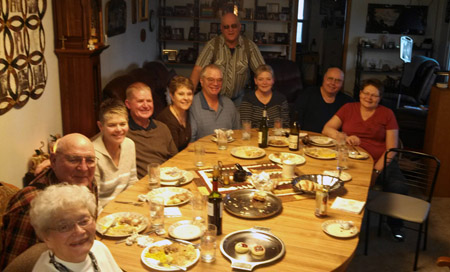 d his wife Jean had purchased my gourmet dinner on the silent auction.