1. The first man buried on the site of what is now Calvary Catholic Cemetery was named Michael Shea. That same year, the first Catholic buried in Lincoln, Henry Armon, joined him. At first, Calvary belonged to St. Theresa Procathedral, and was called St. Theresa Cemetery.
2. It was in 1930 that the Lincoln Diocese acquired Calvary from what is now Butherus, Maser & Love Funeral Home. To this day, it is the only cemetery belonging expressly to the Catholic Diocese of Lincoln.
“Election Month” has been in full swing since Oct. 5, when early voting began for Nebraskans. As I’ve mentioned before, nearly 40% of Nebraskans are expected to vote early in this year’s General Election, with Election Day taking place on Tuesday, Nov. 3. As Catholics, take the time to exercise your moral responsibility to engage in the civic process through voting, whether you vote early or on Election Day.
On this year’s ballot, there are two ballot questions facing Nebraskans. Initiatives 440 and 441 would authorize, under the state constitution and state statute, online sports gambling at any location and on any phone in Nebraska.
Following the heavy rainfall across much of the Diocese of Lincoln, it has been a blessing to be able to drive around and see the fall harvest in full swing these past couple of weeks.
While I regularly pray for safe, seasonal, and sufficient rain on a regular basis, I assure you I have been celebrating the optional Votive Mass for Favorable Weather the past couple months. Thankfully, our Lord has blessed us with some beautiful weather. May we continue to pray for such favorable weather.
1. Bishop James Conley was the son of a Baptist father and Presbyterian mother, but his family did not participate regularly in either denomination. During his public-school education, the young Conley became agnostic.
By Caroline Nebel, Manager, St. Louise Gift & Thrift
St. Louise Gift & Thrift is full of amazing Catholic items. Customers enter and see images of Jesus, prayer booklets, crucifixes, and rosaries in an array of colors. I always wonder what non-Catholics think of these items in the shop; this might be the only place where they are exposed to Catholic items.
Most non-Catholics would recognize a picture of Mary, or a crucifix. But some items are more niche—a non-Catholic might not be familiar with sacramentals like a scapular or miraculous medal. They might not recognize a Byzantine icon in its otherworldly portrayal of the saints. It excites me that for our customers, a trip to the thrift shop is an opportunity to discover the richness of the Catholic faith.
By Rachael Tvrdy Director of Family Life and Discipleship
Think of the struggle you have faced most in life – your “thorn in your side,” the thing that you bring to prayer again and again. We all have one petition that seems to be at the forefront of our minds and hearts.
1. The Newman Center at the University of Nebraska-Lincoln is named after St. John Henry Newman, the patron of Catholic education and the 38th Doctor of the Church. He wrote extensively on the purpose, method, and integration of proper Christian learning, and is the only canonized novelist in history. He was also crucial to Bishop James Conley’s conversion to Catholicism.
By Poe Dee Director of Refugee and Immigrant Services, Catholic Social Services of Southern Nebraska
When the United States Conference of Catholic Bishops (USCCB) concluded its refugee partnership with the federal government in April 2025, affiliates across the nation—including Catholic Social Services of Southern Nebraska (CSS)—were left with significant uncertainty.
The USCCB had partnered with the federal government on resettlement for more than 45 years, building a dedicated team and robust infrastructure. The USCCB had played a key role in helping its affiliates nationwide succeed in resettlement. Losing that partnership created significant uncertainty about how we would continue refugee resettlement work in the future. We wondered who would be the key point of contact to network with the federal government on our resettlement work. We had many unanswered questions and concerns. However, guided by our tagline, “Hope in the Good Life,” we did just that, and remained hopeful.
It’s October and, for the Catholic Church in the United States, it’s Respect Life Month!
This occasion offers us a hyper-focused opportunity to, as the U.S. Bishops state: “Work to teach respect for all human life from conception to natural death, and organize for its protection.” While the Church has many ways to protect life, through prayer, educating the general public, and offering pastoral care to those in need, public policy is another critical way the Church serves the Gospel of Life.
As we enter “Election Month” and early voting begins already, many of us wonder and wrestle with the idea of how it is we can best “protect life” through our civic participation at the ballot. This question is, thankfully, answered thoroughly by the U.S. Bishops in their document, Forming Consciences for Faithful Citizenship.
By Emily Lohr Principal, Early Childhood Director, St. Joseph School, Beatrice
“Those on the path are the ones who have heard.” Luke 8:12
The Parable of the Sower from Luke’s Gospel is one of my favorite passages of Scripture. I find myself returning to it often, especially this year as I have returned to the classroom to teach fifth-grade math and science at St. Joseph School in Beatrice. This year, its message has taken on new meaning as I think about our school’s mission and our daily responsibility to cultivate the soil of our students’ hearts.
That lesson has become especially tangible through something growing just outside our school: a garden.
1. Cardinal John Henry Newman, a convert from Anglicanism and a Catholic saint and Doctor of the Church, is the patron of the American Newman Center system. Cardinal Newman believed in the power of education to save souls, and today Newman Centers across the nation save the souls of college students in practical ways every day. In Nebraska there are three Newman Centers, one at the University of Nebraska-Lincoln (UNL), one at the University of Nebraska at Omaha (UNO), and one at the University of Nebraska at Kearney (UNK).
Jesus said, “Let the little children come to me, and do not hinder them. For it is to such as these that the kingdom of heaven belongs.” Matthew 19:14.
At Little Blessings Child Care of Catholic Social Services of Southern Nebraska, we take these words of Our Lord seriously, not simply by teaching the children about Jesus, but by guiding them to encounter Christ. Every day we bring the little blessings in our care to visit Jesus in our chapel where they genuflect, listen, sing, pray, learn reverence for God’s house, and learn all about the Eucharist. We emphasize charity and love in our lessons and in how we ourselves model behavior for the children and it is so beautiful when we get to see those lessons take root!
Election Day (Nov. 3) is just over a month away, but what I’ve been calling “Election Month” is just days away with Monday, Oct. 5 marking the first day of early voting in Nebraska. While a majority of voters are going to vote in-person on Election Day, around 30-40% of voters are going to vote early between Oct. 5 and Nov. 2. In short, it’s definitely time to start studying hard and praying more about the moral choices we will make when we vote in the weeks ahead.
To that end, here are a handful of tips—certainly not an exhaustive list—for evaluating candidates for public office on your upcoming ballot.
By Marion Miner Nebraska Catholic Conference Associate Director of Pro-Life & Family Policy
What do you know about pregnancy help organizations in Nebraska?
Many readers of the Register are no doubt familiar with one or more of their local pregnancy help organizations (or PHOs), which support pregnant women who would otherwise not receive what they need during a time that too often can seem lonely and overwhelming. These good organizations have played an increasingly large and important role in strengthening social solidarity in America from their beginnings in the 1960s to the present day.
By Fr. Brian Wirth, Director of Catholic Rural Life
As I write this column, we celebrate the Fall Ember Days.
Ember Days are three days of fasting and abstinence observed four times a year—i.e., the Wednesday, Friday, and Saturday in view of the four seasons. Ember Days occur on the weekdays after the Exaltation of the Cross (Sept. 14 ); the feast of St. Lucy (Dec. 13); Ash Wednesday; and Pentecost.
1. Commissioned by Pope Damasus I in the late 4th century, the Vulgate is the definitive Latin translation of the Bible. It was made by St. Jerome – whose feast day is Sept. 30 – and for the most part, translated from the original Hebrew and Greek texts of the Old and New Testaments.
Last year after Halloween, I asked my 6- and 7-year-old sons to throw away the pumpkins they had carved and placed in the front yard. I assumed they had followed my instructions—until a few months ago, when a suspiciously familiar plant began spreading out from under the bushes near the side of the house, eventually covering much of the front grass.
The plant, and its multiple new pumpkin fruits, are evidence that instead of throwing the pumpkins away, the kids had simply chucked them out of sight behind the front bushes. Sometimes in our own lives, seeds can lay dormant and hidden for a time, only to quickly and unexpectedly spring into life.
1. Archbishop Fulton J. Sheen, giant of 20th century television and archbishop of Rochester, N.Y., will be beatified Sept. 24 in St. Louis, by Cardinal Luis Antonio Tagle.
By Drew Hines Director of Development St. Thomas Aquinas Newman Center
One of my favorite things I get to be a part of at the Newman Center is the monthly gathering with our staff and the FOCUS (Fellowship of Catholic University Students) missionaries called “Bagels and Graces.” It is what it sounds like—we have bagels and share graces.
While the gathering itself is a very simple thing, it’s truly incredible to hear and witness the things being shared around those tables every month.
By John Soukup Development Officer Catholic Social Services of Southern Nebraska
For Nolan Lemna of Lincoln, caring for God’s creation and caring for people in need are not separate callings. They are two ways of living out the same responsibility: to be good stewards of God’s gifts and to share those gifts with our neighbors.
That belief is at the heart of a three-year project the 25-year-old is leading, connecting Nebraska farmers who practice conservation-minded and regenerative agriculture with families experiencing food insecurity.
Lemna, a former seminarian in Minnesota who now works as a Nebraska legislative aide, received a $200,000 Nebraska Environmental Trust grant to purchase food from Nebraska farmers and distribute it through Catholic Social Services of Southern Nebraska (CSS) in Lincoln and Community Action Partnership of Mid-Nebraska in Kearney.
1. Although he was destined to become bishop of Constantinople, John Chrysostom (which means “Golden-Mouthed”) was born in Antioch, c. 347. His father, a commander of the imperial army, died when he was very young, but his mother made sure that he received an excellent education.
A religious sister and a priest saw each other across the room. There was a joyful flash of recognition. It had been a long while since their last encounter. They had both aged. The priest greeted Sister with playful surprise: “We’re still alive!”
But at a 50-year health check, would that be a satisfactory report? Does alive mean that I am barely hanging on or that I am vibrant? In the document on religious life from the Second Vatican Council, Perfectae Caritatis, a vibrant religious community is described as one that has Jesus and the community’s charism as their sure foundation and constant reference.
A bishop, a politician, a priest and a lobbyist walk into a bar… and engage in a riveting panel discussion on Pope Leo’s encyclical about artificial intelligence!
Not quite the punchline you expected, and it’s no joke.
On Thursday, Sept. 17, at 7 p.m. at The Post (located in Lincoln in the Telegraph District area), the Nebraska Catholic Conference is hosting “Bishop & Brews.” This Theology-on-Tap-style event will feature Bishop James Conley and other notable panelists for an in-depth discussion on Magnifica Humanitas, Pope Leo XIV’s recent encyclical on safeguarding the human person in an age of AI.
By Ryan Patrick and Katie Patrick, executive director, Catholic Social Services of Southern Nebraska
Where were you on a Friday night in the ‘90s, or even up until the 2000s? There’s a good chance that some of those Fridays were spent at Blockbuster, Family Video, or even Audio Visual. Think back to those nights, perusing the aisles, overcome with decisions, the smell of candy and popcorn enticing you to bring home snacks along with your choice. You finally decide on a movie or two to spend the weekend with, excited to see if you picked a good one.
By Elizabeth Fairbanks Principal, North American Martyrs School in Lincoln
At North American Martyrs School in Lincoln, we seek to fulfill the mandate of Christ to teach the Gospel to all people. (Matthew 28:18-20). We strive to work in partnership with parents on the intellectual, emotional, social, and physical development and growth of their children. We will do this in harmony with the specific and unique gifts God has given to each child, while assisting parents in their duty as the primary religious educators of their children—by teaching ecclesial doctrine and building community through common prayer and Christ-like service.
In short, our mission is to assist in forming the whole child.
1. Blue Masses honor police officers, paramedics, firefighters, and other first responders. The Blue Mass began in Washington D.C. in 1934, and now has spread across the country. It is commonly an annual event, celebrated by the local bishop when possible.
Messages of Hope By Miranda Schumacher Development Officer at CSS Hastings Catholic Social Services of Southern Nebraska
What a year it has been for Catholic Social Services in Hastings!
Last year at this time, we were anticipating our office move to 124 S. Colorado Ave. and beginning plans for a new thrift store. Little did we know that the year ahead would bring even more growth—including the purchase of a warehouse right next to our new office. Along the way, we have implemented new policies, welcomed new staff, and, most importantly, continued to make a lasting impact through our mission.
There is plenty activity in the public policy world at the Nebraska Catholic Conference (NCC). Rather than focus on one issue, let’s chat about a few items.
Bishop & Brews. If you’re in the Lincoln area on Thursday, Sept. 17, join the NCC for an intriguing panel discussion on artificial intelligence (AI). The panel will feature Bishop James Conley, Attorney General Mike Hilgers, Father Kevin FitzGerald, SJ, and yours truly.
Panelists will cover various aspects of AI. We’ll discuss Pope Leo’s recent encyclical, Magnifica Humanitas, and the impact of AI on the human person, community, education, health care, parenting and child protection, data centers and care for creation, you name it.
By Fr. James Morin Rector, St. Gregory the Great Seminary in Seward
Seventeen years ago in August, I arrived at St. Gregory the Great Seminary with a carload full of clothes and books, 19 years old and ready to begin the long process of formation for the priesthood.
By Jeff Schinstock, director of evangelization and catechesis
As we begin another school year, an old saying attributed to St. Bonaventure has taken a prominent place in my mind: “If you learn everything except Christ, you learn nothing. If you learn nothing except Christ, you learn everything.”
The feast day of Pope St. Pius X is celebrated Aug. 21.
By Andrew Winter
1. As a boy, Giuseppe Sarto (1835-1914) lived in a small village near Venice, Italy, the second of 10 children. He walked five miles to and from school every day. His father was an impoverished postman.
By Kristina Brandl, Food Market Program Manager, Catholic Social Services of Southern Nebraska
“I am the light of the world; he who follows me will not walk in darkness, but have the light of life.” (John 8:12)
Every time you decide to buy extra groceries, donate your time or treasure, and pray for our mission, that sacrifice has the capacity to bring just a little more light into our dark world.
There are many who are walking in uncertain seasons of where their next meal will come from or how they will pay next month’s rent.
It’s mid-August, and November feels like light years away. But the truth is, it’ll be here before you know it. And, when it comes, you’ll likely start scrambling to figure out what to do about Election Day on Nov. 3.
Because Election Day will come unexpectedly like a thief in the night, in the same way that magically one morning we wake up to find out it’s no longer summer, it’s never too early to begin thinking about Election Day, and engaging in action. Here’s some tips and suggestions I’d like to offer on that front.
By Sr. Mary Gabriel Diocesan Education Office and Office of Evangelization and Catechesis
There is a Sister in my Community who often falls asleep during movies. She’s one of those people who pours herself out for her students during the school day and is ready to “rest in the Lord” after holy hour and supper. We don’t watch movies often. Sometimes a local convent will watch one for a Sister’s feast day celebration or another special occasion.
Because this Sister so often falls asleep, we’ve developed a new rating system. If the movie was interesting enough to hold her attention we’ll say, “It was a great movie, Sister gave it two eyes wide open!” I suppose if a movie is predictable or something she’s seen before, there might not be the motivation to stay awake. Why bother if you already know what is going to happen?
1. The Marian Sisters of the Diocese of Lincoln are specific to our diocese, and apart from a daughter convent in Beloit, Kan., they do not exist anywhere else in the world. Their motherhouse, “Marycrest,” is located near Waverly, where 37 sisters live together under the rule of St. Francis. They are not cloistered.
A new academic school year is right around the corner (and I believe I just heard the inaudible groanings of countless students and not a few teachers). With any new school year, there are checklists for all the goodies needed for a successful year: backpack, lunch box, pencils, notebooks, planners, the list goes on and on.
By John McDermott Vice President, Marketing & Development Catholic Social Services of Southern Nebraska
With less than 24 hours to go, things looked pretty bleak. And soggy.
Our first Catholic Social Services golf tournament was held on a Friday, Sept. 20, 1996. The afternoon before the tourney, we were staring out our office window at the monsoon-like conditions. The wind-driven rain was forecast to stick around all day, all night, and well into the next day—golf tournament day. It looked as if months of planning were about to literally go down the drain. Should we go ahead and cancel now and let the golfers know when we try to reschedule the event, or do we move forward with having the tourney the next day and hope for the best?
By Fr. Douglas Daro Pastor, Sacred Heart Church, Crete Hispanic Ministry
In June, I moved to Crete, to be the pastor at Sacred Heart Church. With any new appointment comes excitement, nerves, and a continued need to trust in Jesus.
However, before the transition into the new parish takes place, there comes a time to reflect on the amazing gifts God has given and the many blessings experienced from the wonderful and faithful people of God. This was my experience as I said goodbye to the people at St. Benedict Church, the surrounding Nebraska City area and, in a special way, the Hispanic community.
1. Divine Mercy (or the Divine Mercy) refers to the infinite mercy of God for mankind; but specifically, Divine Mercy is a special form of devotion to Jesus, the “face of the Father’s Mercy.” Jesus revealed this devotion to His Divine Mercy to St. Faustina Kowalska in 1931.
1. The number of Spanish-Speaking Catholics in the Lincoln Diocese has increased by 200% in the last 20 years. As such, there is one dedicated parish tasked specifically with serving the Hispanics of the diocese, as well as several bilingual parishes. There is also an Office of Hispanic Ministry, directed by Ricardo Izquierdo.
The Solemnity of Christ the King is celebrated Nov. 23 this year.
1. The School Sisters of Christ the King are a community of religious sisters based in the Diocese of Lincoln. The diocese has the privilege of hosting their only convent, the Villa Regina Motherhouse in Lincoln. The Christ the King Sisters teach in several parish schools around the diocese.
1. Born in 1696, St. Alphonsus Ligouri quickly showed promise as a boy. Thanks to his pious mother, he grew into a virtuous young man devoted to prayer. Thanks to the ingenious education of his father, a naval officer, Alphonsus received his doctorate in civil and canon law at 16 years of age.
One of my favorite things to do is to drive around and look at corn and soybean fields, and marvel at the handiwork of God and our farmers. Doing so unites us to Christ as Sower.
Of all the Gospel accounts, the Parable of the Sower is one that should deeply resonate with us in the Diocese of Lincoln, living in Nebraska, “the “Good Life.”
By Sr. Mary Kansier Marian Sisters of the Diocese of Lincoln
The Church celebrates the memorial of St. Ignatius of Loyola July 31. He lived in Spain and was injured in a battle in 1521. To pass the time during his extended recovery, he read the lives of the saints. He realized that he experienced great peace not only when reading, but after. This prompted him to realize the emptiness of seeking glory as a soldier. After a pilgrimage and a retreat, he decided to dedicate his life to God. He eventually wrote the Spiritual Exercises, a set of meditations and prayers designed to help others discern their own spiritual paths. Today these are used around the world in retreats and other programs.
Recently, I encountered a client I had once helped. After exchanging pleasantries about work and family, she confided in me. I had presumed she’d entered the U.S. with refugee status, so I was surprised to learn that until last week, she had been waiting more than 10 years on an asylum case.
A recent decision by immigration officials determined that she was no longer permitted to lawfully remain and work in the United States. She received a written request to gather her belongings and make arrangements to return to her country of origin. She is a single parent, and the letter said nothing about what would happen to her young children. We ended our conversation with no clear path forward, other than to consult an immigration attorney as soon as possible. Stories like hers are why Catholic Social Services (CSS) offers immigration legal services in the first place — so that no one has to face a moment like this alone.
It can sometimes happen that a person reading two things at once—two books, or a book and an essay, or a poem and a newspaper column—will find an unexpected and remarkable relationship between the two things being read, each illuminating and giving color to the other.
From 1861 until 1909 Father Emmanuel Hartig, a Benedictine missionary, served the Lincoln Diocese tirelessly. Because he traveled constantly across southeast Nebraska, serving the small groups of Catholic settlers for so many years, he has earned the title “Lone Ranger of the Lincoln Diocese.” Without his life and work, the diocese as we know it today would not exist.
I recently read an excellent article by Nathan Kreider on The Catholic Exchange. The article was geared toward unmarried men, but the advice is just as good for married men (and women too). The article proposed that there is a difference between being married and being a husband.
The word “married” identifies the status or the arrangement. It is what the man’s status is. In the judicial system, it is like a contract with a built-in termination clause.
The word “husband” is deeper. It tells you who you are. This is one of the reasons the Church includes it as a sacrament.
God is so good! The Catholic Social Services (CSS) Hastings open house was absolutely amazing, even though the weather was, without a doubt, the worst I’ve seen in Nebraska (I know, I’m still new!). In spite of slight flooding and cars breaking down and needing to be pushed in the pouring rain, our community partners turned out in full force and made it a day to cherish and remember.
1. Charles and John Carroll were distant cousins and prominent Catholics crucial to the founding era of the United States. Charles, born in 1737, became the only Catholic to sign the Declaration of Independence; John, born 1735, was the first bishop of the United States.
By Fr. Kenneth Hoesing Pastor of St. Joseph Parish in Harvard, Hispanic Ministry
A few weeks after I arrived at my current assignment almost two years ago, I had the opportunity to perform a baptism—a triple baptism nonetheless—for a family in my parish. This family’s roots are in Mexico. The parents were born in Mexico, but came to the United States when they were young children.
After the baptisms were done, there was a celebration at the home of the paternal grandparents of the baptized. This was a big celebration. The great-grandmother of the baptized came in from Mexico. Many generations of the family were present. Needless to say, there were a lot of people there. Tables were set up in the garage, and outside the garage to accommodate the crowd.
by Veronica Pino St. Gianna Program Director Catholic Social Services of Southern Nebraska
I recently had the joy of attending Mass with one of our St. Gianna Women Home (SGWH) residents and her son. It was the woman’s first time attending Mass in 16 years. It was a very special occasion, and one I’m incredibly thankful to have been a part of. While I’ve often had the opportunity to pray with residents or guide Bible studies at St. Gianna’s, being able to join them for Mass in the community is an opportunity that is not often presented to me.
In his column two weeks ago, Tom Venzor addressed the central question at the heart of Magnifica Humanitas: “What is man, that God is mindful of him?” (Psalm 8.) And the answer: “God said, let us make man in our own image, after our likeness, and let him have dominion. … So God created man in his own image, in the image of God he created him.” (Genesis 1:26-27.)
By Sr. Jeanette Rerucha, Principal, Villa Marie Home and School for Exceptional Children
When I was first asked to write this column, I had no idea that I would no longer be the principal of Villa Marie School at the time of this writing. But God’s plans are not always our plans, and I am grateful for an opportunity to share some parting thoughts about my time at Villa Marie with God’s most precious children.
1. Born in 1478, Sir Thomas More led a respectable career as a statesman and judge. He served as speaker of the House of Commons as well as Lord Chancellor of England. He was also an excellent husband and father.
By Sr. Mary Ruth School Sisters of Christ the King
Priests and lay faithful from across the Diocese of Lincoln and beyond often express their desire to me, and to my fellow School Sisters of Christ the King, that our Sisters could serve in their parishes and schools. Religious do maintain a relatively strong presence in the apostolates of our diocese as compared to elsewhere in the United States. However, we are still only able to say “yes” to a small fraction of the requests we receive. We simply do not have enough Sisters to bring in the abundant harvest.
By Jeff Schinstock Director of evangelization and catechesis
The summer of 2000 changed my life.
At the time, I had just finished college. God had stirred my heart to a return home in the Church. I was considering law schools and discerning my future when an invitation to something more arrived. Friends, seeing the Lord’s work in my heart, asked me to considering doing Totus Tuus in the summer. I had never heard of it.
The Church was celebrating the Great Jubilee Year. I was being asked to catechize youth across Kansas. I could not have known then that a simple “yes” to six weeks of missionary work would become one of the defining moments of my life.
The Monday after we left the hospital without our daughter, my husband Ryan and I went to evening Mass at the Cathedral of the Risen Christ in Lincoln. When Mass ended, Father Wylie came straight to our pew. He sat quietly beside us and began to pray.
Imogen’s unexpected death never caused me to question my faith, but it was one of the darkest moments of my life. Father Wylie’s presence that evening—his prayers, his quiet hope, his reminder of our enduring love for Imogen—shaped how I learned to carry both grief and motherhood in the days that followed. “She made you parents, and you will be her parents forever,” he said. It was in those moments that I understood something deeper about spiritual fatherhood.
One of my favorite passages in Sacred Scripture comes from Psalm 8: “What is man that you are mindful of him, and a son of man that you care for him? Yet you have made him little less than a god, crowned him with glory and honor. You have given him rule over the works of your hands, put all things at his feet.”
This evidence of Divine Revelation affirms the supreme dignity of the human person. We are made “in the image and likeness of God.” God looks on us and says we are “very good.” God has a particular love for the human person. The human person cannot be stripped of this dignity. Our infinite and invaluable worth, in the eyes of God, cannot be reduced to anything less than this magnificent reality.
Devotion to the Sacred Heart of Jesus began as early as the second century. Saints Gregory the Great, Bernard of Clairvaux, and Anselm all supported it. Likewise, devotion to the Immaculate Heart of Mary dates back at least to the 15th century, but St. Margaret Mary Alacoque and St. John Eudes definitively popularized these two devotions in the 17th century.
By Natalie Bender Photojournalist serving the Register
Since my first photo assignment for the Southern Nebraska Register, I’ve covered hundreds of events. But one ongoing assignment is becoming my favorite: the “Sunday at” feature. It’s sent me to 14 parishes so far, and I look forward to visiting more.
For priests and laity alike, April and May are full of constant activity, yet full of life, excitement, and hope. God’s Providence continually marks the times and seasons.
1. Joan of Arc, called in France “la Pucelle,” or “the Maid,” was born in 1412. As one of five peasant children, she received little education, but at age 13, she began hearing “voices,” and was visited by St. Michael, St. Margaret, and St. Catherine of Alexandria. They were calling her to save France from the English invasions of the Hundred Years’ War.
By Levi Baus, Director, Prison and Reentry Apostolate (PARA)
During this academic year, the Prison and Reentry Apostolate (PARA) received several batches of letters from the fifth and sixth grade CCD classes at St. Mary Church in Sutton. Thanks go out to Mrs. Tracy Galusha for spearheading this effort.
By Sr. Bernadette Radek, M.S. Marian Sisters of the Diocese of Lincoln
Yes, we are all guilty of it: reminiscing. I have some beautiful memories of the month of May: The month of our Blessed Mother, May crowning, my parents both had birthdays in May, and I could go on and on. My most fond memory is that of receiving my first Holy Communion in the month of May at the hands of our pastor, Rev. James Gilroy in Geneva.
1. There are currently five U.S. bishops who were born in the Diocese of Lincoln and/or have served as priests for the diocese*. They are: Bishop John Folda, Bishop Emeritus Michael Jackels, Bishop Emeritus Thomas Olmsted, Bishop Emeritus Kenneth Steiner, and Bishop Robert Vasa.
By Rachael Tvrdy Director of Family Life and Discipleship
Summertime is around the bend, and it’s the ideal season for families to slow down and relax into longer and slower days. Yet for many families, summer is anything but relaxing. In fact, it can become more hectic than the school year as parents scramble to find activities to fill days that are no longer structured in a classroom. Kids can no longer be bored, and constantly are looking to parents to keep them entertained. Parents feel that strain more than ever, and often turn to devices to take the edge off.
Whatever happened to those “lazy, hazy days of summer?”
By April Boellstorff Regional Director in Auburn, Catholic Social Services of Southern Nebraska
I often find myself reflecting on the profound words of our executive director, Katie Patrick: “One of the most powerful moments is when someone who once came to us in need becomes the one giving back. That transformation from receiving to becoming help is at the heart of everything we do.”
1. Before its official establishment as a diocese, the Nebraska Territory had three bishops who presided over it as a vicariate: Bishop John Baptist Miege, S.J., Bishop James O’Gorman, O.C.S.O., and Bishop James O’Connor. It has also had many apostolic administrators who have managed the bishopric while the office of bishop was absent. Apostolic administrators of Lincoln include: Father Michael A. Shine, Msgr. Albert Petrasch, Msgr. Alois J. Klein, Msgr. Francis A. O’Brien, Bishop Fabian Bruskewitz, and Archbishop George Lucas.
1. The first deacons of the Catholic Church were ordained by the Apostles shortly after Pentecost. Their names were Stephen, Philip, Prochorus, Nicanor, Timon, Parmenas, and Nicholas.
By Miranda Schumacher Development Officer at CSS Hastings
One of my favorite days of the year is just around the corner—Give Hastings Day. It is a day that showcases our community’s generosity as neighbors come together to support local nonprofits and strengthen the place we all call home. Each year, I am amazed at what Hastings can accomplish in just 24 hours.
Catholic Social Services is excited to participate again this year on May 7, with all proceeds benefiting our Open Table Sack Lunch Program.
Open Table provides free sack lunches to an average of 100 people every day. With a “no questions asked” approach, we serve everyone with dignity, compassion, and care.
I participated in a Catholic Media Association webinar last week about evangelizing through media. Gretchen Crowe, editor-in-chief of OSV News, began the webinar saying we live in a noisy and polarized landscape, and Catholic journalists, therefore, can play a vital role: to inform and to inspire.
The average homily in America’s Catholic churches lasts about eight minutes, she pointed out. Compared to all one could learn about the Catholic Faith, and all the questions that arise about how to apply the faith and live it out today? “Eight minutes a week is not enough.”
by Fr. Brian Kane Rector, St. Gregory the Great Seminary; Director of Seminarians
Last week, one of our seniors spoke at a gathering of seminary supporters and family members about his experience at St. Gregory the Great Seminary in Seward, over his last four years of formation here. He noted that, although he could speak about the various important parts of seminary formation, including academics and pastoral formation, he wanted to focus on one thing. He said, “I have learned how to love at St. Gregory’s.”
By Veronica Barreto Rosa St. Gianna Program Specialist
I encountered this verse while reading the Second Epistle of St. Peter, and it has stayed with me as I have tried to understand what it truly means to trust in God’s timing: “With the Lord a day can mean a thousand years, and a year can be like a day.” 2 Peter 3:8.
It is a simple idea to express, yet far more difficult to live out in daily life.
As farmers find themselves back in the fields, laboring with Christ the Eternal Sower, sowing good seed during this planting season, Saturday (April 25) is a special date within the Church’s annual liturgical calendar.
April 25 is not only the feast of St. Mark the Evangelist, but also another important liturgical celebration. Tomorrow marks the Major Rogation day. Relatedly, Minor Rogation days occur on the three days before Ascension Thursday. (The Major Rogation date has no connection with the feast of St. Mark, whose feast was subsequently assigned to this date; the feast may be transferred to a different day.)
By Sr. Edith Marie School Sisters of Christ the King
During these Easter days the Church proclaims: Christ is Risen. Our King is victorious. One of my favorite Easter hymns is “Ye Sons and Daughters.” In nine fairly short verses it tells the Easter story, with the first verse proclaiming, “Ye sons and daughters let us sing! The King of heaven the glorious King, O’er death today rose triumphing, Alleluia.”
As I ponder this season of joy, mystery and love, I am reminded by the Holy Spirit that throughout my vocation, Christ as King, the one who said yes to death on the cross and rose victorious, has also been the one who has searched me and called me as a School Sister of Christ the King.
1. Boys Town today serves millions of children every year at eight locations all over the U.S. Its founding site in Omaha houses more than 400 impoverished boys and girls, and provides shelter and love for many more children in family-style houses. It is a veritable village inside Omaha, with its own post office. It is the only National Historic Landmark District in all of Nebraska. The Boys Town Research Hospital is a global leader in the study of deafness and behavioral health.
By Fr. Bernard Lorenz Western Diocesan Hispanic Ministry and Spiritual Advisor of the Lincoln Diocese Cursillo Movement, in residence in McCook
The horses ran
Last December, 23 cowboys and girls rode their horses into Wellfleet to celebrate the feast of the Blessed Mother Mary, Our Virgin of Guadalupe (Dec. 12). This was the third year of this beautiful tradition of joy. It incorporates the blessing of the riders’ horses into the prayer of thanksgiving to God for the gift of His mother Mary to all of us.
These men and women, almost all Mexicans, love their hard work and their horses and their Catholic faith. They love to love it all together in a sincere act of devotion. Many of the English-speaking parishioners attended with great joy. All are welcomed. After the blessings of the men and women and their horses—who ran to love Jesus in the church with His Mother Mary—all enjoyed the Holy Mass and a great potluck meal afterward.
By Julie Perry, St. Francis Gift and Thrift Store Manager
By definition, a volunteer is a person who freely offers to take part in an enterprise or undertake a task. At Catholic Social Services of Southern Nebraska (CSS), it is so much more. It is showing up with heart and compassion, and serving with CSS’s core values of Dignity, Integrity, Empathy, Trust, and Sustainability.
By Fr. Matthew Vandewalle St. John Nepomucene, Weston
In this Happy Easter Season, we Christians do not have some abstract Faith. We can point to an empty tomb and Jesus, who has Risen both body and soul! We all have tangible, or ‘concrete’ realities – persons, places, and things – that helped us in our faith journey... you might call them ‘stepping stones.’
These stepping stones help us to be built up, as St. Paul says, into ‘living stones’ that make up the mystical Body of Christ. Since we each have a body and soul, some of these stepping stones are material things of ‘brick and mortar’ that have been there on our journey. While they are not the most important things, they play an important role. These edifices were planned and built with time, talent, and treasure. I took them for granted in my youth, but now I appreciate them more. While they are things ‘in the concrete,’ they became places of spiritual grace. In fact, some of them are literally... concrete.
By Jeff Schinstock Director of evangelization and catechesis, Director for pro-life activities
“Create in me a clean heart, O God, and renew a right spirit within me” (Psalm 51:12). These ancient words of King David echo through the ages as a cry for interior renewal. Renewal is always necessary in the Church, and renewal must be local. Worrying about fixing far-away problems doesn’t change our reality for the good. The Church is universal, but she is also local with our diocese, our parish and ultimately, me.
As Catholics in the Diocese of Lincoln embark on the implementation of the One Heart in Christ pastoral plan, the question before each of us needs to become deeply personal: How do I, as an individual disciple in a local parish, respond to this call to renewal and mission?
Two weeks ago, I shared the story of a young woman who was living in an unsafe situation. Her mom reached out to me on Christmas Eve begging for local resources that could help her daughter. The parents lived in another state, and with a little more information, I gathered that the daughter was a drug user and the parents forbade drug use in the home.
While there may have been other reasons that the daughter chose to live in a city a thousand miles away, the reality of her being so far from her family—her natural safety net—caused deep physical and emotional distress. In other words, due to distance and previously severed relationships, the crisis displaced the family as the primary responder. When this happens, neighbors and the local community become the next line of support—followed by organizations.
1. Made in 2004, “The Passion of the Christ” is a full-length film depicting Jesus’ torment and death on the Cross on Good Friday. It was directed by a Catholic, Mel Gibson, and starred a Catholic, Jim Caviezel, as Jesus.
A friend recently confided, “I really struggle with drifting into thoughts about irrelevant things during Mass.”
“So do I,” I thought.
Distraction during prayer is a universal problem. It happens in churches and chapels, monasteries and convents, during the rosary, and all other prayers as well. Rare is the event when a prayer is so intense that one cannot look back and recall a distraction. Distraction is so common that the Catechism of the Catholic Church even mentions it:
As Holy Week culminates into the busiest time of year for pastors, parish staffs, and parish communities, it is nevertheless the greatest time of the liturgical year.
Just as farmers excitedly await spring planting and fall harvest after extensive labor and preparations, so too the laborers of the Church excitedly await the spiritual harvest of the Triduum and the Easter Vigil after extensive planting of seeds, labor, and preparations (Mt. 9:37).
Over the past few weeks, this phrase has been heard frequently alongside victims and state leaders alike, as they talked about the largest wildfire in our state’s history. More than 800,000 acres burned in the Nebraska wildfires, affecting fields and displacing cattle at all stages of operations— disrupting herd management, altering breeding and nutritional patterns, rotational grazing and much more.
Yet, it seems that at every stage, help came from neighbors—whether those in close proximity to the fires, whose land was spared, or those in neighboring states who stepped up to help. This is what Nebraska is all about—resilience and compassion.
By Daniel Stara Seminarian of the Diocese of Lincoln, Propaedeutic Stage at St. Gregory the Great Seminary in Seward
The summer before my propaedeutic year, a friend recommended that I spend it volunteering with the poor. I declined. I knew it was a good thing, but I couldn’t see how volunteering somewhere would develop my spiritual life and prepare me for seminary. Looking back on my propaedeutic year, I realized I couldn’t have been more wrong.
“They are no longer two, but one flesh. Therefore, what God has joined together, no human being must separate.” (Matthew 19:6). The Catholic Church has always taught that the consummate bond of marriage between a Christian man and woman cannot be broken by any power on earth except death.
My daughters and I were four dozen deep in our cookie-making tradition when my work phone rang on Christmas Eve. I often don’t answer outside of working hours, but something told me that I needed to answer that call.
When I did, a woman was on the other line crying. I asked her what happened and if there was anything I could do to help. She explained to me that she was calling on behalf of her daughter, who was living with an ex-boyfriend and his family. The environment was toxic, abusive, and escalating—and she had nowhere to go.
Along with Bishop James Conley and the Nebraska bishops, I want to personally express my loving concern and prayers regarding the devastating wildfires that have ravaged the precious many farms, acres, and pastures across Nebraska which have affected so many farmers/ranchers and devastated rural communities.
In this penitential Lenten season, please know you are not alone. With every cross, in trusting faith and confident hope, God has in store for us particular Resurrection blessings. We may not know them now or for some time, but within God’s Providence, he makes all things new.
1. The origins of Camp Kateri in McCool Junction lie with Craig and Marge Buescher, John and Pat Miller, John and Debi Crotty, and Mike and Chere Kane. These four couples sent their children to a Christian summer camp for several years, but then decided it would be better for their children to experience a Catholic camp of their own. This Catholic camp began at the Manna Resort in Fairfield, and the diocese bought the current land in 1998. The Diocese of Lincoln now administrates Camp Kateri.
By Fr. Michael Morin and Sr. Marie Caritas, CK Blessed Sacrament School in Lincoln
Blessed Sacrament School in Lincoln is blessed in so many ways, not least of which is the way we look.
If you were to see a picture of our student body, you would see the beauty and recognize great diversity. Many of our students’ parents are first generation immigrants from countries like Sudan, Mexico, Nigeria, Guatemala, Myanmar and others. Our school families add so much to what it means to be a disciple here in Lincoln. Not many schools in our diocese have this depth of diversity, and we love it!
By Teresa Kiehl, Client Relations Specialist at Hastings, Catholic Social Services of Southern Nebraska
I recently came across a quote and felt sick to my stomach: “I am done with the monster of ‘We,’ the word of serfdom, of plunder, of misery, falsehood and shame. And now I see the face of god, and I raise this god over the earth . . . , this god who will grant them joy and peace and pride. This god, this one word: ‘I.’” - Ayn Rand, “Anthem”
I was not nauseated because of the quote itself. It is easy for me to read something and disregard it if it blatantly contradicts my beliefs and convictions. What made me sick was knowing that the author of this quote has been openly admired by powerful politicians in this country. Ayn Rand (1905-1983) was known for her beliefs in radical and extreme individualism, wherein any given individual should only make decisions based on their own self-interest, disregarding the needs of others.
“I am about to do a new thing; now it springs forth, do you not perceive it? I will make a way in the wilderness and rivers in the desert” (Isaiah 43:19)
Starting over is always challenging and exciting. There are new landscapes, new possibilities, and new blessings; but it can also cause fear. There are so many unknowns, possible failures, and perceived dangers.
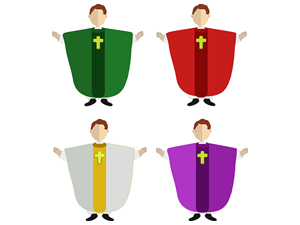
1. At a typical Mass in the Roman Catholic Church, the priest wears an amice—a rectangular white cloth covering his collar and shoulders, an alb—a white robe reaching to his ankles, a cincture, or rope belt, a stole, and a chasuble. Only the stole and the chasuble match the liturgical color of the day.
The first Friday of Lent marked a retreat day for the staff at Catholic Social Services. Our St. Teresa of Calcutta Committee, composed of CSS staff from across our different offices and programs, organized the day for us.
Father Timothy Danek, newly appointed clergy for the incarcerated, celebrated Holy Mass and gave one of three talks. Staff signed up to bring homemade soups and bread, and we had Eucharistic adoration continuously that day.
By Jeff Schinstock Director of evangelization and catechesis, Director for pro-life activities
When the Church remembers St. Lawrence, we usually think about his funny quip during his martyrdom over a fire: “turn me over, I’m done on this side.”
But there is more than a clever story, or even a dramatic martyrdom. We remember a man placed under extraordinary pressure. Lawrence was a servant of the Church who was forced to choose, in a moment of fear and uncertainty, what he truly believed about the Gospel.
Lawrence served as one of the seven deacons of Rome in the third century, entrusted with the care of the Church’s poor and the stewardship of her material goods. He served directly under Pope St. Sixtus II, at a time when being a Christian—let alone a leader in the Church—was dangerous. During the persecution under Emperor Valerian, Sixtus II was arrested and executed. Lawrence watched his spiritual father, his bishop, his pope, led away to death. It was a life changing moment.