Catholic devotion to Mary is one of the most frequently maligned teachings by those critical of the Church. But the criticism of Marian devotion is a relatively new development in Christianity. Prior to the Protestant Revolution, Mary’s important role in salvation history was not hotly disputed. But as the Protestant Revolution passed into the 17th Century, Catholic devotion to Mary became a major focus for those who wanted to discourage membership in the Catholic Church.
Under Nebraska state law, every abortion performed in our state must be reported by the attending abortionist through a reporting form to the Nebraska Department of Health and Human Services (“DHHS”). This report includes a variety of information (e.g., age of the mother, type of procedure performed, reason for the abortion, etc.). DHHS compiles this information and issues an annual report. These annual reports date back to 1974. Recently, DHHS issued its “2016 Statistical Report of Abortions” (full reports accessible at dhhs.ne.gov).
While it is sobering to read, the annual report offers an opportunity to better understand the scope of abortion in Nebraska, which informs our outreach and prayer efforts. This article summarizes some of the categories of information provided in the report.
“Joan of Arc: Heroine of France” by Ann Trompert, illustrated by Michael Garland. Boyds Mills Presss, Honesdale, Penn., 2003, 32 pages, Grades 2-4.
St. Paul tells us in 1st Corinthians 3:19 that the “wisdom of the world is folly with God.” What does this mean? Quite simply, that human minds are limited and can only function well when filled with God’s grace. This of course means that humanity must acknowledge that God is greater than themselves and that divine guidance is necessary. History is filled with examples of mankind refusing to accept this basic principle. When countries do not allow themselves to be led by God, they usually fall into war or ruin.
While walking though Gianna’s Java & Gelato in Lincoln, perhaps to sample one of our new flavors, I spied Father Harlan Waskowiak and Father William Holoubek imbibing several of our specialty drinks with a gelato chaser, or visa-versa.
After a nice conversation with the good fathers, Father Holoubek informed me he had four boxes of donated items for St. Gianna’s Women’s Homes that were collected by St. Mary’s Parish Council of Catholic Women (PCCW) in Sutton.
The state legislature adjourned their session on May 23. The legislature will not reconvene until early January. As with all things, lessons were learned along the way. Reflecting on the past several months, my colleagues and I thought the following lessons were particularly beneficial to us and could be to all Catholics across Nebraska.
As most of you know, Catholic Social Services helps individuals and families across the 24,000 square miles that is the diocese of Lincoln in a number of ways, including housing for women who are escaping the pressures to abort their unborn babies; emergency services; disaster relief; our St. Christopher Car program; the provision of food, clothing, furniture, appliances and other household items; and charity grants for individuals who are unable to afford the total cost of counseling.
The Nebraska Legislature’s Revenue Committee voted May 18 to advance the Opportunity Scholarship Act (LB295) to General File on a 5-3 vote (see below for information to send a thank you to Senators who supported LB295). The bill is now eligible for debate by the entire Legislature for the 2018 legislative session. The advancement to General File marks a historic moment for school choice legislation in Nebraska.
“The Hindenburg: The Fiery Crash of a German Airship” by Kathleen W. Deady Capstone High-Interest Books, Mankato, Minnesota, 2003, 32 pages, Grades 3-5.
At every Super Bowl, fans get many pictures and visual images from the Goodyear Blimp. The Goodyear Blimp is so well known that sometimes people call any blimp, “The Goodyear Blimp.”
On April 24, my administrative assistant Pat Walbrecht and I drove to Hastings to attend our annual volunteer appreciation luncheon. This is something we have done in other parts of the diocese as well.
The event was held in Centennial Hall at St. Cecilia Parish. Our volunteers were served finger-lickin’ fried chicken, mashed potatoes, green beans and rolls. The dessert table contained desserts half the size of a football field. I believe this was so because whoever cut the pieces must have given up sweets for Lent.
In Nebraska, at least 900 individuals are sold for sex multiple times each month. Just last fall, 41 Nebraskans were arrested during a human trafficking sting. Many of us, busy with work, school, soccer games, church activities, are unaware of this horrifying reality happening in our backyard. From Scottsbluff to Omaha, at truck stops, motels and in our neighborhoods, young women and men find themselves enslaved for the sake of profit.
To help address this problem locally, a bill was signed into law this week in the Nebraska Legislature to ensure harsher punishment for those caught buying or selling sex.
Human trafficking is the act of recruiting, harboring, transporting, providing, or obtaining a person for compelled labor or commercial sex acts through force. This industry is one the fastest growing criminal industries internationally, behind the drug trade.
A clear violation of human dignity and justice, this problem persists globally and nationally. The facts of human trafficking may shock and unnerve you, as they did me.
For those who read this column, you might remember a story about a man in his late 30s or early 40s, who came to our office last winter on a cold afternoon after our office closed. Because of his chronic substance abuse, he was not a candidate to live in a homeless shelter and was sleeping in his truck.
By human terms, the odds were against her. When she became pregnant, she was a very young girl, betrothed to Joseph, an older man. Mary’s pregnancy was a scandalous situation by any stretch of the imagination. One underappreciated miracle is the fact that she was not banished, ostracized or persecuted. Had Joseph been anything less than the man he was, the Nativity and the entire Gospel would have been drastically different than they are.
God certainly chose the most excellent of His creation to be the mother of His Son. This is both theological and logical. Therefore, it should come as no surprise that Mary is the most prolific evangelist in the history of the Church. With one miraculous appearance in Mexico in 1531, she converted as many souls to the Church as had been lost to Luther’s Protestant Revolution. In the same way, she changed the culture in France in 1876, Rwanda in the 1980s and 100 years ago, she changed the world when she appeared to three children in Fatima, Portugal. Mary had an extremely important message for us and she provided it 100 years ago. The message is so important that Satan has spent the last 100 years trying to obscure it with many lies, one of which is the lie that Catholics worship Mary.
In a dramatic turn of events at the State Capitol on May 3, the Legislature repealed pro-life language from the statewide budget proposal that would have shifted taxpayer dollars away from abortion clinics and toward comprehensive healthcare centers.
During high school, my dream car was a 1972 Chevrolet Monte Carlo with a 454 cubic inch V-8. However, because of my $1.65 per hour part time job I settled for a 1974 Plymouth Duster with a 225 cubic inch slant six engine with three on the tree (this means it had a manual transmission). It went from 0 to 60, but it took a while.
The Democratic National Committee’s chairman, Tom Perez, recently made a statement further demonstrating that the Democratic Party leadership is intimately united to the advancement of the so-called right to abortion. Mr. Perez’s statement reveals the appalling trend within the Democratic Party to further imbed a culture of death into civilized society. Courage is needed to continue vehemently rejecting such disdain for the dignity of human life.
Last week, while walking through our main lobby, I spied a man who looked troubled. As I approached to say hello, I sensed the urge to invite him in our St. Joseph Chapel. It was Friday, the day Christ Jesus died, so we can live. Friday is also the day we have Exposition of the Blessed Sacrament.
As our eyes met and after saying hello I said, “Would you like to see something beautiful?” “Yes!” he replied. After entering the chapel and seeing the monstrance containing Love itself incarnate, he was hit with love by the Holy Spirit, sent from the Father through His Son. The man immediately sat down and closed his eyes.
As October 31, 2017 comes and goes, you will see and hear a lot of things which celebrate the 500th anniversary of the start of Martin Luther’s Protestant Revolution.
While most people and most announcements will call it the Protestant Reformation, it wasn’t a reformation because Martin Luther’s efforts did not reform Christianity, they deformed it. Martin Luther and his disciples have continued to deform Christianity for the last five centuries. Their efforts have resulted in a severe fracturing of Christianity to the point where there are not two distinct brands of Christianity (Catholic and Protestant) but an exponential splintering of Protestantism on one side and the Catholic Church on the other.
On April 13, President Donald Trump signed into law a pro-life bill, passed by Congress, that reversed a government rule established by Pres. Barack Obama. The rule prohibited states from prioritizing Title X (family planning services) funding to comprehensive health clinics and away from abortion providers. President Obama’s rule was viewed as a “parting gift” to Planned Parenthood. Because this egregious rule was overturned, Nebraskans can achieve one of our most significant pro-life victories in years.
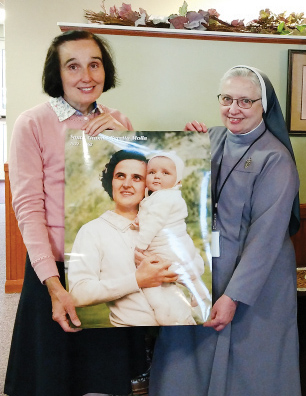
Most of us, I’m sure, are familiar with the life of St. Gianna Beretta Molla. On April 28, 1962, she gave her life for the infant baby girl that she and her husband Pietro named Gianna Emanuela.
While the legislature’s days are winding down with less than thirty days of business remaining, the legislative workload is increasing as major tasks remain. For example, the legislature still has to address the statewide budget and numerous priority legislation.
I love traveling the Diocese of Lincoln, from river to shining river, creek and border. By doing so, I have the opportunity to meet many people, young and old, from all walks of life, some in need.
Several months ago, I met a young woman at her place of work, somewhere south of the Platte River, north of the Kansas border, between the Colorado, Iowa and Missouri borders. Because of my regular travel schedule, I had encountered her numerous times. Being a priest, she felt she could share some personal things about her life.
I will never forget her informing me that once her boyfriend learned she was pregnant, he became abusive and abandoned her.
When it comes to evangelization, it is usually not highly effective to start with an explanation of the Eucharist.
If you are trying to introduce a non-Catholic to the Catholic faith or if you are trying to re-introduce a lapsed Catholic back to the Catholic faith, starting with the Eucharist is kind of like describing a car’s engine to a 15-year-old who just wants his driver’s license. You know the car is nearly useless without the engine, but your teen usually has different interests with regard to the car at that point in life.
There are some teenagers who are fascinated by their car’s engine and there are some non-Catholics who are attracted to Catholicism because of the Eucharist, but they are the exception to the rule.
The Eucharist is also a common topic for those who are skeptical of the Catholic faith. While many of our separated brethren attend religious services which include a “Lord’s Supper” or “communion” they believe it is something far short of the Eucharist we receive in the Catholic Church. In misunderstanding the Eucharist, they misunderstand Jesus.
Last week, we celebrated two significant legislative victories. First, LB46 (Choose Life License Plates) was signed into law by Gov. Pete Ricketts. This is Nebraska’s first pro-life legislative victory since 2011.
Second, LB173 (Sexual Orientation/Gender Identity Non-Discrimination) was, once again, defeated in the legislature for lack of support. This bill would have instituted anti-discrimination protection in the context of public accommodations, housing, and employment for sexual orientation and gender identity. The legislation would have unnecessarily created additional protected classes, harmed small business, infringed upon privacy rights, and violated religious liberty.
However significant these political victories, their significance pales in comparison to the recent terroristic attacks committed by ISIS on Coptic Christians in Egypt on Palm Sunday. The shedding of innocent blood in Coptic Churches located in Tanta and Alexandria stand as a stark reminder of the presence of evil in our world. They stand as a direct attack on the beauty of human life and the goodness of true religious freedom and worship.
“Easter: The King James Version with Pictures,” by Jan Pienkowski Alfred A. Knopf, New York, 1989, 32 pages, Grades 2-4.
Easter is the greatest day in the Church year. On Easter, Our Blessed Savior broke the bonds of death through His resurrection. Christ atoned for the sins of mankind and reopened the pathway to God the Father that had been closed by sinful mankind. Through conquering death, Jesus reveals His divine nature and His compassionate desire to have all people become fully reunited to God.
By Father Christopher Kubat, Catholic Social Services
A while back, I wrote about two homeless men sitting along the bike trail between the O Street bridge and the Devaney Center. As I approached them after a jog, they invited me to sit by them to chat. One of the men knew I was a priest at Catholic Social Services.
Seconds after sitting between them, the one who knew I was a priest asked, “What do you see when you look at me?” I replied, “I see Jesus!” The other man immediately thanked me and said that most people walk past him while looking away, as if he was a leper.
Baptism is necessary for salvation. It infuses us with God’s grace, making us pure and holy, justifying us (makes us right with God) and removes and forgives all of our sins as well as the consequences for those sins. If we were to die immediately after our baptism, we would go straight to heaven without any need for purgatory.
It’s often asked: Why is the Nebraska Catholic Conference involved with [insert any given subject or legislative bill]? Most recently, this happened with a regulation pertaining to the Board of Psychology. I want to offer a summary of the Board of Psychology regulation in question and some key reasons why the NCC gets involved on this and many other issues.
“Goodnight Baseball,” by Michael Dahl, illustrated by Christina Forshay. Picture Window Books, North Mankato, Minn., 2013, 32 pages, Grades preschool - 1.
By Father Christopher Kubat, Catholic Social Services
Thankfully, this is starting to sound like a broken record. As many of you know, Jesus Christ is the reason we do what we do at Catholic Social Services. We do our best to see Jesus Christ in the people who come to us as they see the face of Christ and the love of the Father in us. Because we want our clients and staff to have access to the grace that only comes from Jesus present in the Blessed Sacrament, we have chapels with the Blessed Sacrament in all of our fixed sites.
More than 160 Catholics from across Nebraska—even as far out as Scottsbluff—attended Catholics at the Capitol March 21. The Nebraska Catholic Conference was honored by the turnout and hope the event will continue growing. While this is a once-a-year event, Catholics are always encouraged to make their voices heard at the Capitol.
For those unable to attend, I want to highlight some insights. For those who attended, consider this a refresher.
“Uprooted: The Japanese American Experience During World War II” by Albert Marrin. Alfred A. Knopp, New York, 2016, 246 pages, Grades 8 and higher.
In times of war, nations can act with fear and suspicion. The forces creating war are terrifying and often scapegoats are sought.
Usually these scapegoats are members of a group that can be reviled with few consequences for the perpetrators. After the Pearl Harbor attack in 1941, one of the most sorrowful, painful examples of these actions happened in the United States. President Franklin Roosevelt signed Executive Order 9066 on Feb. 19, 1942. This hateful, racist act would force all Japanese Americans to register for deportation to “relocation camps” hundreds of miles from their homes.
By Father Christopher Kubat, Catholic Social Services
Recently, I had the opportunity to visit the western part of our beautiful diocese. I was privileged to have visited, Grant, Imperial, McCook, Wallace and Curtis.
As many of you know, there are two saints named Isidore: St. Isidore of Seville, who was the Archbishop of Seville and died in the year 636; and St. Isidore the farmer, who died in the year 1130. He was married to St. Maria Torribia and was a Spanish farmer who spent his life helping the poor. He is the perfect patron saint for our western rural apostolate.
Two weeks ago, I wrote a column titled 12 Bible Verses Everyone Should Know. But those were just a few key verses out of many that are helpful in apologetics, and they were only from the New Testament. St. Augustine said, “The New Testament is concealed in the Old and the Old Testament is revealed in the New.”
The week of March 13 saw several attacks on the dignity of human life. These attacks came from three pieces of legislation that received their committee hearings: LB450 (doctor-prescribed suicide); LB120 (free contraceptive services for the poor); and LB529 (minor child’s ability to obtain an abortion without parental consent).
“Drawing from Memory” by Allen Say. Scholastic Press, New York, 2011, 63 pages, Grades 5-7.
Art is a world of imagination and reality. Great artists both see the world around them and also recognize the importance of imaging the unseen. For this reason, art speaks to people and tells them about the world that they live in.
As Catholics, we have the duty to be informed, stay engaged, and make our voices heard in politics. The Gospel demands no less from us. While this is a formidable task, our Lord provides grace-filled opportunities we need to be salt and light for our political society as we seek to build the common good.
One of those opportunities is Catholics at the Capitol which takes place this Tuesday, March 21, at St. Mary Church in Lincoln (14th and K streets). The event begins with free registration at 8:30 a.m., and coffee and donuts will be served. The program begins at 9 a.m. and concludes with 12:10 p.m. Mass at St. Mary.
“Fatima in Lucia’s Own Words,” by Father Louis Kondor Dominican Nuns of the Perpetual Rosary, 18th Edition, 2016, 239 pages, Grades 9 and higher. ISBN: 978-972-8524-203
The Fatima apparitions are one of the most compelling events in the 20th century. They were approved by the Catholic Church in 1930. From May 13-Oct. 13, 1917, the Blessed Virgin appeared to three humble shepherd children, asking for prayers of reparation for sin and a consecration to God through Her Immaculate Heart. Why Fatima was chosen is known only to Divine Providence.
“Six Dots: A Story of Young Louis Braille,” by Jen Bryant, illustrations by Boris Kulikov Alfred A. Knopf, New York, 2016, 36 pages, Grades 2-4.
Though people can perceive the world through any of the five senses, the sense of sight is of particular importance. People read books, go shopping, view nature and appreciate beauty through the visual world. Imagine that you are blind and cannot see anything. How would you survive, go to school or find a job? These are very real questions.
Today, we have an array of equipment to help sightless people but what happened to them in the past? How did blind people live 200 years ago? For example, could they learn to read? Jen Bryant answers many of these questions in her beautifully written story of Louis Braille overcoming these daunting challenges. The name of this remarkable book is “Six Dots: A Story of Young Louis Braille.”
With the way that LB46 was recently debated in the Nebraska Unicameral, you would have thought our state was on the verge of overturning Roe v. Wade and banning abortion once and for all. But far from it.
Though a seemingly small piece of pro-life legislation, the legislature spent the better part of a week debating LB46 introduced by Senator Dan Watermeier of Syracuse (Legislative District 1). LB46 would provide for “Choose Life” license plates that could be purchased in lieu of regular license plates. “Choose Life” plates would come at a small, additional cost, which would be directed to a fund for Temporary Assistance for Needy Families (TANF).
It is with great pleasure that the Nebraska Catholic Conference announces a brand-new position, the Communications and Outreach Specialist (COS), and our newest staff member, Lauren Garcia, who will fill this position.
The COS will assist the executive director of the NCC to foster a robust public understanding of the principles of Catholic social teaching and the mutual public policy interests of our three bishops of Nebraska. The COS will be responsible for devising and implementing strategies for establishing a communications network to advance the NCC’s objectives to members of the media, clergy, diocesan staff, parishioners, legislators, and the general public. The COS will also be responsible for planning and carrying out a program of information/education, grassroots advocacy, and social media development to advance the NCC’s legislative agenda and issue education.
In short, the COS will undertake intentional efforts to do statewide outreach to both Catholic and secular audiences to promote the policy and issue advocacy that the NCC undertakes on behalf of our Bishops. While the foundations for this work have been well established by my predecessors, Jim Cunningham and Greg Schleppenbach, the NCC is particularly excited to have a staff member who will be singularly devoted to this mission of outreach.
I am pleased to announce that Lauren Garcia—an incredibly talented young lady—will be the NCC’s first ever Communications and Outreach Specialist.
Lauren is a Texas native, but I am certain she bleeds Husker Red like the rest of us. She received her undergraduate degree from the University of Nebraska-Lincoln in journalism and mass communications, and advertising. While attending UNL, she was actively involved with the Newman Center. Since graduation, Lauren had been working with FOCUS (Fellowship of Catholic University Students). She served in a variety of roles, including campus missionary and a director of collegiate outreach. Most recently, Lauren served as a philanthropy officer for FOCUS and was based out of Lincoln.
Lauren has a knack for building personal relationships, creative writing, and public speaking. She has a deep understanding of the Catholic faith and the critical role of the New Evangelization, and strives to live out holiness. All of these talents will intersect well with Lauren’s ardent desire to engage in the political sphere and promote the policy interests of the NCC across the state.
As Pope Francis recognized in last year’s World Communications Day message: “Communication, wherever and however it takes place, has opened up broader horizons for many people. This is a gift of God which involves great responsibility.”
The NCC looks forward to expanding our horizons in the field of communications and outreach. We hope that this work creates additional moments for encounters with the Truth—Jesus Christ—who motivates every aspect of our work on behalf of Holy Mother Church and the common good. This will be no small task, but the Lord’s grace is sufficient.
As we continue in our work, we intend to have a more robust, consistent presence in various forms of media, but especially through our Facebook (“Nebraska Catholic Conference”), Twitter (@NECatholic), and website (www.necatholic.org) where you can sign up for our CANN (Catholic Advocacy Network of Nebraska) list to receive regular legislative updates and action alerts.
I encourage you to take a moment and send Lauren an e-mail (This email address is being protected from spambots. You need JavaScript enabled to view it.) to welcome her, wish her the best, and let her know of your prayers. Or give Lauren a call (402.477.7517) and tell her your parish wants to host the NCC to give a parish talk or know what more the parish can do to promote the public policy interests of our bishops. Pray for us as we begin this new journey!
“A Big Guy Took My Ball,” by Mo Willems. Hyperion Books for Children, New York, 2013, 57 pages, Grades 2-3.
Bullying is a serious problem in American schools. It can occur at the elementary or upper-grade levels. Recently, there has been a great deal of programming to reduce bullying in schools and these plans seem to have been somewhat effective.

Tradition tells us that in the year 1208, St. Dominic received the rosary from the Blessed Virgin Mary during an apparition where she appeared to him while he was praying in a monastery in Prouille, France. She asked him to encourage the faithful to pray it daily to combat the rampant spread of heresy and the loss of faith.
Satan loves crabs, but not the delicious crustaceans from the deep blue sea. I’m talking about the ‘Negative Nellies’ who resist new efforts in evangelism and discipleship in a parish. In a way, these types of people can be compared to crabs we find in the deep blue sea, by looking at a phenomenon called “Crab in the Bucket Syndrome.”
Barronelle Stutzman is an ordinary citizen—like you and me—with an extraordinary adventure over the last few years. Barronelle—a woman of Christian faith—is the owner of Arlene’s Flowers in Richland, Washington. Over her career, Barronelle has served and employed a variety of people, including those identifying with a same-sex attraction. Motivated by her faith, Barronelle declined to use her creative skills to serve a long-time customer, Robert Ingersoll, in his same-sex ceremony.
“Gone Wild: An Endangered Animal Alphabet” by David McLimans. Walker and Company, New York, 2006, 32 pages, Grades 3-5.
The treatment of the environment is an important subject. In the past, nature just seemed to be something that needed to be “tamed.” This short-sighted view led to terrible consequences with the extinction of many species of birds, animals and insects.
By Father Christopher Kubat, Catholic Social Services
Recently, I talked to Georgeanne Rashilla and Michelle Wagner, who are now both retired. It is on their hearts to do more for the homeless. This idea has grown in their hearts since being involved in our sack lunch program in Lincoln.
Around a dozen courageous “Warrior Moms” recently testified on a small, but deeply moving piece of legislation introduced by State Senator Joni Albrecht, representative of Legislative District 17 (Wayne, Thurston, and Dakota counties). The bill—entitled the Compassion and Care for Medically Challenging Pregnancies Act—runs the gamut of human experience and human emotion.
“Flight #116 Is Down,” by Caroline Cooney Scholastic Books, New York, 1992, 201 pages, Grades 7-9.
Junior high readers like books that are packed with excitement. To achieve this, the author must create a vivid setting and develop characters that can grow through the experiences they encounter in the plot.
“What does it profit, my brethren, if a man says he has faith but has not works? Can his faith save him? If a brother or sister is ill-clad and in lack of daily food, and one of you says to them, ‘Go in peace, be warmed and filled,’ without giving them the things needed for the body, what does it profit? So faith by itself, if it has no works, is dead” (Jas 2:14-17).
If you have a family member who has fallen away from the Church, you likely spend a lot of time praying about it, looking for opportunities to encourage them to return to the Church.
Three forms of school choice legislation have attracted considerable media attention this legislative session: Tax credit scholarships (LB295), vouchers (LB608), and charter schools (LB630). While each legislative bill differs in key ways, they have all been the target of severe criticisms aimed to demean school choice. Many of these criticisms are rooted in false claims about school choice, and it is important to clear up what school choice really is and debunk a couple key myths.
On Jan. 29, the Fourth Sunday of Ordinary Time, a young single woman with a beautiful little girl attended Mass at St. Gianna’s. I had seen her at Mass several times before. The gospel was about the beatitudes as written in St. Matthew’s gospel: “Blessed are the poor in spirit, for theirs is the kingdom of heaven. Blessed are those who mourn, for they shall be comforted. Blessed are the meek, for they shall inherit the earth. Blessed are those who hunger and thirst for righteousness, for they shall be satisfied. Blessed are the merciful, for they shall obtain mercy. Blessed are the pure in heart, for they shall see God. Blessed are the peacemakers, for they shall be called sons of God. Blessed are those who are persecuted for righteousness sake, for theirs is the kingdom of heaven. Blessed are you when men revile you and persecute you and utter all kinds of evil against you falsely on my account. Rejoice and be glad, for your reward is great in heaven” (Mt 5:3-12).
Any given week, numerous issues could easily become the topic of this column. Some weeks, the topic is easy to determine. Other weeks, it is difficult. This is one of those “other” weeks. Because of that, I want to highlight a few key issues/events.
“We Are Growing,” by Laurie Keller Hyperion Books for Children, New York, 2016, 64 pages, Grades K-2.
Growing up is a difficult task. In elementary school, students always want to become older, bigger and more talented. In literature, this is shown by the students wanting to read “chapter books,” not just those old picture books. You know, the fun ones!
Librarians understand this tendency and try to help young readers find longer books that they can read. In the early grades, students are continuously looking to see who is the tallest, fastest and most popular. It becomes a problem when children do not value themselves appropriately.
In this award-winning book, “We Are Growing,” Laurie Keller takes on these problems with a humorous story about eight blades of grass growing up.
The story begins with one of the blades of grass realizing that it has grown taller. Surprised, the blade tells his fellow yard mates that he has gotten taller. Now all the blades of grass pay attention. Everyone wants something to be important about them. They compare their height, color and appearance with each other.
They measure the one blade of grass and all exclaim in unison, “You did grow.” This blade of grass instantly grows cocky and smugly tells the other blades of grass how easy it is to grow and become important. Sagely turning to his friends, he states that growing up is hard work.
No sooner are the words out of his mouth than another blade of grass shouts out that he has just grown as well. Now the commotion just doesn’t stop. All the blades of grass feel and see that they are growing. They all begin bragging that they are the tallest, the sharpest, the pointiest, etc.
Each blade has something very special about them except one blade of grass. His name is Walt and he can’t think of anything that makes him special. His friends try to get him to think of something that sets him apart from all the other blades of grass. He tries and tries but just can’t think of anything he is good at. Soon he is sweating and having mental anxiety. Walt wonders who he is. Is he really important? All the other blades of grass clearly have something that sets them apart. Why is he special?
Suddenly, an ominous noise can be heard on the lawn. It is a large machine with wheels and seems to be cutting the grass. All the blades of grass start trembling. What happens next?
Does the lawn mower cut down all the eight blades of grass? What happens to all of their ideas of worth? What happens to Walt? Does he find value in himself after the lawn mower is finished with all the blades of grass?
Have you ever felt that you were not important? Who helped you understand how valuable you are in your family? What does Walt learn about himself? To find out the answers to these and other questions, go to the library and check out this funny story, “We Are Growing” by Laurie Keller.
“We Are Growing” was just awarded the Theodore Seuss Geisel Award as the Most Distinguished Beginning Reader Award for 2017 by the American Library Association. Named after the famed Dr. Seuss, the Geisel Award helps teachers and parents realize the importance of helping beginning readers find short novels that can spark their interest in reading.
Laurie Keller addresses many of the early anxieties young children have in the primary grades. Are they valuable? Do people like them? Can they succeed in school? The story is so funny and delightful that children will be laughing as Keller comforts them about their own fears. This is no small feat.
I hope you get a chance to read this charming book with a member of your family!
Recently, as I strolled through the waiting room of our St. Joseph Center, my eyes met with those of a young girl, perhaps 3 years old, with a cute animal hat on her head; it was during the recent cold snap with subzero windchills.
Several years ago, I recognized that Luke 24:13-35 (The Road to Emmaus) was an account of the first Mass celebrated after Christ’s resurrection. I owe this epiphany to Father Larry Gyhra, as it was one of his favorite passages and he spoke about it often. It has become one of my favorite passages as well.
“All Quiet on the Western Front” by Erich Marie Remarque. Random House, New York, 2013 (originally published 1928), 215 pages, Grades 10 and above.
The beginnings of wars are sometimes celebrated with flag-waving and high emotion. World War I was no exception. The soldiers marching off to the front were celebrated and treated as heroes. In all the cities of Europe, young women kissed and cheered the soldiers on.
It was a heady time. Average men, formerly bakers, shopkeepers and mechanics, were suddenly transformed by the magnificence of the event. Now they were the guardians of culture and society. Very few leaders had the perception of the Foreign Secretary of Great Britain, Edward Grey with his famous and accurate comment that “the lamps are going out all over Europe and we shall not see them lit again in our lifetimes.”
Erich Marie Remarque has given us the truth behind Grey’s comments in the novel, “All Quiet on the Western Front.” Ninety years after its initial publication, it likely remains the greatest novel ever written about war.
Paul Baumer is 18 years old and has just graduated from high school. Being in the flower of youth, Paul is excited about books, science and learning. He has a generous personality and cares for his family and for his country. Paul and his classmates are encouraged to enter the German Army by the schoolmaster. He and his classmates will make up the iron soldiers of the nation.
After this exhortation, Paul and his classmates enlist in the German Army. They aren’t alone, as all the young men in Germany become soldiers. After boot camp, he is transferred to the Western Front. There he meets his company and his wise sergeant, Stanislaus Katczinsky. In short order, his company is thrown into action and ordered to attack. Within days of battle, many of the young men have been gunned down in these suicidal attacks.
Between attacks and counterattacks, Paul begins to find himself being hallowed out. The pleasant young man of a few months ago now sees a world that is being destroyed by artillery shells and poison gas. Katczinsky (Kat) shepherds the youthful soldiers through battle after battle. Kat comes from the laboring class and has a simple understanding of life. He teaches Paul and the others how to survive artillery bombardments, poison gas attacks and night patrols. The soldiers in Paul’s platoon become brothers to each other. Completely stripped of any illusions about war, the soldiers dutifully trudge along. But Germany begins to be crushed. The Americans have now entered the war, and the tide has turned. The German soldiers know this. What happens next?
What happens to Paul and Kat? What has the war done to them? Why does Paul wonder if he can ever again fit into society? Why is war so terrible? To find out the answers to these questions, go to the library and check out “All Quiet on the Western Front” by Erich Marie Remarque.
Remarque has written an insightful novel about the horrors of war. We see the futility of war and what it does to individuals and society. So influential was this book that the Nazis banned the title within four years of its publication. The Nazis believed that war was glorious and Remarque’s writing condemned this viewpoint. He had to flee to Switzerland to avoid being executed by the Nazi government. Having failed to catch him, they arrested his sister and had her beheaded.
Ninety years after publication, “All Quiet” remains one of the great literary works describing war and why it should be avoided. Some of the parts are not for the faint of heart, but it is a brilliant study in what happens to people in the midst of a ludicrous war. I hope you read this great novel. It continues to teach as much today as when it was first published.
After listening to the cheers and excitement of hundreds of school children, parents, and teachers at the annual School Choice Rally held at the State Capitol Jan. 19, the Revenue Committee of the State Legislature heard testimony from a number of proponents advocating the advance of LB295 which would allow for the Opportunity Scholarships Act.
The Opportunity Scholarships Act—introduced by Sen. Jim Smith of Papillion—provides privately-funded scholarships for low-to-middle-income students to attend the private school of their choice. These scholarships are funded by private donations to qualified nonprofit scholarship granting organizations (SGOs). In return, those who provide private donations could receive a tax credit (as opposed to a tax deduction) on their state income tax bill for a percent of their donation.
While this idea is novel for Nebraska, similar laws already exist in 17 other states—including a few of our neighbors (Kansas, Iowa, and South Dakota). Like these other states, our State Legislature has the opportunity to advance heroic legislation that 1) protects true parental choice and 2) provides a tremendous state savings.
Protecting Parental Choice. The Catechism of the Catholic Churchputs it beautifully: “As those first responsible for the education of their children, parents have the right to choose a school for them which corresponds to their own convictions. This right is fundamental…. Public authorities have the duty of guaranteeing this parental right and of ensuring the concrete conditions for its exercise.”
The Opportunity Scholarships Act provides a state policy that helps parents—especially those most in financial need—fulfill their duty in choosing the education that is most fitting for their children. Oftentimes, schools and parents in such circumstances are placed in a predicament of finding adequate financial resources to give their child an opportunity at private education. However, LB295 remedies this predicament by establishing a financial resource that could be essential to students and parents in fulfilling their dreams.
State Savings. Importantly, LB295 is able to achieve opportunity for low-to-middle-income students without taking away any funding from public schools. Ultimately, the program relies on the financial charity of private donors.
In the 17 states that currently have scholarship tax credit programs, it is estimated that these states have saved somewhere between $1.7 and $3.4 billion to date. Our neighbors in Iowa have saved at least $280 million since the enactment of their scholarship tax credit program in 2006.
State savings occurs by the number of scholarships that are provided to students who transfer from public to non-public schools or who otherwise would be in a public school but for an Opportunity Scholarship. This creates a direct savings to the state because such students will not receive state aid when attending a non-public school, since a student’s state aid for education is only available to them while in public school. This leads to significant reductions in expenses for local schools and provides them more funds to spend per student.
The Time Is Now. Nebraska is in a unique position this year to advance the Opportunity Scholarships Act out of the Revenue Committee and be heard by the full body of the State Legislature. Now is your chance to help make this happen with a phone call or e-mail to your State Senator and the members of the Revenue Committee. Look up their information at www.nebraskalegislature.gov. Ask them to support and advance LB295.
For more information about this legislation and the many other issues important to us as Catholics, visit www.necatholic.org and “Join CANN (Catholic Advocacy Network of Nebraska)” for our regular action alerts and information updates.
Keep this important piece of education legislation in your prayers—LB295 would certainly be the answer to the prayers of thousands of families across Nebraska seeking a private education.
Catholic Social Services of Southern Nebraska holds a number of fundraising events throughout each year, some of which have been attended by our bishop.
When delivering comments at some of these events, I have heard Bishop Bruskewitz (before his retirement) and now Bishop Conley ask these questions, “What differentiates Catholic Social Services from any other social service agency? What makes what they do any different from what other social services agencies do?”
The answer, of course, is that we do what we do for Jesus Christ. This is outlined in Matthew’s gospel, 25:31-46, the description of the final judgment by Jesus Christ, Who said, “Truly, I say to you, as you did it to one of the least of these, my brethren, you did it to me.”
Last year a young man, one of God’s sons, created in His image and likeness, started coming to CSS for help. Since he was homeless, he came to us mainly for food, clothing and sleeping bags. He was on the streets because of his alcoholism. Almost every time I saw him, he was under the influence. And nearly every time we gave him something, he would point to the heavens and say, “Thank you, Jesus!”
I cannot tell you how many sleeping bags we gave him this winter, for they were all lost or stolen. Recently, we received word that he died on the streets. I am privileged to have offered a memorial Mass for the happy repose of his soul. I pray that he is in the bosom of Abraham and know he will never again need a sleeping bag.
In preparation for receiving the sacrament of Confirmation, the fifth- and sixth-graders at St. Patrick School in McCook held a sleeping bag drive for Catholic Social Services, for the homeless.
Tama Kain, their religion teacher, explained that teaching students about the spiritual and corporal works of mercy is one thing, but having them practice them is another, for it is projects like these they will remember. It is not hard to see the light of Christ in their eyes.
I would like to thank them, their religion teacher Tama, and all of the staff and administrators of St. Patrick School (including Father Gary Brethour).
May all of you and all of our supporters across the diocese and beyond have a blessed and holy 2017!
Jan. 22 marks the 44th anniversary of the United States Supreme Court decision, Roe v. Wade, and its companion case, Doe v. Bolton. As I have written, this anniversary is bittersweet. While we mourn the 60 million unborn lives that have been taken since Roe, we push forward in trust that the ultimate victory is the Lord’s.
As we seek to overturn Roe, it is imperative that we recognize that law follows culture. To put it another way, law is downstream from culture. Culture has a priority over the law. Law may dictate what it desires, but a society whose culture is unprepared to receive the law will prove the law ineffective.
On this year’s anniversary of Roe, I would suggest reflecting on the ways that you engage the culture in order to bring about a greater respect for the unborn child. For me, these engagements with culture are glimmers of hope as faithful advocates push back on Roe and the Supreme Court’s morally bankrupt abortion jurisprudence. I wanted to stop and share a few glimmers of hope from recent pro-life activities that brought joy to me as our culture of life pushes back on the culture of death.
Attendance at the Pro-Life Mass and Nebraska Walk for Life. As I am every year, I was edified last Saturday by the turnout of faithful pro-life advocates that attend both the pro-life Mass and Nebraska Walk for Life. The number of attendees is usually around 5,000 people, and this year was no different.
These events are tremendous signs of solidarity—a diversity of people uniting to promote the common good and supreme dignity of human life. As the Compendium of the Social Doctrine of the Catholic Church articulates, it is “structures of solidarity”—which seek to modify laws and juridical systems—that overcome the “structures of sin” that exist within our society.
The Mass and Walk, then, become visible events where members of society selflessly and sacrificially stand up for the voiceless and those hurting from abortion. These events are a prophetic witness to the fact that life is gift, and it is given by our most benevolent God.
Hidden (Fruitful) Conversations. After the Nebraska Walk for Life, I left the student union and headed south to the origins of the Walk to fetch my car and go home to my lovely wife and baby girl. As I left, I noticed that the pro-abortion, counter-protestors were still meandering across the street with their signs, many of which were painted with vulgar, offensive messages.
But there was something different as I walked by. Nearly each of the counter-protestors remaining (about a dozen of them) was accompanied by a number of college-aged pro-lifers. The pro-lifers had courageously, actively, and respectfully engaged the counter-protestors in conversations about the issue of abortion.
Their outreach reminded me of the words spoken earlier in the day by Senator Ben Sasse to “move the culture by persuasion” and “not in shouting people down, but in engaging people.”
Renewed Energy. A friend of mine has been undertaking a variety of pro-life efforts. My friend was caught up in a number of tasks that were certainly meaningful, but also somewhat removed from the day-to-day efforts in the trenches of the pro-life movement (e.g., praying outside the abortion clinic, assisting at pregnancy resource centers, engaging in conversations with pro-abortion advocates). This led my friend to feel a bit burdened and out-of-touch.
However, my friend shared about a moment of renewal when they came into contact with a post-abortive woman who was seeking healing and counseling. This one encounter reinvigorated my friend’s other pro-life efforts and put those efforts in perspective.
Take-Away. As I offer just a few examples, I am confident each of you could add many more. It is these encounters in the day-to-day of life, oftentimes carried out in the quietness of life when nobody else is looking, that will ultimately bring about a society that properly values life. And it will be this society that not only overturns Roe, but no longer has any need or desire for Roe. Prayerfully engage the culture!
“The Wind In The Willows,” by Kenneth Grahame, illustrated by John Burningham Viking Press, New York, 1908, reprint in 1983, 240 pages, Grades 4-7.
When a book continues to be read 100 years after initial publication, the title must speak to universal themes and sentiments. This makes a book a classic.
“The Wind In The Willows” is such a book. The setting is quite natural with much of the story taking place along a river. The main characters are animals living near the river or in the adjoining forest. But Kenneth Grahame has created them in such an endearing and gentle manner that we all learn about our lives by reading about their lives.
Water Rat (“Ratty”) lives in an idyllic manner along the languid waters of the river. He rows his boat in the pools and eddies and enjoys the beauty of the world. Nearby, Mole has decided to leave his underground home and go upward to the light. He has no idea what is in the light since he has always lived underground.
When Mole bursts above ground the sunlight warms his fur. He had no idea that the world was so beautiful. He quickly meets Ratty and is invited to go for a boat ride. Not believing his good luck, Mole jumps into the boat and is soon lazily going down the river. Ratty explains everything that Mole is seeing for the first time.
The forest looms behind a field near the river. Ratty explains that the forest is dangerous for the river animals, but that deep in the forest lives the Badger, a wise and protective friend. Not far down the river is Toad Hall, the house of Toad. Ratty likes Toad but realizes that he is sometimes conceited and impetuous. Mole learns all of this on his first boat ride. Suddenly, Mole wants to row the boat. Bumping Ratty aside, he grabs the oars. Not listening to Ratty’s warning, Mole soon tips the boat over and both animals wind up in the water. Ratty pulls the beleaguered Mole to the shore and they try to dry off.
Mole tries to behave himself but later ignores Ratty’s advice and plunges into the forest. Soon he is lost in a snowstorm. Exhausted, he doesn’t know what to do. Luckily for him, Ratty has tracked him through the snowstorm and takes him to Badger’s house. There he learns valuable life lessons and discovers that while he is very ordinary, he is important. He has character and the other animals care for him.
With this understanding, Mole now believes he is valuable and worthwhile. This allows Mole to become generous and other-centered. Toad, on the other hand, is not as docile as his actions soon prove. What happens next?
What do the animals learn about themselves and about life? Why do some animals become docile through their experiences while others seem to learn very little? Have you ever known people like them? Why do we sometimes learn and sometimes reject what is good for us? What hand does God play in all of this? To find out the answers to these and other questions, go to the library and check out this delightful animal fantasy, “The Wind In the Willows.”
This book has taught generations of readers about the enduring virtues of charity and honesty. Chapter Seven, “The Piper at the Gates of Dawn,” is one of the most comforting chapters ever written in children’s literature about the love God has for all His children. Though Toad seems to teach children what not to do, his boisterous charm adds the story. “The Wind In The Willows” has been made into several movies. I hope you get a chance to read this delightful story. There is a reason that it is a classic. Enjoy!
I am sure you have heard the saying, ‘Good fruit does not fall far from a good tree.’
We know by faith that charity is one of the infused theological virtues. Virtues, of course, are good habits that, when practiced, bring one closer to God. Each virtue has an opposing vice, which when practiced, lead us away from God. The vice opposed to charity is hatred. When the love of God is lacking from the soul, that soul becomes selfish rather than selfless. Since charity is an infused virtue, it is placed into the soul at baptism. However, in order to grow in the soul, one needs only to cooperate, and for children, the proper example and guidance of their parents is paramount. If you doubt what I say, place two 4-year-old boys in a room together with one toy truck and see what happens....
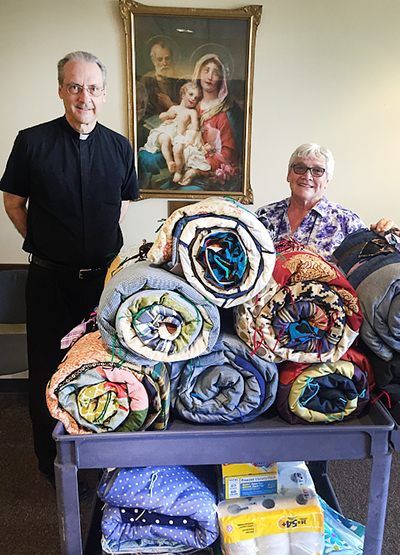
During the last Advent season, the Koperski family decided to do something for families in need. They purchased fabric, stuffing and other materials needed to make warm blankets, pillows and stuffed animals for adults and their children. After receiving a call from their father David, we set up a time for them to come in and drop off the handcrafted gifts.
It was a family effort, though the children did most of the work. The project was spearheaded by Julianna, 13 (who taught herself how to sew a few years ago), and the rest of her siblings: Dominic (11), Lydia (9), and Aiden (2). As dad said, “It’s funny that we can take a pillow for granted!”
Last year, I asked Jack Crowley, one of our Bountiful Harvest corporate members, what differentiates a generous from a non-generous person. Without batting an eye he responded, “Happiness.”
He has frequently told me that there is great joy in giving. Isn’t it true? The happiness in the children’s faces as they brought these beautiful gifts to our office was even more evident when they posed for a picture.
I would like to thank the Koperski family and other families like them, for this is not the first time children have given themselves in projects for CSS. In addition to thanking the children, I always like to thank their parents for, ‘Good fruit does not fall far from a good tree.’
By now, we have all heard the phrase “The New Evangelization.” If you are like me, you have struggled to understand what that phrase even means. Is the Church bringing in some sort of consulting firm? Maybe the theologians are drawing up a plan? When do these evangelists show up at my door?
I’ve come to understand the New Evangelization by breaking it down into subcategories set forth below.
What it is not:
It is not a spectator sport, nor is there a requirement that every Catholic is to grab a bullhorn and a picket sign to threaten everyone with Hell if they don’t repent.
What it is:
The New Evangelization has three primary objectives which tell us what it is. The objectives are: 1. To help practicing Catholics deepen their relationship with God; 2. To help young Catholics become adult Catholics; 3. To attract non-practicing Catholics back to the Catholic Church through a thorough explanation of the truth of the Church and a more robust introduction to the beauty and goodness of Catholicism.
These three objectives are achieved when we combine faith and reason in order to know not only what the Church teaches, but why the Church teaches it and how beautiful the Gospel really is.
Why we need it:
The United States is becoming de-Christianized right before our eyes. There are currently about 70 million Catholics in the U.S. That sounds like a lot, but only around 10% to 30% of us actually receive the sacraments on a fairly regular basis. Catholic families still have more children than the average American family, but young Catholics have been leaving the Church at an increasing rate, and fewer and fewer of those who leave their faith are returning as they reach adulthood.
This means that even though we are baptizing more children than the average American Christian family, we are not ending up with anywhere near that number of adult Catholics.
The Catholic population of the U.S. has basically held steady for the last 20 years, mostly due to Catholic immigrants. But the children of Catholic immigrants are walking away from their faith at at least the same rate as the rest of the country’s Catholic youth. Therefore, researchers predict that the Catholic population of the U.S. is going to be decreasing rapidly over the next 25 years.
Who is supposed to be doing it:
We are all called to participate in the New Evangelization, both as disciples and as priests, prophets and kings. (See the Catechism of the Catholic Church897-913.) This may sound demanding at first, but it isn’t. In fact, if you are nourished by the sacraments and prayer, your participation in the New Evangelization will be extremely fulfilling, invigorating and exciting. Not only that, but it will be eternally rewarding.
Does this mean that you will become a public speaker, lead prayer groups and Bible studies or be ordained a priest? Some of you might, and if you are so called, you must say “yes.” But we all have different gifts. While eloquent speech and the gift of teaching could flow from the grace you receive from a deepened relationship with God, your gifts could lead you to something totally different. This is because the Body of Christ is made of many parts (feet, heart, hands, eyes, mouths, etc.).
In order to function as Christ planned, the Church must have people in all the different roles. It is our job to discern the gifts we receive and then to put those gifts to work in a way that glorifies God. Rest assured that God will not call you to anything that will not flow from the graces he gives you.
We are all called to some role in the New Evangelization because we are each a living part of the great Body of Christ. As that living part, we must function as designed or we might better consider ourselves something other than a living part of the Body.
Some of us may participate in the New Evangelization simply by smiling and showing joy more often than we do today. Others may volunteer to do something new in the parish, such as becoming an usher, an acolyte or a Eucharistic adorer. From the most humble and unseen act of service in the parish to the most visible, the New Evangelization is the call to fill each role according to your gifts, so the Body of Christ is healthy and strong.
How it is supposed to work:
Your role in the New Evangelization is defined by where you are on your personal spiritual journey today.
In other words, you must determine where you could benefit from some growth, then pursue it. You may already know what the Church teaches well, in which case you might spend more time on the reasons for the teachings. You may know the teachings and the reasons, so you might focus on developing a deeper appreciation of the beauty of the Catholic faith through the liturgy, prayer, art, or service of the poor and needy of the world.
If you think you are good enough on all three, you likely need to grow in all three. Sorry, I had to be the one to break the news to you on that one, but people who think they are good on all three are kind of like the Pharisees in the Gospels. Jesus was tough on them.
The opposite of the pharisaical mindset is that of an intentional disciple. An intentional disciple deepens his or her relationship with Christ and thereby effortlessly evangelizes others by word and deed. One of the beauties of the New Evangelization is that by being evangelized, you evangelize.
On the other end of the spectrum is the fearful servant who has been given gifts, but refuses to use them. The fearful servant does nothing, the Pharisee pats himself on the back, and the disciple does God’s will.
The 105th Legislature began their work at the state capitol Jan. 4. To say there has been no shortage of excitement is almost an understatement given everything that has occurred in the first few days.
While the regular theme of this column will be to provide information and insight on specific issues being considered by the legislature, for now I want to offer a summary of why the first few days have triggered such excitement.
Election of Committee Leadership. Every odd-numbered year marks the beginning of a new legislature which occurs over a two-year period. At the beginning of a new legislature (i.e., odd-numbered year), state senators elect various leadership positions, including the speaker of the legislature and the chairperson of the fourteen standing committees that hold hearings on legislation. The speaker of the legislature has important and powerful responsibilities such as determining the daily agenda and determining when legislation will be debated. The chairperson of each committee has similar influence over legislation within their respective committee.
This year, nearly all of the elected leadership positions went to those who identify as politically conservative or Republican. This was an immediate source of tension for politically liberal or Democrat members of the legislature.
Introduction of Legislation. The first 10 working days of the legislative session are devoted to the introduction of legislation. Over the course of those 10 days somewhere around 600 pieces of legislation will be introduced. The number of bills an individual senator introduces varies from senator to senator. Some senators may introduce only a handful of bills while others may introduce as many as 30 or 40 bills.
After introduction, each bill is routed to one of 14 standing committees (e.g., revenue, education, judiciary, health and human services, agriculture). The committee’s duty is to provide a public hearing and allow for public input on the legislation. Ultimately, the committee decides whether to advance legislation to the whole body of the legislature. Where a particular piece of legislation is routed is usually dependent on the underlying subject-matter of the legislation. For example, if a bill is intended to provide tax credits to assist low-income students obtain scholarships to attend private schools, the bill would go to the revenue committee. While a bill’s subject-matter largely controls its direction, there is an executive committee, consisting of eight senators, that ultimately decides where legislation will be directed. Whether a bill is heard by an (un)favorable committee essentially controls its destiny, making this aspect of the process critical.
Robust Debate. As mentioned earlier, nearly all elected leadership positions of the legislature went to politically conservative senators. This caused a ruckus predominantly among politically liberal or Democrat senators. They argued that the bipartisan nature of the legislature was being threatened. In response, it was argued that while senators within the legislature do not identify with any particular political party, as a matter of the structure of the unicameral, it is unquestionable that individual senators and their legislative districts have certain political leanings and attitudes.
Another issue that received attention was term limits and their effect on things like institutional knowledge and respect for written and unwritten traditions. Out of the 49 senators in the legislature, 17 senators are only in their third year of service to the state and another 17 are first-timers to the legislature. This means two-thirds of the legislature has two years or less experience in the legislature. In addition, three newly-elected senators received committee chair positions, which is unprecedented.
However, it was also noted that while many senators might be new to the legislature, many of them have previously held public office and are familiar with representing constituencies and evaluating policy. In other words, for these senators, this is not their first rodeo, so to speak.
Take-Away Point. As the legislature progresses into this year’s and next year’s session, these opening day dynamics will have an all-important effect on the tenor and tone of the legislature moving forward. Many of the issues identified will be the undertones on many of the issues that play themselves out in the next two years.
“Wolf Storm,” by Dee Garretson Harper Collins, 2011, 275 pages, Grades 4-7.
Wolves have filled people with fear and fascination. Perhaps wolves have developed this negative reputation because they roam through forests, mountains and untamed places. They certainly look fierce and formidable. The lonely howl of wolves is intimidating.
Because of these reasons, wolves were for the most part, wiped out of the lower 48 states. In recent years they are beginning to be reintroduced in national forests such as Yellowstone. Dee Garretson has used a number of images of wolves in this novel. The central characters come into frightening firsthand encounters with wolves. The name of this adventure story is “Wolf Storm.”
Everything starts out simply enough. An American movie crew is filming a science fiction movie in the Carpathian Mountains in Slovakia. On the set are domesticated wolves being handled by a wolf trainer. These wolves will be used in various scenes in the film.
The central female character is named Raine. She is a child star and used to being pampered. Opposite Raine is Stefan, a first-time actor from a poor family. Both are in their early teens. A young boy named Jeremy and an older actor named Cecil complete the acting cast for the film.
The film’s setting is an old chalet in the mountains. Raine is very hard to work with because she is conceited. Stefan is merely happy to be acting in the movie because his salary will help his poor family. During a film shooting, Stefan sees a wild wolf skulking at the edge of the set. When Cecil confirms Stefan’s sighting of the wolf, the directors and producers tell them that they are imaging things.
Stefan continues to have an uneasy feeling. When the workday ends, most of the adults go into town for dinner and relaxation. Only the elderly Cecil remains behind with the three children. As evening falls, a blizzard strikes and quickly covers the roads and blankets the chalet. Soon, the children and Cecil know that they are their own. They hear the domesticated wolves growling in their kennels and decide to bring them inside. All the time the snow continues to fall and a pack of wild wolves begin to howl in the forest. The wild wolves are hunting for food and seem to be ready to attack.
As the children wait, a great cracking sound occurs on the mountain side. All three children look up and see a gigantic avalanche bearing down on them. Like a white tidal wave it crushes the chalet. Stefan is buried in a snowdrift and Raine begins digging him out. But no sooner does Raine save Stefan from suffocation than it becomes apparent that the wild wolves are closing in as well. What happens next in this frozen, white nightmare?
What has happened to Jeremy and Cecil? Do the tame wolves join the wild pack? Can the children manage to save themselves from the brutal cold and the threatening wolf pack? What would you do? What do the children do? To find out, go to the library and check out “Wolf Storm” by Dee Garretson.
The story starts off a bit slow as the author has to develop a complicated setting. But the courage of Stefan and the maturation of Raine are uplifting. The most exciting part of the book is the ending when the children are confronted by the lead wolf. These scenes are gripping as Dee Garretson knows how to write thrilling chapters. I hope you get a chance to read this title, or one of her other exciting novels such as “Wildfire Run.” Her stories are fun to read. Enjoy!
The Christmas Season ended Jan. 9 with the celebration of the feast of the Baptism of the Lord in the Jordan River by St. John the Baptist. Didn’t the Christmas season fly by?
Did you ever wonder why the liturgical color of ordinary time is green? It is to symbolize the new growth in our souls from the graces received during the Christmas and Easter seasons, like new green buds during the spring. That said, here are some of my post-Christmas thoughts.
The King of the Universe, the divine person of the Son of God, took flesh from the Blessed Virgin Mary, making her the Mother of God and our blessed mother. King Herod, always fearful of being usurped, who killed his favorite wife and several of his sons, secretly decided to destroy the child Jesus. He would have no king rule over him. The wise men came bearing gifts of gold, a gift fit for a king; frankincense, a gift for God; and myrrh, a perfumed ointment used to anoint dead bodies, to symbolize the type of death Jesus would die. You can bet that King Herod, if he had known about these gifts, would have wanted them for himself.
As we navigate through this period of ordinary time toward the celebration of Lent and Easter, let us remember that the Son of God came to earth and assumed a human nature to accomplish two things – first, to die; and second, to start a Church in which we find our salvation. He came to die, so that we who were dead in sin may live eternally; and to start a Church we call Catholic, which means universal, for everyone, which is the mystical body of Christ. Jesus is the head and we are members of His body.
Today, more than 2,000 years later, many of us feel and live the same way, refusing to have Jesus, the King of the Universe, rule over us. As Jesus was presented gifts of gold, frankincense and myrrh, we can ask ourselves if we pay Jesus homage as our king, if we adore Him as our God, and if we give of ourselves in a sacrificial way by our prayers and penances for others, and whether we use our time, talents and treasures for ourselves or for others, which is evidence of our love of God.
Please allow me to take this opportunity to thank our many volunteers and donors who give us their time, talents and treasures in the imitation of the wise men for no other reason than for their love of Jesus Christ, the eternal Son of God, the Word Made Flesh.
From Jan. 16-27, I will be traveling to the Holy Land with a group (including Gianna Emanuella, the daughter of St. Gianna) where the Word became Flesh and dwelt among us. It is there that I will be offering a number of Masses for our staff, volunteers and donors, who make what we do possible. Jesus Christ, King of the Universe, have mercy on us, the Immaculate Heart of Mary, pray for us!
January is a particularly bittersweet month for the pro-life movement. On the one hand, Jan. 22 marks the anniversary of Roe v. Wade and Doe v. Bolton, the notorious Supreme Court cases that enshrined the right to abortion throughout all nine months of pregnancy. On the other hand, January marks an opportunity to mourn this anniversary with a tremendous sense of hope in the power of Christ as we joyfully witness to the dignity of human life.
As we enter the month of January, I want to highlight various activities that all of us can encounter with hearts of prayer and action.
Pro-Life Mass and Nebraska Walk for Life (Jan. 14). Every year, the Nebraska Right to Life sponsors the Nebraska Walk for Life. The Walk begins at 10 a.m. on the north side of the State Capitol. Beforehand, the Nebraska Catholic Conference and the Bishops’ Pastoral Plan for Pro-Life Activities sponsor a Pro-Life Mass at St. Mary (14th & K) which begins at 9 a.m. Most Rev. George J. Lucas, Archbishop of Omaha, will celebrate the Mass. Rebekah Buell will be the keynote speaker for the Walk, and will share about reversing her RU-486 chemical abortion. Both of these events testify to the power of our public worship and peaceful public demonstration.
Inauguration of President Donald Trump (Jan. 20). As we welcome our next president, it would be beneficial to humbly pray that President Trump would fulfill his campaign promises to ensure that unborn life is protected through the regulations and policies under his control, the laws that he signs, and the judicial appointments he makes (most especially to the Supreme Court).
9 Days for Life Novena (Jan. 21-29). Sponsored by the United States Conference of Catholic Bishops, 9 Days for Life is an annual period of prayer and action focused on cherishing the gift of every person’s life. The main intention is to end abortion. This novena calls people across the country to gather for a unified act of prayer.
You can join the novena at www.9daysforlife.com and receive notifications via mobile app, e-mail, text message, or other social media platforms (e.g., Twitter, Facebook, Instagram)—or you can simply print off the novena. Invite your family, friends, or parish to join.
Anniversary of Roe v. Wade (Jan. 22). The anniversary of Roe v. Wade provides a particularly solemn moment to pray for a greater awareness of the dignity of human life from the moment of conception. This day calls us to acts of prayer, fasting, and almsgiving, to do reparations and atonement for the sin of abortion in our country.
National March for Life (Jan. 27). Every year, around half a million people gather in Washington, DC, to peacefully protest legalized abortion. Having been to the March a number of times in my own life, this event is a foretaste of Heaven. Thousands of saints-in-the-making joyfully testify to the beauty of life and call our nation to something greater. While not all of us can be physically present for this event, there is no doubt we can join in spirit through our prayer, as well as ensuring that our family, friends, co-workers, parish, etc., know about this event since it receives little media coverage.
Pray at Abortion Mill. Planned Parenthood in Lincoln (48th & Old Cheney) is undergoing a resurgence in abortions. For some time, the abortion mill was without a regular abortionist. In recent months, they have hired a regular abortionist, Dr. Deborah Turner (pray for her conversion).
A number of individuals maintain a peaceful presence outside the abortion facility, praying for conversions and counseling women who seek abortions. For those who can, join in this peaceful and physical presence on Tuesday mornings. For those who cannot, set a personal reminder to join through prayer and sacrificial acts (e.g., fasting, almsgiving, spiritual adoption).
As you consider all of these prayer possibilities and the bittersweet nature of January, recall the words of the Psalmist: “May those who sow in tears reap with shouts of joy! He that goes forth weeping, bearing the seed for sowing, shall come home with shouts of joy, bringing his sheaves with him.”
“The Poet’s Dog,” by Patricia MacLachlan Harper/Collins Publisher, 2016, 88 pages, Grades 3-5.
Poetry is the music of literature. This unusual combination of sounds, words and meter can make poetry difficult to understand but also is the reason that poems can describe feelings and situations so completely.
Since poets usually work alone, they must draw on experiences in their worlds. These can be encounters with people, nature or the world of literature. Because poets draw on such wide experiences, they make excellent teachers for those willing to listen and understand.
In this beautifully-told story, two children come into contact with a poet and learn about some of the beauties of life. Patricia MacLachlan is an elegant writer and has crafted a comforting story about this event. She entitles it, “The Poet’s Dog.”
Flora and Nickel are travelling with their mother when a blizzard strikes. Soon, they are unable to continue down the road. All around them a swirling white nightmare blankets their car. After a few hours, their mother strikes out into the storm to try to find help. The children stay in the car for many hours, but then decide that they too must try to find their way to safety.
Nickel wraps his younger sister Flora in a blanket but soon they become lost in the snow. As cold and snow increase, the children know that they will perish if someone doesn’t save them.
Just then, an Irish wolfhound arrives through the swirling gusts. He begins speaking to them. Since the children have not lost their innocence, they can understand the dog’s speech. He tells them his name is Teddy and that he will take them to a cabin in the woods to escape the snowstorm.
They trudge behind him and come to a curious cabin. When they go inside, Teddy tells them that this is Silvan’s cabin. Silvan is a poet and had rescued Teddy as a puppy. The poet has just recently died and Teddy is quite lost without his love.
As the children listen to Teddy, they find out many things. Silvan has read many poems and books to Teddy and taught him about the important things in life. This is why Teddy can talk. Teddy has also learned about love, friendship and loyalty. The children and the dog begin sharing the stories of their lives and feel a bond beginning to develop.
The days continue to pass and Flora cooks their meals, Nickel keeps trying to shovel out to the road and Teddy’s heart starts to heal. After several more days the storm ends. The children don’t know if their mother survived the blizzard, but they do know that people will be searching for them. They suddenly hear a banging on the door. What happens next? Who is at the door? Can the rescuers understand Teddy? Why can’t the adults appreciate the beautiful world Teddy and the children have shared? How can life be like a poem? Do the children get home? What finally happens to Teddy? To find out the answers to these questions, go to the library and check out this touching book, “The Poet’s Dog” by Patricia MacLachlan.
Patricia MacLachlan writes short, poignant novels. Her prose is reassuring, comforting and pleasurable. She won the Newbery Medal for her outstanding novel “Sarah: Plain and Tall.” She holds characters in the palms of her hands as they work out and solve life’s struggles. I hope you get a chance to read this lovely novel or any of her other fine works of fiction. “The Poet’s Dog” is delightful and uplifting. Enjoy!
Not all that long ago, a woman living in the western part of the diocese needed help escaping an abusive husband. Because of the generosity of our donors, we were able to relocate her to another community. Since then, because of the generosity of our supporters, we are helping more women living out west under the umbrella of St. Gianna’s.
One of my Christmas promises was to travel to our offices across the diocese to offer a special Mass for our staff and volunteers. After offering a Mass in the St. Isidore chapel in Imperial, I stopped at Sehnert’s Bakery in McCook, owned and operated by Matt and Shelly Sehnert. I found that baking has been in the Sehnert family for many generations.
While at the bakery, I witnessed and was able to roll out a few Stollens, which are Christmas fruit breads. They have a noticeable hump in the middle that is said to symbolize both the hump of the camels that carried the wise men who visited the baby Jesus bearing gifts of gold, frankincense and myrrh; and the nave of churches (the candied fruit symbolizes the stained glass windows therein).
I was fortunate to be able to help rolling the dough and constructing the hump (it’s a trade secret). In addition, I was able to taste the Christmas bread toasted with a dab of butter. Now I know why it flies off the shelves prior to Christmas at Sehnert’s.
I would like to personally thank Matt and Shelly once again for their hospitality and for allowing me to see the operation in action and the chance to help with rolling the special dough that makes a Stollen. When in McCook, I always try to stop there for a little breakfast roll, coffee or tea.
As I reflect back on my few days out west during this Christmas season, I am grateful to our many donors who support us, not only out west, but throughout the entire diocese as we move forward this New Year. Please do not forget that we at Catholic Social Services are praying for you and your families.
While politicos and people around the world prepare for President-elect Trump’s “First 100 Days” in office, a recent action by President Obama is a stark reminder to remain vigilant of a president’s final days in the Oval Office.
On Dec. 14, President Obama’s administration finalized a rule that would prohibit states from defunding Planned Parenthood’s abortion business.
Three months ago, the federal Department of Health and Human Services (DHHS) proposed a rule concerning its Title X Family Planning Program that was enacted in 1970. Title X is intended “to provide family planning and related preventive health services” to low-income and uninsured individuals. Among the types of services included in Title X are contraception, sexually transmitted diseases, fertility, pregnancy care, and breast and cervical cancer screening. Under Title X, states receive grant money from the federal government. In turn, states then distribute the grant money to qualified subrecipients.
In recent years, especially in response to David Daleiden’s exposé on Planned Parenthood’s involvement in the profitable sale of the fetal tissue of aborted unborn babies, states were placing priorities and limitations on subrecipients. For example, in Tennessee, Title X funds are distributed to community health centers and other providers prior to dispersing funds to Planned Parenthood abortion facilities. This is similarly done by our neighbor to the south, Kansas.
As the DHHS explains on its website announcing the finalization of the rule, “[t]he final rule clarifies the Title X program regulations by adding that no grant recipient [states] making subawards for the provision of services as part of its Title X project may prohibit an entity from participating for reasons other than its ability to provide Title X services.”
The rule will take effect Jan. 18, 2017.
As Steven Aden, senior counsel for Alliance Defending Freedom, stated: “The Obama administration, even in its waning hours, has chosen to put Planned Parenthood’s Big Abortion agenda ahead of women’s health and the right of states to decide how best to prioritize public health funding so that patients and the most comprehensive health providers come first.”
Or, in the words of Chuck Donovan, president of the Charles Lozier Institute which is the research arm of the Susan B. Anthony List: “The rule assists a handful of vendors the administration prefers, at the expense of tens of thousands of patients.”
Ultimately, the problem with this finalized rule is President Obama and his administration’s exaltation and worship of the contraceptive mentality, which has as its safety net the need for abortion. Rather than permit states to justifiably focus their federal funds on entities, like community health centers, that provide comprehensive health services, President Obama and his administration prioritize ideology ahead of serving the real health care interests of low-income and uninsured patients. This, in turn, points to the grasp that the “culture of death” and “throwaway culture” continues to hold on our nation and public policy.
There does remain an opportunity for hope. The policy could be repealed. Repeal may occur through another rule-making process or a joint resolution of disapproval by the House and Senate, with the president’s approval, within 60 working days of Congress. Either task would be formidable, but an important step in providing states the discretion to maintain control in how they utilize their Title X funding and, if they so desire, prevent entities, like Planned Parenthood, from receiving funds based on their involvement with the evil of abortion.
With the incoming Congress and president, there will be work to do to ensure that our country is one that values and respects human dignity by creating a culture of life and a civilization of love. Never forget that the voice and values of people—like you and me—remains important in steering our country in such a direction.
“The Story of the First Christmas” by Ruth Sanderson. Ariel Books, Atlanta, 1994, 10 pages, Grades K-2. ISBN 1-57036-039-1
Pop-up books are some of the most entertaining books in library collections. Filled with cardboard cutouts that “pop up” when the page is opened, these delightful creations have long fascinated readers of all ages.
Some pop-up books have moving parts in which characters wave their hands or move parts of their bodies. The charm of these books is enhanced by the vibrant colors and shapes readers find in the books. They can actually become three-dimensional works of art. One point of importance regarding pop-up books is that they are fragile. So young children must be taught to handle these books carefully or else they can be damaged or destroyed. If the moving parts are broken, much of the magic of pop-up books is lost.
Ruth Sanderson has created a carousel pop-up book about the Nativity. She uses New Testament passages describing Our Lord’s birth. But when you have completed reading the book, you can stretch the entire book into a carousel. It is amazing. The name of the special book is “The Story of the First Christmas.”
On the first page, Sanderson has a cutout of the Annunciation. Here we see the Archangel Gabriel asking the Blessed Virgin to become the Mother of Jesus. Fortunately for everyone, Mary says yes.
Turning the page, readers will encounter an elaborate cut-out of St. Joseph leading the Blessed Mother into Bethlehem. We see them turned away at the inn, so St. Joseph must search for another place for his family. This is followed by the angels visiting the shepherds and chanting the marvelous words, “Behold, I bring you glad tidings, for unto you is born a Savior, Christ the Lord.”
This wonderful news is followed by an elaborate design of the Three Kings coming to visit Jesus. Finally, in the last double sided design, we see that St. Joseph has found the Holy Family a humble home in a stable. There the Holy Child has been wrapped in swaddling clothes by His loving mother, Mary. We also see that the Three Kings’ long journey has come to a joyous end and they present their gifts of gold, frankincense and myrrh to the newborn King of the Jews.
Sanderson does not tell the entire account of the Nativity in this book. Pop-up books are simply too detailed and complicated to keep going on and on. She has selected a number of important passages from the Infancy Narratives and included them with the appropriate texts from the Bible. When readers have finished reading the book, they can take both covers and stretch them in a circle until they touch each other. They actually will form a star. When readers turn the star it will resemble a carousel. When you look at the beauty of the Infancy Narratives being told in this unique and amazing manner, it is easy to see that Ruth Sanderson has a deep love for Jesus Christ and takes pleasure in helping readers delight in this wonderful event.
Very few pop-up books are available in public libraries. The sad reason for this is that children get so excited looking at pop-up books that they frequently tear one of the moving parts. As already mentioned, much of the charm of a pop-up book is that it actually “pops up,” and some of the charm is lost if the book is damaged. But if you want a delightful book for Christmas Eve, go to the bookstore or order “The Story of the First Christmas” by Ruth Sanderson. You will like the book as much as the children. Merry Christmas!
Recently, I went to the home of Dr. Michael and Ginger O’Donnell for a party in honor of Our Lady of Guadalupe, whose feast day we recently celebrated. As you recall, the Blessed Virgin Mary appeared to St. Juan Diego in 1531 pregnant with Jesus Christ. Within six years of the apparitions, millions of people in the Americas became Christians as spiritual sons and daughters of the Virgin Mary (Jn 19:26-27; Rev 12:17) and adopted sons and daughters of God the Father. She was proclaimed “Patroness of the Americas” by Pope Pius XII in 1946.
During this party, the children participated in acting out what is called Las Posadas, which in Spanish means “the inns” or “hotels.” The children dressed up as the expectant Mary and Joseph (there were two Josephs!) and their entourage who went from inn to inn in search for a place for his wife to give birth to the Savior of the World. The children did a marvelous job acting the parts.
The first stop was at the garage door. “We’ve come from Nazareth for the great census and my betrothed is going to have a baby!” said Joseph. Then Mary said, “We will name him Jesus. He will be great, and will be called Son of the Most High!” The answer of course was no. “There is not room in the inn!” said the innkeepers.
After making the second and third requests at the back deck and basement doors, all the while singing in between, Silent Night and Away in a Manger (keep in mind it was cold outside), the last innkeeper suggested staying in a cave fit only for animals. Imagine, the all-powerful King of the Universe being born in a humble stable for animals. Finally, they entered the house and laid the baby Jesus in the manger at the foot of the Christmas tree. I was so proud and impressed with the children.
As we contemplate the mystery that is Christmas, let us thank God the Father for the best gift ever given, that is, the gift of His only begotten Son as Savior of the World. He came to die, so we who were dead in sin may live, not for a time, but for an eternity.
I would like to thank all of our benefactors who support us spiritually, materially and financially during this most holy time of year. Please know that you, your families and intentions remain in our daily prayers and Masses. Merry Christmas!!
Advent is a beautiful time to reflect on the coming of Christ into the world. At the Nebraska Catholic Conference (“NCC”), we are preparing for another coming: the state legislative session.
The 2017 legislative session begins Jan. 4 and marks the convening of the 105th Legislature which will take place over a two-year period (biennium). The first session (2017) of the biennium occurs over a 90-day period. The second session (2018) of the biennium occurs over a 60-day period.
As you read the newspapers or watch the evening news, you are aware our legislature faces many issues. In fact, every year, our state senators introduce for consideration somewhere between 500-600 legislative bills. It goes without saying: there will be plenty to follow.
As we anticipate this year’s legislative session, I wanted to provide some practical advice to prepare for the 105th Legislature.
Visit NCC’s Website and join “Catholic Advocacy Network of Nebraska” (CANN). For most people, tracking all (or even some) of the business of the state legislature is out of the question. This is understandable as the everyday tasks and responsibilities of life can oftentimes take precedence. But this does not mean you should be left unaware of the issues our state government is confronting, especially issues that directly concern Catholic faith and morals (e.g., life, marriage, family, religious liberty, education, poverty, immigration).
At the NCC, we maintain a website (www.necatholic.org) that tracks major legislation of concern to Catholics. On our website (www.necatholic.org), you can also sign up for our “Catholic Advocacy Network of Nebraska.” Through CANN, we provide e-mail updates on the work of the legislature and notify you when Catholics need to take action and contact their state senator. CANN ensures that Nebraska’s Catholic voice resonates in the halls of our state capitol.
The people of Nebraska are considered the “second house” to the state legislature, which means your voice matters to our state senators. As it is etched above the north doors of our state capitol building: “The salvation of the state is watchfulness in the citizen.”
Follow NCC on Social Media. The NCC maintains a page on Facebook and Twitter. ‘Like’ the “Nebraska Catholic Conference” page on Facebook and ‘Follow’ @NECatholic on Twitter. Our Facebook and Twitter pages contain regularly updated content regarding the activity of the NCC and state government.
Contact NCC’s Office & Host Us at Your Parish. While the internet can sometimes be the easiest way to deliver updates, please know you are always welcome to contact us personally to learn more about the issues (402.477.7517). Also, we are always happy to come to your parish and provide updates or give issue-specific presentations.
Learn about the Unicameral. Our legislature has a user-friendly website (www.nebraskalegislature.gov) that provides ample resources to learn more about the legislative process. For example, you can learn the basics of the lawmaking process (i.e., how an idea goes from a bill to law), refresh your history of the unicameral, track introduced legislation, or research past legislation.
Learn about Your State Senator. The legislature’s website also provides a separate page for each state senator. Many state senators maintain regular content to inform constituents about the legislature’s activity. As well, you can easily find your senator’s contact information. Never be afraid to reach out to your Senator—in fact, they are often pleased to hear from constituents.
I highly encourage you to get to know your state senator. Term limits are beginning to have a visible effect on the make-up of the legislative body. For instance, there are seventeen new senators and another seventeen who have served the legislature for only two years. This means there are a lot of new faces in the legislature. It is critical to know who your state senator is, understand their policy positions, and know how they vote on the issues.
Pray. Most importantly, pray for the NCC and pray for our state senators. Pray for the gifts of the Holy Spirit to fill the halls of the state capitol, so that our state might secure the common good for all Nebraskans.
Dear Readers: I hope that you have enjoyed the Children’s Literature Bookshelf during the past year. Buying books for your children, grandchildren, nephews and nieces can be one of the most pleasant Christmas activities of the season. This week I compiled a list of books that have been reviewed in the last weeks of 2015 and through mid-December of 2016. I hope that this list will give you some ideas for books that might make nice Christmas presents.
You may read all the reviews of the past year (and of several previous years as well!) at this link.
It has been an honor to have written these book talks for the Southern Nebraska Register. Thanks for the book recommendations and encouragement you have given me. I hope that you and your family have a joyful Christmas.
I am most appreciative of our many supporters who allow me to drop by from time to time, without an appointment. I figure I need to do the same thing, so when I am free and someone stops by the office to see me unannounced, I ask the receptionist to have them wait in the chapel and I see them pronto.
Last week, a concerned woman wanted to talk. After meeting her in our St. Joseph Chapel, she informed me that “frozen angels have been discovered in blocks of ice in the artic, with their wings intact.”
She seemed a bit concerned. I reassured her by saying that if, in fact, they discovered some kind of winged creatures in ice, they are not angels (for angels do not have bodies as we do), and not to worry. I believe she left somewhat reassured.
That said, since we humans are body-and-soul composites, when we have suffered physical and emotional abuse, our bodies and souls are wounded. This is most evident with the ladies who come to St. Gianna’s with their children. Just this week, we admitted a woman with a black eye to St. Gianna’s. Hidden in her soul are her emotional, psychological and spiritual wounds. The goal at St. Gianna’s is to heal all of these wounds.
Not long ago, a woman with four young children graduated from St. Gianna’s and moved into an apartment. She came to us after escaping a terribly violent situation. I remember meeting her little children, one of whom we were worried about as her affect remained flat for months.
As a baptized Catholic, the mom knew little about her Catholic faith. Because of the seeds planted by the Marian Sisters, she started attending Mass on a daily basis. They were all “angels” at Mass. She and her children thrived and rebounded because of the healing that only the Divine Physician can provide. I remember before her graduation, when she learned she qualified for a housing rent voucher, she refused it saying, “Father, I want to do this myself. I do not want to be dependent on the government!” She is now working at a minimum wage job as a single mother with her four children. Since things are very tight, we still help her with the hurdles present in her life. Her biggest concern right now? Sending her children to a Catholic school. She wants them to have what she did not have, namely, a Catholic education.
As we continue preparing ourselves for Christmas this Advent Season, I cannot help but marvel at the generosity of our loving donors who have made this woman’s physical, psychological and spiritual healing possible. But there are many others like her under the umbrella of St. Gianna’s Women’s Homes and more to come. What is more exciting than to be involved in saving lives and souls?
Please remember Gianna’s Java & Gelato (located at our St. Joseph’s campus at 23rd and O streets in Lincoln) for your caffeine, food and gelato urges, for all of the proceeds help those we serve at Catholic Social Services including the woman and her children mentioned above. Thank you all! St. Gianna, pray for us!
“The Nativity: From the Gospels of Matthew and Luke,” by Ruth Sanderson Eerdmans Press, Grand Rapids, Michigan, 2010, 26 pages, Grades K-6.
Original sin was brought about by the sinful disobedience to God’s commands by our first parents, Adam and Eve. In addition to losing many graces, death entered the world.
Modern people do not like to talk about the effects of original sin because it is either too depressing or because they don’t believe that it exists. If the 20th century teaches us anything, it teaches us that mankind is not perfect and needs God’s graces to overcome tendencies toward sin and selfishness. Though many continue to blindly deny it, this history is proof that humanity has a fallen nature.
Having stated the obvious, what is needed to help people reach God? The answer is again obvious. We cannot overcome the chasm caused by our rebellion against God without divine assistance. Because of this, God must intervene in human history. So, as Saint Paul tells us: “But when time had fully come, God sent forth His Son, born of a woman, born under the Law, to redeem those who were under the Law, so that you might receive adoption as sons, God has sent the Spirit of His Son into our hearts, crying “Abba! Father!” So through God you are no longer a slave but a son, and if a son then an heir.” (Galatians 4: 4-7)
The first great chapter in the Father’s plan of redemption is the Nativity, the birth of Jesus Christ. Ruth Sanderson has drawn a gorgeous picture book based on the Infancy Narratives of St. Matthew and St. Luke. The name of this lovely book is “The Nativity: From the Gospels of Matthew and Luke.”
Sanderson combines the Infancy Narratives of St. Matthew and St. Luke into one complete story of Our Lord’s birth. She begins this commonsense approach with a touching picture of St. Luke’s account of the Annunciation. In the second picture Sanderson paints Mary after she has given her “fiat,” or verbal acceptance of the Angel Gabriel’s message.
Next, readers are graced with the beautiful story of St. Joseph taking Mary to Bethlehem for the census. The artist then paints the birth of Jesus with the Holy Infant wrapped in swaddling clothes lying in the manger. In the succeeding paintings, Sanderson skillfully blends the shepherds visiting the Infant Jesus and the visit of the Three Kings.
After the Three Kings depart, King Herod realizes that he has been tricked by the Magi and sends his brutal assassins to kill the Christ Child and all the boy children of Bethlehem under 2 years of age. But before this can happen, Sanderson paints holy Saint Joseph leading the Blessed Mother and the Holy Child on the flight into Egypt. The book concludes with the Holy Family returning to Nazareth and Jesus “increasing in wisdom and stature and in favor with God and man.” (Lk 2:52)
I can’t encourage you strongly enough to purchase this book for your family. The reviewer does quibble with Sanderson’s use of the 1611 King James translation of the Bible because it downplays the holiness of Mary. Whereas traditional Catholic bibles are based on St. Jerome’s famous Vulgate bible translation (420 A.D) in which the Archangel Gabriel addresses Mary as “gratia plena” or full of grace, the King James translation uses the rather lame expression of “favored woman.” Full of grace and favored woman do not mean the same thing.
Having said that, Sanderson has done everyone a great service with this stunning book. I would encourage you to buy this book for your family and read it to your children. The paintings draw readers into the Infancy Narratives and will enrich your Christmas season. I hope you and your family will enjoy this book as much as I did. God Bless!
I cannot imagine how many turkeys were consumed on Thanksgiving Day, but only know they are delicious, especially with all of the trimmings. Then there are Thanksgiving hams…
I am happy to relate that around 500 turkeys were distributed in Hastings, Auburn and Lincoln before Thanksgiving and Christmas this year because of a few generous donors. Across the diocese, they were distributed either on designated days or incorporated in food pantries (which are sacks or boxes of food that last a family for a week’s time).
I am also happy to announce that our generous benefactors across the diocese responded once again by donating almost 24,000 pounds of food to stock our three fixed food pantries. This is a great help to struggling families because when a food pantry is given to a family that is living paycheck to paycheck, the money saved is freed up to pay for other essentials such as rent, utilities, medical expenses, etc.
As we continue our Advent preparation for the coming of the Christ Child into our hearts, let us not forget the poverty that the Word Made Flesh came into the world. “And she gave birth to her first-born son and wrapped him in swaddling clothes, and laid him in a manger, because there was no place for them in the inn” (Lk 2:7). If Joseph had been a wealthy man, you can be sure that Jesus would have been born in a better place and laid in a bed for an infant, not a manger. Oh the Eucharistic illusions- Bethlehem, which means house of bread… a manger which is a feeding trough for animals. I can only imagine that because of their poverty, obtaining food most likely was also an immediate concern.
Please allow me here to thank all of our donors who support us, who love Jesus Who not only is present in the poor and needy but has told us so (Mt 25:31-46). May your Advent preparation be a fruitful one so that Christmas, and the Christmas season, will be a truly joyful one, reflecting on the greatest gift ever given to us, by our loving Father in heaven, the Word Made Flesh. “The Word became flesh and dwelt among us” (Jn 1:14). Please remember that Masses are offered each month for you, your families and intentions, and also please do not forget you are remembered in our daily prayers!
As Catholics, we have a particular call of care and concern for those who are considered “least among us.” Within this category is found the immigrant, whether documented or undocumented. As our nation undergoes a shift in leadership in the White House, it is fitting to consider our social and political attitude toward the immigrant.
Rhetoric toward the Immigrant during Election. For those who followed the presidential campaign, it comes as no surprise that the rhetoric and messaging of President-elect Trump toward the unauthorized immigrant was problematic. President-elect Trump often spoke about the need for walls and mass deportations of currently unauthorized immigrants. The immigrant community interpreted such words as words of unwelcome and hostility.
Understandably so, President-elect Trump’s victory was quickly followed by the fears and concerns of immigrants. This experience was noted by José Gomez, Archbishop of Los Angeles, in a prayer vigil within days after the election. Archbishop Gomez recognized the worries of children, parents, our own brothers and sisters in Christ. These were fears not based in the imagination—outside the context of objective reality—but responses to the actual words and conduct of a man soon to wield substantial political power.
These types of fears are also shared by our brothers and sisters in Christ who live with us as neighbors here in Nebraska.
Problem of the Rhetoric. The issue with the type of messaging used during the presidential campaign resides not in the fact that President-elect Trump is trying to propose elements of immigration reform, but rather that his language treats the immigrant as an object, a person-less entity, rather than a subject, a person with a face and name, full of value and dignity.
Unfortunately, this treatment of the immigrant stems from a broken immigration system fraught with issues that can only be healed through comprehensive reforms. The immigrant is perceived as a problem to be handled—a task, so to speak—instead of a person facing unique situations and difficulties of their own (which often motivate the desire to immigrate).
Christ as Immigrant. As we enter into the liturgical season of Advent, we are presented with a fitting opportunity to ponder the early aspects of the life of Jesus. In particular, one of the earliest recorded events of our Savior’s infancy concerns the Holy Family’s escape into Egypt. St. Joseph, urged by an angel, flees Bethlehem for Egypt, in order to protect the Christ Child from the coming infanticide of King Herod (Mt. 2:13-15). Christ Himself—“like us in all things but sin”—takes on the experience and status of an immigrant.
This aspect of Christ’s life provides us a point of departure for our social and political attitude toward the immigrant. Perhaps we can ponder how Christ Himself would handle our broken immigration system. What disposition of the heart, language, and conduct would He use in His approach to the immigrant? How can we conform to such an example?
Immigration Reform as Multi-Faceted. To ponder the life of Christ and how He would deal with our current broken immigration system is not to suggest that there is only one particular solution to the problem. With complex issues like immigration, there may be any number of reasonable solutions.
To begin with, for example, Catholic social teaching is clear that the state has a two-fold duty to protect its borders with reasonable legal enforcements and to welcome the stranger, especially those seeking refuge to better their livelihood. These general principles permit for a wide range of policy solutions, but they are fundamental principles that must be respected and balanced. One cannot focus simply on strict enforcement measures without accounting for the freedom of movement between countries. Similarly, one cannot propose open borders without expecting that justly established laws regulating the flow of immigrants be respected.
As Archbishop Gomez concluded his homily at the prayer vigil shortly after the election: “We need to be people of peace, people of compassion…. Tonight we promise our brothers and sisters who are undocumented—we will never leave you alone. In good times and in bad, we are with you. You are family. We are brothers and sisters.”
“Blizzard,” by John Rocco Hyperion Books, New York, 2014, 32 pages, Grades K-3.
Snow is a fact of life in the northern parts of the United States. It can bring up many happy memories of sled riding, snowball fights, snowmen and cups of hot cocoa. School children are usually happy when they see the snow falling because school might be cancelled the next day. When it is, children can sleep in and then later play outside with their friends.
But there is another side to snow. It is always cold and sometimes it can be dangerous. In some states, like Nebraska, it is usually accompanied by high winds that produce snowdrifts. In particularly bad moments there can be a whiteout, which is the snow swirling so fast that people lose all sense of direction.
John Rocco has written a book about the giant snowstorm that struck New England Feb. 6, 1978. The name of the book is “Blizzard.”
As the children look out the window on Monday morning, some snowflakes begin to fall. The students aren’t worried as the weather doesn’t seem to be very dangerous. But the snow continues to fall all morning, leading school leaders to decide to cancel the school day early. Happily, the children troop out of the school and head for home.
But the snow starts falling faster and harder. Luckily, the children get to their homes before the roads and sidewalks become impassible. Thanking their lucky stars, they go to bed hoping that school will be called off the next day.
Much to everyone’s surprise, the snow continued to fall throughout the night and the next day, the snowdrifts were so high that some people had to climb out of their windows to get outside.
One little boy studies the weather and reads a book entitled “Arctic Survival.” He learns that people can survive and travel in snow if they know about clothing and snowshoes. He files this away for future reference. The snow is so deep in his neighborhood that snowplows are unable to reach the area. For several days everyone enjoys the time off from school and work. But people were not prepared for the severity of the storm and begin to run out of food supplies.
On the sixth day of the snowstorm, the boy decides to get supplies for his family at a local grocery store. He knows he needs snowshoes to travel through the deep snow. In the closet, the family has stored all of their old sporting equipment. He sees two tennis rackets and gets an idea. What does he do?
Why does he need tennis rackets? Since the snow is almost as tall as he is, why does he stop by so many peoples’ houses on the way to the store? How does he show both courage and charity on his trip? Why does this boy show us that we can be heroes through common actions? To find out the answers to these and other questions, go to the library and check out this delightful book, “Blizzard” by John Rocco.
John Rocco is an acclaimed author/illustrator of children’s books. He won a Caldecott Honor Medal for the picture book “Blackout” in 2012. This book is the autobiographical account of what he did during the famous New England Blizzard of Feb. 6, 1978. It is a refreshing story of innocence and pluck. I hope you get a chance to read this book with the younger members of your family. You will relish the experience. Don’t forget, tennis rackets have more than one use. Enjoy!
At the annual Catholic Medical Association meeting which was held recently in Washington D.C., a pulmonary doctor gave a wonderful talk on spirituality in the practice of medicine and the miracles he has seen while practicing medicine.
He proceeded to tell a story of a patient he served during his time in the intensive care unit. It was there the patient’s heart stopped. Since he was on a cardiac monitor, the code team was mobilized immediately. While they were busy performing chest compressions and pumping drugs into his IV, the man later reported seeing Jesus Christ in judgment, Who informed him that he was damned to Hell for all eternity. The man said he was told that since he had used the many gifts given to him by God only for himself and not for others, he had lost his soul forever. Can you imagine the feelings of regret and despair?
I bet he had recited many rosaries during his lifetime, because out of nowhere, the Blessed Virgin Mary appeared. “Holy Mary, Mother of God, pray for us sinners, now and at the hour of our death, Amen!” She said, “Son, would you give him another chance? Son …. would you give him another chance? He will do better this time.” Then Jesus turned to His Blessed Mother, our Mother and said, “For you, mother, I will give him a second chance!” I can only imagine someone in the room said, “We have a heartbeat!” After leaving the hospital, this man spendt his time talking about Divine Mercy. But before receiving the mercy of God, we need to repent first. That was the message of St. John the Baptist during his time in the desert (Mt 3:2).
Please allow me to thank all of our volunteers and benefactors because by living self-less lives by using their gifts for others, we have been able to help so many people that have come to us in need. Please know that we will continue praying for you, your families and intentions especially during this holy Advent season and beyond. Please never doubt the power of the holy rosary.
Post-election politics has brought about more of the same heated rhetoric, division, and lack of charity that was par for the political course running up to Nov. 8. While the situation easily drives one to despair for our cultural situation, a silver lining can be found in a prominent, albeit obscure-to-most academic publication.
The silver lining is the most recently published issue of the Harvard Law Review. The issue is dedicated to Justice Antonin Scalia (may he rest in peace). The opening pages contain a handful of tributes to the late Justice Scalia by close friends and colleagues, including three sitting justices of the Supreme Court of the United States. The tributes model civil discourse, generosity, and charity that could only have as its source the very heart of God.
It was no surprise to read Chief Justice John Roberts’ words of praise for and friendship with Justice Scalia. As fellow conservatives and Catholics on the bench, they undoubtedly shared many deep values about law and faith. The Chief Justice wrote about Justice Scalia’s devotion toward family, jovial spirit, and sharp legal acumen. In the end, it was no small compliment for the Chief Justice to call Justice Scalia “our man for all seasons” (a clear reference to the life of St. Thomas More).
Even more moving than the accolades of the Chief Justice were the reflections by Justice Ruth Bader Ginsburg and Justice Elena Kagan. On the major social issues (e.g., abortion, same-sex marriage, religious liberty), there could hardly be a bigger divide between Justice Scalia and Justices Ginsburg and Kagan. Yet, reading their homages, one could sense deep respect, closeness, and devotion, cutting across ideological divides that separated the justices.
While noting deep differences of values, Justice Ginsburg recalled numerous fond memories. She shared their time singing duets for the Washington National Opera, his care and concern for her during major illness, and even a shopping adventure. Most notably, she shared Justice Scalia’s response when asked how the two maintained a deep friendship in spite of major disagreements: “I attack ideas. I don’t attack people…. [S]ome very good people have some very bad ideas…. And if you can’t separate the two, you gotta get another day job.”
Justice Kagan shared rich treasures of her friendship with Justice Scalia. She stressed how Justice Scalia sharpened her own legal skills and led her to “mak[e] my own argument more precise and rigorous” and “work harder and dig deeper, to search for arguments that would be able to withstand his mighty ripostes[.]” She called to mind numerous hunting trips where conversations transcended the legal arguments of the Court and delved into discussions about the joy of family, the meaning of faith, and the other pleasures of life.
Hidden in all of this is the deep witness of Justice Scalia’s life. This was a man who took faith seriously and, thereby, joyfully lived out the call of charity toward God and neighbor. While our own age would consider relationships with those who are “political enemies” or “on the wrong side of the issue” outside the bounds of friendship, Justice Scalia was moved by respect for the human person born out of the love of Christ—a love unbound by any division.
Justice Scalia understood that a true encounter with the other is not subject to limitations. The fruit of his encounter with others was a love that was reciprocated with respect, friendship, and charity, even by those who would be considered his ideological archenemies.
The intimate friendships shared by Justice Scalia and Justices Ginsburg and Kagan are worthy of praise. These testimonies offer a semblance of hope in a political culture gone toxic. They offer a glimpse into a style of political discourse and dialogue—in search for meaning and truth—that is rooted in mutual respect and charity.
We would do well to take note of these relationships and, pray God, imitate their merits during a time when political discourse seems to lack even the slightest traces of decency. Let us be leaven and light in the domain of politics which ultimately belongs to Christ the King. The full tributes are available to read online at: http://harvardlawreview.org/2016/11/in-memoriam-justice-antonin-scalia/.
“Funny Bones: Posada and His Day of the Dead Calaveras” by Duncan Tonathiuh Abrams Books for Young Readers, New York, 2015, 32 pages, Grades K-3.
Mexico has many beautiful customs. The dances in the country are exciting and draw on both Indian and Spanish traditions. One national holiday is particularly popular, the Dia de los Muertos, or Day of the Dead. This widely celebrated day occurs every Nov. 1 -2.
Originally a native feast in Mexico, the celebration began to be observed on All Saints and All Souls Day after the Spanish Conquest.
Special foods are prepared for the commemoration and people enjoy remembering their deceased family members. The artist most responsible for popularizing this festival was José Guadalupe Posada. Duncan Tonathiuh has written an engaging biography about this talented man and his use of calaveras (skulls) to popularize the Dia de los Muertos in Mexico.
In 1852, José Guadalupe Posada is born in the north central Mexican state of Aguascalientes. His family calls him Lupe. As a young boy, Lupe became interested in art and drawing. Lupe’s older brother sees the talent in the lad and enrolls him in a local art school. There Lupe learns to make drawings, lithographs and other types of art. He is talented and soon creates cartoon drawings of local politicians that are both humorous and politically provocative.
Eventually he moves to Mexico City and continues drawing and soon begins sketching pictures for the Day of the Dead. The pictures use skeletons in most cases and are frequently portrayed doing funny things. Posada moves beyond the Dia de los Muertos and sketches political figures as calavera characters. Now his cartoon characters become political statements about events occurring in Mexico. This increases his popularity with the masses.
There is always humor in the pictures because the skeletons keep asking each other funny questions. There is also the fact that calaveras remind readers that life will come to an end. This raises the question of what people have done with their lives on earth. In this sense, the calaveras are a testimony to Posada’s belief in the necessity of living a virtuous life. Until his death after the 1910 Mexican Revolution, Posada continues to tap deeply into the Mexico psyche with his art. Why is this?
Why are Posada’s drawings so famous? Are they just funny, or do they tell readers about the importance of living each day for others?
Have you ever heard of Dia de los Muertos or The Day of the Dead? Why is it celebrated on All Saints and All Souls Day? To find out the answers to these and other questions, go to the library and check out this fine work of nonfiction, “Funny Bones: Posada and His Day of the Dead Calaveras” by Duncan Tonathiuh.
This is a fascinating book to read. The American Library Association has awarded it both the Pura Belpre Honor Award (book award about the best portrayal of Latin American issues) and the Robert Sibert Medal as the outstanding book in nonfiction for 2016. It is a book that can be read in a group setting or by individual readers. I think it can be read for enjoyment and education and is also a book that younger readers would like to hear read to them.
So if you don’t know anything about José Posada or the Day of the Dead, this is the book for you. It is great fun! Enjoy!
Every year, the ladies at St. Gianna and their children gather in the community dining room for the annual Thanksgiving dinner with turkey and ham, complete with all of the fixings. Also present are Sister Bernadette Radek M.S., Sister Karen Eden M.S., Sister Carol Hohmeier M.S., and some of our volunteers.
St. Gianna’s, if you might not know, is a 24-apartment home for women, with their children, who are escaping domestic violence and the pressures of having an abortion. It is staffed by the Marian Sisters of the Diocese of Lincoln. In our sixth year, with the grace of God, we have helped save between 20 and 30 babies, while providing a safe place for women who are escaping violent situations with nowhere to go. Not long ago, one such mother told me what peace she had one night, after waking up, watching her children sleep safe and sound. She was most grateful that she and her children were at St. Gianna.
Since opening, most women, when shown their apartments for the first time visibly cry with a tremendous level of gratitude.
While at this year’s Thanksgiving dinner, after getting my first plate (of two), I sat at a number of tables as I was invited to sit with some of the mothers and their children. It was a good time to get to know the ladies and their sons and daughters even more. One such little girl, after complimenting her on her beautiful dress, informed me that it was really a costume she wore on Halloween. She was a little Dorothy from “The Wizard of Oz.” It was flashy and fancy. Since she had a nice purse in tow, I couldn’t help but ask, “And what do young ladies keep in their purses?” After a bit of a pause, she replied, “Well …. rosaries, gummy bears and play money.” I was impressed that the first thing she listed was her rosary beads.
At St. Gianna’s, not only do we help ladies with a safe home until they are able to live safely and independently, we do so much more.
Not only do we help them materially and psychologically, but also spiritually as we want to help them save their souls… for they and their children are sons and daughters of God the Father, made in His image and likeness. In addition to wanting to help them find some earthly peace, we want to help them find peace that only God can give, the kind of peace that no one can take away from them.
Since opening, there have been women who have entered the Catholic Church and some who have returned to the practice of the faith. I am grateful for the loving example of the Marian Sisters at St. Gianna. Their mere presence is a great aid to helping the ladies and their children grow closer to God. But of course they do much more, for they teach not only by their loving example but also by their words. They are great teachers.
I would like to thank them, our St. Gianna and CSS volunteers and supporters in a special way this Thanksgiving. Please remember you are all in our prayers! Happy Thanksgiving!
“Angel Girl” by Laurie Friedman, illustrated by Ofra Amit Carolrhoda Books, Minneapolis, 2008, 32 pages, Grades 3-4.
In times of great trial, some people would just as soon try not to see problems. This position solves nothing however since historical events do not simply vanish. However, others choose to take heroic steps to confront evil.
During World War II, the Nazi Third Reich developed an evil plan later known as the Holocaust. In the Holocaust, certain groups were selected to be exterminated by the Nazis. The primary group was the Jewish community but many other nationalities, minority and religious groups were also included. Among these were Gypsies, Seventh Day Adventists, homosexuals, Russian prisoners of war, and Catholic and Protestant clergymen deemed to be threats to the state. In the face of this descending nightmare, people were often faced with a choice: Should they try to do something against this evil, or just try to stay out of trouble?
Laurie Friedman has written a remarkable story about two children, Herman and Roma, and their decisions when they are caught in the horrible vise of the Holocaust. The name of this courageous story is “Angel Girl.”
The pleasant, pre-war life of the Jewish community is shattered with the arrest of all Jews in the town. Eleven-year-old Herman Rosenblat and his family are marched to the train station. Cattle cars are standing by to transport them to concentration camps. At the station, everyone is separated by sex. Herman’s mother tells him to leave the young children and the women and join the men. She and the other women and young children disappear into crowded railcars. Most of the Jews will never again see their separated family members.
After a frightening ride in crammed cattle cars, the Jews arrive at the concentration camp. There they are registered, given prison clothes and sent to a barracks. Herman is terrified and lays on his thin bunk, wondering what is going to happen. One of the first things he discovers is that the prisoners are going to be fed very little. In a matter of weeks, Herman is slowly starving to death. He walks in misery to the fence one day and sees a young girl hiding in the trees nearby. She is holding an apple and wants to give it to him. But both children know if they are caught that they will be executed. So the girl waits until the guards aren’t looking and throws the apple over the fence to Herman. The starving boy gratefully eats the apple and begins to get both strength and hope.
Each day the girl returns and throws him another apple. This goes on for months. Finally, the war comes to an end and the prisoners are freed. Herman doesn’t even know the name of his rescuer but tells her through the barbed wire on the last day that she has been his Angel Girl. A tear forms in her beautiful green eyes before she leaves. But who is she and will Herman ever see her again?
What happens next in the story? How do the terrible trials of Herman end in such a beautiful true life story? The ending is as poignant as it is surprising. I hope you get a chance to go to the library and read this exceptional book, “Angel Girl” by Laurie Friedman.
This book is about a horrible event in history so it is not pleasant to read. However, it could be used very effectively in a middle school social studies class, or as a text for middle grade students studying the Holocaust.
The ending is so beautiful that it will leave readers gasping and demonstrates that in the midst of the sins of mankind, God can write straight with crooked lines. I hope you get a chance to read this remarkable story.
With the election results sealed, our political attention shifts to the newly elected public officials and how their political stances will affect the direction of our country. At the heart of concern for many people is the direction our newly elected public officials will take on the issue of abortion.
It goes without saying, but can never be exhausted: the lives of the innocent, defenseless unborn demand a priority of place in our hearts and political demands. Their legal protection and right to life, once again, hinges on the fortitude of public officials and the vigilant demands of the electorate—people like you and me. It would be fitting, then, to preliminarily evaluate where we stand as a nation and a state.
President-Elect Trump. President-elect Trump provided no small amount of controversy on the campaign trail. Chief among the concerns for his candidacy and presidency was whether, as a fundamental matter, he could be trusted. While some deeply trusted his campaign promises and actions, others responded with reasonable skepticism. While some considered him the “lesser of two evils,” others conscientiously abstained from casting a vote for lack of moral character.
Despite the varying attitudes, President-elect Trump frequently articulated pro-life principles on the campaign trail. He vowed to appoint Supreme Court justices who would overturn Roe v. Wade. He voiced support for legislation banning elective abortions after 20 weeks post-fertilization. He opposed taxpayer-funded abortions and urged protection of religious freedom and conscience rights. He promised to defund Planned Parenthood as long as they perform abortions. As well, he chose Indiana Governor Mike Pence, a strong pro-life advocate, as his running mate.
All of this stood in stark contrast to former Secretary of State Hillary Clinton, whose political positions have been categorized as rabidly pro-abortion.
As President-elect Trump begins his transition to the Oval Office, he has maintained his pro-life positions. His website (www.greatagain.gov) reiterates protection of innocent human life from conception until natural death and protection of individual conscience rights in healthcare. In last week’s edition of 60 Minutes, President-elect Trump restated his intention to appoint pro-life judges to the Supreme Court which could overturn Roe and return the issue to state governments. Additionally, led by Vice-President elect Pence, the transition team, which will help appoint key leadership position within the administration, contains numerous individuals with strong pro-life convictions.
This occurs alongside other political victories which helped secure a Republican-controlled U.S. Senate and House of Representatives. Notably, the national Republican Party platform has been staunch in its defense of innocent unborn human life, protection of conscience, and appointment of pro-life judges.
Nebraska State Legislature. The Nebraska Unicameral has not seen a major pro-life bill passed into law since 2010. Since then, unfortunately, our Unicameral has been ineffective in passing pro-life legislation.
While it is not yet entirely clear, the elections might have something to say about this drought of pro-life legislation. Early indications reveal that the legislative body may consist of a sufficient number of state senators with pro-life stances to pass legislation. However, a number of factors remain too unclear and unknown to be certain about where we ultimately stand in the state legislature.
A Call to Action. While there appears to be a window of opportunity both at the federal and state levels for pro-life possibilities, any opportunity will not come with ease. As stated earlier, capitalizing on opportunity will require tremendous fortitude by elected officials to defend the unborn child. Notably, the political voice and will of the electorate can greatly assist in building up the fortitude of their elected officials.
If you do not already, pray and fast for your and all elected officials. Never grow weary in this endeavor. Also, beg for the courage to hold your elected officials accountable, especially those who have professed pro-life values. Take the time to call or write your elected official.
As we have witnessed for years with Supreme Court Justice Anthony Kennedy, one vote can make all the difference. Your ability to exercise your political influence can help make the difference with one vote. As inscribed on our state capitol: “The salvation of the state is watchfulness in the citizen.”
There are obvious advantages of being a grown-up, other than getting to stay up later at night.
For example, being an adult, barring any horizontal growth, one can use the same warm winter coat year after year. Not so with children, as they are constantly growing not only horizontally, but vertically, too. This means that children usually need a new winter coat on a yearly basis, depending on their rate of growth. This makes it a challenge for some families who are struggling – especially when there are multiple children.
I am grateful to the Knights of Columbus for holding the second annual children’s coat giveaway. It was held Saturday, Nov. 12 at the beautiful St. Joseph Center, where our main social services and Gianna’s Java & Gelato are located. With the help of multiple councils across the state of Nebraska, more than 1,000 new winter coats were given away to children, young and old. Included in the mix were hats and gloves.
In addition to the many Knights, former Heisman Trophy winner Johnny “The Jet” Rogers, first responders from the police and fire departments, UNL athletes and former NFL great Chris Bober were on hand to greet the children. They were also treated to hot dogs, chips and a drink.
On the evening of Thursday, Nov. 10, I had a chance to catch up with Mike Conrad, the supreme director of the Knights of Columbus and member of St. John Parish in Ft. Calhoun. He and a large group of Knights and wives unpacked many of the coats and arranged them, according to sizes, on tables in our Guadalupe Center. Their charity and enthusiasm were infectious. I knew that the only reason they were conducting this coat giveaway was for their love for Jesus Christ who lives in the poor. They knew they were directly helping Jesus Christ (Mt 25:31-46).
I would like to take this opportunity to thank the Knights of Columbus and all who were involved with this effort, and all of our benefactors who make it possible to help the many needy individuals and families who come to us in need on a daily basis.
As the winter is upon us, we will be needing more winter clothing items, including coats, hats, scarfs, socks, boots, gloves, and mittens.
We will also need sleeping bags, because among the many needy individuals – young and old – who will need these items, some will be homeless.
Please know that we at Catholic Social Services of Southern Nebraska will keep you, your families and intentions in our prayers!
By the time you read this column, the elections will have already been decided. However, at the time of the writing of this piece, Election Day has not yet commenced. I considered making predictions that would inevitably be wrong for all of you to read. But that would hurt my pride. Instead, I want to identify a problem regarding the current state of our political discourse that I witnessed during our election season, followed by a remedy.
The problem regards our quickness to assert conclusions with little semblance of argumentation. The remedy is the need to promote charity in truth in our political discourse.
Problem: Asserting Conclusions. The reality is that we live in a ‘soundbite’ world. Tweets have to be written in 140 characters or less. Status updates in a newsfeed need to be readable within the scroll of a mouse. Online videos have to establish their main point within seconds before they lose their audience to the next thing. Talk shows, radio broadcasts, and newscasts typically assemble point-counterpoint productions that last minutes, at most.
This style of discourse—if you can call it discourse—rarely allows a person to make much of an argument. Instead, the messenger usually asserts as many conclusions as possible in a short period of time, hoping the conclusions will emotionally resonate with listeners.
This method of engagement has implications on our larger political discourse.
Rather than structuring claims in the form of an argument that naturally leads to a conclusion, we simply assert a conclusion. We offer scant, if any, evidence for support. And, when our opponent disagrees with our conclusion, they do the same in return. In the end, we tend to bicker over who is right without ever analyzing and evaluating ‘why?’ either one of us is right.
A brief example: When Michael Rose-Ivey decided to take a knee during the national anthem of a Husker football game, he created a statewide controversy reflective of a nationwide controversy. Reactions abounded. Some asserted he was wrong to kneel. Others asserted he was within his rights to kneel.
Seemingly, very few argued (provided reasons) why his actions were right or wrong. What followed was a lack of understanding or any meeting of the minds between the arguing parties.
Instead of a robust public discourse on the issue of kneeling and the meaning of the national anthem, most conversations could be categorized as two folks talking past each other while asserting conclusions. Many other examples could be identified.
In the end, asserting conclusions diminishes robust public discourse. Inevitably, the poisoned fruit of this truncated form of communication is division, which is the work of the Evil One.
Remedy: Charity in Truth. In his encyclical, Charity in Truth, Pope Benedict XVI recognizes that “[c]harity is at the heart of the Church’s social doctrine.” It is the social doctrine of the faith—rooted in the person of Jesus Christ—which calls us to pursue the common good through politics.
To this end, charity must be at the heart of our politics. But, as Pope Benedict notes: charity can never be without truth. So, our practice of charity must be in the light of truth.
It is truth, as Pope Benedict continues, that allows us to “come together in the assessment of the value and substance of things.” Truth creates “communication and communion” as it “opens and unites our minds[.]” Truth also assists us in recognizing the essential need for Christian values to build a “good society and for true integral human development.”
Public discourse—conducted in charity and truth—does not call for the mere assertion of conclusions that fail to assess the truth of things in the world. It calls for charity in order to be guided by the love of God, the One who calls us to love of neighbor. It also calls for truth, which seeks to enter into dialogue and foster an authentic search for truth.
Through charity in truth, society can begin to foster and experience a communication that enables communion and, it is in communion, that we are set free.
“Some Writer! The Story of E.B. White,” by Melissa Sweet Houghton Mifflin Harcourt, Boston, 2016, 162 pages, Grades 5-7.
Biography is a fascinating genre of literature describing a person’s life. In this form of writing, we learn about heroes and villains, monarchs and presidents, poets and writers. A fine biographer tells the audience the entire story of the subject’s life, not just the pleasant parts. In fact the person’s shortcomings are often as illustrative as are their strengths. Melissa Sweet has written a delightful biography about E.B. White, the author of the beloved novel, “Charlotte’s Web.”
Elwyn Brooks (E.B) White was born in 1899 in Mount Vernon, New York. Though not rich, the White family was financially comfortable. Surrounded by a loving family, E.B. led a happy childhood. As a young boy his family began to take extended vacations in the Belgrade Lakes region of southern Maine. During this time, E.B. starts developing his love of nature and of farm animals. Additionally, he writes in notebooks and journals about scenes from nature that interest him. This desire to write grows when the young boy enters school. He joins a literary club known as the St. Nicholas League and begins sending in stories for literary competitions. When he finishes high school, E.B. enrolls at Cornell University. At Cornell, White sharpens his writing skills and learns how to edit unnecessary words from his writing. This results in writing style that is both simple and elegant while being pleasing to readers.
After college, White begins writing for the New Yorker Magazine. His office mate is James Thurber, later to become a famed humorist and the author of the hysterical short story, “The Secret Life of Walter Mitty.” They are as different as night and day with Thurber being outgoing and engaging while White is shy and retiring. White is so painfully reticent that he can scarcely bring himself to ask a lady out for a date. But eventually he finds a woman he loves named Katherine Sergeant Angell. They will later marry and have a son named Joe.
After writing for the New Yorker Magazine for a number of years, the Whites buy a farm in Maine and live there for extended periods of time. At the farm, E.B. begins raising pigs, chickens and sheep. He also sees any number of spiders making webs in his barn. Studying the spiders, White discovers the beauty of their webs and their amazing work habits. He begins to think about writing a children’s book about these insects and animals. Who should be the main characters? How about a pig and a spider? Now that is a thought.
How many children’s books does E.B. White write? How can characters so simply drawn reach the hearts of millions of readers? Since its publication date in 1952, why does “Charlotte’s Web” still command the love and attention of children? Have you ever read any of E.B. White’s novels? It is not too late to start. As well, you will do yourself a favor by going to the library and checking out this fine biography, “Some Writer! The Story of E.B. White” by Melissa Sweet.
This is a pleasing biography about E.B. White, the author of the famed book “Charlotte’s Web.” White draws his characters so simply and beautifully that readers fall in love with them. For nearly 65 years, “Charlotte’s Web” has been one of the favorite children’s books of all time. Sweet’s writing and illustrations draw readers into the story. The loving character of E.B. White comes shining through the pages. I hope you get a chance to read this biography and encourage the younger members of your family to do the same. Also, encourage your youngsters to read his novels as well. That is if they can pry them out of your hands. They are great! Enjoy!
“Then God said, “Let us make man in our image and likeness … So God created man in his own image, in the image of God he created him … And God saw everything that he had made, and behold, it was very good” (Gen 2:26-31).
There are many lessons to be learned from the first book of the Bible. First and foremost, it was God Almighty who effortlessly created the heavens and the earth; and God created us in His image and likeness, for the purposes of knowing and loving Him.
Just days ago, I stopped to talk to two homeless men who have been sleeping under the bridges next to our office. They were up the embankment, sitting on a concrete wall where ornamental grass grows. They were surprised that I stopped to say hello, as most people walk, ride or run by without acknowledging their presence.
After exchanging a few pleasantries, they invited me to sit down. As we talked, they intermittently took sips from the tallboys they were drinking. It is hard to conceal a tallboy with a brown paper bag. This, of course, is one of the reasons they are homeless. The drive to drink is overwhelming for many.
Since it was getting late, I asked if they had anything to eat. They of course did not. I told them to hold tight as I went into our food pantry to see what we had available. I knew, of course, we always have sandwiches on hand. I soon returned with sandwiches and Gatorade. They were most grateful.
Then one looked me in the eye and asked, “When you see me, what do you think …. what do you see?” I replied, “I see Jesus.” I heard the other man say with a loud voice, somewhat surprised, “Thank you!” The man who asked the question described how he felt when people passed him by, something, as a paraphrase, ‘akin to a leper.’
“I love you guys,” I said, “Because God created you in His image and likeness. You both are sons of God the Most High!”
St. Mother Teresa of Calcutta’s favorite scripture passage was Mt 25:31-46 when Jesus said, “As you did it to one of these least of my brethren, you did it to me.” One can read this over and over, but it becomes real when taking care of the poor and homeless day after day. There are other social service organizations in Lincoln, the country and the world, but Catholic-run charities are unique because we do what we do for Jesus Christ, period.
There are many lessons learned through the years. For example, when someone knows you love and respect them because of their inherent dignity of being a son or daughter of God, they start to trust you. It is then one can begin to tackle tough issues like substance abuse. It is easy giving someone a sandwich and a Gatorade, but it is harder helping someone by the grace of God overcome addictive behavior and escape homelessness. But of course, it does not end there but truly begins and ends in having faith in Jesus Christ, Who is the only Way, Truth and Life (Jn 14:6). St. Mother Teresa of Calcutta, pray for us!!
In my last column, I reflected on our civic responsibility to vote and how we, as Catholics, are called to be informed by our faith and values. We are called to live out the Gospel of Jesus Christ and “to have the mind of Christ” (1 Cor. 2:16) as we approach the ballot Nov. 8.
I addressed what it meant to have the “mind of Christ” regarding two major issues—the dignity of human life and marriage and the family. In this column, I want to pursue this theme with regard to some other major issues that are addressed in the United States Conference of Catholic Bishops’ document, Forming Consciences for Faithful Citizenship. These issues and principles demand our attention, for they assist in establishing a just society and the common good.
Religious Liberty. Religious liberty is our first liberty. Ultimately, religious liberty is rooted in our fundamental search for truth. It protects us, most of all, in our pursuit to know and understand truths which are most supreme, those pertaining to God and religion. Religious liberty allows us to pursue these truths not only in the context of our worship, but also in the work of evangelization. It also protects us from unjust interferences by political authorities.
Preferential Option for the Poor. While it can sometimes be difficult to craft the “right” or “best” policy that assists the poor, the Church holds a particular place in her heart for the poor. This is in imitation of Christ Himself. It is our Savior who demands our love for the poor which will be a basis upon which our Lord judges our work on earth (see Matthew 25:31-46).
Welfare policy should, as Faithful Citizenship states, “reduce poverty and dependency, strengthen family life, and help families leave poverty through work, training, and assistance with child care, health care, housing, and transportation.” As well, faith-based groups should be recognized as “responsive, effective partners” in this charitable work for the poor. To this degree, the Church should be free to serve the “least among us” without having to compromise her sincerely held religious beliefs, for it is those very same beliefs that impel her to service.
Healthcare. This is yet another area of complexity that can often be difficult to craft the right solution, but, again, the mind of Christ provides us with the proper principles and foundations. As Faithful Citizenship states: “The nation’s health care system needs to be rooted in values that respect human dignity, protect human life, respect the principle of subsidiarity, and meet the needs of the poor and uninsured, especially born and unborn children, pregnant women, immigrants, and other vulnerable population.”
Additionally, those intimately involved in the medical field (e.g., doctors, nurses, pharmacists) should have the ability to provide healthcare without violating their moral and religious convictions. As well, people should have the ability to purchase healthcare in accord with their faith.
Education. The mind of Christ and the Church recognizes all persons have a “right to receive a quality education” (Faithful Citizenship). As well, parents—who are the first and most important educators—have a “fundamental right to choose the education best suited to their needs of their children, including public, private, and religious schools” (Faithful Citizenship). These concerns are fundamental matters of justice for parents and students.
Immigration. The Church has been a robust voice for comprehensive immigration reform. Nations certainly have a “right and responsibility… to control their borders and to maintain the rule of law” so long as it is in a just and humane manner. At the same time, Catholics have a unique role to play to “welcome the stranger” with the love of Christ.
Our tradition of Catholic social teaching is rich with wisdom and it certainly has many more insights to offer on these issues, in addition to many other issues. Yet, I hope these two columns begin to inform us, at a basic level, what it means to approach Election Day with the mind of Christ. These principles provide criteria by which we can make judgments of political candidates, parties, and issues. These principles bear witness to the love of Christ.