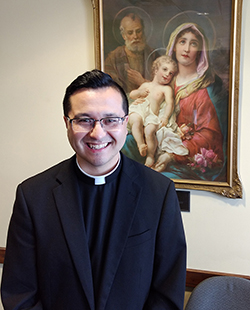
Technically, CSS is supposed to be open on Christmas Eve morning; however, I always give our employees that day off. Since last-minute stragglers come in on Christmas Eve, I always come in to the office in the morning.
Before I jump into my column, I want to wish everybody who has been reading my column over the last year a very Merry Christmas! I am honored and humbled you take even a few minutes of your day to learn more about the work of the Nebraska Catholic Conference and how together we can build the common good through political—and, ultimately, cultural—engagement. You are a gift to the Church and a sign of the love of God! May the Incarnation of God, through the Christ Child, bring you the joy and peace that your heart desires!
“The Holy Bible: The Infancy Narratives” St. Matthew, Chapter One and Two. St. Luke, Chapter One and Two
“The Night Before Christmas” by Moore, Clement; photos by Raquel Jaramillo. Atheneum Books for Young Readers, New York, 2001, 32 pages, All Ages.
Christmas is one of the happiest days of the year. We celebrate the birth of our Savior, Jesus Christ. The finest way to do this at home is to read one of the Infancy Narratives from the Bible.
St. Matthew emphasizes the role of St. Joseph in the birth of Our Lord. In Chapter One, an angel appears to St. Joseph in a dream and tells him: “Joseph, son of David, do not fear to take Mary as your wife, for that which is conceived in her is of the Holy Spirit, she will bear a son, and you shall call his name Jesus, for he will save his people from their sins.” This emphasizes St. Joseph’s earthly fatherhood as well as demonstrating that Jesus is the fulfillment of all the Old Testament prophesies concerning the Messiah.
St. Luke develops the role of the Blessed Mother in these marvelous events. In Chapter One, St. Luke recounts the Annunciation and the Visitation which culminates with one of the most profound prayers in all of Sacred Scripture, The Magnificat. In Chapter Two, St. Luke tells us of the birth of Jesus and of Mary wrapping Him in swaddling clothes and laying Him in a humble manger. In St. Luke’s Gospel we are introduced to the shepherds coming to greet and adore Jesus. Both Infancy Narratives of the birth of Our Lord are poignant, personal and edifying.
It is particularly instructive for the father or mother of the family to read one of these accounts before opening presents. My father-in-law, Edward Dailey, understood the beauty and need to share the accounts of the birth of the Messiah. Each Christmas Eve, before opening the presents, he would either read the Infancy Narrative from St. Matthew or St. Luke. The reading of the birth of Jesus by the patriarch of the family impressed the importance of this holy event. We all understood that the presents could wait, because God the Father had sent the perfect present to humanity.
In addition to this sacred material, the reading of a delightful poem such as “The Night Before Christmas” can add joy and spontaneity to Christmas Eve. Written by Clement Moore, a seminary professor of Oriental and Greek languages in New York, the poem was published anonymously in 1823. It became wildly popular and remains so to this day. One would hardly expect such a well-liked poem to have been written by a scholar of classical languages, but truth is stranger than fiction. The book is filled with photos of all the events in the poem. We see a family going to bed and later being awakened by the arrival of St. Nicholas and the tiny reindeer. All of the photographs depict the joy and happiness of the event as the family sees St. Nicholas filling the stockings with care. St. Nicholas has a happy face and truly is a “right jolly old elf.” When he goes up the chimney, readers will want to also say: “Merry Christmas to all and to all a good night.”
As your family gathers together on this holy evening, I hope that you choose one of the Infancy Narratives for the joyful edification of your family. It is both instructive and pleasing for children to hear the Infancy Narratives.
Additionally, add to the pleasure and fun of the night by reading the delightful “The Night Before Christmas” by Clement Moore. You can help make Christmas Eve both instructive and entertaining for your family by using sacred and secular readings. I hope that you have a joyful Christmas.
During my college years, while at home, my uncle, then in his mid-50s, came over for a visit. As he bent over to give his mother a kiss, my Irish grandmother grabbed his bald head and planted a kiss right smack on top and said, “You’re just my little boy!”
Saying nothing, I thought, ‘Little boy? Lady … he’s an old man!’ He seemed so ancient at the time.
You know the Eucharist is the body, blood, soul, and divinity of Jesus Christ. The bread and wine become the body, blood, soul, and divinity of Christ when the priest consecrates the bread and wine during the Eucharistic prayer, which is during the Mass. “This is my body.” “This is the Chalice of my blood.” The Eucharist is not a symbol, it is not simply a spiritual thing, it is not a recalling of the Last Supper, and it is not bread or wine. But you know this.
Things Jesus Never Said: Thy Legislature Come! But even if Jesus never said these words, we know that Christ calls us to anticipate the advent of many things in life, including the advent of a new legislative session.
Dear Friends of the Children’s Literature Bookshelf: It has been a pleasure writing these columns for you and your family. I hope that the titles have brought joy and insight to you. I know that I have benefited greatly from writing the book talks for the Southern Nebraska Register. May you and your family have a Blessed Christmas. 2019 should be another exciting year for children’s literature. Thank you so much!
You may read all the reviews of the past year (and of several previous years as well!) at this link. I hope that this list will give you some ideas for books that might make nice Christmas presents.
Doesn’t it seem we are often in a hurry? And why does it seem when we need to leave for an appointment or an engagement, something pops up that needs our immediate attention?
The apparition of Our Lady at Guadalupe, inscribed on the tilma worn by Juan Diego nearly 500 years ago, is pregnant with meaning and purpose. As Father Peter John Cameron, OP, recounts in his book, Mysteries of the Virgin Mary: Living Our Lady’s Graces, “[t]he ‘first impression’ of Our Lady of Guadalupe on the indigenous people [of Mexico] must have been shocking.”
One of the common modern misperceptions of Christianity is that there was an “Old Testament” god and now there is a “New Testament” god. The “Old Testament” god was grumpier, angrier, and much more wrathful than the easy-going god we have today.
As a child, my understanding of the concept ‘trade’ was limited. Trade was something you did with baseball cards. If you were a knucklehead like me, you traded the baseball cards of your favorite athlete, Nolan Ryan, to your “girlfriend” for a handful of dimes. I can still hear echoes of my mom’s disappointment the moment I told her about this “brilliant” trade. Apparently, love is blind even at age 8.
As an adult, this concept of trade still predominates. Instead of baseball cards, I now trade ineffective football players for better football players to maximize fantasy points, so I can beat my father-in-law, Dan, in our next head-to-head fantasy football bout—all of this, of course, for bragging rights.
As a lobbyist at the legislature, my concept of trade has broadened. In some instances, senators might trade votes on an issue to gain support for another issue—some call this form of trading a compromise or the art of the deal or getting to ‘yes’ or, depending on the gravity of the issues involved, selling your soul. The concept of trade has also been present in discussions about human trafficking legislation. Trafficking involves the trade of a human being for a certain service, sometimes labor or sometimes sex—a practice universally condemned by any human being with the slightest sense of conscience.
“Fault Lines in the Constitution: the Framers, Their Fights and the Flaws That Affect Us Today” by Cynthia Levinson and Sanford Levinson. Peachtree Publishers, Atlanta, 2017, 235 pages, Grades 6-9.
I do not know about you, but I am not a huge fan of chicken salad. Don’t get me wrong. I love chicken—fried, baked, boiled, whatever… but chicken salad?? That said, for those who are not fans of chicken salad, my sister Barb’s concoction will change your mind. It has apples, raisins and other secret ingredients to make it one of a kind.
The liturgical year ends with a powerful—albeit underrated—solemnity: Our Lord Jesus Christ, King of the Universe. This Sunday solemnity is often overshadowed by Thanksgiving festivities, which turn the hearts and minds of many to Christmas shopping. Even Advent eclipses the solemnity, as if the end of the liturgical year is a mere stepping stone toward the Incarnation that Advent anticipates.
But the Solemnity of Christ the King is a feast worth pausing for.
“Giving Thanks. Poems, Prayers and Praise Songs of Thanksgiving,” by Katherine Paterson, Illustrated by Pamela Dalton. Handprint Books, San Francisco, 2013, 56 pages, Grades 3-6.
When I was assigned to Catholic Social Services of Southern Nebraska in 2003, I mistakenly thought I would have to give up doing some of the things I enjoyed as a priest assigned to a parish, namely teaching RCIA classes.
Does the Church teach that a sacramental marriage is incomplete, unless the husband and wife consummate the marriage? A great way to explore this interesting question is to look at the Holy Family. If Mary remained a virgin perpetually, this would seem to suggest that consummation is not a basic requirement of an indissoluble marriage in the Catholic Church.
The wisdom of the saints is found in the way they lived. The saints exemplify heroic virtue and embody the Gospel. Animated by the Holy Spirit, they radically lived for God and neighbor. They reveal that, with divine grace, a life lived in imitation of Christ is wholly within our grasp. In short, saints reveal to us the way of charity.
This is as true for the saints of old, as it is for the saints of today—and for all those in between, like St. Thomas Aquinas. In fact, it is from St. Thomas Aquinas that I want to draw some lessons about public discourse on political issues.
“A Boy of Old Prague,” by Aulamith Ish-Kishop. Dover Publications, Mineola, N.Y., 1963, 90 pages, Reading Level: Grades 4-6. Comprehension Level: Grades 4 through adult.
In October 1859, The Blessed Virgin Mary appeared to a young Belgian immigrant woman named Adele Brise, on the east side of Green Bay, Wisc. (just 20 minutes northeast of the present-day city). I had heard of the Our Lady of Good Help shrine and know of a handful of people who have visited the site.
I first met Jack Odgaard when I was a third-year law student at the University of Nebraska College of Law. The summer prior to meeting Jack, I had taken part in the Blackstone Legal Fellowship sponsored by Alliance Defending Freedom, a not-for-profit legal organization that advocates for the right of people to freely live out their faith.
“Vatican Council II, The Conciliar and Post Conciliar Documents, Volume I” by Austin Flannery, O.P. Costello Publishing Company, Northport, New York, 1996, 1,036 pages, Document in Review, Nostra Aetate, p.738-742. Grades 9 and higher.
Anti-Semitism is a bigoted prejudice that allows attacks on Jewish people, synagogues or institutions. It has happened throughout the last 2,000 years with evil outbursts of violence against individual Jews and the religion of Judaism.
Because I did not stop growing until I reached 6’4”, I distinctly remember as a child my mother taking me winter coat shopping every one to two years. I was born six weeks prematurely and know that if I would have been a full-term infant, I would now be much taller!
In buying a coat, the decision always involved getting one with a hood or not. Having a hood was always a great extra feature for those days that were especially cold and windy. They came in real handy during recess time, my favorite class.
A quick reminder: Election Day is on Tuesday, Nov. 6. Don’t forget to vote. Your vote matters!
If you want to learn more about candidates running for office (e.g., Governor, Secretary of State, State Auditor, State Legislature) and where they stand on critical issues facing our state and nation, check out the Nebraska Catholic Conference Candidate Survey at www.NebraskaCatholicVoter.com.
With that said, I want to recap our annual Bishops’ Pro-Life Banquet and Conference. Hundreds of pro-lifers from across the state gathered together with our bishops to celebrate the Gospel of Life and learn more about important developments in the mission field of pro-life activities. The two days were filled with joyful solidarity. In particular, I want to summarize the content of our three main speakers for the Saturday morning conference.
“We Will Not Be Silent: The White Rose Student Resistance Movement That Defied Adolf Hitler” by Russell Freedman. Clarion Books, Boston and New York, 2016, 104 pages, Grades Six and higher.
Through the years, I have seen many things while jogging on the trail from our near downtown office to the Devaney Center and back—many kinds of birds, snakes, and small mammals, including a fox that passed me along the waterway at a good clip. But the most beautiful and important creatures I have encountered have been created in God’s image and likeness.
Not even a year into his saintly pontificate, John Paul II proclaimed to the Polish people—but really to all humanity—that Christ is “the key to understanding that great and fundamental reality that is man. For man cannot be fully understood without Christ. Or rather, man is incapable of understanding himself fully without Christ. He cannot understand who he is, nor what his true dignity is, nor what his vocation is, nor what his final end is. He cannot understand any of this without Christ.”
By proclaiming these words during the opening Mass of his pilgrimage to his motherland, John Paul II was echoing the words of the famous 22nd paragraph of the Second Vatican Council’s Pastoral Constitution on the Church in the Modern World, Gaudium et Spes: “The truth is that only in the mystery of the Incarnate Word does the mystery of man take on light…. Christ, the final Adam, by the revelation of the mystery of the Father and His love, fully reveals man to himself and makes his supreme calling clear.”
As Catholic Christians it is all too easy to take for granted the meaning of life that Christ reveals to man. More precisely, what I mean is that for most of humanity, life is incomprehensible. Life is experienced as empty. At best, it has a brief meaning that swiftly fades away as evaporating mist. In short, life is lived without a guide to show the way, which leads one to believe that there never was or ever will be a definitive way.
This is particularly true for the “modern man” who has reduced the desires of his heart to the here and now, to the material—only to what the mind can readily comprehend through the senses, with disregard for the transcendent, the truth, goodness and beauty that lay behind every aspect of reality, buried away like a treasure waiting to be discovered if one only has received the map and key, namely, Jesus Christ.
Father Luigi Giussani illustrated this condition of the modern man: “I once saw a man who had been electrocuted in a power station. He had shrunken and become small… about one-third his original size. You see, reason in the modern age, for modern man, has been shocked by a super high-voltage current and has shrunken… because he has defined reason as the measure of reality.”
In describing this reduction of man’s reason, Giussani was not criticizing the capacity of our intellect to set us free to the truth God has inscribed into our hearts and creation, but rather he was pointing out the shortsightedness that can consume our mind. The mind is no longer instructed by the eternal and divine, but by the temporal and mundane.
This everyday mindset naturally—albeit unfortunately—finds its place in politics and the way our society tends to view otherwise rich realities, such as human dignity and the common good.
Rather than viewing each human being as somebody created in the image and likeness of God, our modern mindset views each human being as a disposable thing to be used. Human life is given a meaning that is completely constructed, unsurprisingly in a way that never benefits the human life of the one being discarded. We see this first and foremost in the tragedy that is abortion and assisted suicide. But this view of “human life as disposable” is evident in so many other atrocities, such as genocide, human trafficking, nuclear proliferation and arms trade, and contraception.
Without a mind and heart inspired by Jesus Christ, our politics quickly becomes a power grab whose only aim and purpose is to never consider the indelible mark of love God has stamped on our hearts.
But as the words of John Paul II in that Vigil Mass of Pentecost in Victory Square of Warsaw remind us: It is the Holy Spirit that we must invoke, that we must call upon and invite to “renew the face of the earth, the face of this land.”
Let us pray, through the intercession of Saint John Paul II, that our political and cultural life would find meaning in the Sacred Heart of Jesus Christ, King of the Universe!
For some around the central and eastern part of the diocese, I am sure you remember the snow storm on Sunday, Oct. 14.
I had planned a trip out west for dinner with this year’s Caritas Christi winners, Gerald and Jean Witte, and their family, who live out by Cambridge. I had thought we were only supposed to get a dusting of snow, but there was enough snow that the roads were not the best and the visibility was poor. We all thought it best to reschedule our dinner.
My backup plan was to spend time in our St. Joseph Chapel at our main office. At the tail end of the holy hour, I heard some rustling in the food pantry, which is not far from the chapel. By this time, the snow was really coming down. It was around noon.
This week’s “In Layman’s Terms” is a guest column by my friend Maris Bentley, in which she talks about evangelization:
My good friend, Bob Sullivan, introduced me to the work of street evangelization several years ago, shortly after I met him. I was living in Omaha at the time (I live near Plattsmouth now, in the Lincoln diocese) and several of us from Omaha traveled to Lincoln to learn more about the evangelization taking place on the streets there as part of the rapidly growing national apostolate called St. Paul Street Evangelization.
God, the Father of all creation, in the beginning of time, looked upon creation and saw that it was good. This reflection upon the goodness of creation applied—and continues to apply—to the pinnacle of His creation, man and woman, who He made in His image and likeness. Yet, throughout history, men and women have sought to deny this goodness. In our own day, rather than seeing the goodness of human life, especially in those facing death, we have done the opposite: we look on life and perceive it to be undesirable and, as such, to be discarded, thrown away. This is evident with the evil of assisted suicide. But this is not God’s desire for a culture of life.
In striving for a culture of life, the fundamental question arises: how can we build a culture and a political order that values human life and prevents assisted suicide?
One of the mandates of charity given to us by Jesus was feeding the hungry. “Come, O blessed of my Father, inherit the kingdom prepared for you from the foundation of the world; for I was hungry and you gave me food, I was thirsty and you gave me drink” (Mt 25:34-35). In addition to our fixed and mobile food pantries, we have greatly expanded our food recovery program operated out of our Hastings office.
These programs are designed to help individuals and families obtain food for their homes to last at least a week. Because there are people who are not looking for groceries but a ready-made meal, our two sack lunch programs were started.
Before I jump into my column, I want to remind you to register—if you have not already—for our annual Bishops’ Pro-Life Banquet and Conference in Lincoln (Oct. 26-27). This year’s conference, entitled “Saving Lives in the Good Life,” will equip attendees with the solidarity and knowledge needed to build a culture of life within our homes, parishes, communities, and state.
Dr. George Delgado, our keynote for both the Friday night banquet and Saturday conference, will highlight the modern medical miracle that is the abortion pill reversal (“APR”) process. The APR process has helped hundreds of mothers, who have initiated the chemical abortion process, to reverse their abortion and have a second chance to choose life.
Recently at an ethics committee meeting at one of the Catholic hospitals in the diocese of Lincoln, I had a conversation with one of the members who also supports our mission at Catholic Social Services and St. Gianna’s Women’s Homes.
Brett Kavanaugh may or may not be on his way to the Supreme Court by the time you read this article—it is uncertain at the time I write this. But one thing is certain: politics is where public discourse goes to die. What I mean is that the way our society conducts public debates on contentious issues fails two fundamental criteria: charity and truth.
“Before She Was Harriet” by Lesa Cline-Ransome, illustrated by James E. Ransome. Holiday House, New York, 2017, 32 pages, Grades 1-3.
Biographies introduce readers to the lives of important people. Readers can learn about historical events and facts that make up events. Biographers can be great teachers as the historical material in the subjects’ lives help define the period in which they lived.
The Catholic Medical Association gathered for their annual meeting in Dallas Sept. 19-27. The meeting was unique in that, in addition to top quality medical and scientific talks, the day also included confessions, Mass, and adoration. There was a separate side room with 24-hour Exposition of the Blessed Sacrament.
More than 500 Catholic doctors and health professionals attended, along with many priest chaplains.
I was privileged to give a breakout session talk on the Apostolate of Suffering, which is a national organization based in Lincoln. It was founded by Clara Tiry in Milwaukee, Wisc. in 1926. The purpose of the apostolate is to unite all who suffer in a spiritual union, and to assure them that their lives and sufferings have meaning joined to the cross of Jesus Christ.
Every election cycle, the staff at the Nebraska Catholic Conference gets a frequently asked question: “Where can I find information about [insert candidate for public office] and their stance on [insert important political issue]?” We are asked about issues such as the right to life of the unborn child, religious liberty protections, marriage and human sexuality, immigration, poverty, school choice, the death penalty. We are also asked about public offices ranging from local judges to the governor, from state senators to the President of the United States.
Finding much needed information about candidates can sometimes be difficult and time consuming—and other times it can be nearly impossible to find. But it shouldn’t have to be that way, which is why we want to make your life a little easier as you prepare to vote on Tuesday, Nov. 8.
Not long ago, a young woman with multiple small children left an abusive husband and was admitted to St. Gianna’s. Like all of the women who are admitted, she was most grateful. And like all of the women who have children, she was also grateful to have a safe place for her little ones.
“Lift up your heads, O gates! And be lifted up, O ancient doors! That the King of glory may come in. Who is the King of glory? The Lord, strong and mighty, the Lord, mighty in battle! Lift up your heads, O gates! And be lifted up, O ancient doors! Who is the King of glory? The Lord of hosts, he is the King of glory!”
These beautiful words are taken from Psalm 24:7-10 and describe the entrance of Almighty God into the temple, which ultimately means the temple of our souls.
“Saving Lives in the Good Life” is this year’s theme for the annual Bishops’ Pro-Life Banquet and Conference—and if you want to be a part of building a “culture of life” in Nebraska, we invite you to register and join us!
Recently, on the eve of the memorial of the passion of St. John the Baptist, after the office closed, I decided that my bag of bones needed a bit of exercise.
My usual jogging route is from our near downtown office to the Devaney Center and back. While returning, I noticed a man I estimate in his 30s, with a backpack, leaning against one of the pillars supporting one of the many bridges over Antelope Creek and the bike trail.
Some of us have come to believe that our priests, bishops, or even the pope, are more perfect and divinely protected from error than is actually the case.
We will all benefit if we accept the fact that the clergy are, first and foremost, human beings just like the rest of us. Ordination is not the same as canonization and being elevated to high levels within the Church is no sign that the person is a holy or competent person. Over the centuries, we have had a number of popes who have fallen well short of demonstrating lives of virtue and holiness. Some of the popes have been absolute scoundrels, but while many have been examples of immorality, indecision, and/or incompetence, none has ever taught error as a matter of Church doctrine.
It’s never too early to prepare for Election Day! This is as true for the less-appreciated and underrated midterm elections as it is for a politically heightened presidential election cycle.
To prepare for the upcoming mid-term elections Nov. 6, I want to offer a few thoughts as you prepare to exercise your faithful citizenship.
I am elated to announce that on Sunday, Sept. 30, Catholic Social Services will celebrate its 20th annual Bountiful Harvest banquet, held at the Hastings City Auditorium.
“It is appropriate, therefore,” according to the U.S. Department of Labor, “that the nation pays tribute on Labor Day to the creator of so much of the nation’s strength, freedom, and leadership—the American worker.” While I wish to take away nothing from the real sense in which this statement is true, there is another sense in which this statement is lacking: the recognition of the Ultimate Creator, God, who has bestowed upon man the dignity of work.
As we enter into the Labor Day weekend, it is fitting that we take a moment to ponder the deeper philosophical and theological foundations of work. Such an opportunity allows us to more fully understand work—to see work not only as a toil and suffering that has accompanied man from the beginning of history, but also as a creative activity that provides for the blessings and flourishing of human life.
On Wednesday evening, Aug. 15, Dr. Gianna Emanuela flew into the Lincoln municipal airport for a quick visit. She is in the country to further promote, and decide where in the United States to build, an international center dedicated to her mother and father. Since she was relatively close to Lincoln, it was easy to stop by. This was her fourth visit to Lincoln. This is an amazing blessing because once she visits a city, she usually does not return. She considers St. Gianna’s Home a special place and loves the people of the Diocese of Lincoln and their love and devotion to her mother, St. Gianna.
I just had a conversation with a good friend of mine who recently converted to Catholicism. In the course of our conversation, he stated, “I have a lot of friends who are faithful Christians. Given the scandals in the Church right now, how could I recommend they consider converting to Catholicism?”
Good questions are rarely easy to answer. This is a really good question.
It’s not every Thursday morning that I wake up, check my e-mail, news, and blogs, only to discover that Pope Francis has revised the Catechism of the Catholic Church (“CCC”)—but such was the case on the morning of Aug. 2. As with some other of Pope Francis’ public acts, this revision has caused theologians, commentators, secular journalists, and Catholic laity alike to ask the question: what exactly does this mean? My hope is that this column will help answer this question and a few others related to Pope Francis’ revision of paragraph 2267.
The Immaculate Heart of Mary Counseling Center in Lincoln had a retreat Aug. 1, conducted by Father Ben Holdren, pastor of St. Peter and St. Joseph parishes in Bellwood. It was the first official day for our two new interns, Alexandra Marcotte and Jeff Vance. We are unique in that we incorporate the Catholic faith in our counseling. Since it was their first official day on the job, we thought we would start off on the right foot with a retreat.
Several months ago, I wrote a column pointing out that the priest sex abuse scandal has been handled well by the Catholic Church in the United States.
Unfortunately, there seems to be a different problem in the Church which has not yet been addressed. You may have heard of Theodore McCarrick. He was the Archbishop of Washington D.C., and a Cardinal in the Church. The key word in that last sentence is, “was.” He just resigned his position in the College of Cardinals, and Pope Francis has suspended him from the exercise of any public ministry, and a life of prayer and penance until the accusations made against him are examined in a canonical trial.
Under Nebraska state law, every abortion performed in our state must be reported by the attending abortionist through a reporting form to the Nebraska Department of Health and Human Services (“DHHS”). This report includes a variety of information (e.g., age of the mother, type of procedure performed, reason for the abortion, etc.). DHHS compiles this information and issues an annual report. These annual reports date back to 1974. In April, DHHS issued its “2017 Statistical Report of Abortions” (full reports accessible at http://dhhs.ne.gov).
While it is sobering to read, the annual report offers an opportunity to better understand the scope of abortion in Nebraska, which informs our outreach and prayer efforts. This article summarizes some of the categories of information provided in the report.
“The Return of the King: Part Three of the Lord of the Rings,” by J. R. R. Tolkien. Houghton Mifflin Harcourt, Boston, 1955, 277 pages, Grades 7 and higher.
For those who read the Southern Nebraska Register, you know that Father Justin Fulton was appointed the assistant director of Catholic Social Services of Southern Nebraska.
Father Fulton was born and raised in Auburn, and attended UNL where he received a degree in 2003 in finance and marketing. He later completed a master’s degree in organizational management-entrepreneurial and economic development from Peru State College in 2008. After working in the world as a supervisor at State Farm, he went on to attend St. Gregory the Great Seminary in Seward, and St. Charles Borromeo Seminary in Philadelphia, and was ordained to the priesthood by Bishop Conley May 23, 2015. I am starting to feel old now….
The Church is a “pilgrim” Church—she is always journeying toward the Second Coming of Christ. As a pilgrim Church, we constantly face new challenges and questions that modern life presents us. On July 25, the Church will celebrate the 50th anniversary ofHumanae Vitae, the famous encyclical of Pope Paul VI which confronted one of modernity’s many challenges and questions: the rise of artificial methods of birth control and the regulation of birth. This document continues to be relevant and foundational for the challenges we face today regarding married love and responsible parenthood.
As some of you may know, I am in residence at North American Martyrs Parish and live in the basement. Father Brian Connor, the pastor, has been gracious and occasionally rolls donuts downstairs to keep me happy.
I was at the bank the other morning, when a man walked in with a gun. I noticed him immediately, long before anyone else did. Before the man could do anything, I was on him. He didn’t even see me coming before I said, “good morning.”
Justice Antonin Scalia once said this about a majority opinion written by Justice Anthony Kennedy: “The opinion is couched in a style that is as pretentious as its content is egotistic. It is one thing for separate concurring or dissenting opinions to contain extravagances, even silly extravagances, of thought and expression; it is something else for the official opinion of the Court to do so. If, even as the price to be paid for a fifth vote, I ever joined an opinion for the Court that began: ‘The Constitution promises liberty to all within its reach, a liberty that includes certain specific rights that allow persons, within a lawful realm, to define and express their identity,’ I would hide my head in a bag. The Supreme Court of the United States has descended from the disciplined legal reasoning of John Marshall and Joseph Story to the mystical aphorisms of the fortune cookie.”
Such words seem harsh and perhaps a clash between two men of authority with differing worldviews. But similar thoughts have been echoed by other scholars and commentators, on the right and left of the political spectrum. As one leading progressive political commentator, Ian Millhiser, stated: “[Justice Kennedy’s] writing ranged from needlessly flowery to completely incoherent. And, while his views sometimes placed him to the left of men like Scalia and Bork, his ‘liberal’ opinions were frequently his most incomprehensible.”
“Karl, Get Out of the Garden: Carolus Linnaeus and the Naming of Everything,” by Anita Sanchez, illustrated by Catherine Stock. Charlesbridge Press, Watertown, Massachusetts, 2017, 48 pages, Grades 3-5.
One of my favorite stories of St. Mother Teresa is about an emaciated man she picked up off the streets of Calcutta. After carrying him to the infirmary, while picking maggots off the rotting flesh of his extremities, the sick man started cursing Mother Teresa. When he asked why she was doing this to him, she explained that God commanded it.
After he asked her who God was, she stated that he knew good and well who God was. After asking for further clarification, she stated, “My God is love.” It was then he asked for baptism. Shortly afterwards, he expired.
Bishop Conley recently wrote about Jack Phillips and Jack’s legal case—Masterpiece Cakeshop v. Colorado Civil Rights Commission—that was decided June 4 by the Supreme Court of the United States (“SCOTUS”). Bishop Conley recognized that “[l]egal scholars have already begun debating the consequences of the Supreme Court decision[.]” Unsurprisingly, there is no shortage of interpretations of Masterpiece Cakeshop and the future of religious freedom, freedom of speech, marriage, and gay rights. The hope here is to summarize some of these interpretations.
Recently, at the end of a warm afternoon, while walking through our parking lot, I encountered a middle-aged, homeless man who reminded me of Charlton Heston in his role as Moses in the 1956 film The Ten Commandments (only much thinner—my hunch is that this is the case because of a lack of four squares each day). His long gray beard was most notable, as was an absence of a full set of teeth.
Christians are all over the board on how to handle situations where a family member, friend or acquaintance believes something which contradicts the Catholic faith.
One extreme is to constantly correct them. This turns people off. The other extreme is to ignore their misunderstanding as we spend our time talking around the truth. In other words, we let them persist in their misunderstanding. After all, who wants to be a thorn in someone’s side? Yet Scripture tells us we cannot simply let everything go.
Ireland experienced a watershed moment in its nation’s history and identity May 25. With a voter turnout of 64%, two out of three voters (66.4%) cast a ballot to repeal a provision in the Irish Constitution protecting the right to life of the unborn child.
By doing so, the Irish people have made a fundamental and decisive choice for the “culture of death,” which we, as Americans, know is a culture which permeates and poisons every aspect of human existence—it is a hole from which God alone can rescue us.
I am happy to announce that on Sunday, June 24, Catholic Social Services of Southern Nebraska is having our fifth annual St. Francis Summer’s Eve Celebration. It will be on the Spirit of Brownville Riverboat (on East Main Street, Brownville) once again from 5 to 7 p.m.
[Editor's Note: due to inclement weather, Summer’s Eve Celebration has been rescheduled to Sun. July 22.]
In recent years, attempts at advancing religious liberty legislation, including in Nebraska, have faced fierce opposition, especially from LGBT (Lesbian, Gay, Bisexual, and Transgender) organizations. These efforts to protect our “first, most cherished liberty” have garnered mixed results of successes and defeats.
Seedlings readers may remember the story of a little girl staying with her mother at St. Gianna’s who, after being taken into the chapel for a visit and told that Jesus was in the gold tabernacle, wanted one day to say hello and sing a little song to Jesus as she and her mother walked by the chapel door.
We all deal with people who tell us that we need to tolerate things which are contrary to our faith. Yet these same people often show no interest in tolerating our decision to practice our faith consistently.
Whether we substitute other words for tolerance, such as equality, inclusiveness, welcoming, affirming, accompanying, etc…, the expectation is always the same: As Catholics we are expected to change our beliefs and behaviors, but the broader culture is not expected to tolerate, much less accept, the moral teachings of the Catholic Church. There is a reason for this and I’ll get to it shortly, but first, let’s look at the definition of tolerance.
This week’s column will continue discussing legislation the Nebraska Catholic Conference actively lobbied, but which were not discussed in this column during the legislative session.
Last week, this column discussed LB726, which would have mandated insurance companies to provide coverage for in vitro fertilization procedures under certain circumstances. The NCC opposed this legislation as an attack on marriage, family, and life.
Another legislative bill that undermined marriage and family was LB785, which would have removed husband and wife terminology from the marriage solemnization requirements.
Every Monday morning, the staff at our main office divide and conquer. We divide the cleaning duties and conquer the dirt and grime in the building. This saves hiring a cleaning service so more money can be given away in both emergency services and grants for counseling for those who are unable to afford the total cost of psychological services for some reason.
Before jumping into this week’s article, a brief reminder that Primary Election Day is Tuesday, May 15. Last week’s column encouraged everybody to read Forming Consciences for Faithful Citizenship: A Call to Political Responsibility from the Catholic Bishops of the United States. There is still time to review this document, if you have not already. Pray that the primaries glorify God!
The legislative session has been completed for nearly a month. While numerous legislative bills are discussed in this column throughout the legislative session, it is impossible to cover every piece of legislation the Nebraska Catholic Conference actively lobbies. But thankfully this column can continue to discuss legislative bills, even after the session has ended. One such legislative bill is LB726, which the NCC opposed as an attack on marriage, family, and life.
I am sure you have heard the saying, ‘If it isn’t one thing, it’s another,’ or, ‘If I didn’t have bad luck, I would not have any luck at all,’ or even, ‘When it rains, it pours.’ When a person uses one of these sayings they mean that they do not simply have one problem, but a slurry of them.
It’s nearly that time again: (Primary) Election Day! Though it is all too easy to think this is ‘just’ the primary elections and there is no presidential race this year, as Catholics we have a civic and moral duty to exercise our right to vote—in a way that is faithful to Jesus Christ. As the United States Bishops have stated in their document Forming Consciences for Faithful Citizenship: “We are called to bring together our principles and our political choices, our values and our votes, to help build a better world.” To prepare for the primary election, a few points are worth consideration.
“The Lord is my shepherd, there is nothing I lack” (Ps 23:1). These words were fulfilled when the eternal Son of God the Father took on flesh to rescue us from the grasp of the wolf or Satan and his fellow fallen angels.
Jesus said, “I am the good shepherd. A good shepherd lays down his life for the sheep” (Jn 10: 11). In addition, Jesus said, “I am the gate. Whoever enters through me will be saved, and will come in and go out and find pasture” (Jn 10: 9). Jesus is referring to heaven.
This is a common question and a fair one. After all, nowhere does the Bible explicitly state, “go to Mass every Sunday.” However, the Bible does implicitly say we need to go to Mass every Sunday. And Christians have always worshipped on Sunday. (CCC 2041 and 2042)
The state legislature adjourned sine die (translated: with no further day appointed for business) April 18. This means the legislature will not reconvene until early January for the 106th Legislature, at which point we will see a new batch of senators after November elections. The only exception for reconvening would be a special session (which is a rare event).
On April 11, Dr. Gianna Emanuela flew to the United States to visit two places: Lincoln, and Fargo, N.D. In Lincoln, she came to visit St. Gianna Women’s Homes (where we help women who escape the pressures of abortion and domestic violence) and Gianna’s Java & Gelato.
The Nebraska Legislature adjourned sine die (meaning, with no appointed date for resumption) on Wednesday. While I will comment further on the legislative session, for now I want to discuss another newsworthy matter—more appropriately, a lifesaving matter. On April 4, a new medical study, authored by Drs. George Delgado and Mary Davenport, was published that analyzes outcomes of using progesterone to reverse RU-486 medication abortions. This study is an important step forward in validating the “abortion pill reversal” method that has already saved the lives of hundreds of unborn children.
Our sack lunch programs in Hastings and Lincoln have allowed us to interact with the poor and needy in a unique manner. Recently, a man came in for a sack lunch. I was informed he was ‘smiling ear to ear.’ I was told his joy and happiness were infectious.
As he turned to leave after picking up his meal, the volunteers noticed he did not have legs. He hobbled out on his artificial legs with a smile of gratitude.