Growing up, I always loved this time of year. I always looked forward to the binding spirit of patriotism that would bring my hometown of Auburn together. This time was always remembered as a solemn time, remembering the birth of the United States Marine Corps Nov. 10 and then celebrating all veterans on Veterans Day Nov. 11.
Walker Percy, the acclaimed Southern novelist and Catholic, once said: “In this society, which is post-Christian, post-modern... there is no coherent theory of man.”
One of the hallmarks of living in Nebraska is the automatic guarantee of being a Nebraska Husker football fan. It seems when you are born in this state, you get weighed and measured, you get your fingerprints and Social Security number, and then you get a Big Red Foam Finger and a husk of corn.
Whether you are a Husker fan or not, if you are in Nebraska you are inundated with the hysteria that is Husker football.
“An authentic faith…always involves a deep desire to change the world[.]”
These words of Pope Francis from Evangelii Gaudium (“The Joy of the Gospel”) echo the desire of Jesus Christ for all lay members of the Church. These words were also at the core of the pontificate of John Paul II whose feast day we celebrated Tuesday.
Fall shows off its brilliance and the beauty of nature is on full display. Foliage, football, festivals, harvest, marching bands, hayrack rides and family bring out the best smiles and laughter of life. And then at the end of October, we see leaves falling and trees becoming bare. We see life passing before our eyes. Trees are empty, the harvest is picked, and it seems death has invaded the land.
In the Church we see this in our Liturgical life as well. We celebrate the miracle of the Paschal Mystery being lived through His Church as we feast on All Saints Day. Then we pray for all deceased as we solemnly encounter All Souls Day. We are called to pray and sacrifice in a special way during November as we realize we too will return to dust. And we pray there will be others who pray for us when we depart from this earthly life.
“As Catholics, we are called to cherish, defend, and protect those who are most vulnerable, from the beginning of life to its end, and at every point in between.”
These are the powerful introductory words found at www.respectlife.org, the homepage for the United States Conference of Catholic Bishops’ 2019 Respect Life Month efforts.
Friendship is a beautiful gift. When one is newly born, one is born into a community of friendship and love. A baby has a mom and a dad. Relationship is natural, needed, and is a gift. That is the way God designed it. It shows us naturally we all need community.
In my last column, I discussed Espinoza v. Montana Department of Revenue. This is a legal case which will be heard by the Supreme Court of the United States (“SCOTUS”) sometime this Fall. The main issue in Espinoza is whether it is unconstitutional to discriminate against religious believers and institutions from receiving public funds that other people and institutions may generally receive.
You ever get tired of polls and statistics? (I feel like Andy Rooney off of 60 Minutes.) Statistics and polls: they try to influence you on what to buy, who to vote for, how you should live your life. And then a month or so later all the polls flip and you’re left scratching your head as to why you stressed out over the polls earlier. Statistics and polls. It seems to me they are cooked up sometimes just to make you read a headline or tune in to a show.
Here at CSS we wanted to let everyone know of some true statistics. We also wanted to share our story of what we do in our diocese.
Kendra Espinoza is a single mom with two daughters. Both her daughters transferred out of public school and into a Christian school. Kendra’s youngest daughter struggled to succeed in her public school. Her oldest daughter experienced teasing and occasional bullying from her public school classmates. Kendra also wanted her girls in a school that taught the same Christian values she taught at home.
You ever made a smoothie? In the pad where I live, I have an awesome NutriBullet that basically cooks for me. I find it is difficult to cook for one person and sometimes time just does not allow my culinary skills to come to fruition.
Sometimes knowing what is not happening helps you understand what is happening.
This is a fact with regard to many things in our life, but most certainly within the Catholic faith. There is an abundance of misinformation about the Catholic faith. Some of it is intentional myth developed to attack the faith of Catholics and some of it comes from superstition, laziness, ignorance, or confusion.
The following are adapted remarks from last week’s Bishops’ Pro-Life Banquet. The banquet featured this year’s Gospel of Life Award bestowed on a person who has demonstrated exemplary efforts within the pro-life movement.
My first pets growing up were named Thunder and Lightning. They were hamsters. Thunder and Lightning taught the Fulton kids a lot about life. They taught us the need to be cleanly. They taught us that cleaning up living spaces could be hard work—especially hamster cages. They taught us it never does any good to keep people up in the wee hours of night—that hamster wheel churning still makes noise in my mind to this day. And they taught us we all have to say goodbye at some point. Thunder and Lightning both now reside about a foot underground near the clothesline at the ol’ homestead in Auburn. Thunder and Lightning gave us a lot of laughs, a lot of memories, and taught us a lot of responsibility. Pets do that. Pets give us joy.
Earlier this year, the North Dakota Legislature passed into law H.B. 1336. This law required abortionists to tell women seeking an abortion that “it may be possible to reverse the effects of an abortion-inducing drug if she changes her mind.” The law also required that a mother be given information that, if she chose, would connect her with local medical professionals who could help her counteract the effects of abortion-inducing drugs and increase the chances of saving her baby.
If this law sounds familiar, it is because it is. Earlier this year, the Nebraska State Legislature passed a similar law, which went into effect at the end of August.
I always got a kick out of going to the local barber shop when I was a kid. I’d ride my bike to Louie’s Barber Shop back in my hometown and watch Louie Clark do his craft. And of course, the best entertainment was just chatting away with farmers, classmates, business people, coaches, and friends. And as Louie gave his customers one of his two trademark cuts—a flat-top or an Ivy League—to those who wanted it or did not want it—he would always laugh as he collected his $5. Louie would say, “Well you’re ready for the front row again. You’re looking fresh,” and out the door went his styled-up customer.
In 2014, Elaine and Jonathan found themselves at a dead end. Having journeyed through the legal system, the United States Supreme Court failed to hear their court case.
Elaine and her husband, Jonathan, owned a small business, Elane Photography. In 2006, Elaine was asked by Vanessa Willock to photograph a “commitment ceremony” between her and her same-sex partner. Elaine politely declined. As a faithful Christian, Elaine believed in marriage as a lifelong institution between one man and one woman, and was unable to use her artistic talents to express a message inconsistent with this belief.
A few months ago, I devoted four consecutive columns to transubstantiation. In that series I said that there was one Catholic teaching which was so important, so essential, that we are setting our faith, even our salvation, up for disaster if we do not know and understand it.
Labor Day has come and gone. In our own day, the events of yesterday are all too easily forgotten. We are overwhelmed with daily activities, only with more to follow in subsequent days. We are inundated by information through 24-hour news cycles and social media. And so on and so forth. These dynamics of daily life make it difficult—and seemingly impossible—to remember and reflect on the deeper dimensions of life, such as the meaning and dignity of work which ought to be at the heart of not only Labor Day but also our daily lives.
It is pretty easy to say this. It is a lot tougher to live it. In a world of hurt, anxiety, and despair, life is tough. Many people lose hope. Many struggle with faith in God.
Our CSS outreach in Auburn has endured horrific personal tragedies in the last month. On Saturday, July 20, I was notified by the manager of the Auburn thrift store—my aunt Lana Fulton—that she was diagnosed with Stage IV pancreatic cancer, spread to the liver. It was a huge shock.
That same evening of July 20, we learned that Auburn thrift store employee Julie Kriefels’ son Cody was tragically killed in an ATV accident. The community and our agency were rocked.
Parents who send their children to Catholic schools have always sacrificed. They pay for the education of twice as many children: their child, and a student in the public school system. This is aside from the volunteer hours, the meetings, the extra unexpected fees and costs, the fundraising, sports, band, chorus, cheer, dance, drama, speech, the Walk for Life, the Christmas program, classroom parties, chaperone duties, prom, the March for Life, mission trips, community service, and anything else your child tries. Every parent could be out of the house every night of the week for 10 months of the year. Don’t get me wrong – public school parents have plenty of opportunity to donate their time, talent and treasure to their child’s school, as well.
“The Girl Who Drew Butterflies: How Maria Merian’s Art Changed Science,” by Joyce Sidman. Houghton Mifflin Harcourt, Boston, 2018, 141 pages, Grades 5-7.
If it weren’t already obvious enough, Planned Parenthood again tipped its hand in recent weeks to reveal its true character: an organization hell-bent on the killing of unborn children, willing to sacrifice any person or program that challenges their relentless focus on abortion. Two sets of recent headlines, both in national news, have brought that character into stark relief.
August 1999. I vividly remember packing up my ‘91 Dodge Shadow in Auburn and getting ready to fire it up and move to UNL for my freshman year college studies. I was pumped to finally have my “freedom.” I was ready to be an adult.
Why are Catholic schools not thriving when Catholic schools are free of many of the problems public schools struggle with such as violence, poverty, untreated mental health problems, and other factors which make education very difficult?
Some might claim it is lack of money, lack of resources, lack of leadership, training, etc… I propose it is none of these things. While money, resources, and other things certainly help, they would all fail Catholic schools just as they are failing public education.
In 1969, the Nebraska Catholic Conference was formed. According to one historical recounting, the NCC entered the public policy scene “with a yawn.”
At the time, it was unclear what a Catholic Conference was, what it was intended to accomplish, who its leadership would be, and what, if any, influence it would ultimately have on policy and politics in Nebraska. Fifty years later, experience has proven that the Nebraska Catholic Conference is an influential, professional, and faithful organization committed to the common good, not just for Catholics but for all of society.
“Mozart: Gift of God,” by Demi. Ignatius Press, San Francisco, 2018, 37 pages, K-3.
Saint Gregory the Great is reputed to have said: “those who sing, pray twice.” Not only do singers use words in their songs, but they also use poetry in their melodies. This accounts for the range of feelings music can invoke.
One of the most important emotions in music is joy. The famous writer/illustrator Demi pays tribute to joy and to the life the composer Mozart in this lovely biography. Entitled “Mozart: Gift of God,” Demi shows us the immense talent of Mozart and how his great love for God lead to his incredible output of operas, sonatas, concertos and Requiem Masses. It is a beautiful book and a delight to read.
A couple of weeks ago, I had the privilege to travel to my hometown of Auburn, to meet with our wonderful CSS employees who run our community outreach there. We have talented and dedicated staff and I am very proud of them. They live the Gospel daily in their work.
Looking back on the past three or four centuries, you can see why and how public and Catholic schools have evolved in the U.S. We see that Horace Mann, the father of the American public education system, which he reformed in the 1800s, reformed more than the education system; he reformed much of the American culture.
A significant aspect of that reform was to remove parents as the primary educators of their children on matters of faith and morals and put the public school system in place of the parent. Catholic schools were a way of responding to Mann’s reform by keeping parents in the primary role as educators of their children, preserving the family, and preventing the assimilation of Catholic immigrants and American Catholics into the melting pot of Protestant America.
“Drowned City: Hurricane Katrina and New Orleans,” by Don Brown, author and illustrator. Houghton Mifflin Harcourt, Boston, 2015, 95 pages, Grades 7-9.
Greetings to all and especially to anyone from Kalamazoo or Crete who may be reading this column!
On the 4th of July, I was graced to be invited to a party at the home of my wonderful friends Ryan and Kate. I found it a blessing to meet both of their families and it gave me a sense of belonging, warmth and love, and I am very grateful to them and to Almighty God. These young parents are a testament to the parents who raised them and the way they brought them up: faithful, dynamic, fun-loving, loving and Catholic.
Decades after Horace Mann, the Know Nothing Party and the Potato Famine, small villages and communities in the Midwest were not only using Catholic Bibles in their public schools, they were celebrating Mass in chapels within the public schools.
Coming off the United States Conference of Catholic Bishops’ Religious Freedom Week (June 22-29) is a good time as any to provide a religious freedom development update. The development is a United States Supreme Court decision (American Legion v. American Humanist Association) upholding the constitutionality of a cross monument on public property.
“Refugee,” by Alan Gratz. Scholastic Press, New York, 2017, 338 pages, Grades 8-10.
Refugees are forced to flee their homelands because of war, ethnic attacks and hatreds. These terrible situations have happened in many nations because of long held angers or greed to possess other countries.
Would you like to see something scary? Something that you do not see every day? Check out the picture included with this article. Here are a bunch of Lincoln priests wearing regular clothes to a baseball game. Sorry you had to see some of the least fashionable guys on earth!
Before discussing Catholic schools as they exist today, which comes in part five of this five-part series, it may help to have a very brief overview of the history of education (K-12) in the United States. I’ll leave out a lot, but hopefully it will include enough to give some perspective to the issues facing the Church in Catholic education today.
In our modern culture, religious liberty faces a fundamental problem. Too often, religious liberty is narrowly conceived as ‘special pleading.’ By this, I mean religious liberty is perceived as an avenue by which certain religious views seek special treatment and protections. This applies particularly to religious views which have lost their former cultural and legal influence.
As of May 31, the Nebraska Legislature adjourned sine die (a Latin term meaning without any further day of scheduled business). This marks the completion of the 106th Legislature, First Session.
“Remembering D-Day: The Plan, the Invasion, Survivor Stories” by Ronald J. Drez. National Geographic Society, Washington D.C., 2004, 61 pages, Grades 4-6.
From Tom Venzor: In lieu of my normal column, this week’s columnist is Lauren Garcia, the Nebraska Catholic Conference’s Communications & Outreach Specialist. Lauren provides a beautiful reflection on finding love in the ruins of a broken culture of death and seeing the face of Christ and allowing Him to transform our vision, so that we can assist Him n the work of building a culture of life. Enjoy!
In Omaha I have three sisters: Mary Baker, Barb Tranisi and Eileen Newton; but in Lincoln I have seven: Barb Rupp, Rozee Kloke, Patty Krings, Christy Bousquet, Angie Korus, April Kassebaum and Monica Barber.
My Lincoln sisters are members of North American Martyrs Parish where I currently live in residence. The three sisters in Omaha are my siblings, and the seven in Lincoln are my sisters in the Lord.
So far in this series, we have looked at the literal writings about transubstantiation and the Eucharist in Scripture and a few key Christians throughout the past 2,000 years. After that, we selected the Bread of Life Discourse in John 6 and examined the literal and spiritual senses of those verses. Now we can look at phenomena we call miracles as another way to know and understand transubstantiation and the Eucharist.
As a bit of background, I usually write this column by Monday and the Southern Nebraska Register typically arrives in your mailbox on that Friday. This sometimes makes it difficult to provide the most up-to-date information about the Nebraska Legislature’s activities. Oftentimes, there are major legislative actions that occur in between the time I write and when you read. Had I any ability to accurately write about the future that has not yet occurred, I would do so. But given that I’ll never acquire such a talent, I’ll stick to writing about events that have occurred.
Once you read this column, the Legislature will have nearly completed its business for the 2019 session. Speaker Jim Scheer recently announced that the Legislature will not require the entire 90 days to complete this session’s work. Instead, they will adjourn May 31. The final two days of session (May 30 and May 31) are intended to address any veto overrides and to wrap up final round debate on remaining legislation. This means the Legislature is completing nearly all its substantive work two weeks before the originally scheduled final day of session—and you’ll hardly hear anybody complaining about that fact.
Recently, I visited Dr. Gianna Emanuela during her trip to the United States when she visited Denver. She extends her greetings to all of us in the Lincoln diocese especially the Marian sisters, volunteers, and supporters of St. Gianna’s Women’s Homes. While driving back, I stopped in Imperial, Nebraska where we have our westernmost office and thrift store, St. Isidore Gift & Thrift.
If you have read the first two parts of this series, I am hopeful that you are in agreement that the Church has a lot of reason behind its teaching on the Eucharist.
Earlier this week, the Opportunity Scholarships Act (LB670) received three hours of debate by the entire legislature. School choice proponents and opponents held a civil and robust debate, covering a variety of policy issues related to LB670.
For the bill to receive an additional three hours of debate, Senator Lou Ann Linehan, LB670’s sponsor, must demonstrate she has 33 votes to overcome a filibuster. Absent such a showing, the Speaker of the Legislature will not reschedule the legislation. During debate, Sen. Linehan promised she would work hard throughout the legislative interim to garner the necessary support to revisit the issue next January.
Throughout my columns on scholarship tax credit legislation, I have often focused on the message of school choice proponents, but today I would like to begin focusing on the main arguments put forward by school choice opponents.
As I wind up my time at Catholic Social Services of Southern Nebraska, I reflect on the countless auction dinners I’ve done with my administrative assistant Pat Walbrecht.
Last week, the Judiciary Committee advanced LB519, introduced by Sen. Julie Slama of Auburn. The legislation is an omnibus bill for several different human trafficking proposals. Included in this package is LB516, introduced by Sen. Patty Pansing Brooks of Lincoln, which the Nebraska Catholic Conference supported earlier this session during public hearing.
LB516 is a critical step forward for Nebraska in combating the modern-day slavery of human trafficking. The legislation ensures all children in Nebraska who are being sold for sex (one major form of human trafficking) are recognized as abused and neglected children. It also ensures that these children are subsequently connected with needed support services.
After some of the Apostles were thrown into prison for preaching about Jesus Christ and the Church He founded, they were miraculously rescued in the cover of darkness. “But during the night, the angel of the Lord opened the doors of the prison, led them out, and said, ‘Go and take your place in the temple area, and tell the people everything about this life’” (Acts 5:19-20).
In other words, the angel of the Lord sent the apostles back in the arena of life to do the work of the Lord by preaching the Word. It is evident they did it for the Lord God.
When the Judiciary Committee held a public hearing on the Abortion Pill Reversal Information Act (LB209), they heard from two medical professionals in particular. One of those professionals was a Lincoln OB-GYN,
Dr. Robert Plambeck. If you’ve delivered a child in Lincoln, there is a chance Dr. Plambeck was your OB-GYN. After all, Dr. Plambeck has delivered more than 4,000 babies since 1991.
“Spooked: How a Radio Broadcast and the War of the Worlds Sparked the 1938 Invasion of America” by Gail Jarrow. Calkins Creek Publishers, Honesdale, Pennsylvania, 2018, 139 pages, Grades 5-8.
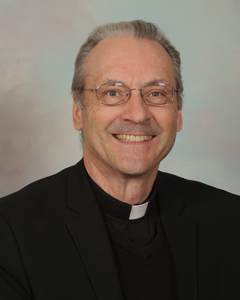
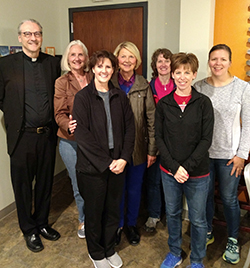
After Sister Bernadette, Sister Karen and Sister Carol informed the ladies at St. Gianna’s Women’s Homes that I will be leaving my position at Catholic Social Services in June, they all put their heads together and planned a pizza party on-site at St. Gianna’s as a surprise going-away event for yours truly.
Now, there have been other pizza parties there before and I usually try to make them, but am not always successful because of my schedule. The sisters always invite me, but this time reminded me several times, which I thought was rather odd. Even my administrative assistant, Pat Walbrecht, asked me if I was going.
Despite all of this, I did not suspect that it would be an occasion to hold a surprise going away party. Needless to say when I arrived, I was surprised beyond description. Because my birthday was a few days prior, there was even a birthday cake and ice cream.
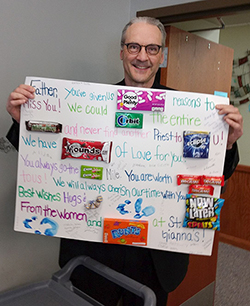
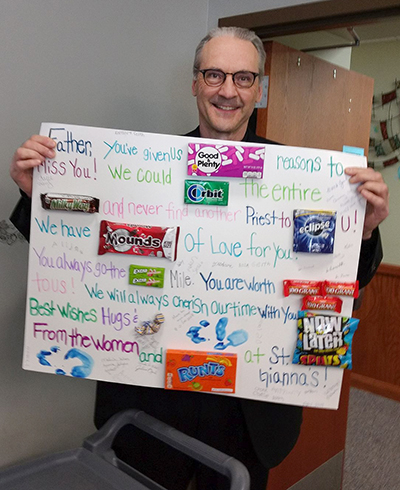
The touching ‘frosting on the cake,’ so to speak, was a special poster made and signed by the ladies and children which used 10 different kinds of candy. The clever thing about the poster was that the names of the candy were used in the message. If you are unable to read what the poster says by looking at the picture, it reads (the names of the candy in italics): “Father, you’ve given us Good & Plenty reasons to miss you! We could Orbit the entire Milky Way and never find another priest to Eclipse U! We have Mounds of love for you! You always go to the Extreme mile. You are worth 100 Grand (three bars!) to us! We will always cherish our time with you Now and Later. Best wishes, hugs and Kisses. From the women and Runts at St. Gianna’s!
There were even two little handprints from one of the “runts.” The kids were especially interested in showing me this work of art! After singing happy birthday and praying, we all had our fill of pizza, lasagna, cake and ice cream. I plan on keeping the poster and eating and sharing the candy.
When I leave in June, in addition to missing the wonderful staff, volunteers and clients at CSS, I am going to miss the Marian Sisters, ladies and children at St. Gianna’s. How can I ever forget them, especially after such an incredible going-away party?
Through the intercession of St. Gianna, may the ladies and their children always be safe at St. Gianna’s as they grow closer to Almighty God Who is their Father. St. Gianna, pray for us!
In a historic moment on May 27, 2015, the Nebraska Legislature eliminated the death penalty after a 30-19 vote to override the governor’s veto. Over a year later in November 2016, after extensive public debate, Nebraska voters overwhelmingly supported the “repeal of the repeal”—or, in other words, the reinstatement of the death penalty.
Since the reinstatement, countless events surrounding the death penalty have taken place in our state and globally for the Church.
Last Wednesday night, the Nebraska Legislature’s Revenue Committee advanced LB670—the Opportunity Scholarships Act—to the whole legislative body. The legislation was advanced by a vote of 5-2-1. Supporting the legislation were Senators Lou Ann Linehan (Elkhorn), Mark Kolterman (Seward), Mike Groene (North Platte), Tom Briese (Albion), and Brett Lindstrom (Omaha). Opposing the legislation were Senators John McCollister (Omaha) and Sue Crawford (Bellevue). Present not voting was Senator Curt Friesen (Henderson).
“The Easter Story” by Gennady Spirin. “The Easter Story” according to the Gospels of St. Matthew, St. Luke and St. John from the King James Bible. Henry Holt and company, New York, 1999, 32 pages.
Earlier this Lent, I had a chance to talk to a single mother with a small boy in church, where there is a set of beautifully done Stations of the Cross. She is someone we have helped with rent and utilities preventing a homeless situation. She is someone interested in becoming a baptized Catholic.
One of the great things about being Catholic is the fact that we all agree on the doctrines and dogmas of the Church, commonly called the “teachings,” right?
In my latest meeting with Angela Reiling, our volunteer coordinator in our Lincoln office named after St. Joseph, she gave me an update of some of the volunteer projects on the near horizon.
In an unprecedented policy shift, Nebraska’s Department of Health and Human Services (“DHHS”) will no longer be Nebraska’s Title X grant recipient. Instead, the federal government has awarded the grant funds to a private organization, Family Planning Council of Nebraska. This development negatively affects the Nebraska Legislature’s ability to ensure that Title X grant funds, consisting of taxpayer dollars, are not used to subsidize the abortion industry.
Not long ago, I called a priest friend who recently talked to a former Swiss Guard who had worked for the future St. John Paul II. They had a policy back then that if any members reported late for their shift, they would have to volunteer at the Missionaries of Charity (MC) convent nearby. The MCs are the order of sisters founded by St. Mother Teresa of Calcutta. It should be mentioned that the members of the Swiss Guard are all tough men, tough guys in a good sense, with the mission of guarding the Vicar of Christ who sits on the Chair of Peter.
Those who reject Catholicism have varied explanations for their decision, but one of the reasons you might hear is, “truth is found in science, not theology.”
Strangely, the person offering this opinion is rarely a scientist. Because of this, they are simply telling you that they have more faith in science than in God, or the Church’s understanding of God.
“We are facing an enormous and dramatic clash between good and evil, death and life, the ‘culture of death’ and the ‘culture of life.’ We find ourselves not only ‘faced with’ but necessarily ‘in the midst of’ this conflict....”
These words come from Saint Pope John Paul II’s famous encyclical, The Gospel of Life. And their truth was verified during last week’s legislative committee hearing on LB209, a pro-life policy that would empower every mother seeking an abortion with information giving her a second chance at choosing life.
Join us for Catholics at the Capitol (Wednesday, March 27). Our annual advocacy day gives Catholics the opportunity to engage in the legislative process and advocate on important public policy. The morning program, held at St. Mary Church (14th & K), will include Mass, an educational program to learn about legislative issues, and advocacy with your state senator. There will also be an optional lunch ($10) program at the Newman Center (transportation provided), featuring several state senators and their experience of faith and politics. Invite family and friends. Visit www.necatholic.org for more details and registration information.
March 20 marked the halfway point of this year’s 90-day legislative session. Day 1 of the session seems like ages ago and Day 90 is hardly visible on the horizon.
“The Family Romanov: Murder, Rebellion & The Fall Of Imperial Russia,” by Candace Fleming. Schwartz & Ward Books, New York, 2014, 292 pages, Grades 9-12.
One of my favorite flowers is the crocus. Why? Despite not being the most beautiful, they are the first to pop through the earth, some years as early as mid-February. They remind me of the upcoming resurrection of the dead on the last day.
“I know this bill will allow for more students with similar stories as mine to have a choice in their education, a choice that could change their lives.”
These were Jacob Idra’s closing remarks during last week’s Revenue Committee hearing on LB670, the Opportunity Scholarships Act, a legislative bill providing more private education choice for low-income and working-class families in Nebraska.
Jacob is a freshman at Creighton University. When he’s not lighting up a room with his smile and his fashionable attire, he’s studying business. But his story begins long before Creighton University. His story begins in Africa.
Recently, I listened to a voicemail from a young woman. It was at the end of the day. The tone of her voice contained an element of urgency. I called and left a message. The next morning, we were able to connect.
Robert George, a leading Catholic intellectual, has long recognized that the West is experiencing a clash of orthodoxies. This clash, George notes, is between the Judeo-Christian worldview which has formed Western civilization and the “isms” that seek to displace and supersede the foundations of Western culture. These “isms” typically pertain to “sexuality, the transmitting and taking of human life, and the place of religion and religiously informed moral judgment in public life.” He identifies these “isms” as “contemporary American life-feminism, multiculturalism, gay liberationism, [and] lifestyle liberalism” which he names “the secularist orthodoxy.”
“The Young Chef: Recipes and Techniques for Kids Who Love to Cook” by Mark Ainsworth Culinary Institute of America, Houghton Mifflin Harcourt, Boston, 2016, 191 pages, Grades 9-12.
I remember my dad telling me that during the Great Depression, when the doctor came calling at his house when one of his siblings was sick, he did his best to hide, because whatever awful-tasting medicine the sick sibling was forced to take, they in turn would have to take. He had vivid memories of an old man, wearing a tall black hat and long trench coat, with a big black bag full of disgusting pills and syrup.
“If indeed ‘the just ordering of society and of the state is a central responsibility of politics,’ the Church “cannot and must not remain on the sidelines in the fight for justice’” (Pope Francis, The Joy of the Gospel, no. 183).
The Nebraska Catholic Conference’s annual advocacy day, Catholics at the Capitol, is just around the corner (Wednesday, March 27). And you (and all your family and friends) are invited!
Not long ago, a man lost his job. He was very stressed because he was married with children. Despite having historically low unemployment rates, these things happen for any number of reasons. Like many families, up until the job loss, they were living paycheck to paycheck.