By Sr. Bernadette Radek
In his book, “The Problem of Pain,” C.S. Lewis delved into the meaning of pain and suffering. Why does such a good God allow pain and suffering? Why do some people suffer so intensely while others appear to go through life seemingly relatively free from much suffering?
One person who could have asked those questions – but didn’t – was Sister Theresa Gottwald (1922-2010), who was one of our co-foundresses of the Marian Sisters of the Diocese of Lincoln. Living close to Sister Theresa for so many years, I was able to see how she reacted to all the suffering in her life.
Sister Theresa was in very poor health when she was born and baptized two days later. As a baby she had a very severe case of whooping cough and that resulted in the weaking of her lungs, and she became susceptible to lung diseases.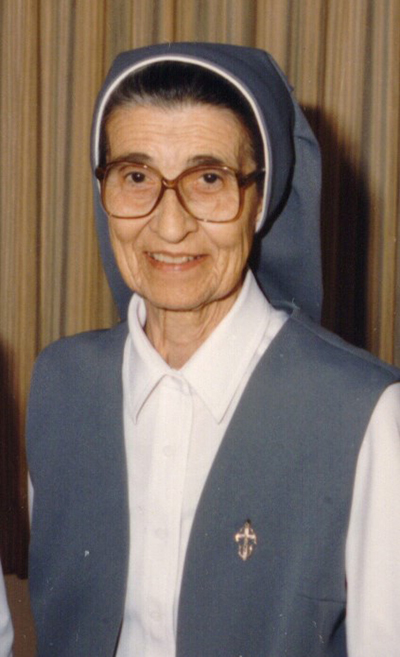
Sister witnessed much suffering, too. As a nurse in the hospital, during both the Nazi and Communist occupations, Sister took care of wounded soldiers who both threatened and cursed her. When the political situation became so serious, she and Sister Marta, (our other co-foundress) with the permission of their mother superior, escaped through the underground to Austria.
It was here that it was obvious that Sister Theresa’s health was a problem. No country that she applied to would give her a visa because of her poor health. She was refused repeatedly. After two years of trying, the Lord stepped in, and she, by a turn of unexpected events, was able to come to the United States. Although Sister could speak or understand several Slavic languages, English was not among the languages she knew. Her path was strewn with many trials, misunderstandings, and most of all, the sorrow of not being with her family, her religious community or with Sister Marta, who had received an offer of a visa to Canada and had to take it or lose the chance to migrate.
Finally, when Sister Marta was able to come to the United States, and to Lincoln, at St. Thomas Orphanage, the trials of beginning a new community were plentiful.
I entered the community four years after the community was established. I found Sister Theresa to be such a fun-loving happy person who was often ill and often in the hospital for her illnesses. What struck me most was that she met it all with such grace and acceptance. The doctors and nurses who took care of her – and there were many through the years – loved her. Why?
Because she never acted like a sick person. She would entertain friends who came to visit her, often making jokes at her own expense, or imitating people to perfection. It would bring down the house. Friends who came to visit her intending to cheer her up, instead went home cheered up themselves.
Sister Theresa was employed for many years at Madonna Home (now Madonna Rehabilitation Hospital) as a nurse aide. At Madonna, she made many friends due to her dedicated care of patients. During recreation at the motherhouse, we enjoyed listening to Sisters talk about all the funny things that happened during the day.
When Sister Theresa finally retired, she spent time working in the motherhouse flower garden and taking care of the motherhouse chapel. Sister Theresa’s health continued to decline and, eventually, she was placed in hospice care at the motherhouse. For two years, she was in and out of hospice care. Right up to the end, her mind was clear as a bell.
In those last days, when she felt up to it, she and I would work on fine-tuning the escape story for the Marian History. I was amazed at how she remembered it in detail, as though she were reliving it.
Sister taught me to value of suffering with patience and acceptance knowing that God can bring great things from it all. Her attitude toward suffering made a profound impression on me and I am so grateful to her. I want to emulate that attitude of God’s will be done in time of suffering and never complain, thinking, “Why me?”
There are still times when I hear her whisper in my ear, “You take care of yourself.”