By Bishop Fabian Bruskewitz
SAINT POPE JOHN PAUL THE SECOND
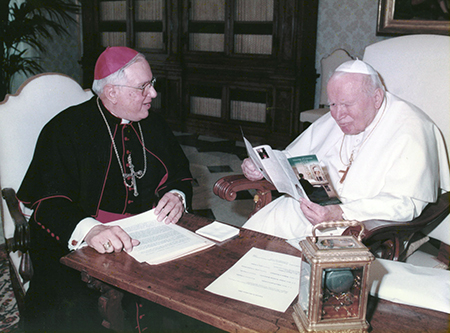
In my long and sometimes event-filed life, I have had the completely unplanned, unexpected, and totally undeserved privilege of knowing and speaking with seven Popes, three of whom are now (canonized) saints in heaven. Among them was Saint John Paul the Second (Karol Wojtyla), who today is already called by many Pope John Paul the Great.
I had my first glimpse of him when I was a student-priest in Rome, working on my doctorate in theology, and found myself assigned to be one of several dozen priest-ushers at the last session of the Second Vatican Council in Saint Peter’s Basilica in the Vatican September through December, 1968. Karol Wojtyla then was a young auxiliary bishop there from the Archdiocese of Krakow in Poland, and had a seat and desk situated near the back of the basilica. However, I got to know him, and indeed to become his friend, some time later when I found myself, once again unplanned and unexpected, called by Saint Paul VI, to work in the Holy See in the Roman Curia as an official in the Congregation (Dicastery or Department) for Catholic Education.
That Congregation was presided over by Cardinal Gabriel Garrone, who was the Prefect and by Archbishop Joseph Schroeffer, who was the Secretary. Garrone had previously been the Archbishop of Toulouse in France and Schroeffer had previously been the Bishop of Eichstatt in Germany. Just about every six months, the Congregation, which consisted of Cardinals and Bishops from around the world, would meet. We who were on the staff would often attend the meetings. That is how Wojyla, who by that time had become the Cardinal Archbishop of Krakow and was assigned by Saint Pope Paul VI also to be a member of the Congregation for Catholic Education, got to meet me, know me, and also got to be my good friend. We found ourselves with many similar opinions and viewpoints about matters concerning seminaries and priestly formation as well as about university governance and studies, both Catholic and other universities.
POPE JOHN PAUL THE FIRST
Pope Saint Paul VI died in June of 1978. At that time I had been working already in the Roman Curia for about 10 years and living at Villa Stritch, the residence that the Catholic Bishops of the United States provide in Rome for diocesan priests from the USA assigned to work in Roman Curia.
When the American Cardinals at that time came to Rome for the Conclave to choose his successor, they chose to live at Villa Stritch except for when they would be locked away in the Vatican for the papal election. I remember being in Saint Peter’s Square after the white smoke came out from the chimney of the Sistine Chapel, signaling that the election had been successful, and then waiting for the announcement of the result along with a large crowd of people. The announcement proclaimed that the new Pope had been the Archbishop and Patriarch of Venice, Cardinal Albino Luciani. He was a Cardinal whom I really did not know. However, filled with joy, I joined about one billion Catholics around the world in welcoming the news and looking forward to a new pontificate. This papal election took place on August 26, 1978.
Sadly and tragically, however, the new Pope suddenly died only about a month later, on September 28, 1978, and once again the American Cardinals joined our community at Villa Stritch to take part in the new Conclave.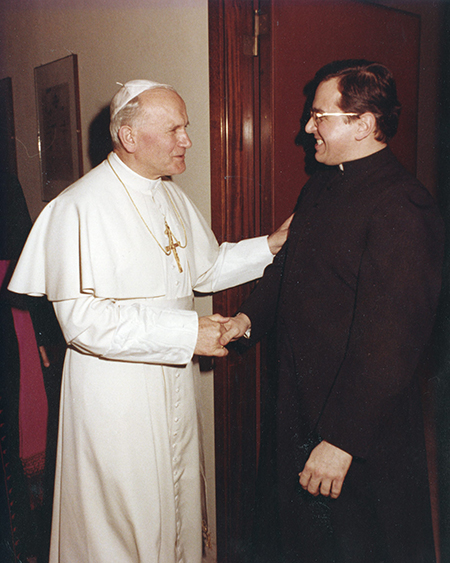
THE FOREIGN POPE
The new Conclave concluded with the customary white smoke on October 22, 1978. Cardinal Felici made the traditional announcement, but the huge crowd in in front of the Basilica seemed dumbfounded by the name. The way Cardinal Felici pronounced it caused many people think that it sounded African. A little Italian lady who was standing next to me pulled on my sleeve and asked me “Is he black?” I said, “No. he is Polish.” She seemed shocked and then asked me “Is he Catholic?” I assured her that he was. Her shock was understandable since Karol Wojylya was the first non-Italian Bishop of Rome elected in 455 years and the first Slavic Pope ever!
Thus began the more than 26-year pontificate (one of the longest in history) of the Successor of Saint Peter, who had lost his mother at age 8, his older and only brother shortly later, who became an underground seminarian, a survivor of a Nazi and (later) Communist regime, a lover of arts, a mentor to youth, a university professor who earned two doctorates (one in theology and one in philosophical phenomenology), an escapee from an assassination attempt, a forgiving priest, and an ardent prelate and Bishop.
His was a Pontificate which gave to the Catholic Church 14 encyclicals, 11 apostolic constitutions, 42 apostolic letters, three books, countless sermons and homilies. Pope Saint John Paul II was at ease and fluent in several dozen languages. Along with some persons (such as the American President Ronald Reagan), he was the one who liberated Eastern Europe from Communist dictatorship, while he also canonized and beatified hundreds of new saints and blesseds. He is also easily considered to have been the most travelled Pope in all history. May he pray for all of us now in the language of heaven!